
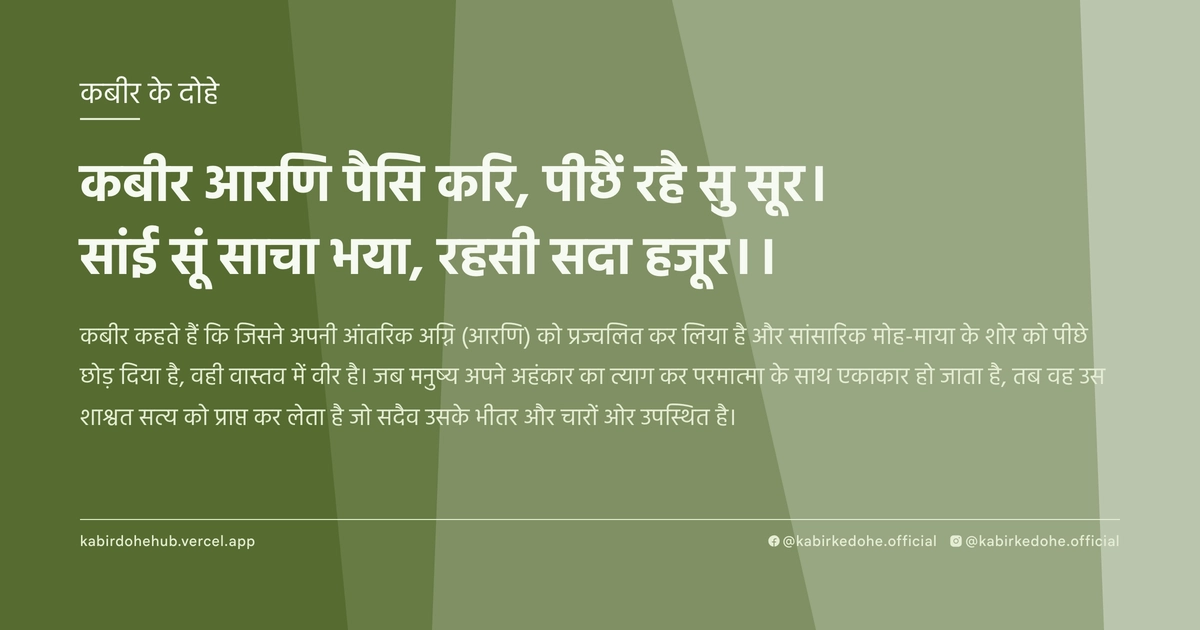
कबीर आरणि पैसि करि, पीछैं रहै सु सूर।
सांई सूं साचा भया, रहसी सदा हजूर।।
Kabir aarani paisi kari, peechhain rahai su sur. Sai soon sacha bhaya, rahasi sada hazoor.
इस पृष्ठ पर इस कबीर दोहे का अर्थ (meaning), हिंदी व्याख्या और अंग्रेज़ी अनुवाद, दार्शनिक विश्लेषण और व्यावहारिक जीवन सीख दी गई है। यह दोहा प्रपत्ति (Surrender) विषय से जुड़ा है — Kabir doha meaning and explanation in Hindi and English.
अर्थ (Meaning):
कबीर कहते हैं कि जिसने अपनी आंतरिक अग्नि (आरणि) को प्रज्वलित कर लिया है और सांसारिक मोह-माया के शोर को पीछे छोड़ दिया है, वही वास्तव में वीर है। जब मनुष्य अपने अहंकार का त्याग कर परमात्मा के साथ एकाकार हो जाता है, तब वह उस शाश्वत सत्य को प्राप्त कर लेता है जो सदैव उसके भीतर और चारों ओर उपस्थित है।
Kabir asserts that the true warrior is one who has ignited the internal fire of spiritual discipline and left the clamor of worldly attachments behind. By aligning oneself with the Eternal Truth and dissolving the ego, the seeker becomes one with the Divine, realizing that the Presence of the Almighty is constant and omnipresent.
व्याख्या (Interpretation):
यहाँ 'आरणि' का अर्थ केवल लकड़ी से अग्नि उत्पन्न करना नहीं, बल्कि साधना की उस तीव्रता से है जो अज्ञान को जला देती है। यह दोहा भौतिक वीरता के बजाय आध्यात्मिक वीरता की बात करता है। जब साधक माया के भ्रम को पीछे छोड़ता है, तो वह 'सूर' यानी वीर कहलाता है। यह निरगुण भक्ति का सार है जहाँ ईश्वर किसी मूर्ति में नहीं, बल्कि आत्मा के शुद्धिकरण में मिलता है। अद्वैत वेदांत के अनुसार, जब 'मैं' का भाव मिटता है, तब केवल 'वह' (ब्रह्म) शेष रहता है। यह विरोधाभास है कि स्वयं को खोकर ही स्वयं को पाया जा सकता है।
The term 'Arani' refers not merely to the friction-stick used to kindle fire, but to the intense spiritual discipline that incinerates ignorance. Kabir redefines bravery, shifting it from physical conquest to the internal victory over the ego. By leaving the 'noise' of the world behind, the seeker emerges as a 'Sur' (Warrior). This aligns with Nirgun Bhakti, where the Divine is found not in idols but in the purification of the soul. According to Advaita Vedanta, when the illusion of the separate 'I' dissolves, only the universal Brahman remains. It is the central paradox: only by losing the self can one truly find the Self.
दार्शनिक विश्लेषण (Philosophical Analysis):
कबीर का यह दोहा उस कालखंड की उपज है जब धर्म कर्मकांडों और बाहरी दिखावे में सिमट गया था। कबीर ने 'आरणि' के प्रतीक के माध्यम से आंतरिक तपस्या पर बल दिया, जो कि सूफी मत के 'नफ्स' (अहंकार) को मारने की प्रक्रिया और योग के कुंडलिनी जागरण के समान है। उन्होंने स्पष्ट किया कि मोक्ष किसी तीर्थ या मंदिर में नहीं, बल्कि चेतना के रूपांतरण में है।
यह विचार अद्वैत वेदांत के 'अहं ब्रह्मास्मि' से गहराई से जुड़ा है। जब साधक अपनी आंतरिक अग्नि से वासनाओं और मोह को जला देता है, तो वह द्वैत (दो होने का भाव) से मुक्त हो जाता है। कबीर यहाँ यह संदेश दे रहे हैं कि सत्य की प्राप्ति के लिए बाहरी शोर का त्याग अनिवार्य है।
सामाजिक स्तर पर, कबीर ने जाति और वर्ण व्यवस्था को चुनौती दी। उनके लिए 'वीर' वह नहीं था जिसने युद्ध जीते हों, बल्कि वह था जिसने अपने मन को जीता हो। यह एक क्रांतिकारी बदलाव था जिसने आध्यात्मिकता को उच्च वर्ग के पंडितों से छीनकर आम जनमानस के हृदय तक पहुँचाया।
सूफीवाद के प्रभाव में, कबीर 'फना' (विनाश) की बात करते हैं—अपने अस्तित्व का परमात्मा में विलीन हो जाना। जब तक मनुष्य अपनी पहचान को पकड़ कर रखता है, वह सत्य से दूर रहता है। 'सांई सूं साचा भया' का अर्थ है कि अब कोई अंतर नहीं रहा; प्रेमी और प्रियतम एक हो गए हैं।
अतः, यह दोहा केवल एक धार्मिक उपदेश नहीं, बल्कि एक मनोवैज्ञानिक प्रक्रिया है। यह हमें सिखाता है कि वास्तविक शांति और शाश्वत उपस्थिति (हजूर) केवल तभी अनुभव की जा सकती है जब हम अपनी कृत्रिम पहचानों की परतों को उतार फेंकें और उस मूल तत्व में लौटें जो कभी नष्ट नहीं होता।
This couplet emerges from an era where religion had become stagnant, trapped in rigid rituals and external displays. Through the metaphor of 'Arani,' Kabir emphasizes internal austerity, mirroring the Sufi process of killing the 'Nafs' (ego) and the Yogic practice of awakening inner consciousness. He asserts that liberation is not found in pilgrimages or temples, but in the transmutation of consciousness.
This perspective is deeply intertwined with the Advaita Vedanta concept of 'Aham Brahmasmi' (I am Brahman). When the seeker uses the internal fire to incinerate desires and attachments, they are liberated from duality. Kabir suggests that the cessation of external noise is a prerequisite for hearing the internal truth.
Socially, Kabir challenged the caste hierarchy. To him, a 'Warrior' was not one who conquered lands, but one who conquered the mind. This was a revolutionary shift, democratizing spirituality by moving it from the exclusive domain of priestly elites to the hearts of the common people.
Influenced by Sufism, Kabir speaks of 'Fana'—the annihilation of the self into the Divine. As long as a human clings to their separate identity, they remain estranged from the Truth. 'Sai sun sacha bhaya' implies the collapse of duality; the lover and the Beloved have become one.
Ultimately, this doha is not merely a religious exhortation but a psychological roadmap. It teaches that true peace and the eternal Presence (Hazur) can only be experienced once we strip away the layers of our artificial identities and return to the primordial essence that is indestructible.
मूल संदेश (Core Message):
- बाहरी शोर को शांत करें ताकि आंतरिक सत्य सुनाई दे सके।
- अहंकार का दहन ही वास्तविक आध्यात्मिक वीरता है।
- परमात्मा कोई बाहरी गंतव्य नहीं, बल्कि एक आंतरिक अवस्था है।
- जब 'मैं' मिटता है, तब केवल शाश्वत सत्य शेष रहता है।
- साधना की तीव्रता ही अज्ञान के अंधकार को मिटाती है।
- समर्पण ही वह सेतु है जो जीव को शिव से जोड़ता है।
- Silence the external noise to hear the internal Truth.
- The incineration of the ego is the only true spiritual bravery.
- The Divine is not an external destination, but an internal state.
- When the 'I' dissolves, only the Eternal Truth remains.
- The intensity of discipline is what erases the darkness of ignorance.
- Surrender is the bridge that connects the individual to the Universal.
व्यावहारिक उदाहरण (Practical Example):
वाराणसी के एक पुराने घाट पर माधव नाम का एक वृद्ध बुनकर रहता था। वह अपनी कला में निपुण था, लेकिन उसका मन हमेशा इस बात से अशांत रहता था कि समाज उसे एक साधारण बुनकर मानता है। वह चाहता था कि लोग उसकी श्रेष्ठता को पहचानें और उसे एक महान कलाकार कहें।
माधव दिन भर कपड़े बुनता, लेकिन उसका ध्यान इस बात पर रहता कि कौन उसकी प्रशंसा कर रहा है और कौन उसकी उपेक्षा। यह 'बाहरी शोर' उसके भीतर एक अंतहीन युद्ध छेड़ चुका था। वह जितना अधिक प्रसिद्ध होना चाहता था, उतना ही अधिक वह मानसिक तनाव और क्रोध से घिरता गया।
एक दिन वह एक संत के पास गया और पूछा, "मैं श्रेष्ठ बनना चाहता हूँ, फिर भी मेरा मन अशांत क्यों है?"
संत ने उसे एक जलता हुआ कोयला दिखाया और कहा, "जैसे यह कोयला लोहे को पिघलाकर उसे नया आकार देता है, वैसे ही तुम्हें अपनी इच्छाओं की अग्नि में अपने अहंकार को जलाना होगा। जब तक तुम 'मैं' और 'मेरा' के शोर में रहोगे, तुम उस शांति को नहीं पा सकोगे जो तुम्हारे भीतर पहले से है।"
माधव को कबीर की 'आरणि' का बोध हुआ। उसने तय किया कि वह अब प्रशंसा के लिए नहीं, बल्कि समर्पण के लिए बुनेगा। उसने अपनी कला को ईश्वर की सेवा माना और अपनी पहचान को उस अनंत धागे में पिरो दिया जो पूरे ब्रह्मांड को जोड़ता है।
धीरे-धीरे, माधव ने महसूस किया कि जब उसने अपनी श्रेष्ठता की चाह को पीछे छोड़ दिया, तो वह वास्तव में स्वतंत्र हो गया। अब उसे इस बात से फर्क नहीं पड़ता था कि लोग उसे क्या कहते हैं।
उसकी बुनाई में अब एक ऐसी गहराई और शांति थी जो पहले कभी नहीं थी। लोग उसकी कला की ओर खिंचे चले आते थे, लेकिन माधव अब उनकी प्रशंसा के शोर से ऊपर उठ चुका था।
वह अब एक 'सूर' बन चुका था—एक ऐसा योद्धा जिसने बाहरी दुनिया को नहीं, बल्कि अपने भीतर के अहंकार को जीता था।
अंत में, माधव ने पाया कि जिस 'सांई' या परमात्मा को वह बाहर खोज रहा था, वह उसकी अपनी निस्वार्थ सेवा और मौन में ही उपस्थित था। वह अब हर पल उस शाश्वत उपस्थिति का अनुभव करता था।
On an ancient ghat in Varanasi lived an elderly weaver named Madhav. He was masterful in his craft, yet his mind was perpetually restless, haunted by the fact that society viewed him as a mere commoner. He craved recognition, longing for the world to acknowledge him as a great artist.
Madhav spent his days weaving fabric, but his attention was always fixed on who was praising him and who was ignoring him. This 'external noise' had ignited an endless war within him. The more he sought fame, the more he became entangled in mental stress and anger.
One day, he approached a wandering saint and asked, "I strive for excellence, yet why is my mind so turbulent?"
The saint showed him a glowing ember and said, "Just as this coal melts iron to give it a new form, you must burn your ego in the fire of spiritual discipline. As long as you live in the noise of 'I' and 'Mine,' you will never find the peace that already resides within you."
Madhav suddenly understood the essence of Kabir's 'Arani.' He decided that from that day forward, he would weave not for praise, but for surrender. He viewed his art as a service to the Divine and wove his identity into the infinite thread that connects the entire universe.
Gradually, Madhav realized that by letting go of the desire for superiority, he had actually become free. He no longer cared about the labels people placed upon him.
There was now a depth and serenity in his weaving that had never existed before. People were drawn to his art, but Madhav had risen above the noise of their admiration.
He had become a 'Sur'—a warrior who had conquered not an external enemy, but the ego within.
Ultimately, Madhav discovered that the 'Sai' or Divine he had been searching for externally was present in his own selfless service and silence. He now experienced that eternal Presence in every single breath.
अभ्यास मार्गदर्शन (Practice Guidance):
- प्रतिदिन 20 मिनट मौन का अभ्यास करें, जहाँ आप बाहरी दुनिया के शोर को पूरी तरह त्याग कर केवल अपनी श्वास और आंतरिक साक्षी भाव पर ध्यान केंद्रित करें।
- एक 'अहंकार डायरी' लिखें: दिन भर में जब भी आपको अपनी श्रेष्ठता सिद्ध करने की इच्छा हो या किसी की प्रशंसा की भूख लगे, उसे लिखें और फिर विश्लेषण करें कि वह इच्छा किस डर या कमी से पैदा हुई है।
- सेवा का अभ्यास: सप्ताह में एक बार ऐसा कार्य करें जिसके लिए आपको कोई श्रेय न मिले और जिसके बारे में कोई न जाने। यह 'अनाम सेवा' आपके अहंकार की अग्नि को प्रज्वलित करेगी।
- निदान चेकलिस्ट: क्या मैं अभी भी दूसरों की राय से विचलित होता हूँ? क्या मेरी शांति बाहरी परिस्थितियों पर निर्भर है? क्या मैं स्वयं को दूसरों से अलग या श्रेष्ठ महसूस करता हूँ? यदि हाँ, तो आरणि की अग्नि अभी मंद है।
- Practice 20 minutes of absolute silence daily, consciously disconnecting from the external noise and focusing solely on the breath and the state of the internal witness.
- Maintain an 'Ego Journal': Record every instance during the day when you feel the urge to prove your superiority or crave validation, then analyze the underlying fear or void driving that desire.
- Practice Anonymous Service: Once a week, perform an act of kindness for which you receive no credit and which remains unknown to others. This 'nameless service' fuels the fire of ego-dissolution.
- Diagnostic Checklist: Am I still swayed by others' opinions? Is my peace dependent on external circumstances? Do I still perceive myself as separate or superior to others? If yes, the fire of the Arani is still dim.
चिंतन प्रश्न (Reflection Questions):
- मेरी वह कौन सी 'पहचान' है जिसे खोने के डर से मैं सबसे अधिक संघर्ष करता हूँ?
- क्या मेरी धार्मिक या आध्यात्मिक आचरण वास्तव में आंतरिक परिवर्तन के लिए है, या यह केवल एक सामाजिक मुखौटा है?
- जब मैं अकेला होता हूँ और कोई मुझे देख नहीं रहा होता, तब मेरा 'अहंकार' किस रूप में प्रकट होता है?
- क्या मैं वास्तव में सत्य की खोज कर रहा हूँ, या मैं केवल अपनी मान्यताओं की पुष्टि चाहता हूँ?
- मेरे जीवन का वह कौन सा 'शोर' है जो मुझे मेरी आत्मा की आवाज़ सुनने से रोक रहा है?
- यदि मेरी सारी उपलब्धियाँ और पद छीन लिए जाएँ, तो मेरे भीतर क्या बचेगा?
- Which specific 'identity' do I struggle most to protect, and what fear drives this attachment?
- Is my religious or spiritual practice truly for internal transformation, or is it merely a social mask?
- When I am completely alone and unseen, in what form does my ego manifest?
- Am I genuinely seeking the Truth, or am I merely seeking confirmation of my existing beliefs?
- What is the specific 'noise' in my life that prevents me from hearing the voice of my soul?
- If all my achievements and titles were stripped away, what would remain of me?