
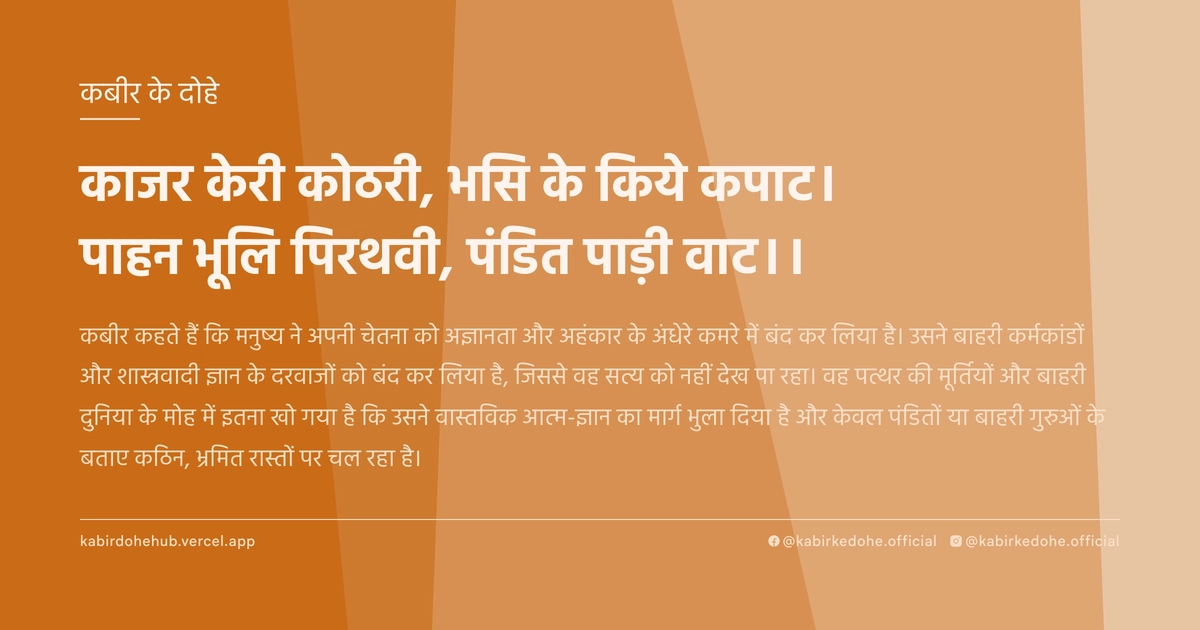
काजर केरी कोठरी, भसि के किये कपाट।
पाहन भूलि पिरथवी, पंडित पाड़ी वाट।।
Kaajar keri kothari, bhasi ke kiye kapaat. Paahan bhuli prithvi, pandit paadi vaat.
इस पृष्ठ पर इस कबीर दोहे का अर्थ (meaning), हिंदी व्याख्या और अंग्रेज़ी अनुवाद, दार्शनिक विश्लेषण और व्यावहारिक जीवन सीख दी गई है। यह दोहा धार्मिक पाखंड (Religious Hypocrisy) विषय से जुड़ा है — Kabir doha meaning and explanation in Hindi and English.
अर्थ (Meaning):
कबीर कहते हैं कि मनुष्य ने अपनी चेतना को अज्ञानता और अहंकार के अंधेरे कमरे में बंद कर लिया है। उसने बाहरी कर्मकांडों और शास्त्रवादी ज्ञान के दरवाजों को बंद कर लिया है, जिससे वह सत्य को नहीं देख पा रहा। वह पत्थर की मूर्तियों और बाहरी दुनिया के मोह में इतना खो गया है कि उसने वास्तविक आत्म-ज्ञान का मार्ग भुला दिया है और केवल पंडितों या बाहरी गुरुओं के बताए कठिन, भ्रमित रास्तों पर चल रहा है।
Kabir asserts that humanity has imprisoned its consciousness within a dark chamber of ignorance and ego. By shutting the doors of genuine intuition in favor of rigid rituals and scriptural dogma, the seeker has become blind. In the obsession with stone idols and the material world, the essence of the Earth and the Self is forgotten, leaving the seeker to wander aimlessly on the convoluted paths prescribed by orthodox scholars.
व्याख्या (Interpretation):
यह दोहा अज्ञानता के गहरे अंधेरे का वर्णन करता है। 'काजर की कोठरी' मन की उस अवस्था का प्रतीक है जहाँ माया ने सत्य को ढक लिया है। 'भसि के किये कपाट' का अर्थ है कि अहंकार ने ज्ञान के द्वारों को पूरी तरह बंद कर दिया है। यहाँ 'पाहन' (पत्थर) और 'पिरथवी' (पृथ्वी) का द्वंद्व यह दर्शाता है कि मनुष्य निर्गुण ब्रह्म के बजाय सगुण रूप और भौतिकता में उलझा है। यह निर्गुण भक्ति का आह्वान है, जहाँ ईश्वर किसी मूर्ति में नहीं बल्कि स्वयं के भीतर स्थित है। अद्वैत वेदांत के अनुसार, जब तक यह 'मैं' और 'मेरा' का पर्दा नहीं हटता, तब तक आत्मा और परमात्मा का मिलन असंभव है। यह विरोधाभास है कि जिसे हम ज्ञान (पंडित) कहते हैं, वही अक्सर सत्य के मार्ग में सबसे बड़ी बाधा बन जाता है।
This couplet describes the profound darkness of spiritual ignorance. The 'chamber of soot' symbolizes a state of mind where Maya has veiled the ultimate truth. 'Shutting the doors' refers to how the ego seals off the gateways of intuition. The tension between 'stone' and 'earth' signifies the human tendency to mistake the symbol for the reality, prioritizing idol worship over the living presence of the Divine. This is a call toward Nirgun Bhakti, asserting that God resides not in carved stone but within the self. According to Advaita Vedanta, as long as the veil of 'I' and 'mine' persists, the non-duality of Atman and Brahman remains hidden. The central paradox lies in the fact that the 'Pandit'—the symbol of learned knowledge—often becomes the primary architect of the seeker's confusion.
दार्शनिक विश्लेषण (Philosophical Analysis):
कबीर का यह दोहा उनके युग के धार्मिक पाखंड और जातिगत श्रेष्ठता पर एक तीखा प्रहार है। 15वीं शताब्दी में, धर्म केवल कर्मकांडों और पुरोहित वर्ग के नियंत्रण में था। कबीर ने इस व्यवस्था को चुनौती देते हुए कहा कि सत्य किसी विशेष भाषा, जाति या मंदिर के अधीन नहीं है। उन्होंने 'पंडित' शब्द का प्रयोग केवल एक व्यक्ति के लिए नहीं, बल्कि उस मानसिक जड़ता के लिए किया है जो शास्त्रों को सत्य मान लेती है और अनुभव को नकार देती है।
दार्शनिक स्तर पर, यह सूफीवाद के 'फना' (अहंकार का विनाश) और वेदांत के 'माया' के सिद्धांत से मेल खाता है। जब मनुष्य बाहरी दुनिया की चमक-धमक और पत्थर की मूर्तियों में ईश्वर को खोजता है, तो वह वास्तव में अपनी ही चेतना से दूर जा रहा होता है। कबीर का तर्क है कि ईश्वर 'घट-घट' में व्याप्त है, इसलिए बाहरी खोज एक व्यर्थ प्रयास है।
यहाँ ritualism (कर्मकांड) का विरोध केवल बाहरी विरोध नहीं है, बल्कि यह एक मनोवैज्ञानिक विश्लेषण है। जब हम किसी बाहरी वस्तु पर निर्भर होते हैं, तो हमारा आंतरिक आत्मविश्वास और अंतर्ज्ञान समाप्त हो जाता है। यह मानसिक गुलामी की स्थिति है जहाँ व्यक्ति स्वयं सोचने की क्षमता खो देता है और दूसरों के बताए रास्तों पर चलने लगता है।
कबीर का 'निर्गुण' मार्ग यह सिखाता है कि ईश्वर निराकार है। यदि हम उसे आकार देते हैं, तो हम उसे सीमित कर देते हैं। पत्थर की मूर्ति की पूजा करना गलत नहीं है, लेकिन यह मानना कि ईश्वर केवल उसी पत्थर में है, अज्ञानता की पराकाष्ठा है। यह अद्वैतवाद का सार है—सब कुछ एक ही चेतना का विस्तार है।
अंततः, यह दोहा अहंकार के विलीनीकरण की बात करता है। जब तक 'कोठरी' (अहंकार) है, तब तक प्रकाश (ज्ञान) नहीं आ सकता। ज्ञान वह नहीं है जो किताबों से आता है, बल्कि वह है जो अनुभव से उपजता है। कबीर हमें उस 'पंडित' को मारने के लिए कहते हैं जो हमारे भीतर बैठा है और हमें तर्क और अहंकार के जाल में उलझाए रखता है।
This doha is a searing critique of the religious hypocrisy and caste-based superiority prevalent during Kabir's era. In the 15th century, spirituality was largely mediated by a priestly class and rigid rituals. Kabir challenged this hegemony, asserting that Truth is not the property of any specific language, caste, or temple. The term 'Pandit' here does not merely refer to a scholar, but to the mental rigidity that prioritizes scriptural literacy over direct experiential realization.
Philosophically, this aligns with the Sufi concept of 'Fana' (annihilation of the ego) and the Vedantic doctrine of 'Maya'. When a seeker searches for the Divine in external ornaments or stone idols, they are effectively moving away from their own center. Kabir argues that since the Divine is omnipresent ('Ghat-Ghat'), any external search is fundamentally a detour.
His opposition to ritualism is not just a social critique but a psychological analysis. Dependence on external intermediaries erodes internal intuition and spiritual autonomy. This creates a state of mental servitude where the individual ceases to inquire and simply follows a prescribed, often erroneous, path.
Kabir's 'Nirgun' path teaches that the Divine is formless. To assign a form is to limit the Infinite. While idol worship is a tool, believing that the Divine is confined to a stone is the height of ignorance. This is the essence of Advaita—the realization that all existence is an extension of a single, non-dual consciousness.
Ultimately, the doha speaks of the dissolution of the ego. As long as the 'chamber' of the ego exists, the light of gnosis cannot enter. Knowledge is not an accumulation of data from books but a flowering of direct experience. Kabir urges us to slay the 'inner Pandit'—the intellectual ego that traps us in a web of logic and pride.
मूल संदेश (Core Message):
- बाहरी कर्मकांड केवल मन के अंधेरे को ढकने का प्रयास हैं।
- सत्य किसी व्यक्ति या संस्था की बपौती नहीं है।
- अहंकार का विनाश ही वास्तविक ज्ञान का प्रवेश द्वार है।
- पत्थर में नहीं, बल्कि जीवित चेतना में ईश्वर को खोजें।
- अनुभवजन्य ज्ञान ही एकमात्र वास्तविक मुक्ति का मार्ग है।
- External rituals are merely attempts to veil the darkness of the mind.
- Truth is not the monopoly of any individual or institution.
- The annihilation of ego is the only gateway to real gnosis.
- Seek the Divine in living consciousness, not in lifeless stone.
- Experiential wisdom is the only authentic path to liberation.
व्यावहारिक उदाहरण (Practical Example):
एक समय की बात है, वाराणसी के घाटों पर माधव नाम का एक वृद्ध बुनकर रहता था। माधव अपनी पूरी जिंदगी धर्मग्रंथों को पढ़ने और बड़े-बड़े पंडितों के चरणों में बैठकर यह सीखने में बिता चुका था कि मोक्ष कैसे प्राप्त किया जाए। वह हर दिन घंटों मंदिर में बिताता, महंगे अनुष्ठान करता और इस विश्वास में रहता कि उसकी बाहरी शुद्धता उसे ईश्वर के करीब ले जाएगी।
माधव का जीवन नियमों से बंधा था। वह तय करता था कि कौन सा भोजन शुद्ध है, कौन सा अशुद्ध, और वह उन लोगों से दूर रहता था जिन्हें समाज 'नीच' मानता था। उसके लिए धर्म एक सीढ़ी थी, जिस पर चढ़कर वह स्वर्ग जा सके। लेकिन उसके मन के भीतर एक गहरा खालीपन था, एक ऐसा अंधेरा जिसे वह अपनी पूजाओं से भी नहीं भर पा रहा था।
एक दिन, माधव की मुलाकात एक साधारण से फकीर से हुई जो घाट की सीढ़ियों पर बैठा था। फकीर ने माधव को देखा और मुस्कुराकर कहा, 'माधव, तुम जिस दरवाजे को खटखटा रहे हो, उसकी चाबी तुम्हारे अपने हाथ में है, लेकिन तुमने उसे अपनी ही अहंकार की कोठरी में छुपा दिया है।'
माधव को यह बात समझ नहीं आई। उसने गर्व से कहा, 'मैंने वेदों का अध्ययन किया है, मैं सबसे बड़े पंडितों का शिष्य हूँ। मुझे मार्ग पता है।'
फकीर ने शांति से उत्तर दिया, 'तुमने नक्शा तो पढ़ लिया, लेकिन जमीन पर चलना भूल गए। तुम पत्थर की मूर्तियों में ईश्वर को ढूंढ रहे हो, जबकि वह तुम्हारे बगल में बैठे उस भूखे भिखारी की आँखों में है जिसे तुम अशुद्ध मानकर अनदेखा कर रहे हो।'
यह बात माधव के हृदय पर बिजली की तरह गिरी। उसने महसूस किया कि उसने अपना पूरा जीवन 'पंडितों की वाट' यानी दूसरों के बताए रास्तों पर चलते हुए बिताया, लेकिन उसने कभी अपने भीतर झाँकने की कोशिश नहीं की। उसने महसूस किया कि उसकी धार्मिकता वास्तव में उसके अहंकार का एक मुखौटा थी।
उस दिन माधव ने पहली बार एक 'अछूत' माने जाने वाले व्यक्ति को भोजन कराया और उसकी आँखों में वही चमक देखी जो वह मंदिर की मूर्तियों में खोज रहा था। उसने महसूस किया कि मंदिर के बंद कपाट वास्तव में उसके अपने मन के कपाट थे।
माधव ने शास्त्रों की रटंत विद्या को त्याग दिया और सेवा व प्रेम का मार्ग अपनाया। उसने जाना कि वास्तविक पूजा पत्थर को नहलाना नहीं, बल्कि इंसानियत को जगाना है।
उसका जीवन अब नियमों से नहीं, बल्कि करुणा से संचालित होने लगा। वह अब एक 'पंडित' नहीं था, बल्कि एक जागृत मनुष्य बन गया था।
उसने पाया कि जब उसने बाहरी दिखावे की 'काजर वाली कोठरी' को तोड़ दिया, तो उसके जीवन में वास्तविक प्रकाश का आगमन हुआ।
Once, in the ghats of Varanasi, lived an elderly weaver named Madhav. Madhav had spent his entire life studying scriptures and sitting at the feet of renowned scholars, trying to learn the precise mechanics of achieving salvation. He spent hours daily in temples, performing expensive rituals, believing that external purity would bring him closer to God.
Madhav's life was bound by rigid rules. He meticulously decided what food was pure and what was impure, and he avoided those whom society deemed 'low-caste.' For him, religion was a ladder to heaven. Yet, deep within, there was a void—a darkness that no amount of ritualistic bathing or chanting could illuminate.
One day, Madhav encountered a simple fakir sitting on the stone steps of the ghat. The fakir looked at him and smiled, saying, 'Madhav, the door you are knocking on has a key in your own hand, but you have hidden it inside the soot-covered chamber of your own ego.'
Madhav was perplexed. He replied with pride, 'I have studied the Vedas; I am a disciple of the greatest Pandits. I know the path.'
The fakir replied calmly, 'You have memorized the map, but you have forgotten how to walk on the earth. You seek God in stone idols, while He resides in the eyes of that hungry beggar you ignore because you consider him impure.'
These words struck Madhav like a bolt of lightning. He realized he had spent his life walking the 'Pandits' path'—following instructions from others—without ever venturing into the depths of his own soul. He saw that his religiosity was merely a sophisticated mask for his ego.
That day, for the first time, Madhav fed a man considered an untouchable and saw in his eyes the same divine spark he had been searching for in temple statues. He realized the 'closed doors' were not those of the temple, but those of his own heart.
Madhav abandoned the rote learning of scriptures and embraced the path of service and love. He understood that true worship is not about bathing a stone, but about awakening humanity.
His life ceased to be governed by rules and began to be led by compassion. He was no longer a 'Pandit' in the academic sense, but a realized human being.
He discovered that once he broke the 'soot-covered chamber' of external pretense, the true light of consciousness finally entered his life.
अभ्यास मार्गदर्शन (Practice Guidance):
- दैनिक आत्म-निरीक्षण: प्रतिदिन 15 मिनट मौन बैठें और विचार करें कि आज आपने कितनी बार अपनी 'सही' होने की जिद (अहंकार) को दूसरों पर थोपा।
- अनुभव बनाम सूचना: किसी भी धार्मिक या आध्यात्मिक दावे को केवल इसलिए न मानें क्योंकि वह किसी किताब या 'पंडित' ने कहा है। उसे अपने जीवन के अनुभव की कसौटी पर परखें।
- सेवा का अभ्यास: सप्ताह में एक बार ऐसे व्यक्ति की निस्वार्थ मदद करें जिसे समाज उपेक्षित करता है, ताकि आप बाहरी भेदों (जाति, धर्म) के पार देख सकें।
- डायग्नोस्टिक चेकलिस्ट: यदि आप दूसरों की गलतियों पर तुरंत निर्णय लेते हैं या अपनी धार्मिक पहचान पर गर्व महसूस करते हैं, तो समझें कि आपकी 'कोठरी' के कपाट अभी भी बंद हैं।
- Daily Self-Inquiry: Spend 15 minutes in silence daily, reflecting on how many times you imposed your 'correctness' (ego) on others today.
- Experience over Information: Do not accept any religious or spiritual claim simply because it is written in a book or stated by a 'Pandit.' Test it against your own lived experience.
- Practice of Service: Once a week, selflessly help someone marginalized by society to train your vision to see beyond external divisions of caste or creed.
- Diagnostic Checklist: If you find yourself judging others instantly or feeling a sense of pride in your religious identity, recognize that the doors of your 'chamber' are still closed.
चिंतन प्रश्न (Reflection Questions):
- मेरे जीवन में वह 'पंडित' कौन है—कोई बाहरी व्यक्ति या मेरा अपना बौद्धिक अहंकार?
- मैं किन धार्मिक या सामाजिक पहचानों के पीछे छिपकर अपनी आंतरिक शून्यता को भरने की कोशिश कर रहा हूँ?
- क्या मेरी आध्यात्मिकता मुझे दूसरों के प्रति अधिक विनम्र बना रही है, या अधिक श्रेष्ठ?
- यदि आज मेरे पास कोई धार्मिक पहचान न हो, तो मेरी नजर में मेरी कीमत क्या होगी?
- मैं सत्य को खोजने के लिए किन 'बंद दरवाजों' (पुरानी धारणाओं) को तोड़ने के लिए तैयार हूँ?
- Who is the 'Pandit' in my life—an external authority or my own intellectual ego?
- Which religious or social identities am I using as a shield to hide my inner emptiness?
- Is my spirituality making me more humble toward others, or more convinced of my superiority?
- If I were stripped of all religious and social labels today, what would be my intrinsic value?
- Which 'closed doors' of old beliefs am I truly willing to break to encounter the Truth?