
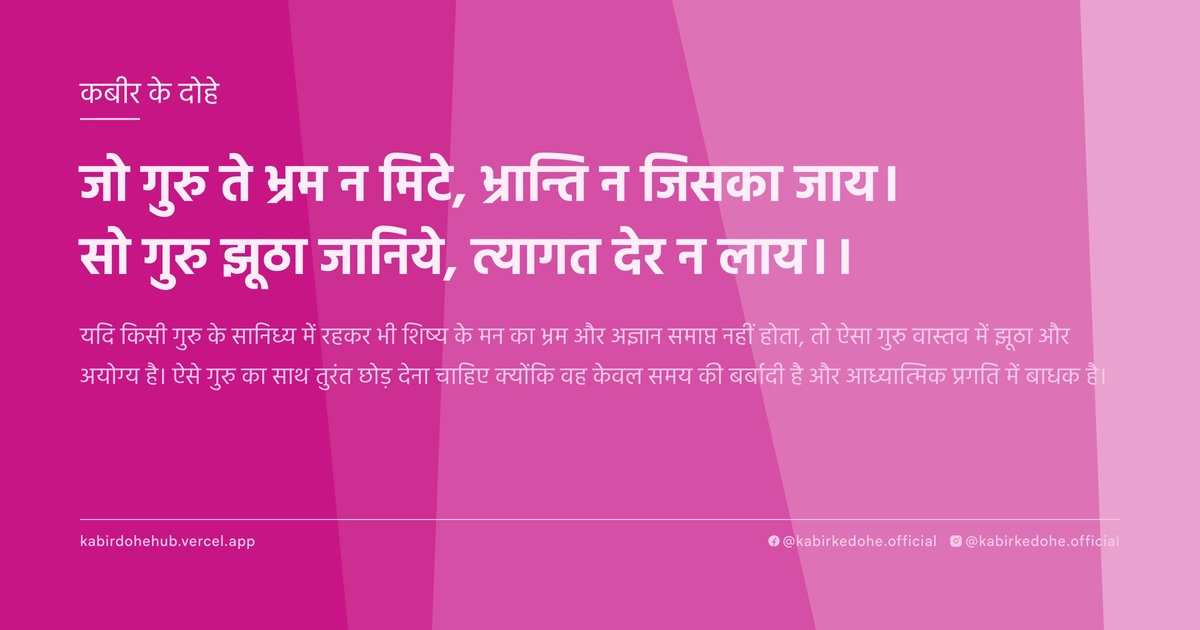
जो गुरु ते भ्रम न मिटे, भ्रान्ति न जिसका जाय।
सो गुरु झूठा जानिये, त्यागत देर न लाय।।
Jo guru te bhram na mite, bhranti na jiska jaaye. So guru jhootha jaaniye, tyagat der na laay.
इस पृष्ठ पर इस कबीर दोहे का अर्थ (meaning), हिंदी व्याख्या और अंग्रेज़ी अनुवाद, दार्शनिक विश्लेषण और व्यावहारिक जीवन सीख दी गई है। यह दोहा गुरु महत्व (The Guru's Importance) विषय से जुड़ा है — Kabir doha meaning and explanation in Hindi and English.
अर्थ (Meaning):
यदि किसी गुरु के सानिध्य में रहकर भी शिष्य के मन का भ्रम और अज्ञान समाप्त नहीं होता, तो ऐसा गुरु वास्तव में झूठा और अयोग्य है। ऐसे गुरु का साथ तुरंत छोड़ देना चाहिए क्योंकि वह केवल समय की बर्बादी है और आध्यात्मिक प्रगति में बाधक है।
If a disciple's delusions and misconceptions do not vanish under the guidance of a teacher, then that teacher is fraudulent and unworthy. One should abandon such a guide without delay, as they serve only as an obstacle to spiritual awakening and a waste of precious human life.
व्याख्या (Interpretation):
शाब्दिक अर्थ यह है कि गुरु का मुख्य कार्य अज्ञान का नाश करना है। रूपक स्तर पर, 'भ्रम' वह माया है जो आत्मा को परमात्मा से अलग दिखाती है। निर्गुण भक्ति में, गुरु वह दर्पण है जिसमें साधक अपना वास्तविक स्वरूप (ब्रह्म) देखता है। यदि दर्पण धुंधला है, तो प्रतिबिंब स्पष्ट नहीं होगा। यह दोहा अद्वैत वेदांत के उस सिद्धांत पर आधारित है जहाँ ज्ञान का उद्देश्य 'अविद्या' का निवारण करना है। जब तक द्वैत का भाव बना रहता है, तब तक गुरु की सार्थकता सिद्ध नहीं होती। यह विरोधाभास है कि हम बाहरी रूप और उपाधियों को गुरु मानते हैं, जबकि वास्तविक गुरु वह है जो हमें स्वयं के भीतर के शून्य से परिचित कराए।
Literally, the verse asserts that a teacher's primary function is the eradication of ignorance. Metaphorically, 'bhram' (delusion) represents the Maya that veils the soul's unity with the Divine. In Nirgun Bhakti, the Guru is the mirror in which the seeker beholds their true nature (Brahman). If the mirror is clouded, the reflection remains distorted. This aligns with Advaita Vedanta, where the goal of knowledge is the removal of 'Avidya' (primordial ignorance). As long as the sense of duality persists, the Guru's efficacy remains unproven. The central paradox lies in our tendency to mistake external titles and rituals for spiritual authority, whereas a true Guru is one who leads the seeker to the void within.
दार्शनिक विश्लेषण (Philosophical Analysis):
कबीर का यह दोहा मध्यकालीन भारत की उस सामाजिक व्यवस्था पर प्रहार है जहाँ धर्मगुरुओं ने केवल कर्मकांडों और बाहरी आडंबरों के माध्यम से सत्ता और सम्मान अर्जित किया था। कबीर ने देखा कि लोग केवल इसलिए गुरु मान लेते हैं क्योंकि उनके पास शास्त्र हैं या वे ऊँची जाति के हैं, जबकि उनके अपने जीवन में सत्य का अभाव है। यह दृष्टिकोण सूफीवाद के 'पीर' की अवधारणा और वेदांत के 'ज्ञान' मार्ग का संगम है, जहाँ अनुभव को प्रमाण माना जाता है, न कि परंपरा को।
यहाँ 'झूठा गुरु' केवल वह नहीं है जो झूठ बोलता है, बल्कि वह है जो शिष्य को उसकी अपनी चेतना से दूर ले जाता है। कबीर का तर्क है कि यदि गुरु केवल बौद्धिक चर्चाएँ करता है लेकिन साधक के अहंकार (Ego) को नहीं तोड़ पाता, तो वह आध्यात्मिक रूप से अक्षम है। यह मनोवैज्ञानिक रूपांतरण की मांग है, न कि केवल सूचनाओं के आदान-प्रदान की।
अद्वैत वेदांत के अनुसार, आत्मा और ब्रह्म एक ही हैं। भ्रम यह है कि हम स्वयं को शरीर और मन मानते हैं। यदि गुरु इस मूलभूत भ्रम को नहीं मिटा पाता, तो वह केवल एक शिक्षक है, आध्यात्मिक मार्गदर्शक नहीं। कबीर यहाँ 'साधना' की व्यावहारिकता पर जोर दे रहे हैं।
यह दोहा जातिगत श्रेष्ठता और धार्मिक कट्टरता के विरुद्ध एक घोषणापत्र है। कबीर यह स्पष्ट करते हैं कि सत्य किसी विशेष कुल या पोथी का मोहताज नहीं है। यदि परिणाम (भ्रम का नाश) नहीं मिल रहा, तो माध्यम (गुरु) को बदलना अनिवार्य है।
अंततः, यह विश्लेषण हमें यह सिखाता है कि अंधश्रद्धा (Blind Faith) आध्यात्मिक पतन का कारण बनती है। विवेक (Discernment) ही वह उपकरण है जिससे एक सच्चा गुरु पहचाना जा सकता है। कबीर हमें स्वयं के विवेक को जागृत करने की चुनौती देते हैं ताकि हम बाहरी सहारे के बजाय आंतरिक सत्य की खोज कर सकें।
Kabir’s verse is a scathing critique of the medieval Indian social structure, where religious leaders amassed power and prestige through mere rituals and outward displays of piety. Kabir observed that people accepted gurus based on their mastery of scriptures or high caste status, despite a total absence of lived truth in the teacher's own life. This perspective merges the Sufi concept of the 'Pir' with the Vedantic path of 'Jnana', prioritizing experiential realization over inherited tradition.
In this context, a 'false guru' is not merely one who lies, but one who fails to lead the disciple toward their own consciousness. Kabir argues that if a teacher engages only in intellectual discourse without dismantling the disciple's ego, they are spiritually incompetent. He demands a psychological transformation rather than a mere exchange of information.
According to Advaita Vedanta, the Atman and Brahman are identical. The fundamental delusion is the belief that we are limited to the body and mind. If a guru cannot dissolve this primary illusion, they are a scholar, not a spiritual guide. Kabir emphasizes the pragmatism of 'Sadhana'—the practice must yield a tangible result.
This verse serves as a manifesto against caste superiority and religious bigotry. Kabir clarifies that Truth is not the monopoly of any specific lineage or book. If the outcome—the eradication of delusion—is not achieved, the medium (the guru) must be discarded immediately.
Ultimately, this analysis reveals that blind faith is the catalyst for spiritual decay. Viveka (discernment) is the only tool capable of identifying a true guide. Kabir challenges the seeker to awaken their own discernment, shifting the locus of authority from the external figure to the internal truth.
मूल संदेश (Core Message):
- अंधश्रद्धा आध्यात्मिक प्रगति की सबसे बड़ी बाधा है।
- सच्चा गुरु वह है जो आपको आपसे मिला दे।
- बाहरी कर्मकांड केवल मन का भ्रम बढ़ाते हैं।
- विवेक ही वह कसौटी है जिससे सत्य की पहचान होती है।
- अहंकार का विसर्जन ही वास्तविक ज्ञान की शुरुआत है।
- सत्य किसी व्यक्ति में नहीं, बल्कि अनुभव में निहित है।
- Blind faith is the greatest obstacle to spiritual evolution.
- A true Guru is one who introduces you to your own Self.
- External rituals only thicken the veil of delusion.
- Discernment is the only litmus test for Truth.
- The dissolution of ego is the dawn of real knowledge.
- Truth resides not in a person, but in direct experience.
व्यावहारिक उदाहरण (Practical Example):
वाराणसी के एक पुराने घाट पर माधव नाम का एक वृद्ध बुनकर रहता था। वह जीवन भर एक ऐसे गुरु के पीछे चला जिसने उसे कठिन उपवास, घंटों की माला जप और बाहरी दिखावे की शिक्षा दी। माधव ने अपनी पूरी जमापूंजी उस गुरु के आश्रम में लगा दी, लेकिन उसके मन की अशांति और क्रोध कम नहीं हुआ। वह अब भी अपने बेटों से घृणा करता था और समाज को नीचा देखता था।
एक दिन माधव की मुलाकात एक साधारण से व्यक्ति से हुई जो केवल मौन रहकर मुस्कुराता था। उस व्यक्ति ने माधव से कहा, 'तुम माला जप रहे हो, लेकिन क्या तुम्हारा मन उस माला के मनकों की तरह अलग-अलग है या एक धागे में पिरोया हुआ है?'
माधव को झटका लगा। उसने महसूस किया कि उसका गुरु उसे केवल 'विधि' सिखा रहा था, 'बोध' नहीं। वह गुरु जिसे वह पूजता था, वास्तव में उसे अहंकार की एक नई परत दे रहा था—यह अहंकार कि वह 'धार्मिक' है।
माधव ने उस दिन कबीर के इस दोहे को याद किया। उसने महसूस किया कि यदि वर्षों की सेवा के बाद भी उसके भीतर का द्वेष और भ्रम नहीं गया, तो वह गुरु केवल एक व्यापारी था जो उसकी श्रद्धा का सौदा कर रहा था।
उसने तुरंत उस आश्रम का मोह त्याग दिया। उसने बाहरी कर्मकांडों को छोड़कर आत्म-निरीक्षण शुरू किया। उसने पाया कि शांति किसी आश्रम में नहीं, बल्कि उसके अपने भीतर के अहंकार को मिटाने में थी।
माधव ने अपने बेटों से माफी मांगी और अपने काम को ही पूजा बना लिया। उसने पाया कि जब वह बिना किसी अपेक्षा के दूसरों की मदद करता है, तो उसका भ्रम अपने आप मिटने लगता है।
उसकी आँखों में अब वह चमक थी जो पहले कभी नहीं थी। वह अब किसी बाहरी व्यक्ति की तलाश नहीं कर रहा था, बल्कि स्वयं के भीतर के गुरु को खोज चुका था।
यह 'कबीर ट्विस्ट' था—जब उसने बाहरी सहारे की झूठी सुरक्षा को छोड़ा, तभी उसे वास्तविक मुक्ति का मार्ग मिला। उसकी जीवनशैली अब दिखावे से मुक्त और प्रेम से परिपूर्ण थी।
On an ancient ghat in Varanasi lived an elderly weaver named Madhav. For most of his life, he followed a guru who taught him rigorous fasting, hours of mantra chanting, and the importance of outward piety. Madhav invested all his meager savings into the guru's ashram, yet his inner turmoil and anger remained untouched. He continued to resent his sons and look down upon society.
One day, Madhav encountered a simple man who spoke little and smiled often. This man asked him, 'You chant your beads, but is your mind like the separate beads, or is it woven into a single thread?'
Madhav was shaken. He realized that his guru was teaching him 'method' but not 'awakening'. The teacher he revered was actually gifting him a new layer of ego—the ego of being 'religious'.
In that moment, Madhav recalled Kabir's verse. He understood that if years of service had not removed his hatred and delusion, the guru was merely a merchant trading in his faith.
He immediately severed his ties with the ashram. Abandoning external rituals, he began a process of deep self-inquiry. He discovered that peace was not found in a sanctuary, but in the annihilation of his own ego.
Madhav apologized to his sons and turned his weaving into a form of worship. He found that when he helped others without expectation, his delusions began to dissolve naturally.
A light appeared in his eyes that had never been there before. He stopped searching for an external savior and discovered the Guru within.
This was the 'Kabir Twist'—only by letting go of the false security of an external authority did he find the path to true liberation. His life became a reflection of simplicity and unconditional love.
अभ्यास मार्गदर्शन (Practice Guidance):
- प्रतिदिन 20 मिनट मौन बैठें और स्वयं से पूछें: 'क्या मेरी आध्यात्मिक मान्यताएं मेरे व्यवहार में करुणा और शांति ला रही हैं, या केवल मेरे अहंकार को बढ़ा रही हैं?'
- एक 'भ्रम डायरी' बनाएँ जहाँ आप उन पूर्वाग्रहों और धारणाओं को लिखें जिन्हें आप सत्य मानते हैं, और फिर तर्क और अनुभव के आधार पर उनकी जाँच करें।
- व्यवहार परिवर्तन: किसी भी ऐसे व्यक्ति या विचार का अनुसरण करना बंद करें जो आपको दूसरों से श्रेष्ठ महसूस कराए, भले ही वह धार्मिक संदर्भ में हो।
- डायग्नोस्टिक चेकलिस्ट: 1. क्या मैं अभी भी दूसरों में दोष ढूँढता हूँ? 2. क्या मैं अपनी पहचान अपनी धार्मिक उपाधियों से जोड़ता हूँ? 3. क्या मेरे मन में अभी भी 'मैं' और 'तू' का भेद है? (यदि हाँ, तो आपका मार्गदर्शन अभी भी भ्रमित है।)
- Sit in silence for 20 minutes daily and ask: 'Are my spiritual beliefs manifesting as compassion and peace in my behavior, or are they merely inflating my ego?'
- Maintain a 'Delusion Diary' where you list the biases and assumptions you hold as truths, then scrutinize them through the lens of logic and direct experience.
- Behavioral Shift: Cease following any person or ideology that makes you feel superior to others, even if that superiority is framed as 'spiritual advancement'.
- Diagnostic Checklist: 1. Do I still seek faults in others? 2. Do I tie my identity to religious titles? 3. Does the distinction between 'I' and 'Thou' still persist? (If yes, your guidance is still clouded by delusion.)
चिंतन प्रश्न (Reflection Questions):
- क्या मैं वास्तव में सत्य की खोज कर रहा हूँ, या मैं केवल एक ऐसी पहचान चाहता हूँ जो मुझे दूसरों से अलग और विशेष दिखाए?
- मेरे जीवन में 'गुरु' कौन है—कोई व्यक्ति, कोई सोशल मीडिया इन्फ्लुएंसर, या मेरा अपना अंतर्मन?
- यदि आज मेरी सारी धार्मिक और सामाजिक उपाधियाँ छीन ली जाएँ, तो मेरे भीतर क्या बचेगा?
- मैं किन 'सत्य' के पीछे भाग रहा हूँ जो वास्तव में मेरी अपनी असुरक्षाओं का विस्तार हैं?
- क्या मेरी भक्ति मुझे विनम्र बना रही है या मुझे यह विश्वास दिला रही है कि मैं 'जागृत' हूँ और बाकी सब सोए हुए हैं?
- मैं अपने जीवन के किन भ्रमों को पकड़े हुए हूँ क्योंकि उन्हें छोड़ने का साहस मुझमें नहीं है?
- Am I truly seeking Truth, or am I merely searching for an identity that makes me feel distinct and special?
- Who is the 'Guru' in my life—a person, a social media influencer, or my own inner voice?
- If all my religious and social titles were stripped away today, what would remain of me?
- Which 'truths' am I chasing that are actually just extensions of my own insecurities?
- Is my devotion making me humble, or is it convincing me that I am 'awakened' while everyone else is asleep?
- Which delusions am I clinging to simply because I lack the courage to let them go?