
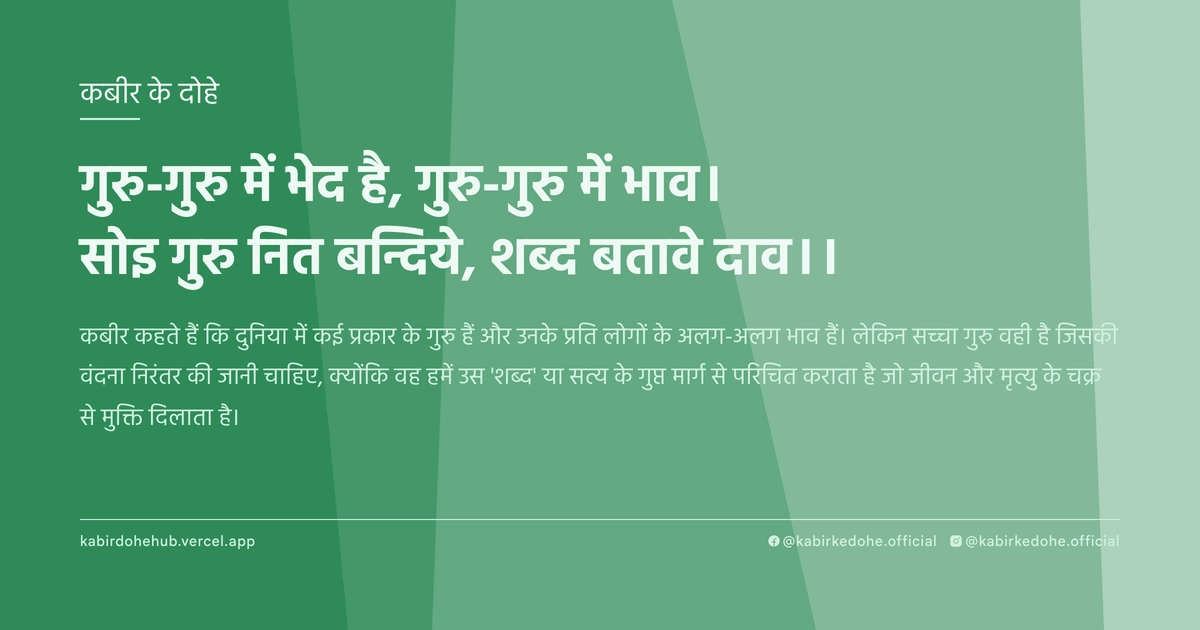
गुरु-गुरु में भेद है, गुरु-गुरु में भाव।
सोइ गुरु नित बन्दिये, शब्द बतावे दाव।।
Guru-guru mein bhed hai, guru-guru mein bhaav. Soi guru nit bandiye, shabd batave daav.
इस पृष्ठ पर इस कबीर दोहे का अर्थ (meaning), हिंदी व्याख्या और अंग्रेज़ी अनुवाद, दार्शनिक विश्लेषण और व्यावहारिक जीवन सीख दी गई है। यह दोहा गुरु महत्व (The Guru's Importance) विषय से जुड़ा है — Kabir doha meaning and explanation in Hindi and English.
अर्थ (Meaning):
कबीर कहते हैं कि दुनिया में कई प्रकार के गुरु हैं और उनके प्रति लोगों के अलग-अलग भाव हैं। लेकिन सच्चा गुरु वही है जिसकी वंदना निरंतर की जानी चाहिए, क्योंकि वह हमें उस 'शब्द' या सत्य के गुप्त मार्ग से परिचित कराता है जो जीवन और मृत्यु के चक्र से मुक्ति दिलाता है।
Kabir asserts that there are many types of teachers and varying perceptions of gurus. However, the only guru truly worthy of eternal reverence is the one who reveals the 'Shabd'—the primordial sound or divine word—and discloses the strategic path to transcend the illusions of existence.
व्याख्या (Interpretation):
इस दोहे का शाब्दिक अर्थ है कि गुरुओं के बीच अंतर होता है। गहराई में, कबीर यहाँ 'बाहरी गुरु' (जो केवल शास्त्र पढ़ाते हैं) और 'आंतरिक गुरु' (जो आत्म-साक्षात्कार कराते हैं) के बीच भेद कर रहे हैं। यह निर्गुण भक्ति का सार है जहाँ ईश्वर किसी मूर्ति में नहीं, बल्कि उस 'शब्द' या नाद में है जो ब्रह्मांड की धड़कन है। माया हमें बाहरी आडंबरों में उलझाती है, लेकिन सच्चा गुरु उस पर्दे को हटाकर आत्मा और ब्रह्म की एकता (अद्वैत) का बोध कराता है। यहाँ 'दाव' का अर्थ उस आध्यात्मिक चाल या तकनीक से है जिससे अहंकार का विनाश होता है।
Literally, the verse acknowledges the diversity among gurus. Metaphorically, Kabir distinguishes between the 'formal teacher' who imparts academic knowledge and the 'spiritual catalyst' who awakens the soul. This aligns with Nirgun Bhakti, where the Divine is not a person but a vibration—the 'Shabd'. Maya creates the illusion that ritualistic guidance is sufficient, but the true Guru dismantles the ego to reveal the non-duality of Atman and Brahman. The 'daav' refers to the esoteric spiritual strategy required to navigate the complexities of the mind and achieve liberation from the cycle of rebirth.
दार्शनिक विश्लेषण (Philosophical Analysis):
कबीर का यह दृष्टिकोण उनके समय के धार्मिक कट्टरपंथ और पाखंड के विरुद्ध एक सशक्त प्रहार था। उन्होंने देखा कि लोग केवल उपाधियों और वस्त्रों के आधार पर गुरुओं का चयन करते थे, जबकि वास्तविक ज्ञान आंतरिक अनुभव का विषय है। यह विश्लेषण अद्वैत वेदांत के उस सिद्धांत से मेल खाता है जहाँ जीव और ईश्वर के बीच का अंतर केवल अज्ञानता के कारण है।
सूफी मत के 'पीर' की अवधारणा यहाँ स्पष्ट दिखती है, जहाँ बिना एक मार्गदर्शक के सत्य की खोज असंभव मानी जाती है। कबीर ritualism (कर्मकांड) को पूरी तरह नकारते हैं; उनके लिए मंदिर या मस्जिद जाना व्यर्थ है यदि गुरु ने 'शब्द' का रहस्य नहीं खोला।
मनोवैज्ञानिक स्तर पर, यह दोहा हमें बाहरी प्रमाणन (external validation) की खोज छोड़कर आंतरिक सत्य की ओर मुड़ने को कहता है। अहंकार अक्सर ऐसे गुरुओं की तलाश करता है जो उसकी प्रशंसा करें, जबकि सच्चा गुरु वह है जो अहंकार को नष्ट करे।
यहाँ 'शब्द' केवल ध्वनि नहीं, बल्कि वह चेतना है जो सृष्टि का आधार है। यह नाद-ब्रह्म की अवधारणा है, जहाँ मौन में ही सबसे गहरा संवाद होता है।
अंततः, कबीर यह समझाते हैं कि गुरु कोई व्यक्ति नहीं, बल्कि एक ऊर्जा या सिद्धांत है। जब शिष्य पूरी तरह समर्पित होता है, तब वह व्यक्ति-गुरु से ऊपर उठकर उस सार्वभौमिक गुरु (Universal Consciousness) से जुड़ जाता है।
Kabir’s perspective serves as a potent critique of the religious dogmatism and hypocrisy prevalent in his era. He observed that seekers often chose gurus based on titles, lineage, or attire, whereas authentic realization is an internal experience. This analysis resonates with Advaita Vedanta, which posits that the perceived separation between the individual soul and the Absolute is merely a product of ignorance.
The influence of Sufism is evident here, mirroring the concept of the 'Pir' or spiritual guide without whom the path to Truth remains obscured. Kabir vehemently rejects ritualism; for him, visiting temples or mosques is futile if the guru has not unlocked the mystery of the 'Shabd'.
Psychologically, this verse urges a shift from seeking external validation to pursuing internal truth. The ego typically seeks a teacher who affirms its existing biases, while a true spiritual guide is one who systematically dismantles the ego's constructs.
The 'Shabd' mentioned is not merely a spoken word but the primordial vibration—the cosmic consciousness that underlies all existence. This is the concept of Nada-Brahma, where the deepest communication occurs in the silence beyond sound.
Ultimately, Kabir suggests that the Guru is not an individual but a principle of enlightenment. When a disciple achieves total surrender, they transcend the personality of the human teacher to merge with the Universal Consciousness.
मूल संदेश (Core Message):
- बाहरी आडंबरों और उपाधियों के भ्रम को त्यागें।
- सच्चा मार्गदर्शन वह है जो अहंकार का विनाश करे।
- सत्य किसी व्यक्ति में नहीं, बल्कि आंतरिक 'शब्द' में है।
- मौन ही सबसे उच्च स्तर का आध्यात्मिक संवाद है।
- शिष्य की पात्रता उसकी विनम्रता और समर्पण में है।
- Discard the illusion of external rituals and titles.
- True guidance is that which annihilates the ego.
- Truth resides not in a person, but in the inner 'Shabd'.
- Silence is the highest form of spiritual communication.
- The disciple's readiness lies in humility and surrender.
व्यावहारिक उदाहरण (Practical Example):
वाराणसी के एक पुराने घाट पर माधव नाम का एक वृद्ध नाविक रहता था। वह जीवन भर केवल नाव चलाने और लोगों को पार उतारने का काम करता रहा।
शहर में कई बड़े पंडित और विद्वान आते थे जो धर्म की लंबी-चौड़ी व्याख्याएं करते थे। माधव उनकी बातें सुनता, लेकिन उसके मन में हमेशा एक बेचैनी रहती थी कि सत्य आखिर है क्या।
एक दिन उसकी मुलाकात एक फकीर से हुई जो घाट की सीढ़ियों पर मौन बैठा था। फकीर ने कोई शास्त्र नहीं पढ़ाया, न ही कोई मंत्र दिया।
उसने बस माधव से कहा, 'नाव की लहरों को मत देखो, उस गहराई को देखो जहाँ लहरें शांत हो जाती हैं।'
माधव ने महसूस किया कि वह अब तक केवल बाहरी शोर को ही ज्ञान मान रहा था। उसने उन विद्वानों को गुरु माना था जो केवल शब्दों का जाल बुनते थे।
उस फकीर के एक छोटे से संकेत ने माधव को यह समझा दिया कि असली गुरु वह है जो आपको आपके अपने भीतर के मौन से मिला दे।
माधव ने बाहरी दिखावे और धार्मिक पहचान को छोड़ दिया। अब वह नाव चलाते समय भी उस आंतरिक शांति का अनुभव करता था।
उसका व्यवहार बदल गया; अब वह यात्रियों से केवल पैसे नहीं लेता था, बल्कि उनके दुख-सुख को गहराई से सुनने लगा।
उसने जान लिया कि 'शब्द' कहीं बाहर नहीं, बल्कि उसके अपने हृदय की धड़कन में छिपा है।
माधव की नाव अब केवल नदी पार नहीं कराती थी, बल्कि वह लोगों के लिए शांति का एक छोटा सा केंद्र बन गया था।
On an ancient ghat in Varanasi lived an elderly boatman named Madhav. His entire life was spent rowing boats and ferrying pilgrims across the river.
Many learned pundits and scholars visited the city, delivering elaborate discourses on religion. Madhav listened to them, but a persistent restlessness remained—he wondered what Truth actually was.
One day, he encountered a wandering dervish sitting in silence on the stone steps of the ghat. The dervish taught no scriptures and gave no complex mantras.
He simply told Madhav, 'Do not look at the ripples on the surface of the river; look at the depth where the ripples cease to exist.'
Madhav suddenly realized that he had been mistaking the external noise for knowledge. He had regarded those scholars as gurus simply because they spoke eloquently.
That single, pointed insight from the dervish taught him that a true guru is not one who provides answers, but one who connects you to your own inner silence.
Madhav abandoned his pursuit of external validation and religious labels. Now, even while rowing, he remained anchored in that internal stillness.
His behavior transformed; he no longer saw passengers as mere sources of income but began to listen to their sorrows and joys with profound empathy.
He understood that the 'Shabd' was not a hidden text, but the very rhythm of his own heart.
Madhav’s boat ceased to be just a means of transport; it became a sanctuary of peace for everyone who stepped onto it.
अभ्यास मार्गदर्शन (Practice Guidance):
- प्रतिदिन 20 मिनट मौन अभ्यास करें, जहाँ आप केवल अपनी सांसों की ध्वनि को सुनें और बाहरी शोर से खुद को अलग करें।
- एक डायरी लिखें जिसमें आप उन 'गुरुओं' या प्रभावों की सूची बनाएं जिन्होंने आपको केवल बाहरी दिखावा सिखाया, और फिर विचार करें कि वास्तविक सत्य क्या हो सकता है।
- व्यवहार परिवर्तन: जब भी आप किसी से सलाह लें, तो यह देखें कि क्या वह सलाह आपके अहंकार को बढ़ा रही है या उसे चुनौती दे रही है।
- निदान चेकलिस्ट: क्या मैं अभी भी उपाधियों (Degrees/Titles) से प्रभावित हूँ? क्या मेरी शांति बाहरी परिस्थितियों पर निर्भर है? क्या मैं सत्य को केवल किताबों में ढूंढ रहा हूँ?
- Practice 20 minutes of daily silence, focusing solely on the sound of your breath to detach from external auditory noise.
- Maintain a journal listing the 'gurus' or influences that encouraged superficiality, and contrast them with moments of genuine internal realization.
- Behavioral Shift: Whenever you seek advice, analyze whether that guidance inflates your ego or challenges it to dissolve.
- Diagnostic Checklist: Am I still swayed by titles and credentials? Is my peace dependent on external circumstances? Am I searching for Truth exclusively in texts?
चिंतन प्रश्न (Reflection Questions):
- क्या मैं वास्तव में सत्य की खोज कर रहा हूँ, या मैं केवल अपनी मान्यताओं की पुष्टि करने वाला गुरु ढूंढ रहा हूँ?
- मेरे जीवन में 'शब्द' का क्या अर्थ है—क्या यह केवल भाषा है या एक गहरी चेतना?
- यदि मेरी सारी सामाजिक पहचान (पद, प्रतिष्ठा, जाति) छीन ली जाए, तो मेरे भीतर क्या बचेगा?
- मैं कितनी बार अपनी सहज बुद्धि (Intuition) को बाहरी विशेषज्ञों की राय के लिए कुर्बान करता हूँ?
- क्या मेरा आध्यात्मिक झुकाव मुझे अधिक विनम्र बना रहा है या मुझे दूसरों से श्रेष्ठ होने का अहसास करा रहा है?
- Am I truly seeking the Truth, or am I merely looking for a guru who validates my existing biases?
- What does 'Shabd' mean in my life—is it merely language, or a deeper state of consciousness?
- If all my social identities (rank, prestige, caste) were stripped away, what would remain within me?
- How often do I sacrifice my intuition in favor of the opinions of 'external experts'?
- Is my spiritual inclination making me more humble, or is it fueling a sense of superiority over others?