
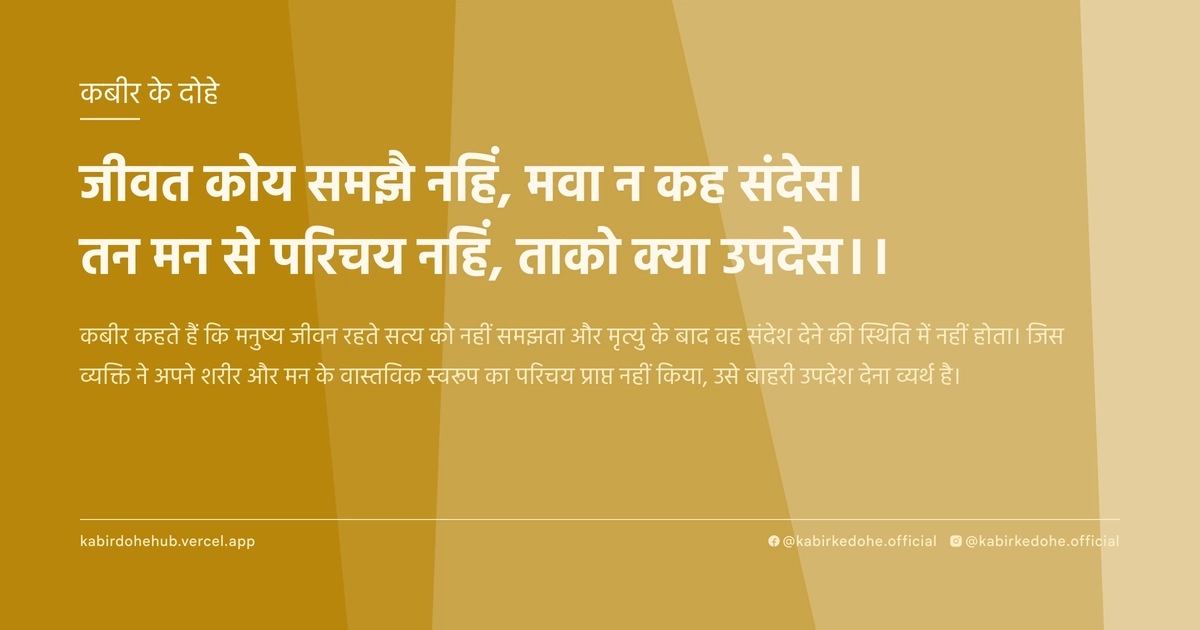
जीवत कोय समझै नहिं, मवा न कह संदेस।
तन मन से परिचय नहिं, ताको क्या उपदेस।।
Jeevat koy samjhe nahi, mava na kah sandes. Tan man se parichay nahi, taako kya updes.
इस पृष्ठ पर इस कबीर दोहे का अर्थ (meaning), हिंदी व्याख्या और अंग्रेज़ी अनुवाद, दार्शनिक विश्लेषण और व्यावहारिक जीवन सीख दी गई है। यह दोहा जागृति (The Wake-up Call) विषय से जुड़ा है — Kabir doha meaning and explanation in Hindi and English.
अर्थ (Meaning):
कबीर कहते हैं कि मनुष्य जीवन रहते सत्य को नहीं समझता और मृत्यु के बाद वह संदेश देने की स्थिति में नहीं होता। जिस व्यक्ति ने अपने शरीर और मन के वास्तविक स्वरूप का परिचय प्राप्त नहीं किया, उसे बाहरी उपदेश देना व्यर्थ है।
Kabir asserts that humans fail to comprehend the ultimate truth while living, and once dead, they cannot send messages back. For one who lacks an internal realization of their own body and mind, external spiritual instructions are entirely futile.
व्याख्या (Interpretation):
यह दोहा मानव जीवन की त्रासदी और अज्ञानता पर प्रहार करता है। 'जीवत कोय समझै नहिं' का अर्थ है कि हम माया के प्रभाव में इतने अंधे हैं कि जीवित रहते हुए आत्म-साक्षात्कार नहीं करते। 'मवा' (मृत्यु) के बाद जब बोध होता है, तब तक समय समाप्त हो चुका होता है। यहाँ 'तन मन से परिचय' का अर्थ केवल शारीरिक ज्ञान नहीं, बल्कि निर्गुण भक्ति के उस स्तर से है जहाँ आत्मा और परमात्मा की एकता (अद्वैत) का अनुभव होता है। जब तक साधक अपने भीतर के 'साक्षी' को नहीं पहचानता, तब तक शास्त्र या गुरु के शब्द केवल बाहरी शोर होते हैं। यह विरोधाभास है कि हम पूरी दुनिया को जानने की कोशिश करते हैं, लेकिन स्वयं को जानना भूल जाते हैं।
This couplet strikes at the tragedy of human ignorance and the veil of Maya. 'Jivat koy samjhai nahi' implies that we are so blinded by worldly illusions that we neglect self-realization during our conscious life. By the time the 'message' of truth arrives at the threshold of death, the opportunity for transformation has vanished. The phrase 'Tan man se parichay' refers not to biological knowledge, but to the experiential realization of the Atman-Brahman non-duality central to Nirgun Bhakti. Until a seeker recognizes the 'Witness' within, external scriptures or sermons remain mere noise. It highlights the central paradox: humanity spends a lifetime exploring the external universe while remaining a stranger to its own internal essence.
दार्शनिक विश्लेषण (Philosophical Analysis):
कबीर का यह दर्शन अद्वैत वेदांत और सूफी मत के 'फना' होने की प्रक्रिया का संगम है। वे उस समय की सामाजिक व्यवस्था पर प्रहार कर रहे हैं जहाँ धर्म केवल कर्मकांडों और बाहरी दिखावे तक सीमित था। कबीर का मानना था कि मोक्ष किसी मंदिर, मस्जिद या बाहरी उपदेश से नहीं, बल्कि 'स्व' के गहन विश्लेषण से मिलता है।
यहाँ 'उपदेस' की व्यर्थता का उल्लेख है। यह एक मनोवैज्ञानिक सत्य है कि जब तक व्यक्ति की चेतना तैयार नहीं होती, तब तक ज्ञान केवल सूचना बनकर रह जाता है। कबीर यहाँ 'अहंकार' को सबसे बड़ी बाधा मानते हैं। जब तक 'मैं' (ego) जीवित है, तब तक सत्य का अनुभव असंभव है।
सूफीवाद के संदर्भ में, यह 'इश्क-ए-हकीकी' (परमात्मा से प्रेम) की कमी को दर्शाता है। बिना आंतरिक प्रेम और तड़प के, ज्ञान केवल बौद्धिक व्यायाम है। कबीर यह स्पष्ट करते हैं कि शरीर केवल एक माध्यम है, लेकिन जब तक मन उस माध्यम को पार कर शून्य में विलीन नहीं होता, तब तक मुक्ति नहीं मिलती।
ऐतिहासिक रूप से, कबीर ने जाति और धर्म के बंधनों को तोड़कर एक ऐसी आध्यात्मिकता की नींव रखी जो पूरी तरह से व्यक्तिगत अनुभव पर आधारित थी। उन्होंने यह स्थापित किया कि ईश्वर 'घट-घट' में है, लेकिन हम उसे बाहर ढूंढते हैं।
अंततः, यह दोहा हमें चेतावनी देता है कि समय सीमित है। मृत्यु एक पूर्ण विराम है, और यदि जीवन के दौरान आंतरिक परिचय (Self-Knowledge) प्राप्त नहीं हुआ, तो बाहरी ज्ञान का कोई मूल्य नहीं रह जाता। यह 'अविद्या' के विनाश और 'विद्या' के उदय का आह्वान है।
Kabir's philosophy here is a confluence of Advaita Vedanta and the Sufi concept of 'Fana' (annihilation of the self). He critiques the socio-religious climate of his era, where spirituality had devolved into mere ritualism and external displays of piety. For Kabir, liberation is not found in temples or mosques, but through a rigorous internal audit of the self.
The mention of the futility of 'Updes' (sermons) points to a psychological truth: unless the consciousness is primed for reception, spiritual knowledge remains mere information. Kabir identifies the 'Ego' as the primary obstacle; as long as the illusory 'I' persists, the realization of the Absolute remains impossible.
In the context of Sufism, this reflects a lack of 'Ishq-e-Haqiqi' (Divine Love). Without an internal longing and an emotional surrender, spiritual discourse is nothing more than an intellectual exercise. Kabir clarifies that while the body is the vehicle, the mind must transcend the vehicle to merge into the Void (Shunya).
Historically, Kabir dismantled caste and creedal barriers by proposing a spirituality based entirely on personal experience. He asserted that the Divine resides within every 'Ghat' (vessel/body), yet humans waste their lives searching for it in the external world.
Ultimately, this doha serves as a stark warning about the finitude of time. Death is an absolute cessation of the physical medium; if the internal introduction (Self-Knowledge) is not achieved during life, external wisdom becomes irrelevant. It is a call for the destruction of 'Avidya' (ignorance) and the awakening of 'Vidya' (true knowledge).
मूल संदेश (Core Message):
- बाहरी ज्ञान केवल सूचना है, आंतरिक अनुभव ही वास्तविक ज्ञान है।
- मृत्यु के बाद का बोध व्यर्थ है; जागरण इसी क्षण में आवश्यक है।
- जब तक स्वयं को नहीं जानोगे, तब तक दुनिया का ज्ञान एक बोझ है।
- अहंकार का विसर्जन ही आत्म-परिचय का एकमात्र द्वार है।
- सत्य शब्दों में नहीं, बल्कि अस्तित्व के मौन अनुभव में निहित है।
- External knowledge is mere information; internal experience is true wisdom.
- Realization after death is futile; awakening is required in this moment.
- Knowledge of the world is a burden until you know yourself.
- The dissolution of ego is the only gateway to self-introduction.
- Truth resides not in words, but in the silent experience of existence.
व्यावहारिक उदाहरण (Practical Example):
एक समय की बात है, वाराणसी के घाटों पर माधव नाम का एक वृद्ध बुनकर रहता था। माधव अपनी कला में निपुण था और शहर के सबसे महंगे रेशमी वस्त्र बनाता था। वह अत्यंत धार्मिक था, प्रतिदिन घंटों पूजा करता और बड़े-बड़े संतों के प्रवचन सुनता था। वह मानता था कि ज्ञान संचय करना ही मोक्ष का मार्ग है।
माधव के पास एक युवा शिष्य था, जो अक्सर पूछता था, 'काका, आप इतने शास्त्र पढ़ते हैं, फिर भी आपके चेहरे पर वह शांति क्यों नहीं दिखती जो एक मौन साधु के चेहरे पर होती है?' माधव हमेशा उसे शास्त्रों के श्लोकों से चुप करा देता।
एक दिन माधव की मुलाकात एक फकीर से हुई जो सड़क किनारे बैठा था। फकीर ने माधव के महंगे कपड़ों को देखा और मुस्कुराकर कहा, 'तुमने कपड़े तो बहुत सुंदर बुने हैं, लेकिन क्या तुमने अपनी आत्मा के धागों को सुलझाया है?'
माधव ने गर्व से कहा, 'मैंने सैकड़ों ग्रंथों का अध्ययन किया है, मैं धर्म का ज्ञाता हूँ।' फकीर ने शांति से उत्तर दिया, 'किताबों का ज्ञान बोझ है, यदि वह तुम्हारे व्यवहार में नहीं उतरा। तुम दूसरों को उपदेश देते हो, लेकिन क्या तुम जानते हो कि जब तुम क्रोधित होते हो, तो तुम्हारे भीतर कौन बोल रहा होता है?'
माधव को पहली बार महसूस हुआ कि वह केवल 'सूचनाओं' का संग्रह था, 'अनुभव' का नहीं। उसने महसूस किया कि वह अपनी पहचान अपने कपड़ों, अपनी जाति और अपने ज्ञान के अहंकार से जोड़ चुका था।
उस रात माधव सो नहीं सका। उसे कबीर की पंक्तियाँ याद आईं कि बिना आत्म-परिचय के उपदेश व्यर्थ है। उसने महसूस किया कि वह जीवन भर बाहर की दुनिया को सुधारने की कोशिश करता रहा, जबकि उसके भीतर का घर अंधेरे में था।
अगले दिन से माधव ने ग्रंथों को पढ़ना कम किया और मौन का अभ्यास शुरू किया। उसने अपनी बुनाई को एक ध्यान बना लिया। अब वह केवल रेशम नहीं बुनता था, बल्कि हर धागे के साथ अपने अहंकार को काटने का प्रयास करता था।
धीरे-धीरे उसका व्यवहार बदलने लगा। वह अब दूसरों को सही रास्ता बताने के बजाय, स्वयं सही होने का प्रयास करने लगा। उसकी शांति अब शब्दों में नहीं, बल्कि उसकी उपस्थिति में झलकने लगी।
वर्षों बाद, जब माधव की मृत्यु निकट आई, तो उसके चेहरे पर एक अलौकिक मुस्कान थी। उसने अब किसी संदेश की आवश्यकता नहीं समझी, क्योंकि वह स्वयं वह संदेश बन चुका था।
उसने जान लिया था कि शरीर और मन का परिचय ही एकमात्र वास्तविक ज्ञान है, बाकी सब केवल शब्दों का जाल है।
Once in the ghats of Varanasi, there lived an elderly weaver named Madhav. Madhav was a master of his craft, weaving the most expensive silk garments in the city. He was deeply religious, spending hours in prayer and attending discourses by renowned saints, believing that the accumulation of knowledge was the path to salvation.
Madhav had a young apprentice who often asked, 'Kaka, you read so many scriptures, yet why doesn't your face reflect the peace seen in a silent monk?' Madhav would always silence him with complex verses from the texts.
One day, Madhav encountered a wandering fakir sitting by the roadside. The fakir looked at Madhav's opulent clothes and smiled, asking, 'You have woven beautiful fabrics, but have you untangled the threads of your own soul?'
Madhav replied with pride, 'I have studied hundreds of texts; I am a scholar of Dharma.' The fakir calmly replied, 'Bookish knowledge is a burden if it does not descend into your behavior. You preach to others, but do you know who is speaking within you when you are consumed by anger?'
For the first time, Madhav realized he was merely a collection of 'information,' not 'experience.' He saw that he had tied his identity to his clothes, his caste, and the ego of his scholarship.
That night, Madhav could not sleep. He recalled the essence of Kabir's words: that sermons are futile without self-introduction. He realized he had spent his life trying to correct the external world while his internal house remained in darkness.
From the next day, Madhav reduced his reading and began practicing silence. He turned his weaving into a meditation. He no longer just wove silk; with every thread, he attempted to cut through his ego.
Gradually, his behavior shifted. Instead of trying to show others the right path, he focused on embodying the path himself. His peace was no longer found in his words, but in his mere presence.
Years later, as death approached, a divine smile graced Madhav's face. He no longer felt the need to send a message, for he had become the message himself.
He had finally understood that the introduction of the body and mind is the only true knowledge; everything else is but a web of words.
अभ्यास मार्गदर्शन (Practice Guidance):
- प्रतिदिन 20 मिनट 'साक्षी भाव' का अभ्यास करें: अपने विचारों को बिना किसी निर्णय के केवल देखें, जैसे आप किसी अजनबी को देख रहे हों।
- आत्म-पूछताछ जर्नल: हर रात लिखें कि आज किस क्षण में मेरा 'अहंकार' (Ego) हावी हुआ और उस समय मेरे भीतर कौन सा 'मुखौटा' सक्रिय था।
- मौन व्रत: सप्ताह में एक दिन या दिन में कुछ घंटे पूर्ण मौन रहें, ताकि बाहरी शब्दों का शोर कम हो और आंतरिक ध्वनि सुनाई दे।
- निदान चेकलिस्ट: क्या मैं दूसरों की गलतियाँ जल्दी पकड़ता हूँ? (यदि हाँ, तो मैं अभी भी बाहरी उपदेशों में हूँ)। क्या मैं अपनी प्रतिक्रियाओं के मूल कारण को जानता हूँ? (यदि नहीं, तो मुझे आत्म-परिचय की आवश्यकता है)।
- Practice 'Witness Consciousness' for 20 minutes daily: Observe your thoughts without judgment, as if watching a stranger.
- Self-Inquiry Journaling: Every night, record the moments where your 'Ego' took over and identify which 'mask' was active during that interaction.
- Vow of Silence: Dedicate one day a week or a few hours daily to complete silence to diminish external noise and amplify the internal voice.
- Diagnostic Checklist: Do I spot others' flaws quickly? (If yes, I am still trapped in external preaching). Do I understand the root cause of my reactions? (If no, I lack self-introduction).
चिंतन प्रश्न (Reflection Questions):
- यदि आज मेरी मृत्यु हो जाए, तो क्या मैं गर्व से कह सकूँगा कि मैंने वास्तव में स्वयं को जाना था, या मैं केवल दूसरों की धारणाओं का एक पुतला था?
- मेरे व्यक्तित्व का वह कौन सा हिस्सा है जिसे मैं दुनिया से छिपाता हूँ, और क्या वही हिस्सा मेरे वास्तविक 'स्व' के सबसे करीब है?
- मैं दूसरों को जो उपदेश देता हूँ, क्या मैं स्वयं उसका पालन करता हूँ, या मेरा ज्ञान केवल दूसरों को नियंत्रित करने का एक साधन है?
- डिजिटल युग में, मेरी 'ऑनलाइन पहचान' मेरे वास्तविक अस्तित्व को कितना ढक चुकी है?
- क्या मेरी आध्यात्मिक खोज वास्तव में सत्य को जानने के लिए है, या यह केवल मेरे अहंकार को 'विशिष्ट' महसूस कराने का एक नया तरीका है?
- If I were to die today, could I honestly say I knew myself, or was I merely a puppet of others' perceptions?
- Which part of my personality do I hide from the world, and is that hidden part closest to my true self?
- Do I embody the advice I give to others, or is my knowledge merely a tool to control them?
- In the digital age, to what extent has my 'online persona' obscured my actual existence?
- Is my spiritual quest truly about seeking truth, or is it just a new way for my ego to feel 'special' and superior?