
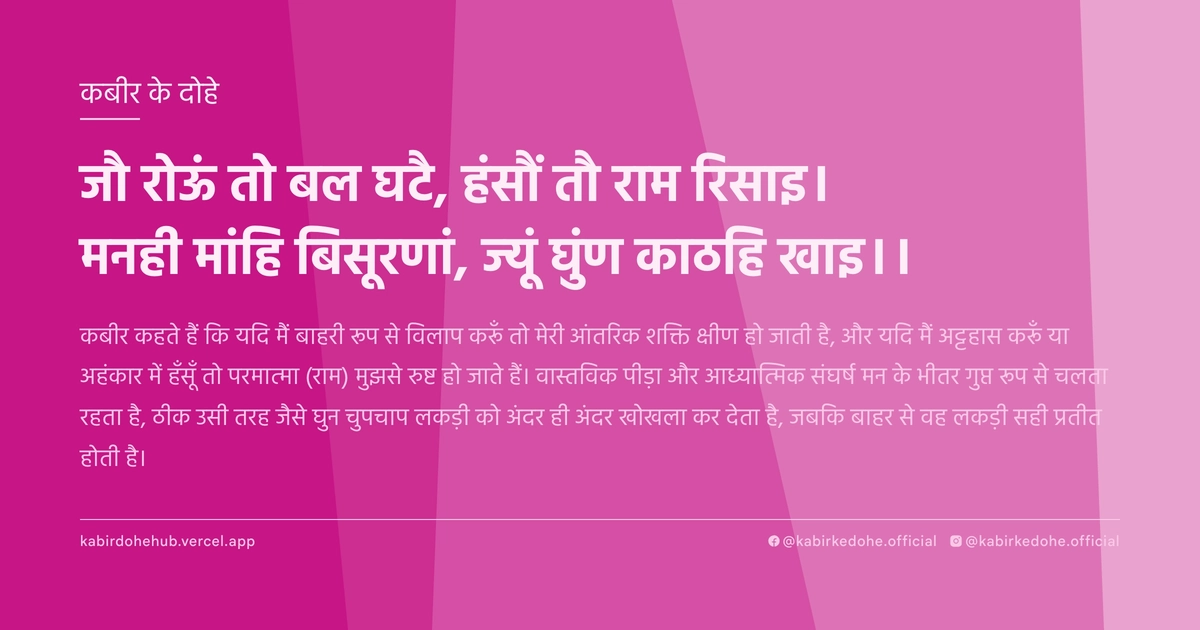
जौ रोऊं तो बल घटै, हंसौं तौ राम रिसाइ।
मनही मांहि बिसूरणां, ज्यूं घुंण काठहि खाइ।।
Jau roon to bal ghatai, hansau tau Ram risai. Manhi manhi bisuranan, jyun ghun kaathahi khai.
इस पृष्ठ पर इस कबीर दोहे का अर्थ (meaning), हिंदी व्याख्या और अंग्रेज़ी अनुवाद, दार्शनिक विश्लेषण और व्यावहारिक जीवन सीख दी गई है। यह दोहा भक्ति (Bhakti) विषय से जुड़ा है — Kabir doha meaning and explanation in Hindi and English.
अर्थ (Meaning):
कबीर कहते हैं कि यदि मैं बाहरी रूप से विलाप करूँ तो मेरी आंतरिक शक्ति क्षीण हो जाती है, और यदि मैं अट्टहास करूँ या अहंकार में हँसूँ तो परमात्मा (राम) मुझसे रुष्ट हो जाते हैं। वास्तविक पीड़ा और आध्यात्मिक संघर्ष मन के भीतर गुप्त रूप से चलता रहता है, ठीक उसी तरह जैसे घुन चुपचाप लकड़ी को अंदर ही अंदर खोखला कर देता है, जबकि बाहर से वह लकड़ी सही प्रतीत होती है।
Kabir explains that outward weeping depletes one's inner strength, while outward laughter or arrogance displeases the Divine. The true spiritual struggle and the agony of separation reside silently within the heart, acting like a wood-borer (ghun) that hollows out a piece of timber from the inside, leaving the exterior seemingly intact while the core is consumed.
व्याख्या (Interpretation):
इस दोहे में कबीर बाहरी प्रदर्शन और आंतरिक वास्तविकता के बीच के विरोधाभास को दर्शाते हैं। 'रोना' यहाँ केवल शोक नहीं, बल्कि मोह और आसक्ति में पड़कर अपनी ऊर्जा को नष्ट करना है। 'हँसना' यहाँ सांसारिक विजय के अहंकार का प्रतीक है, जो साधक को परमात्मा से दूर करता है। यह स्थिति निर्गुण भक्ति की उस अवस्था को दर्शाती है जहाँ साधक न तो दुख में डूबता है और न ही सुख में मदहोश होता है। 'मनही मांहि बिसूरणां' उस आंतरिक विरह की अग्नि को कहते हैं जो माया के पर्दे के पीछे छिपी रहती है। यह अद्वैत वेदांत के उस सत्य की ओर संकेत है जहाँ आत्मा अपनी वास्तविक पहचान (ब्रह्म) को पाने के लिए तड़पती है, लेकिन यह तड़प बाहरी शोर नहीं, बल्कि एक मौन रूपांतरण है। जैसे घुन लकड़ी को नष्ट करता है, वैसे ही यह आध्यात्मिक विरह अहंकार को धीरे-धीरे समाप्त कर देता है।
In this couplet, Kabir illustrates the paradox between external performance and internal reality. 'Weeping' here represents not just grief, but the depletion of spiritual energy through attachment and emotional volatility. 'Laughter' symbolizes the arrogance of worldly success, which creates a barrier between the seeker and the Divine. This state reflects the path of Nirgun Bhakti, where the seeker remains equidistant from both sorrow and joy. 'Manahi maahi bisoornan' refers to the internal agony of separation—a silent fire burning behind the veil of Maya. It points toward the Advaita Vedantic truth where the Atman yearns for its non-dual union with Brahman. This yearning is not a loud lamentation but a silent transformation. Just as the wood-borer consumes the timber, this spiritual longing gradually erodes the ego, hollowing out the false identity to make room for the Divine presence.
दार्शनिक विश्लेषण (Philosophical Analysis):
कबीर का यह विचार उनके युग के धार्मिक पाखंड और बाहरी कर्मकांडों के प्रति एक तीखा प्रहार है। उस समय धर्म का अर्थ केवल मंदिर-मस्जिद जाना या सार्वजनिक रूप से विलाप करना था। कबीर ने इस 'प्रदर्शनवाद' को खारिज करते हुए आंतरिक शुद्धि पर बल दिया। वे बताते हैं कि ईश्वर बाहरी शोर में नहीं, बल्कि मौन की गहराइयों में मिलते हैं।
दार्शनिक स्तर पर, यह दोहा सूफीवाद के 'इश्क-ए-हकीकी' (ईश्वरीय प्रेम) से मेल खाता है, जहाँ प्रेमी अपने दर्द को दुनिया से छिपाकर केवल अपने महबूब (ईश्वर) के साथ साझा करता है। यह 'गुप्त विरह' ही साधक की असली तपस्या है। यदि दर्द बाहर प्रकट हो जाए, तो वह केवल सहानुभूति बटोरने का साधन बन जाता है, आध्यात्मिक उन्नति का नहीं।
अद्वैत वेदांत के परिप्रेक्ष्य में, 'बल घटना' का अर्थ है प्राण ऊर्जा का क्षय होना। जब मनुष्य अपनी भावनाओं के अतिरेक में बहता है, तो वह अपनी साक्षी भाव (Witness Consciousness) को खो देता है। कबीर यहाँ एक मध्य मार्ग का सुझाव दे रहे हैं—स्थितप्रज्ञता, जहाँ व्यक्ति बाहरी दुनिया के लिए सामान्य दिखता है, लेकिन भीतर एक गहन आध्यात्मिक क्रांति चल रही होती है।
अहंकार का विनाश (Ego Annihilation) इस प्रक्रिया का केंद्र है। घुन का उदाहरण अत्यंत सटीक है क्योंकि अहंकार अचानक नहीं टूटता; वह धीरे-धीरे, सूक्ष्म रूप से नष्ट होता है। जब तक साधक को यह अहसास होता है कि वह 'खोखला' हो गया है, तब तक उसका पुराना व्यक्तित्व पूरी तरह समाप्त हो चुका होता है और केवल परमात्मा शेष रहता है।
अंततः, कबीर यह समझाते हैं कि वास्तविक भक्ति वह नहीं है जो दुनिया को दिखाई दे, बल्कि वह है जो आत्मा को बदल दे। वे ritualism (कर्मकांड) के बजाय realization (साक्षात्कार) को प्राथमिकता देते हैं। यह संदेश आज के युग में भी प्रासंगिक है, जहाँ लोग अपनी आध्यात्मिकता का प्रदर्शन सोशल मीडिया या सार्वजनिक मंचों पर करते हैं, जबकि उनका आंतरिक शून्य और बढ़ता जाता है।
Kabir's insight is a sharp critique of the religious hypocrisy and external ritualism prevalent during his era. At that time, religion was often reduced to visiting temples or mosques or performing public acts of piety. Kabir rejects this 'performative spirituality,' emphasizing instead the necessity of internal purification. He asserts that the Divine is not found in external noise but in the profound depths of silence.
Philosophically, this couplet aligns with the Sufi concept of 'Ishq-e-Haqiqi' (Divine Love), where the lover conceals their agony from the world, sharing it only with the Beloved. This 'hidden longing' is the true austerity of the seeker. If the pain is broadcasted, it becomes a tool for seeking sympathy rather than a vehicle for spiritual evolution.
From the perspective of Advaita Vedanta, the 'depletion of strength' refers to the loss of Prana or spiritual energy. When a human is swept away by emotional extremes, they lose their 'Sakshi Bhava' or Witness Consciousness. Kabir suggests a middle path—a state of equanimity where the individual appears ordinary to the world, while a profound spiritual revolution occurs within.
Ego annihilation is the core of this process. The metaphor of the wood-borer is precise because the ego does not shatter instantly; it is eroded subtly and slowly. By the time the seeker realizes they have been 'hollowed out,' the old personality has vanished, leaving only the Divine presence.
Ultimately, Kabir teaches that true devotion is not what is visible to the world, but what transforms the soul. He prioritizes realization over ritualism. This message remains vital today, in an age where spirituality is often performed for a public audience, while the internal void continues to widen.
मूल संदेश (Core Message):
- बाहरी प्रदर्शन आध्यात्मिक ऊर्जा को नष्ट करता है।
- अहंकार की हँसी ईश्वर और आत्मा के बीच बाधा है।
- वास्तविक रूपांतरण मौन और आंतरिक विरह में निहित है।
- अहंकार का विनाश एक धीमी और सूक्ष्म प्रक्रिया है।
- साक्षी भाव ही दुख और सुख से मुक्ति का मार्ग है।
- सत्य वह है जो भीतर घटित होता है, वह नहीं जो दिखाया जाता है।
- External performance depletes spiritual energy.
- The laughter of ego is a barrier between the soul and the Divine.
- True transformation lies in silence and internal longing.
- The annihilation of ego is a slow and subtle process.
- Witness consciousness is the only path to liberation from duality.
- Truth is that which occurs within, not that which is displayed.
व्यावहारिक उदाहरण (Practical Example):
वाराणसी के एक पुराने घाट पर माधव नाम का एक वृद्ध बुनकर रहता था। वह शहर के सबसे कुशल बुनकरों में से एक था, लेकिन उसके चेहरे पर हमेशा एक शांत, लगभग उदासीन भाव रहता था। लोग उसे 'पत्थर दिल' कहते थे क्योंकि जब उसके पड़ोसियों के घर में उत्सव होता, तो वह केवल हल्का मुस्कुराता, और जब कोई शोक मनाता, तो वह विलाप नहीं करता था।
माधव का एक युवा शिष्य था, राघव, जो बहुत भावुक था। राघव अक्सर माधव से पूछता, "गुरुजी, आप इतने तटस्थ कैसे रह सकते हैं? क्या आपको दुख नहीं होता? क्या आप ईश्वर के लिए तड़पते नहीं हैं?" माधव केवल मुस्कुराता और अपने करघे पर काम करता रहता। राघव को लगता कि माधव में कोई आध्यात्मिक गहराई नहीं है।
एक दिन राघव ने देखा कि माधव रात के अंधेरे में अपने कमरे में अकेला बैठा है। वह रो नहीं रहा था, न ही मंत्र पढ़ रहा था। वह बस अपनी आँखें बंद किए एक गहन मौन में डूबा था। राघव ने महसूस किया कि माधव के चारों ओर एक ऐसी ऊर्जा थी जो शब्दों से परे थी। वह शांति इतनी गहरी थी कि राघव को अपने भीतर का शोर सुनाई देने लगा।
माधव ने राघव को पास बुलाया और कहा, "बेटा, जब मैं बाहर रोता हूँ, तो मैं अपनी शक्ति को दूसरों की सहानुभूति में खर्च करता हूँ। और जब मैं अपनी सफलता पर हँसता हूँ, तो मैं अपने अहंकार को भोजन देता हूँ। मैंने सीखा है कि असली विरह वह है जो भीतर जलता रहे, पर बाहर धुआँ न करे।"
राघव ने महसूस किया कि वह अब तक केवल 'अभिनय' कर रहा था। वह दुख में चिल्लाता था ताकि लोग उसे दुखी समझें, और सुख में हँसता था ताकि लोग उसे खुश समझें। वह कभी भी अपने वास्तविक स्वरूप से नहीं मिला था।
माधव ने उसे समझाया कि जैसे घुन लकड़ी को अंदर से खाता है, वैसे ही इस मौन विरह ने उसके भीतर के 'मैं' को धीरे-धीरे खत्म कर दिया है। अब वह केवल एक माध्यम है, कर्ता नहीं।
राघव ने उस दिन से अपनी भावनाओं का प्रदर्शन करना छोड़ दिया। उसने सीखा कि अपनी पीड़ा और अपनी खुशी को भीतर समेटकर उन्हें ईश्वर के प्रति समर्पण में कैसे बदला जाए।
समय बीता, और राघव भी माधव की तरह शांत हो गया। अब लोग उसे भी 'उदासीन' कहने लगे, लेकिन राघव के भीतर एक अनंत आनंद का सागर लहरा रहा था। उसने जान लिया था कि असली भक्ति शोर में नहीं, बल्कि उस मौन में है जहाँ अहंकार का अस्तित्व समाप्त हो जाता है।
On an ancient ghat in Varanasi lived an elderly weaver named Madhav. He was one of the most skilled weavers in the city, yet his face always bore a calm, almost indifferent expression. People called him 'stone-hearted' because when neighbors celebrated, he only smiled faintly, and when they mourned, he did not join the lamentations.
Madhav had a young disciple, Raghav, who was intensely emotional. Raghav often asked, "Guruji, how can you be so detached? Do you feel no pain? Do you not yearn for God?" Madhav would only smile and continue working on his loom. Raghav believed that Madhav lacked spiritual depth.
One night, Raghav saw Madhav sitting alone in his room. He wasn't weeping, nor was he chanting mantras. He was simply immersed in a profound silence. Raghav felt an energy radiating from Madhav that was beyond words. The silence was so deep that Raghav could suddenly hear the noise of his own internal chaos.
Madhav called Raghav closer and said, "Son, when I weep outwardly, I spend my strength seeking sympathy from others. And when I laugh in pride, I feed my ego. I have learned that true longing is that which burns within, but produces no smoke outside."
Raghav realized that until then, he had only been 'acting.' He screamed in grief so people would see his pain, and laughed in joy so people would see his happiness. He had never actually encountered his true self.
Madhav explained that just as the wood-borer eats the timber from within, this silent longing had slowly eroded the 'I' inside him. He was now merely a medium, no longer the doer.
From that day, Raghav stopped performing his emotions. He learned how to gather his pain and joy within and transform them into total surrender to the Divine.
As time passed, Raghav also became serene like Madhav. People began calling him 'indifferent' too, but within Raghav, an infinite ocean of bliss was surging. He had discovered that true devotion is not in the noise, but in the silence where the ego ceases to exist.
अभ्यास मार्गदर्शन (Practice Guidance):
- दैनिक मौन अभ्यास: प्रतिदिन 20 मिनट पूर्ण मौन में बैठें। बाहरी शोर को सुनने के बजाय, अपने भीतर उठने वाले भावनात्मक तूफानों को बिना किसी प्रतिक्रिया के केवल देखें।
- भावनात्मक अवलोकन जर्नल: जब भी आप बहुत अधिक खुशी या दुख महसूस करें, तो उसे तुरंत व्यक्त न करें। एक डायरी में लिखें कि यह भावना कहाँ से आ रही है और क्या यह आपके अहंकार को संतुष्ट कर रही है।
- साक्षी भाव का अभ्यास: दिन भर में कई बार खुद से पूछें, "क्या मैं इस भावना को जी रहा हूँ, या मैं इसे केवल देख रहा हूँ?" स्वयं को एक तटस्थ दर्शक के रूप में स्थापित करें।
- निदान चेकलिस्ट: यदि आप दूसरों की प्रतिक्रिया के बिना अपनी खुशी या दुख को महसूस नहीं कर पा रहे हैं, तो इसका अर्थ है कि आप अभी भी 'प्रदर्शन' के जाल में हैं। यदि आपकी शांति बाहरी परिस्थितियों पर निर्भर है, तो आपका 'घुन' (अहंकार का क्षय) अभी शुरू नहीं हुआ है।
- Daily Silence Practice: Sit in complete silence for 20 minutes daily. Instead of listening to external noise, observe the emotional storms arising within you without reacting to them.
- Emotional Observation Journal: Whenever you feel intense joy or sorrow, resist the urge to express it immediately. Write in a journal where this emotion originates and whether it is feeding your ego.
- Practice of Witness Consciousness: Multiple times a day, ask yourself, "Am I experiencing this emotion, or am I merely observing it?" Establish yourself as a neutral witness.
- Diagnostic Checklist: If you cannot feel your joy or sorrow without an audience or external reaction, you are still trapped in 'performance.' If your peace depends on external circumstances, the 'wood-borer' (erosion of ego) has not yet begun.
चिंतन प्रश्न (Reflection Questions):
- मेरे जीवन के कौन से दुख केवल इसलिए बढ़ा-चढ़ाकर बताए जाते हैं ताकि मुझे सहानुभूति मिले?
- क्या मेरी 'आध्यात्मिक यात्रा' का कोई हिस्सा केवल दूसरों को प्रभावित करने के लिए है?
- जब मैं अकेला होता हूँ, तब मेरा वास्तविक चेहरा क्या होता है, और दुनिया के सामने मैं कौन सा मुखौटा पहनता हूँ?
- क्या मैं अपनी सफलताओं पर हँसते समय यह भूल जाता हूँ कि यह सब क्षणभंगुर है?
- मेरे भीतर वह कौन सा 'घुन' है जो मेरे अहंकार को धीरे-धीरे खत्म कर रहा है, या क्या मैं अभी भी पूरी तरह ठोस अहंकार से भरा हूँ?
- यदि दुनिया से प्रशंसा और सहानुभूति पूरी तरह समाप्त हो जाए, तो क्या मेरी भक्ति और मेरा धर्म जीवित रहेगा?
- Which of my sorrows are exaggerated simply to garner sympathy from others?
- Is any part of my 'spiritual journey' designed merely to impress others?
- Who am I when I am truly alone, and which mask do I wear before the world?
- When I laugh at my successes, do I forget that everything is ephemeral?
- What is the 'wood-borer' within me that is slowly eroding my ego, or am I still entirely solid in my pride?
- If all praise and sympathy from the world vanished, would my devotion and faith still survive?