
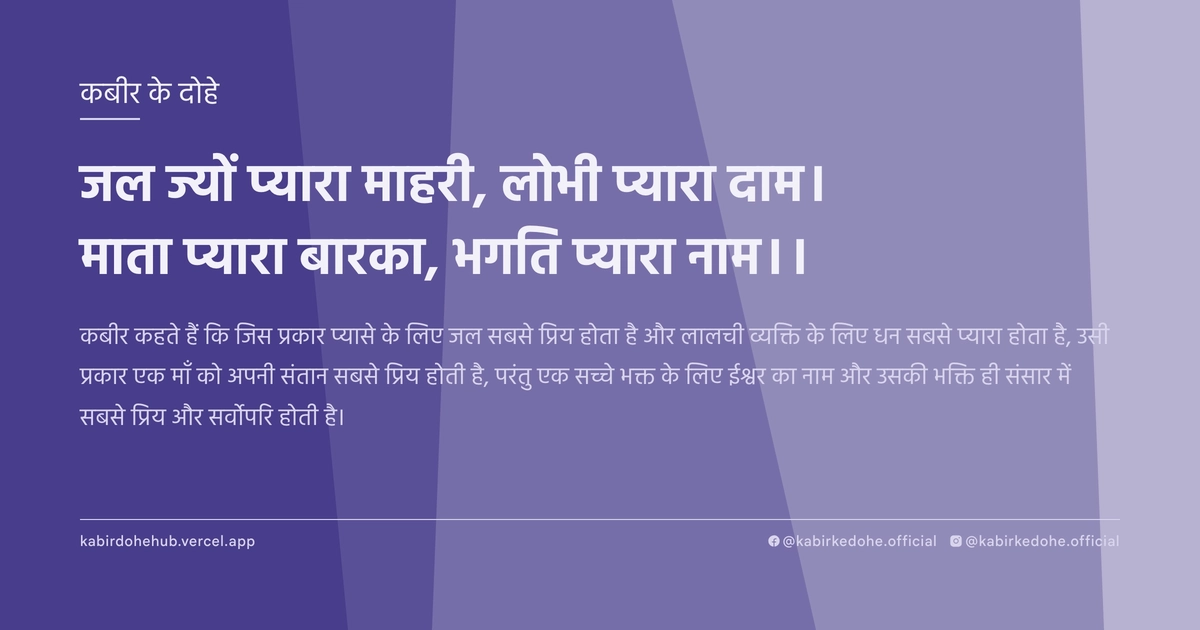
जल ज्यों प्यारा माहरी, लोभी प्यारा दाम।
माता प्यारा बारका, भगति प्यारा नाम।।
Jal jyon pyaara maahari, lobhi pyaara daam. Mata pyaara baarka, bhagati pyaara naam.
इस पृष्ठ पर इस कबीर दोहे का अर्थ (meaning), हिंदी व्याख्या और अंग्रेज़ी अनुवाद, दार्शनिक विश्लेषण और व्यावहारिक जीवन सीख दी गई है। यह दोहा भक्ति (Bhakti) विषय से जुड़ा है — Kabir doha meaning and explanation in Hindi and English.
अर्थ (Meaning):
कबीर कहते हैं कि जिस प्रकार प्यासे के लिए जल सबसे प्रिय होता है और लालची व्यक्ति के लिए धन सबसे प्यारा होता है, उसी प्रकार एक माँ को अपनी संतान सबसे प्रिय होती है, परंतु एक सच्चे भक्त के लिए ईश्वर का नाम और उसकी भक्ति ही संसार में सबसे प्रिय और सर्वोपरि होती है।
Kabir explains that just as water is the most precious thing to a thirsty person and wealth is the ultimate desire for a greedy man, and just as a mother holds an incomparable love for her child, for a true seeker, the Divine Name and the path of devotion are the most beloved and supreme treasures in existence.
व्याख्या (Interpretation):
यह दोहा मानवीय प्रवृत्तियों और आध्यात्मिक सर्वोच्चता के बीच के अंतर को स्पष्ट करता है। प्रारंभ में, कबीर भौतिक और भावनात्मक आसक्तियों—जैसे प्यास, लोभ और ममता—का उल्लेख करते हैं, जो स्वाभाविक मानवीय गुण हैं। फिर वे इन सांसारिक प्रेमों की तुलना 'नाम' (ईश्वर के निराकार स्वरूप) के प्रति प्रेम से करते हैं। यहाँ 'नाम' केवल एक शब्द नहीं है, बल्कि वह चेतना है जो आत्मा को परमात्मा से जोड़ती है। यह निर्गुण भक्ति का सार है, जहाँ बाहरी आडंबरों के बजाय आंतरिक समर्पण को महत्व दिया गया है। यह दर्शाता है कि जब आत्मा अपनी वास्तविक प्रकृति को पहचान लेती है, तो सांसारिक मोह फीके पड़ जाते हैं और केवल ब्रह्म के प्रति प्रेम शेष रहता है। यह द्वैत से अद्वैत की ओर संक्रमण है।
This couplet elucidates the distinction between transient human inclinations and supreme spiritual longing. Kabir begins by citing physical and emotional attachments—thirst, greed, and maternal love—which are inherent human traits. He then contrasts these worldly loves with the love for the 'Naam' (the Formless Divine). Here, 'Naam' is not merely a linguistic label but the primordial vibration and consciousness that connects the Atman to Brahman. This is the essence of Nirgun Bhakti, where internal surrender outweighs external ritualism. It suggests that once the soul recognizes its true nature, worldly attachments pale in comparison to the intoxication of Divine love. It represents the transition from duality (the feeling of separation) to non-duality (Advaita), where the seeker realizes that the beloved is not outside, but within.
दार्शनिक विश्लेषण (Philosophical Analysis):
कबीर का यह दोहा उस युग की उपज है जब समाज कर्मकांडों और बाहरी दिखावे में उलझा हुआ था। कबीर ने स्पष्ट रूप से बताया कि ईश्वर किसी मंदिर या मस्जिद में नहीं, बल्कि हृदय की शुद्धता और 'नाम' के सुमिरन में है। यह विचार सूफीवाद के 'इश्क-ए-हकीकी' (ईश्वरीय प्रेम) और अद्वैत वेदांत के 'अहम ब्रह्मास्मि' के करीब है।
यहाँ 'लोभी' और 'दाम' का उल्लेख मानव मन की उस प्रवृत्ति को दर्शाता है जो बाहरी वस्तुओं में सुख खोजती है। कबीर तर्क देते हैं कि भौतिक सुख क्षणभंगुर हैं। धन की प्यास कभी नहीं मिटती, लेकिन नाम की प्यास आत्मा को तृप्त करती है। यह मनोवैज्ञानिक रूपांतरण की प्रक्रिया है जहाँ व्यक्ति अपनी पहचान को 'अहंकार' (Ego) से हटाकर 'परमात्मा' में विलीन करता है।
कबीर जाति और धर्म की सीमाओं को तोड़ते हुए यह संदेश देते हैं कि भक्ति का मार्ग सबके लिए खुला है। उनके लिए 'नाम' वह सेतु है जो मनुष्य को माया के जाल से मुक्त करता है। माया वह भ्रम है जो हमें विश्वास दिलाता है कि हम शरीर हैं, जबकि हम वास्तव में शुद्ध चेतना हैं।
सूफी संतों की तरह, कबीर भी प्रेम को ही ज्ञान का सर्वोच्च शिखर मानते हैं। उनके अनुसार, बिना प्रेम के ज्ञान केवल बौद्धिक अहंकार है। जब भक्त 'नाम' को सबसे प्यारा मानने लगता है, तो वह वास्तव में अपनी व्यक्तिगत इच्छाओं का त्याग कर रहा होता है।
अंततः, यह दोहा हमें सिखाता है कि प्राथमिकताएं ही हमारे अस्तित्व को निर्धारित करती हैं। यदि हमारी प्राथमिकता धन या मोह है, तो हम बंधन में हैं; यदि हमारी प्राथमिकता आत्म-साक्षात्कार और भक्ति है, तो हम मुक्त हैं। यह मुक्ति किसी मृत्यु के बाद मिलने वाला पुरस्कार नहीं, बल्कि इसी जीवन में जीवित रहते हुए प्राप्त की जाने वाली अवस्था है।
This couplet emerged from an era dominated by rigid ritualism and external displays of piety. Kabir asserts that the Divine resides not in temples or mosques, but in the purity of the heart and the remembrance of the 'Naam'. This philosophy aligns closely with the Sufi concept of 'Ishq-e-Haqiqi' (Divine Love) and the Advaita Vedanta principle of 'Aham Brahmasmi' (I am Brahman).
The mention of the 'greedy' and 'wealth' highlights the human tendency to seek fulfillment in external objects. Kabir argues that material desires are insatiable; the thirst for wealth never ends, whereas the thirst for the Divine Name satiates the soul. This is a process of psychological transformation where the individual shifts their identity from the 'Ego' to the 'Universal Consciousness'.
By transcending caste and creed, Kabir proclaims that the path of devotion is open to all. For him, 'Naam' is the bridge that liberates the soul from the web of Maya (illusion). Maya is the cosmic deception that convinces us we are merely physical bodies, whereas we are, in truth, pure consciousness.
Similar to Sufi mystics, Kabir views love as the pinnacle of knowledge. He suggests that knowledge without love is merely intellectual arrogance. When a devotee deems the 'Naam' as the most beloved, they are effectively annihilating their personal desires and ego.
Ultimately, this verse teaches that our priorities define our existence. If our priority is wealth or attachment, we remain in bondage; if it is self-realization and devotion, we attain liberation. This liberation is not a post-mortem reward but a state of being achieved while alive, through the dissolution of the separate self into the Whole.
मूल संदेश (Core Message):
- भौतिक इच्छाएं कभी समाप्त नहीं होतीं, वे केवल बढ़ती हैं।
- सच्ची तृप्ति केवल आंतरिक चेतना के जागरण से संभव है।
- प्रेम जब व्यक्तिगत से सार्वभौमिक होता है, तब वह भक्ति बन जाता है।
- नाम का सुमिरन अहंकार को मिटाने का सबसे सरल मार्ग है।
- आत्मा का वास्तविक स्वभाव आनंद है, न कि अभाव।
- सांसारिक मोह एक भ्रम है; केवल परमात्मा का प्रेम शाश्वत है।
- Material desires never end; they only multiply.
- True fulfillment is possible only through the awakening of inner consciousness.
- When love shifts from the personal to the universal, it becomes Devotion.
- Remembrance of the Name is the simplest path to annihilate the ego.
- The true nature of the soul is bliss, not lack.
- Worldly attachment is an illusion; only Divine love is eternal.
व्यावहारिक उदाहरण (Practical Example):
वाराणसी के घाटों पर रहने वाले एक वृद्ध विधवा, जानकी, का जीवन अत्यंत कठिन था। वह दूसरों के घरों में छोटे-मोटे काम करके अपना गुजारा करती थी। उसके पास न तो धन था और न ही कोई अपना, फिर भी उसके चेहरे पर एक असीम शांति रहती थी।
उसी मोहल्ले में एक धनी व्यापारी रहता था, जो दिन-रात धन संचय करने में लगा रहता था। वह जितना अधिक कमाता, उसकी चिंताएं उतनी ही बढ़ती जातीं। वह जानकी को देखकर अक्सर सोचता कि इस गरीबी में भी यह महिला इतनी खुश कैसे है?
एक दिन व्यापारी ने जानकी से पूछा, "तुम्हारे पास न घर है, न गहने, फिर भी तुम इतनी संतुष्ट कैसे हो? क्या तुम्हें धन का लोभ नहीं?"
जानकी ने मुस्कुराते हुए उत्तर दिया, "बेटा, जैसे प्यासे को पानी प्यारा होता है, वैसे ही मुझे मेरे राम का नाम प्यारा है। धन तो हाथ की मैल है, आता है और चला जाता है, लेकिन यह आंतरिक शांति कभी नहीं छूटती।"
व्यापारी को पहले तो यह बात समझ नहीं आई, लेकिन उसने देखा कि जानकी जब भी काम करती, वह मन ही मन ईश्वर का स्मरण करती रहती थी। उसके लिए काम ही पूजा थी और नाम ही उसका एकमात्र सहारा था।
धीरे-धीरे व्यापारी ने महसूस किया कि उसकी सारी दौलत उसे वह नींद नहीं दे पा रही थी जो जानकी को एक फटी चटाई पर भी आती थी। उसने महसूस किया कि वह 'दाम' (धन) के पीछे भाग रहा था, जबकि जानकी 'नाम' के आनंद में डूबी थी।
व्यापारी ने अपनी जीवनशैली बदली। उसने दान करना शुरू किया और प्रतिदिन कुछ समय मौन रहकर आत्म-चिंतन करने लगा। उसने पाया कि जब वह अपनी संपत्ति का मोह छोड़कर दूसरों की सेवा करने लगा, तो उसे वह खुशी मिली जो करोड़ों रुपयों से नहीं खरीदी जा सकती थी।
यह 'कबीर ट्विस्ट' था—जब व्यापारी ने समझा कि बाहरी संचय केवल एक भ्रम है और आंतरिक संबंध ही वास्तविक संपत्ति है। उसने जानकी को अपनी गुरु मान लिया और भौतिकता के शोर से निकलकर भक्ति की शांति में कदम रखा।
अब वह व्यापारी केवल धन का संग्रह नहीं करता था, बल्कि वह अपने जीवन को 'नाम' की भक्ति से सींचने लगा। उसकी चिंताएं समाप्त हो गईं और उसके जीवन में वह प्रेम आया जो पहले केवल कागजों और सिक्कों में सिमटा हुआ था।
जानकी की सरल भक्ति ने एक अहंकारी मन को विनम्र बना दिया, यह सिद्ध करते हुए कि भक्ति की शक्ति किसी भी भौतिक वैभव से कहीं अधिक श्रेष्ठ और स्थायी होती है।
In the ghats of Varanasi lived an elderly widow named Janaki. Her life was fraught with hardship; she survived by doing odd jobs in various households. She possessed neither wealth nor kin, yet an infinite peace radiated from her countenance.
In the same neighborhood lived a wealthy merchant, consumed by the relentless pursuit of accumulating riches. The more he earned, the deeper his anxieties grew. He often wondered how Janaki could remain so serene despite her crushing poverty.
One day, the merchant asked her, "You have no home, no jewelry, yet you are so content. Do you not crave wealth?"
Janaki smiled and replied, "Son, just as a thirsty person loves water, I love the Name of my Ram. Wealth is but the dust on one's hands—it comes and goes—but this inner peace never leaves me."
The merchant initially dismissed this as the excuse of the poor. However, he noticed that while Janaki worked, she was in a constant state of internal remembrance. For her, work was worship, and the 'Naam' was her only true sanctuary.
Gradually, the merchant realized that all his gold could not buy the sleep that Janaki enjoyed on a tattered mat. He saw that he was chasing 'Daam' (wealth), while Janaki was immersed in 'Naam' (the Divine).
Driven by this realization, the merchant altered his lifestyle. He began practicing charity and spending time in silent contemplation. He discovered that when he let go of the obsession with accumulation and served others, he found a joy that millions of rupees could not purchase.
This was the 'Kabir Twist'—the moment he understood that external accumulation is a mirage and internal connection is the only real asset. He accepted Janaki as his spiritual guide, stepping out of the noise of materialism into the silence of devotion.
No longer did he collect wealth for the sake of ego; instead, he began to nourish his life with the devotion of the Name. His anxieties vanished, and a love entered his life that was previously confined to ledgers and coins.
Janaki's simple devotion humbled an arrogant mind, proving that the power of Bhakti is far superior and more enduring than any material opulence.
अभ्यास मार्गदर्शन (Practice Guidance):
- दैनिक अभ्यास: प्रतिदिन 20 मिनट मौन बैठें और अपने भीतर उठने वाले 'लोभ' या 'आसक्ति' के विचारों को केवल देखें, बिना किसी निर्णय के।
- आत्म-पूछताछ जर्नल: लिखें कि ऐसी कौन सी भौतिक वस्तुएं हैं जिनके बिना आप अधूरा महसूस करते हैं, और फिर विश्लेषण करें कि क्या वह कमी वास्तव में भौतिक है या भावनात्मक।
- व्यवहार परिवर्तन: सप्ताह में एक बार अपनी सबसे प्रिय वस्तु का त्याग करें या किसी जरूरतमंद को दान करें, ताकि आसक्ति के बंधन ढीले हों।
- डायग्नोस्टिक चेकलिस्ट: क्या मैं तनाव में हूँ? (यदि हाँ, तो देखें कि क्या यह किसी भौतिक हानि का डर है)। क्या मैं दूसरों की सफलता से ईर्ष्या करता हूँ? (यदि हाँ, तो यह 'लोभ' का संकेत है)। क्या मैं शांति के लिए बाहरी साधनों पर निर्भर हूँ? (यदि हाँ, तो 'नाम' के आंतरिक सुमिरन की आवश्यकता है)।
- Daily Practice: Sit in silence for 20 minutes daily and observe the thoughts of 'greed' or 'attachment' as they arise, without judgment.
- Self-Inquiry Journal: List the material objects you feel incomplete without, then analyze whether the void is truly material or emotional.
- Behavioral Shift: Once a week, give away a prized possession or donate to someone in need to loosen the grip of attachment.
- Diagnostic Checklist: Am I stressed? (If yes, check if it's fear of material loss). Do I feel envy at others' success? (If yes, this is a sign of 'Lobh'). Do I rely on external means for peace? (If yes, there is a need for internal 'Naam' remembrance).
चिंतन प्रश्न (Reflection Questions):
- यदि आज आपकी सारी भौतिक संपत्ति छीन ली जाए, तो आपके व्यक्तित्व का क्या बचेगा?
- आप जिसे 'प्रेम' कहते हैं, क्या वह वास्तव में दूसरे के प्रति है या अपनी इच्छाओं की पूर्ति का एक साधन है?
- आपकी डिजिटल पहचान (सोशल मीडिया) आपके वास्तविक आंतरिक स्वरूप को कितना छिपाती है?
- क्या आप वास्तव में ईश्वर को चाहते हैं, या केवल उस शांति को जो ईश्वर के नाम से जुड़ी है?
- वह कौन सा 'लोभ' है जिसे आप अपनी 'जरूरत' कहकर उचित ठहराते हैं?
- क्या आप अपनी संतान या प्रियजनों के प्रति प्रेम में उन्हें स्वतंत्र करते हैं या उन्हें अपनी संपत्ति मानते हैं?
- If all your material possessions were stripped away today, what would remain of your identity?
- Is what you call 'love' truly for the other, or is it a means to satisfy your own emotional needs?
- To what extent does your digital persona hide your actual internal state?
- Do you truly desire the Divine, or only the peace that is associated with the Divine Name?
- What is the specific 'greed' that you justify by labeling it as a 'necessity'?
- In your love for children or partners, do you grant them freedom, or do you treat them as your possessions?