
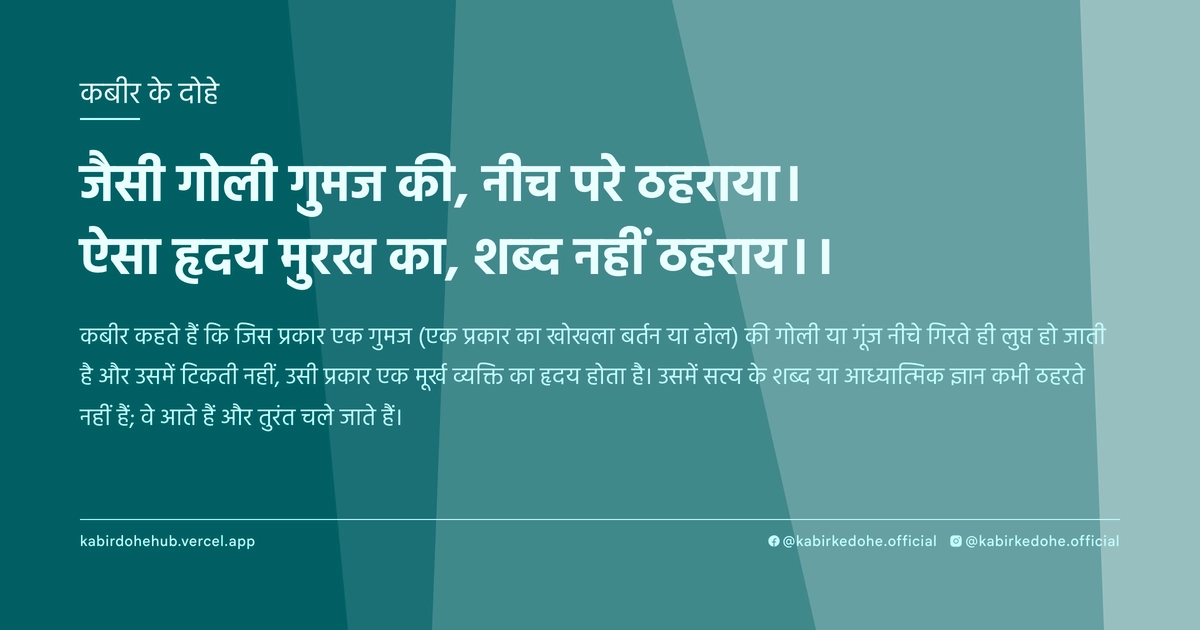
जैसी गोली गुमज की, नीच परे ठहराया।
ऐसा हृदय मुरख का, शब्द नहीं ठहराय।।
Jaisi goli gumaj ki, neech pare thahraya. Aisa hriday murakh ka, shabd nahin thahraye.
इस पृष्ठ पर इस कबीर दोहे का अर्थ (meaning), हिंदी व्याख्या और अंग्रेज़ी अनुवाद, दार्शनिक विश्लेषण और व्यावहारिक जीवन सीख दी गई है। यह दोहा अहंकार (The Ego) विषय से जुड़ा है — Kabir doha meaning and explanation in Hindi and English.
अर्थ (Meaning):
कबीर कहते हैं कि जिस प्रकार एक गुमज (एक प्रकार का खोखला बर्तन या ढोल) की गोली या गूंज नीचे गिरते ही लुप्त हो जाती है और उसमें टिकती नहीं, उसी प्रकार एक मूर्ख व्यक्ति का हृदय होता है। उसमें सत्य के शब्द या आध्यात्मिक ज्ञान कभी ठहरते नहीं हैं; वे आते हैं और तुरंत चले जाते हैं।
Kabir observes that just as the sound or the bead of a hollow percussion instrument (gumaj) falls away and fails to linger, so is the heart of a fool. In such a mind, the sacred word or spiritual wisdom never takes root; it enters and vanishes instantly without leaving a lasting impression.
व्याख्या (Interpretation):
यहाँ 'गुमज' एक रूपक है उस मानसिक अवस्था का जो केवल बाहरी शोर से भरी है लेकिन भीतर से रिक्त है। शाब्दिक अर्थ में, यह एक ऐसे बर्तन की बात है जिसमें कुछ ठहर नहीं सकता। आध्यात्मिक स्तर पर, यह 'अहंकार' और 'माया' के प्रभाव को दर्शाता है। जब हृदय वासनाओं और बाहरी दिखावे से भरा होता है, तो वह 'शून्य' नहीं होता, बल्कि 'अशुद्ध' होता है। निर्गुण भक्ति में, 'शब्द' केवल अक्षर नहीं बल्कि वह ईश्वरीय कंपन है जो आत्मा को जगाता है। यदि हृदय में स्थिरता (धैर्य) और विनम्रता नहीं है, तो ब्रह्म का ज्ञान वहां टिक नहीं सकता। यह अद्वैत वेदांत के उस सिद्धांत की ओर इशारा करता है जहाँ अज्ञानता (Avidya) के कारण हम सत्य को देखते तो हैं, पर उसे आत्मसात नहीं कर पाते।
Here, the 'gumaj' serves as a metaphor for a mental state that is filled with external noise yet remains internally void. Literally, it describes a vessel incapable of retaining its contents. Spiritually, this represents the influence of 'Maya' (illusion) and the ego. When the heart is cluttered with desires and superficiality, it is not truly 'empty' (in the Zen sense) but 'polluted.' In Nirgun Bhakti, the 'Shabd' (Word) is not merely a linguistic unit but the primordial cosmic vibration that awakens the soul. If the heart lacks stability and humility, the knowledge of Brahman cannot reside there. This aligns with the Advaita Vedanta concept of 'Avidya' (ignorance), where the seeker perceives the truth but fails to assimilate it because the vessel of the self is cracked by ego.
दार्शनिक विश्लेषण (Philosophical Analysis):
कबीर का यह दोहा उस समय के धार्मिक पाखंड और रटंत विद्या पर प्रहार है। उनके युग में, लोग वेदों और पुराणों के श्लोकों को रटते थे, लेकिन उनके जीवन में कोई परिवर्तन नहीं आता था। कबीर इसे 'मूर्खता' कहते हैं क्योंकि ज्ञान का उद्देश्य सूचना का संग्रह नहीं, बल्कि रूपांतरण है।
यह विश्लेषण सूफी मत के 'इश्क' और 'फना' के करीब है। सूफीवाद में माना जाता है कि जब तक 'मैं' (अहंकार) मौजूद है, तब तक 'वह' (परमात्मा) नहीं आ सकता। जिस प्रकार गुमज की गोली गिर जाती है, वैसे ही अहंकार से भरा मन सत्य को अस्वीकार कर देता है क्योंकि सत्य अहंकार को मिटाने की मांग करता है।
अद्वैत वेदांत के अनुसार, आत्मा और ब्रह्म एक हैं। लेकिन इस एकता का अनुभव करने के लिए चित्त की शुद्धि आवश्यक है। कबीर यहाँ चेतावनी दे रहे हैं कि केवल सुनने से मोक्ष नहीं मिलता। यदि श्रोता का हृदय कठोर है, तो सबसे महान उपदेश भी व्यर्थ हैं।
सामाजिक रूप से, कबीर जाति और कर्मकांड के आधार पर श्रेष्ठता के दावे को खारिज करते हैं। उनके लिए 'मूर्ख' वह नहीं है जिसके पास डिग्री नहीं है, बल्कि वह है जिसका हृदय सत्य को धारण करने में असमर्थ है। यह बौद्धिक अहंकार के विरुद्ध एक आध्यात्मिक विद्रोह है।
अंततः, यह दोहा मनोवैज्ञानिक रूपांतरण की बात करता है। यह बताता है कि ज्ञान के लिए 'पात्रता' (Receptivity) अनिवार्य है। जब तक हम अपने पुराने विश्वासों और पूर्वाग्रहों को नहीं छोड़ते, नया और शाश्वत सत्य हमारे भीतर नहीं ठहर सकता।
Kabir’s couplet is a scathing critique of the rote learning and religious hypocrisy prevalent in his era. During his time, scholars memorized scriptures without any corresponding internal transformation. Kabir defines this as 'foolishness' because the purpose of spiritual knowledge is not the accumulation of information, but the transmutation of the self.
This analysis resonates with the Sufi concepts of 'Ishq' (divine love) and 'Fana' (annihilation of the self). Sufism posits that as long as the 'I' (ego) exists, the 'He' (Divine) cannot enter. Just as the bead of the gumaj falls away, a mind saturated with ego rejects the Truth because Truth demands the dissolution of the ego.
According to Advaita Vedanta, the Atman and Brahman are one. However, experiencing this non-duality requires the purification of the 'Chitta' (consciousness). Kabir warns that mere listening does not lead to liberation. If the heart is hardened by pride, even the most profound discourse remains futile.
Socially, Kabir rejects claims of superiority based on caste or ritualistic purity. For him, the 'fool' is not the uneducated person, but the one whose heart is incapable of holding the Truth. This is a spiritual rebellion against intellectual arrogance.
Ultimately, the doha addresses psychological transformation. It emphasizes that 'receptivity' is a prerequisite for enlightenment. Until we relinquish our preconceived notions and biases, the eternal Truth cannot find a dwelling place within us.
मूल संदेश (Core Message):
- सूचना ज्ञान नहीं है; रूपांतरण ही वास्तविक ज्ञान है।
- अहंकार वह छेद है जिससे सत्य बाहर निकल जाता है।
- विनम्रता वह पात्र है जिसमें ईश्वरीय शब्द ठहरते हैं।
- बाहरी अनुष्ठान व्यर्थ हैं यदि हृदय कठोर बना रहे।
- सत्य को सुनने के लिए कान नहीं, एक रिक्त और शुद्ध हृदय चाहिए।
- Information is not wisdom; transformation is the only true knowledge.
- Ego is the leak through which spiritual truth escapes.
- Humility is the only vessel capable of holding the Divine Word.
- External rituals are futile if the heart remains hardened.
- To truly hear the Truth, one needs not ears, but a void and pure heart.
व्यावहारिक उदाहरण (Practical Example):
एक समय की बात है, बनारस के घाटों पर एक वृद्ध विधवा रहती थी, जिसका नाम जानकी था। जानकी का पूरा दिन मंदिर जाने, माला जपने और पंडितों की बातें सुनने में बीतता था। वह शहर की सबसे 'धार्मिक' महिला मानी जाती थी, लेकिन उसका स्वभाव अत्यंत कठोर था। वह अपने आस-पास के गरीब लोगों को तुच्छ समझती थी और छोटी-छोटी बातों पर क्रोध करती थी।
एक दिन, एक फकीर घाट पर आया और उसने जानकी को एक सरल सत्य बताया: 'माँ, जिस हृदय में करुणा नहीं, वहाँ ईश्वर का वास नहीं होता।' जानकी ने इसे सुना, सिर हिलाया और अगले ही पल वह फिर से किसी अन्य महिला की बुराई करने लगी।
फकीर ने देखा कि जानकी के कान तो खुले थे, लेकिन उसका हृदय एक बंद पत्थर की तरह था। वह शब्दों को सुनती तो थी, पर उन्हें महसूस नहीं करती थी। वह ठीक उसी 'गुमज' की तरह थी, जहाँ ज्ञान की गूंज आती तो थी, पर ठहरती नहीं थी।
कुछ समय बाद, जानकी के घर में एक छोटा बच्चा आया जो बहुत बीमार था। वह बच्चा किसी का नहीं था, एक अनाथ था जिसे उसने दयावश रखा था। जब बच्चा तड़पा, तो जानकी की सारी रटी-रटाई प्रार्थनाएं और पंडितों के श्लोक उसे बेकार लगने लगे।
उस क्षण, उसकी आंतरिक दीवार टूटी। उसने पहली बार महसूस किया कि वह अब तक केवल 'शब्दों' का व्यापार कर रही थी, 'अनुभव' का नहीं। उसने उस बच्चे की सेवा में अपना अहंकार भुला दिया।
जब उसने बच्चे के माथे पर हाथ रखा, तो उसे महसूस हुआ कि वह करुणा ही असली 'शब्द' है जिसे वह अब तक खोज रही थी। उसकी कठोरता पिघल गई।
अब जब वह मंदिर जाती, तो वह केवल सुनने के लिए नहीं, बल्कि उस करुणा को जीने के लिए जाती। उसने दूसरों की आलोचना करना छोड़ दिया और सेवा को ही अपना धर्म बना लिया।
यह जानकी का 'कबीर ट्विस्ट' था—जहाँ एक बाहरी दुख ने उसके हृदय के उस छेद को भर दिया जहाँ से ज्ञान फिसल कर गिर जाता था। अब उसका हृदय एक स्थिर सरोवर बन गया था, जिसमें सत्य ठहरने लगा था।
Once, on the ghats of Varanasi, lived an elderly widow named Janaki. Her entire day was spent visiting temples, chanting beads, and listening to the discourses of learned priests. She was regarded as the most 'religious' woman in the city, yet her nature was incredibly harsh. She looked down upon the poor and succumbed to anger over the smallest trifles.
One day, a wandering Sufi arrived at the ghat and told her a simple truth: 'Mother, in a heart devoid of compassion, God cannot reside.' Janaki heard the words, nodded politely, and in the very next moment, returned to criticizing another woman.
The Sufi observed that while Janaki's ears were open, her heart was like a sealed stone. She heard the words, but did not feel them. She was exactly like the 'gumaj'—the echo of wisdom entered her, but it never lingered.
Some time later, an orphaned child, frail and severely ill, came into Janaki's care. She had taken him in out of a fleeting sense of duty. As the child suffered, all the rote prayers and Sanskrit shlokas she had memorized felt utterly useless.
In that moment of raw helplessness, her internal wall crumbled. She realized for the first time that she had been trading in 'words' rather than 'experience.' In serving the dying child, she forgot her own perceived superiority.
As she placed her hand on the child's forehead, she felt that this raw compassion was the actual 'Word' she had been searching for all along. Her hardness melted away.
Now, when she visited the temple, she didn't go to collect more information, but to live that compassion. She stopped judging others and made service her primary religion.
This was Janaki's 'Kabir Twist'—where an external tragedy filled the void in her heart through which wisdom had always slipped away. Her heart finally became a still lake where Truth could settle and remain.
अभ्यास मार्गदर्शन (Practice Guidance):
- प्रतिदिन 15 मिनट 'मौन अवलोकन' का अभ्यास करें। केवल सुनें, प्रतिक्रिया न करें।
- स्व-पूछताछ जर्नल: लिखें कि आज किस सत्य को मैंने सुना लेकिन अपने अहंकार के कारण उसे लागू नहीं किया।
- व्यवहार परिवर्तन: दिन में एक बार किसी ऐसे व्यक्ति की मदद करें जिसे आप नापसंद करते हैं, ताकि हृदय की कठोरता कम हो।
- डायग्नोस्टिक चेकलिस्ट: क्या मैं केवल ज्ञान का संग्रह कर रहा हूँ या मेरा व्यवहार बदल रहा है? क्या मैं दूसरों को सुधारने की कोशिश करता हूँ या स्वयं को?
- Practice 15 minutes of 'Silent Observation' daily. Listen deeply without formulating a reaction.
- Self-Inquiry Journaling: Record one instance today where you heard a truth but failed to implement it due to ego.
- Behavioral Shift: Perform one act of kindness for someone you dislike to dissolve the hardness of the heart.
- Diagnostic Checklist: Am I merely collecting spiritual information or is my behavior evolving? Do I spend more time correcting others or refining myself?
चिंतन प्रश्न (Reflection Questions):
- क्या मेरी धार्मिक पहचान केवल एक सामाजिक मुखौटा है, या यह मेरे आंतरिक स्वभाव को बदल रही है?
- मैं कितनी बार दूसरों को 'मूर्ख' कहता हूँ, जबकि मैं स्वयं सत्य को आत्मसात करने में असमर्थ हूँ?
- मेरे जीवन का वह कौन सा 'शब्द' या सत्य है जिसे मैंने सुना तो है, पर कभी जिया नहीं?
- क्या मेरा डिजिटल व्यक्तित्व (सोशल मीडिया) मेरी आध्यात्मिक गहराई को बढ़ा रहा है या उसे केवल एक प्रदर्शन बना रहा है?
- यदि आज मेरा सारा ज्ञान छीन लिया जाए, तो मेरे भीतर कितनी करुणा शेष रहेगी?
- Is my religious identity merely a social mask, or is it actually transforming my inner nature?
- How often do I label others as 'fools' while I myself remain unable to assimilate the Truth?
- What is the one 'Word' or truth I have heard many times but have never actually lived?
- Is my digital persona enhancing my spiritual depth or merely turning it into a performance?
- If all my intellectual knowledge were stripped away today, how much genuine compassion would remain within me?