
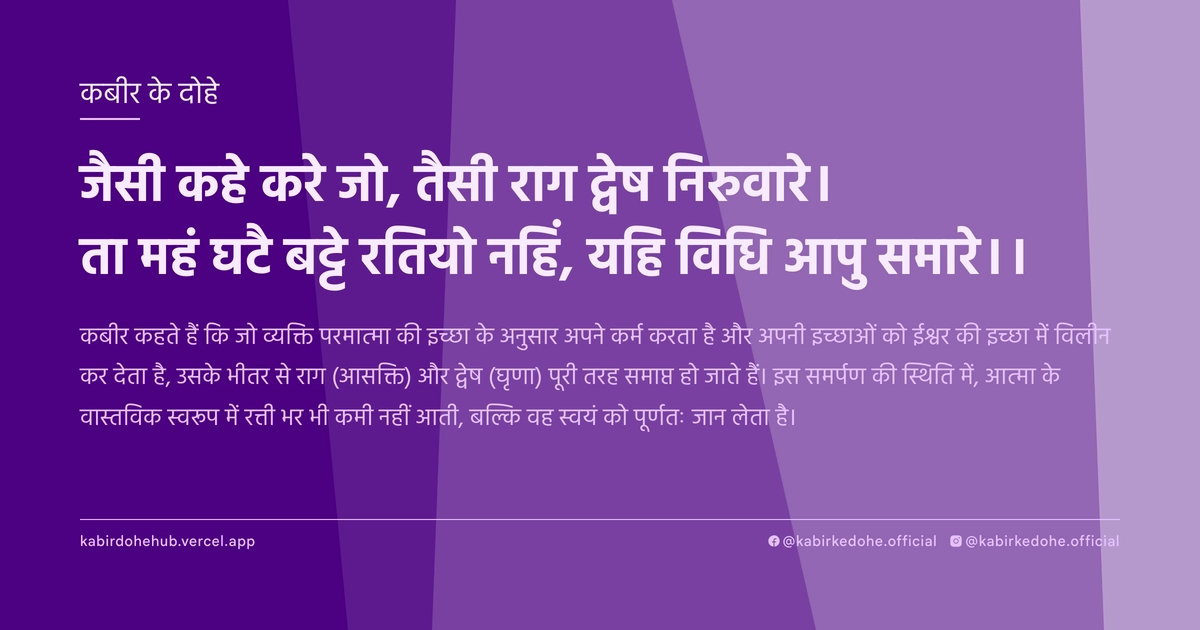
जैसी कहे करे जो, तैसी राग द्वेष निरुवारे।
ता महं घटै बट्टे रतियो नहिं, यहि विधि आपु समारे।।
Jaisi kahe kare jo, taisi raag dvesh niruvare. Ta mahan ghatai batte ratiyo nahin, yahi vidhi aapu samare.
इस पृष्ठ पर इस कबीर दोहे का अर्थ (meaning), हिंदी व्याख्या और अंग्रेज़ी अनुवाद, दार्शनिक विश्लेषण और व्यावहारिक जीवन सीख दी गई है। यह दोहा संयम (Self-discipline) विषय से जुड़ा है — Kabir doha meaning and explanation in Hindi and English.
अर्थ (Meaning):
कबीर कहते हैं कि जो व्यक्ति परमात्मा की इच्छा के अनुसार अपने कर्म करता है और अपनी इच्छाओं को ईश्वर की इच्छा में विलीन कर देता है, उसके भीतर से राग (आसक्ति) और द्वेष (घृणा) पूरी तरह समाप्त हो जाते हैं। इस समर्पण की स्थिति में, आत्मा के वास्तविक स्वरूप में रत्ती भर भी कमी नहीं आती, बल्कि वह स्वयं को पूर्णतः जान लेता है।
Kabir asserts that one who aligns their actions and speech with the Divine Will, surrendering personal desire to the cosmic flow, eradicates all attachments (raag) and aversions (dwesh). In this state of total surrender, not a shred of the soul's essence is diminished; rather, through this path, the individual realizes their true, eternal Self.
व्याख्या (Interpretation):
इस दोहे का शाब्दिक अर्थ है कि ईश्वर की आज्ञा का पालन करने से मानसिक द्वंद्व समाप्त होते हैं। रूपकात्मक स्तर पर, यह 'अहं' के विसर्जन की प्रक्रिया है। जब साधक 'मैं' को हटाकर 'वह' (परमात्मा) को स्थापित करता है, तो वह निर्गुण भक्ति की उस अवस्था में पहुँचता है जहाँ द्वैत समाप्त हो जाता है। माया हमें यह विश्वास दिलाती है कि हमारी व्यक्तिगत इच्छाएँ ही सत्य हैं, लेकिन वास्तव में वे बंधन हैं। जब राग और द्वेष मिटते हैं, तो आत्मा और ब्रह्म की एकता (अद्वैत) का अनुभव होता है। यह विरोधाभास है कि स्वयं को मिटाकर ही व्यक्ति वास्तव में स्वयं को प्राप्त करता है। यहाँ 'रति' का अर्थ है कि समर्पण से कुछ खोता नहीं, बल्कि सब कुछ प्राप्त होता है।
Literally, the verse suggests that following Divine command eliminates mental conflict. Metaphorically, it describes the process of ego-annihilation. When the seeker replaces 'I' with 'Thou' (the Divine), they enter the realm of Nirgun Bhakti where duality vanishes. Maya tricks the consciousness into believing personal desires are the ultimate truth, yet they are merely shackles. Once attachment (raag) and hatred (dwesh) are dissolved, the non-duality of Atman and Brahman is realized. It is the central paradox: only by erasing the false self does one discover the True Self. The mention of 'rati' (a tiny particle) emphasizes that in surrender, nothing of spiritual essence is lost; instead, the totality of existence is gained.
दार्शनिक विश्लेषण (Philosophical Analysis):
कबीर का यह दर्शन 15वीं शताब्दी के सामाजिक और धार्मिक परिवेश में उपजा था, जहाँ कर्मकांड और बाहरी आडंबर चरम पर थे। वे मंदिर-मस्जिद के भेदों को नकारते हुए अंतःकरण की शुद्धि पर बल देते हैं। यह दोहा अद्वैत वेदांत के उस सिद्धांत से मेल खाता है जहाँ जीव और ब्रह्म को एक माना गया है। कबीर यहाँ 'इच्छा' के त्याग की बात कर रहे हैं, जो सूफी मत के 'फना' (अहं का विनाश) के समान है।
सांसारिक मनुष्य राग और द्वेष के बीच झूलता रहता है, जो उसे मानसिक अशांति की ओर ले जाता है। कबीर का तर्क है कि जब तक 'कर्ता' का भाव जीवित है, तब तक दुख बना रहेगा। जैसे ही व्यक्ति यह स्वीकार करता है कि वह केवल एक माध्यम है और चलाने वाला परमात्मा है, वह मनोवैज्ञानिक बोझ से मुक्त हो जाता है।
यह दृष्टिकोण जाति और वर्ण व्यवस्था के विरुद्ध एक सशक्त प्रहार है, क्योंकि यदि सब कुछ ईश्वरीय इच्छा है, तो कोई भी व्यक्ति जन्म के आधार पर श्रेष्ठ या निम्न नहीं हो सकता। यह समानता का आध्यात्मिक आधार है।
अक्सर लोग इस समर्पण को निष्क्रियता या भाग्यवादिता समझ लेते हैं, परंतु कबीर की दृष्टि में यह 'सक्रिय समर्पण' है। यह कर्म को छोड़ने की बात नहीं, बल्कि कर्म के फल की आसक्ति को छोड़ने की बात है।
अंततः, यह विश्लेषण हमें बताता है कि मोक्ष किसी बाहरी तीर्थ में नहीं, बल्कि राग-द्वेष से मुक्त उस चित्त में है जो परमात्मा की लय में नृत्य कर रहा है। यह अहंकार के पूर्ण विलोपन की यात्रा है।
Kabir's philosophy emerged from the 15th-century socio-religious landscape, a time dominated by rigid rituals and outward displays of piety. He rejected the dichotomy of temple and mosque, emphasizing the purification of the inner heart. This verse aligns with Advaita Vedanta, which posits the fundamental unity of the individual soul (Jiva) and the Universal Consciousness (Brahman).
Kabir addresses the eradication of 'will,' mirroring the Sufi concept of 'Fana' (the annihilation of the self in God). The worldly human oscillates between attraction (raag) and repulsion (dwesh), leading to perpetual mental turmoil. Kabir argues that as long as the sense of 'doership' (the ego) persists, suffering remains inevitable.
By accepting oneself as a mere instrument of the Divine Will, the seeker is liberated from the psychological burden of expectation and failure. This perspective serves as a potent critique of the caste system; if all actions are governed by a singular Divine Will, no human can claim superiority based on birth.
Common literalist misconceptions often mistake this surrender for passivity or fatalism. However, in Kabir's vision, this is 'active surrender.' It is not an abandonment of action (Karma), but an abandonment of attachment to the fruits of action (Nishkama Karma).
Ultimately, this analysis reveals that liberation is not found in external pilgrimages but in a mind freed from polarity. It is the journey of dissolving the ego to realize that the drop is, in fact, the ocean.
मूल संदेश (Core Message):
- अहंकार की इच्छा ही समस्त दुखों का मूल कारण है।
- समर्पण का अर्थ हार मानना नहीं, बल्कि विराट सत्य में विलीन होना है।
- राग और द्वेष मानसिक बेड़ियाँ हैं जो आत्मा को मुक्त नहीं होने देतीं।
- जब 'मैं' मिटता है, तब केवल 'वह' शेष रहता है।
- ईश्वरीय इच्छा के साथ तालमेल ही वास्तविक मानसिक शांति का एकमात्र मार्ग है।
- आंतरिक शुद्धि बाहरी अनुष्ठानों से नहीं, बल्कि भाव के परिवर्तन से आती है।
- The ego's desire is the root cause of all human suffering.
- Surrender is not defeat, but merging into the Vast Truth.
- Attachment and aversion are mental shackles preventing spiritual liberation.
- When the 'I' vanishes, only the 'Divine' remains.
- Alignment with the Cosmic Will is the only path to genuine peace.
- Inner purity comes from a shift in consciousness, not from external rituals.
व्यावहारिक उदाहरण (Practical Example):
वाराणसी के घाटों पर रहने वाली एक वृद्ध विधवा, जानकी, का जीवन अत्यंत कठिन था। वह दूसरों के घरों में छोटे-मोटे काम करती और जो मिलता, उसी में संतोष करती। लेकिन उसके मन में एक गहरा द्वेष था—उस समाज के प्रति जिसने उसे विधवा होने के बाद तिरस्कृत किया था। वह अक्सर मन ही मन उन लोगों को कोसती जो उसे अछूत समझते थे।
एक दिन वह कबीर के एक सत्संग में गई, जहाँ उसने सुना कि 'जो ईश्वर की इच्छा को स्वीकार करता है, उसके भीतर का द्वेष समाप्त हो जाता है।' जानकी ने सोचा, 'क्या मेरा यह दुख भी उसकी इच्छा है?'
शुरुआत में उसे यह विचार कड़वा लगा। उसने खुद से पूछा, 'क्या मेरी पीड़ा ईश्वर चाहता था?' लेकिन धीरे-धीरे उसने महसूस किया कि उसका द्वेष उसे और अधिक जला रहा था, जबकि उसकी परिस्थिति तो स्थिर थी।
उसने एक प्रयोग किया। जब भी कोई उसे अपमानित करता, वह यह सोचने लगी कि 'यह व्यक्ति भी ईश्वर का एक यंत्र है, और यह परिस्थिति मुझे मेरे अहंकार को मिटाने का अवसर दे रही है।'
उसने अपने कार्यों को 'सेवा' के रूप में देखना शुरू किया, न कि 'मजबूरी' के रूप में। उसने यह मान लिया कि उसकी वर्तमान स्थिति उसकी आध्यात्मिक यात्रा का एक हिस्सा है जिसे परमात्मा ने चुना है।
जैसे-जैसे उसने अपनी इच्छाओं को ईश्वरीय इच्छा के साथ जोड़ा, उसका क्रोध शांत होने लगा। वह अब उन लोगों के प्रति भी करुणा महसूस करने लगी जिन्होंने उसे दुख दिया था।
एक दिन, जिस महिला ने उसे सबसे अधिक अपमानित किया था, वह गंभीर बीमार हुई। जानकी ने बिना किसी हिचकिचाहट के उसकी सेवा की। जब उस महिला ने पूछा कि तुम ऐसा क्यों कर रही हो, तो जानकी ने बस मुस्कुराकर कहा, 'मैं तो बस वही कर रही हूँ जो वह मुझसे करवाना चाहता है।'
उस महिला की आँखों में आँसू आ गए और उसने अपनी गलती मानी। जानकी ने महसूस किया कि जब उसने अपने 'अहं' और 'द्वेष' को ईश्वर की इच्छा में विलीन कर दिया, तो वह वास्तव में स्वतंत्र हो गई।
उसका जीवन अब अभावों में भी आनंदमय था क्योंकि उसने बाहरी दुनिया से अपनी खुशी की शर्त हटा दी थी। वह अब एक जीवित उदाहरण थी कि समर्पण कैसे मुक्ति का मार्ग है।
जानकी अब केवल एक विधवा नहीं थी, वह एक मुक्त आत्मा थी जिसने राग और द्वेष के पार जाना सीख लिया था।
Janaki, an elderly widow living on the ghats of Varanasi, led a life of extreme hardship. She performed menial tasks in various households, surviving on meager earnings. However, deep within her lay a simmering resentment—a hatred for a society that had marginalized her after her husband's death. She spent her nights cursing those who viewed her as an outcast.
One day, she attended a gathering where Kabir's verses were recited. She heard that 'one who aligns with the Divine Will eradicates all hatred.' Janaki wondered, 'Is my suffering also His will?'
Initially, the thought felt bitter. She questioned, 'Would God truly desire my pain?' But gradually, she realized that while her circumstances were static, her hatred was the actual fire consuming her from within.
She began a conscious experiment. Whenever someone insulted her, she told herself, 'This person is merely an instrument of the Divine, and this situation is an opportunity to dissolve my ego.'
She started viewing her labor as 'service' (Seva) rather than 'compulsion.' She accepted her current state as a curated part of her spiritual journey, designed by the Divine.
As she merged her personal will with the Cosmic Will, her anger began to dissipate. She started feeling genuine compassion even for those who had caused her the most grief.
One day, the woman who had most cruelly insulted her fell gravely ill. Without a moment's hesitation, Janaki stepped in to nurse her. When the woman asked why she was helping, Janaki simply smiled and said, 'I am only doing what He wishes me to do.'
Overwhelmed, the woman wept and asked for forgiveness. Janaki realized that by dissolving her 'I' and her 'hatred' into the Divine Will, she had attained a freedom that no social status could provide.
Her life, despite the lack of material wealth, became joyful because she had removed the conditions for her happiness. She became a living testament to the power of surrender.
Janaki was no longer just a widow; she was a liberated soul who had crossed the bridge of attachment and aversion.
अभ्यास मार्गदर्शन (Practice Guidance):
- दैनिक अभ्यास: प्रतिदिन 20 मिनट मौन बैठें और अपने मन में आने वाले हर विचार को 'ईश्वर की इच्छा' के रूप में देखें, चाहे वह सुखद हो या दुखद।
- आत्म-पूछताछ जर्नल: प्रतिदिन लिखें—'आज मैंने कहाँ अपनी इच्छा को थोपने की कोशिश की और कहाँ मैंने समर्पण किया?'
- व्यवहारिक परिवर्तन: जब कोई अप्रिय स्थिति उत्पन्न हो, तो तुरंत प्रतिक्रिया देने के बजाय 10 सेकंड रुकें और सोचें, 'यह परिस्थिति मुझे क्या सिखाने आई है?'
- निदान चेकलिस्ट: यदि आप अभी भी दूसरों की आलोचना कर रहे हैं या छोटी बातों पर विचलित हो रहे हैं, तो समझें कि 'राग-द्वेष' अभी जीवित है। यदि आप विपरीत परिस्थितियों में भी शांत हैं, तो आप सही मार्ग पर हैं।
- Daily Practice: Spend 20 minutes in silence, observing every thought and emotion as a manifestation of the Divine Will, regardless of whether it feels pleasant or painful.
- Self-Inquiry Journal: Each night, record: 'Where did I try to impose my personal will today, and where did I successfully surrender?'
- Behavioral Shift: When faced with an unpleasant situation, pause for 10 seconds before reacting and ask, 'What is the Divine trying to teach me through this event?'
- Diagnostic Checklist: If you find yourself criticizing others or feeling agitated by trivialities, recognize that 'raag-dwesh' (attachment-aversion) is still active. If you remain equanimous in adversity, you are aligning with the wisdom.
चिंतन प्रश्न (Reflection Questions):
- क्या मेरी 'इच्छाएं' वास्तव में मेरी हैं, या वे समाज द्वारा थोपे गए मुखौटे हैं?
- मैं जिन लोगों से घृणा करता हूँ, क्या वे वास्तव में मेरे शत्रु हैं या मेरे अहंकार को तोड़ने के माध्यम?
- यदि कल मेरा सब कुछ छिन जाए, तो क्या मैं अभी भी कह पाऊँगा कि 'यह ईश्वर की इच्छा है'?
- मेरे जीवन का कौन सा हिस्सा अभी भी 'मेरे नियंत्रण' की जिद कर रहा है?
- क्या मैं अपनी सफलता का श्रेय खुद लेता हूँ और विफलता का दोष भाग्य को देता हूँ? यह दोहरापन कहाँ से आता है?
- क्या मैं वास्तव में शांत हूँ, या मैं केवल शांति का ढोंग कर रहा हूँ ताकि दुनिया मुझे आध्यात्मिक समझे?
- Are my 'desires' truly mine, or are they masks imposed upon me by society?
- Are the people I hate truly my enemies, or are they instruments designed to break my ego?
- If everything I possess were taken away tomorrow, could I still say, 'This is the Divine Will'?
- Which part of my life is still stubbornly insisting on 'my control'?
- Do I take credit for my success but blame fate for my failures? Where does this duality stem from?
- Am I truly at peace, or am I merely performing peace so the world perceives me as spiritual?