
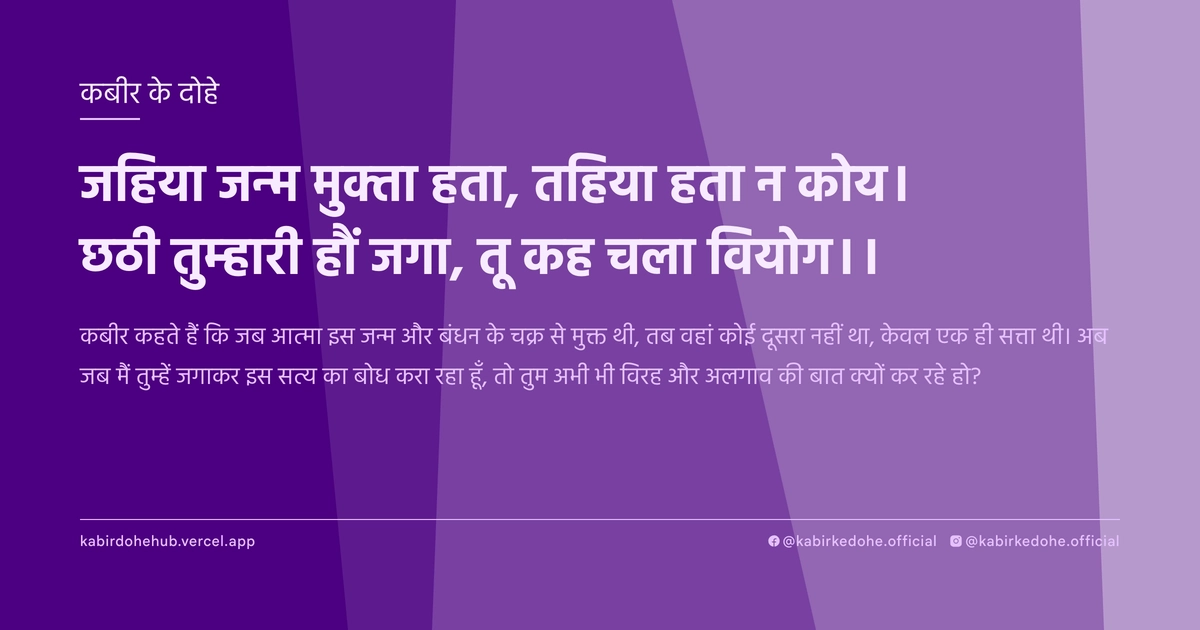
जहिया जन्म मुक्ता हता, तहिया हता न कोय।
छठी तुम्हारी हौं जगा, तू कह चला वियोग।।
Jahiya janm mukta hata, tahiya hata na koy. Chhathi tumhari haun jaga, tu kah chala viyog.
इस पृष्ठ पर इस कबीर दोहे का अर्थ (meaning), हिंदी व्याख्या और अंग्रेज़ी अनुवाद, दार्शनिक विश्लेषण और व्यावहारिक जीवन सीख दी गई है। यह दोहा मुक्ति (Liberation) विषय से जुड़ा है — Kabir doha meaning and explanation in Hindi and English.
अर्थ (Meaning):
कबीर कहते हैं कि जब आत्मा इस जन्म और बंधन के चक्र से मुक्त थी, तब वहां कोई दूसरा नहीं था, केवल एक ही सत्ता थी। अब जब मैं तुम्हें जगाकर इस सत्य का बोध करा रहा हूँ, तो तुम अभी भी विरह और अलगाव की बात क्यों कर रहे हो?
Kabir asserts that when the soul was liberated from the cycle of birth and bondage, there was no duality; only one singular existence prevailed. Now that I have awakened you to this primordial truth, why do you still cling to the notion of separation and the pain of longing?
व्याख्या (Interpretation):
इस दोहे का शाब्दिक अर्थ यह है कि मुक्ति की अवस्था में द्वैत का अभाव होता है। रूपक के स्तर पर, 'जन्म' यहाँ केवल शारीरिक जन्म नहीं, बल्कि अहंकार का उदय है। निर्गुण भक्ति के अनुसार, आत्मा और परमात्मा एक ही हैं। माया ने हमें यह भ्रम दिया है कि हम अलग हैं, जिससे 'वियोग' या विरह का जन्म होता है। कबीर यहाँ उस अद्वैत स्थिति की ओर संकेत कर रहे हैं जहाँ ज्ञाता, ज्ञान और ज्ञेय का भेद समाप्त हो जाता है। यह विरोधाभास है कि हम जिसे खोज रहे हैं, वह वास्तव में खोजने वाला स्वयं ही है।
Literally, the verse suggests that in the state of liberation, duality ceases to exist. Metaphorically, 'birth' refers not merely to physical incarnation but to the emergence of the ego. In Nirgun Bhakti, the Atman and Brahman are non-dual. Maya creates the illusion of separation, leading to 'viyog' or the agony of longing. Kabir points toward the Advaita state where the knower, the known, and the knowledge merge into one. The central paradox is that the seeker is, in essence, the very destination they seek.
दार्शनिक विश्लेषण (Philosophical Analysis):
कबीर का यह दृष्टिकोण अद्वैत वेदांत और सूफी मत के 'वहदत-अल-वजूद' (अस्तित्व की एकता) का संगम है। उन्होंने अपने समय के कर्मकांडों और जातिगत भेदभाव को इसलिए नकारा क्योंकि वे बाहरी आवरण थे जो मनुष्य को उसकी आंतरिक एकता से दूर रखते थे। उनके लिए मुक्ति किसी स्वर्ग की प्राप्ति नहीं, बल्कि इस बोध का जागरण है कि हम कभी अलग थे ही नहीं।
यहाँ 'वियोग' का उल्लेख मनोवैज्ञानिक स्तर पर है। मनुष्य अपनी पहचान को शरीर, नाम और सामाजिक स्थिति से जोड़ लेता है, जिससे वह स्वयं को ब्रह्मांड से कटा हुआ महसूस करता है। यह अलगाव ही समस्त दुखों की जड़ है। कबीर इस मानसिक रोग का उपचार 'जागृति' (Awakening) के माध्यम से करते हैं।
सूफीवाद की तरह, कबीर विरह को एक साधन मानते हैं, लेकिन अंततः वे इसे मिटाने की बात करते हैं। जब साधक को यह अहसास होता है कि वह स्वयं वह 'परम तत्व' है, तो विरह समाप्त हो जाता है और केवल आनंद शेष रहता है। यह अहंकार का पूर्ण विलोपन (Fana) है।
ऐतिहासिक रूप से, कबीर ने धर्मों के बीच की दीवारें गिराईं। उन्होंने बताया कि चाहे वह मंदिर हो या मस्जिद, यदि वहां 'मैं' और 'तू' का भेद है, तो वह ईश्वर तक नहीं पहुँच सकता। वास्तविक इबादत स्वयं के भीतर की एकता को पहचानना है।
अंततः, यह दोहा हमें यह सिखाता है कि मुक्ति कोई भविष्य की घटना नहीं है, बल्कि एक वर्तमान वास्तविकता है जिसे केवल याद करने की आवश्यकता है। हम पहले से ही मुक्त हैं; केवल हमारी अज्ञानता हमें बंधक बनाए हुए है।
Kabir's perspective is a synthesis of Advaita Vedanta and the Sufi concept of 'Wahdat-al-Wujud' (Unity of Existence). He rejected the ritualism and caste hierarchies of his era because these external shells obscured the internal unity of the soul. For Kabir, liberation is not the attainment of a distant heaven, but the awakening to the fact that we were never separate from the Divine.
The mention of 'viyog' (separation) operates on a psychological level. Humans anchor their identity to the body, a name, and a social status, creating a perceived rift between themselves and the cosmos. This perceived separation is the root of all existential suffering. Kabir treats this mental affliction through the catalyst of 'Jagriti' or spiritual awakening.
Similar to Sufism, Kabir acknowledges longing as a tool, but ultimately advocates for its dissolution. When the seeker realizes they are the 'Supreme Element' itself, the longing vanishes, leaving only pure bliss. This is the annihilation of the ego, or 'Fana'.
Historically, Kabir dismantled the walls between religions. He argued that whether in a temple or a mosque, if the distinction between 'I' and 'Thou' persists, the Divine remains unreachable. True worship is the recognition of the unity within.
Ultimately, this verse teaches that liberation is not a future event but a present reality that needs only to be remembered. We are already free; it is only our ignorance that keeps us imprisoned in the illusion of duality.
मूल संदेश (Core Message):
- अलगाव एक मानसिक भ्रम है, वास्तविकता नहीं।
- मुक्ति कहीं बाहर से नहीं आती, यह केवल आंतरिक जागरण है।
- अहंकार का अंत ही परमात्मा से मिलन का एकमात्र मार्ग है।
- विरह तब तक है जब तक आप स्वयं को अधूरा मानते हैं।
- आप वह पूर्ण सत्य हैं जिसे आप खोजने का प्रयास कर रहे हैं।
- Separation is a mental illusion, not an existential reality.
- Liberation is not an external acquisition, but an internal awakening.
- The annihilation of the ego is the only path to union with the Divine.
- Longing persists only as long as you perceive yourself as incomplete.
- You are the very Absolute Truth you are striving to find.
व्यावहारिक उदाहरण (Practical Example):
एक समय की बात है, वाराणसी के घाटों पर माधव नाम का एक वृद्ध बुनकर रहता था। माधव अपनी पूरी जिंदगी सूत कातने और कपड़े बुनने में बिता चुका था, लेकिन उसके मन में हमेशा एक बेचैनी रहती थी कि वह ईश्वर से बहुत दूर है। वह घंटों मंदिर की सीढ़ियों पर बैठकर रोता और प्रार्थना करता कि उसे परमात्मा का दर्शन हो।
माधव का मानना था कि वह एक तुच्छ इंसान है और ईश्वर एक महान राजा है जो कहीं ऊपर बादलों में रहता है। वह अपने जीवन को एक अंतहीन विरह की कहानी मानता था, जहाँ वह केवल एक अधूरा टुकड़ा था जो अपने पूर्ण हिस्से की तलाश में था।
एक दिन उसकी मुलाकात एक घुमक्कड़ संत से हुई। संत ने माधव की व्याकुलता देखी और उससे पूछा, 'तुम किसे खोज रहे हो?' माधव ने रोते हुए कहा, 'मैं उस परमात्मा को खोज रहा हूँ जिससे मैं अलग हो गया हूँ।'
संत मुस्कुराए और उन्होंने माधव के हाथ में मौजूद कपड़े के एक धागे को खींचकर पूछा, 'क्या यह धागा कपड़े से अलग है?' माधव ने कहा, 'नहीं, यह तो कपड़े का ही हिस्सा है।'
संत ने फिर कहा, 'तो फिर तुम क्यों रो रहे हो कि तुम ईश्वर से अलग हो? जैसे यह धागा कपड़े से अलग नहीं है, वैसे ही तुम उस परमात्मा से अलग नहीं हो। तुम बस यह भूल गए हो कि तुम वही हो।'
यह बात माधव के हृदय पर बिजली की तरह गिरी। उसे अहसास हुआ कि उसकी पूरी जिंदगी की तड़प एक भ्रम थी। वह जिसे बाहर खोज रहा था, वह उसके अपने ही अस्तित्व की गहराई में छिपा था।
उस क्षण माधव का 'वियोग' समाप्त हो गया। उसने महसूस किया कि उसकी करघे की आवाज़, उसकी सांसें और घाटों की लहरें—सब एक ही संगीत का हिस्सा हैं।
अब माधव मंदिर की सीढ़ियों पर रोता नहीं था, बल्कि मुस्कुराते हुए कपड़े बुनता था। उसके लिए अब हर धागा परमात्मा का विस्तार था।
उसने अपनी पूरी संपत्ति गरीबों में बांट दी और एक शांत जीवन जीने लगा, क्योंकि अब उसे किसी बाहरी सहारे या चमत्कार की आवश्यकता नहीं थी।
उसकी इस आंतरिक क्रांति ने आसपास के लोगों को भी प्रभावित किया। लोग अब उसके पास केवल कपड़े लेने नहीं, बल्कि उस शांति का रहस्य जानने आने लगे जो उसने पा ली थी।
Once, on the ghats of Varanasi, lived an elderly weaver named Madhav. Madhav had spent his entire life spinning yarn and weaving cloth, yet a persistent restlessness gnawed at him, believing he was far removed from God. He would spend hours on the temple steps, weeping and praying for a divine vision.
Madhav believed he was a mere insignificant human and that God was a great King residing far above in the clouds. He viewed his life as a story of endless separation, a fragmented piece searching for its lost whole.
One day, he encountered a wandering mystic. Seeing Madhav's distress, the mystic asked, 'Whom are you searching for?' Madhav replied tearfully, 'I am searching for the Divine from whom I have been severed.'
The mystic smiled and, pointing to a single thread in the cloth Madhav was holding, asked, 'Is this thread separate from the fabric?' Madhav replied, 'No, it is a part of the cloth.'
The mystic then said, 'Then why do you weep, claiming you are separate from God? Just as this thread is not separate from the fabric, you are not separate from the Divine. You have simply forgotten that you are That.'
These words struck Madhav like a bolt of lightning. He realized that his lifelong agony was a delusion. The one he sought externally was hidden within the depths of his own existence.
In that instant, Madhav's 'viyog' ended. He felt that the rhythm of his loom, his own breath, and the ripples of the Ganges were all parts of a single, cosmic melody.
Madhav no longer wept on the temple steps; instead, he wove his cloth with a smile. To him, every thread was now an extension of the Divine.
He distributed his wealth among the poor and lived a life of profound stillness, for he no longer required external crutches or miracles.
This internal revolution influenced those around him. People began visiting him not just for fabric, but to understand the secret of the peace he had attained.
अभ्यास मार्गदर्शन (Practice Guidance):
- प्रतिदिन 20 मिनट मौन बैठें और विचार करें कि 'मैं' शरीर या नाम नहीं हूँ, बल्कि वह चेतना हूँ जो पूरे ब्रह्मांड में व्याप्त है।
- एक डायरी लिखें जिसमें आप उन क्षणों को दर्ज करें जब आपने स्वयं को दूसरों से अलग या छोटा महसूस किया, और फिर विश्लेषण करें कि वह अलगाव केवल एक विचार था, वास्तविकता नहीं।
- व्यवहार में बदलाव: जब भी किसी के प्रति क्रोध या ईर्ष्या आए, तो रुककर सोचें कि सामने वाला व्यक्ति भी उसी एक चेतना का हिस्सा है जिससे मैं बना हूँ।
- डायग्नोस्टिक चेकलिस्ट: क्या मैं अभी भी ईश्वर को बाहर खोज रहा हूँ? क्या मैं अपनी पहचान केवल अपनी उपलब्धियों या दुखों से जोड़ रहा हूँ? क्या मैं दूसरों में 'परायापन' महसूस करता हूँ? यदि हाँ, तो आप अभी भी वियोग के भ्रम में हैं।
- Sit in silence for 20 minutes daily, contemplating that 'I' am not the body or the name, but the consciousness that permeates the entire universe.
- Maintain a journal recording moments where you felt separate or inferior to others, then analyze how that separation was merely a thought, not a reality.
- Behavioral Shift: Whenever anger or jealousy arises toward another, pause and realize that the other person is a manifestation of the same consciousness that constitutes your own being.
- Diagnostic Checklist: Am I still searching for God externally? Do I tie my identity solely to my achievements or sorrows? Do I feel 'otherness' toward people? If yes, you are still dwelling in the illusion of separation.
चिंतन प्रश्न (Reflection Questions):
- यदि मेरा नाम, मेरा पेशा और मेरा इतिहास छीन लिया जाए, तो वास्तव में 'मैं' कौन हूँ?
- मैं अपनी डिजिटल पहचान (सोशल मीडिया) को इतना महत्व क्यों देता हूँ, जबकि वह मेरी वास्तविक चेतना का एक सूक्ष्म अंश भी नहीं है?
- मेरे जीवन में कौन सा ऐसा डर है जो मुझे यह मानने से रोकता है कि मैं ब्रह्मांड के साथ एक हूँ?
- क्या मेरी धार्मिक आस्थाएँ मुझे दूसरों से जोड़ती हैं या मुझे एक विशिष्ट समूह का हिस्सा बताकर अलग करती हैं?
- मैं अपनी कमियों को स्वीकार करने के बजाय उन्हें छिपाने के लिए किस 'मुखौटे' का उपयोग करता हूँ?
- If my name, profession, and history were stripped away, who is the 'I' that remains?
- Why do I grant such importance to my digital identity when it is not even a fraction of my true consciousness?
- What fear within me prevents me from accepting that I am one with the universe?
- Do my religious beliefs connect me to others, or do they isolate me by defining me as part of a specific group?
- What 'mask' do I wear to hide my flaws instead of accepting them as part of the human experience?