
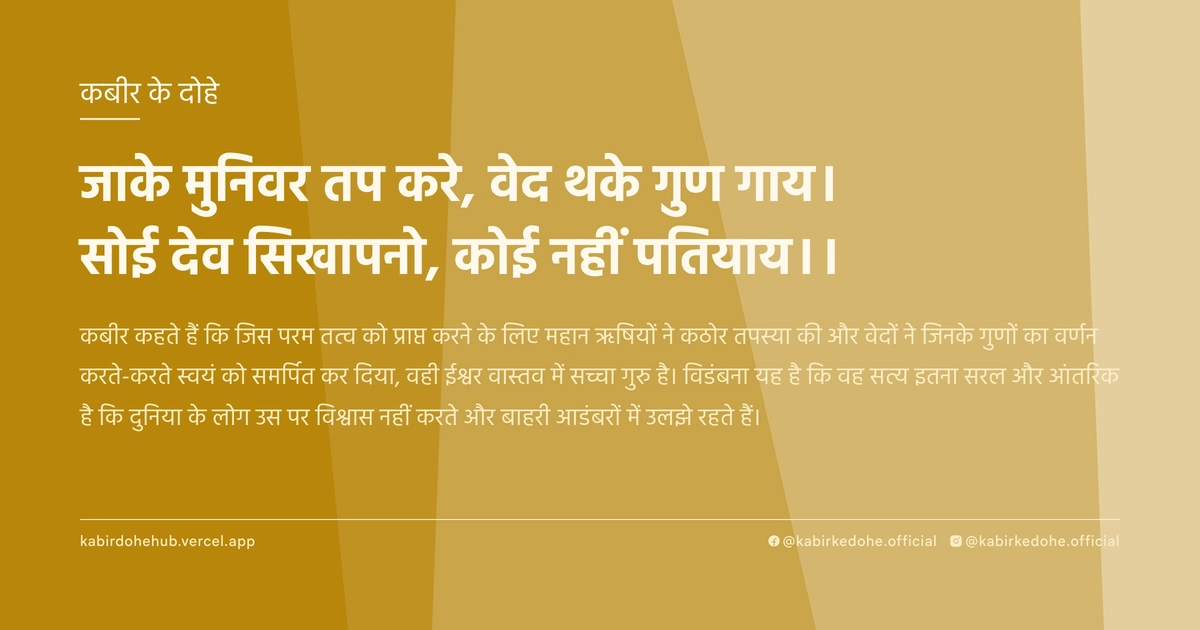
जाके मुनिवर तप करे, वेद थके गुण गाय।
सोई देव सिखापनो, कोई नहीं पतियाय।।
Jaake munivar tap kare, ved thake gun gaay. Soi dev sikhapano, koi nahi patiyaay.
इस पृष्ठ पर इस कबीर दोहे का अर्थ (meaning), हिंदी व्याख्या और अंग्रेज़ी अनुवाद, दार्शनिक विश्लेषण और व्यावहारिक जीवन सीख दी गई है। यह दोहा निर्गुण ब्रह्म (Nirguna Brahman) विषय से जुड़ा है — Kabir doha meaning and explanation in Hindi and English.
अर्थ (Meaning):
कबीर कहते हैं कि जिस परम तत्व को प्राप्त करने के लिए महान ऋषियों ने कठोर तपस्या की और वेदों ने जिनके गुणों का वर्णन करते-करते स्वयं को समर्पित कर दिया, वही ईश्वर वास्तव में सच्चा गुरु है। विडंबना यह है कि वह सत्य इतना सरल और आंतरिक है कि दुनिया के लोग उस पर विश्वास नहीं करते और बाहरी आडंबरों में उलझे रहते हैं।
Kabir asserts that the Ultimate Truth, for which great sages performed rigorous austerities and the Vedas exhausted themselves singing its praises, is the only true Teacher. Yet, the paradox remains that this divine reality is so profoundly internal and simple that the world refuses to believe in it, preferring instead the noise of external rituals.
व्याख्या (Interpretation):
इस दोहे का शाब्दिक अर्थ है कि ईश्वर की महिमा अनंत है, जिसे वेद भी पूरी तरह नहीं समेट सकते। रूपक के स्तर पर, 'मुनिवर' और 'वेद' उस बौद्धिक और आध्यात्मिक प्रयास का प्रतीक हैं जो मनुष्य सत्य की खोज में करता है। कबीर यहाँ निर्गुण भक्ति का समर्थन कर रहे हैं, जहाँ ईश्वर किसी मूर्ति या मंदिर में नहीं, बल्कि आत्मा के भीतर स्थित है। यह अद्वैत वेदांत के उस सिद्धांत को दर्शाता है जहाँ जीव और ब्रह्म एक ही हैं। 'सिखापनो' या गुरु का अर्थ यहाँ बाहरी व्यक्ति नहीं, बल्कि अंतरात्मा की वह जागृति है जो माया के पर्दे को हटा देती है। मनुष्य की त्रासदी यह है कि वह सत्य को बाहर खोजता है, जबकि वह उसके अपने अस्तित्व का मूल है।
Literally, the verse speaks of the infinite glory of the Divine, which even the Vedas cannot fully encapsulate. Metaphorically, the 'sages' and 'Vedas' represent the peak of human intellectual and spiritual striving. Kabir aligns here with Nirgun Bhakti, suggesting that the Divine is not a sculpted idol but the formless essence within. This mirrors Advaita Vedanta's non-duality, where the Atman and Brahman are one. The 'Teacher' (Sikhapano) is not an external figure but the awakening of the inner consciousness that pierces the veil of Maya. The central paradox is the human tendency to seek externally what can only be realized internally, mistaking the map for the destination.
दार्शनिक विश्लेषण (Philosophical Analysis):
कबीर का यह दोहा उनके समय के धार्मिक कट्टरवाद और कर्मकांडों पर एक गहरा प्रहार है। 15वीं शताब्दी में, ज्ञान केवल संस्कृत जानने वाले पुरोहितों और वेदों के व्याख्याकारों तक सीमित था। कबीर ने इस एकाधिकार को चुनौती देते हुए यह स्थापित किया कि सत्य किसी पुस्तक या भाषा का मोहताज नहीं है। वे बताते हैं कि यदि वेदों जैसी महान कृतियाँ भी उस सत्य को पूरी तरह नहीं समझा पाईं, तो साधारण मनुष्य केवल रटने से उसे कैसे पा सकता है?
दार्शनिक रूप से, यह सूफी मत के 'वहदत-अल-वजूद' (अस्तित्व की एकता) और वेदांत के अद्वैत से मेल खाता है। यहाँ 'तप' का अर्थ केवल शरीर को कष्ट देना नहीं, बल्कि अहंकार का विसर्जन है। कबीर का तर्क है कि जब तक 'मैं' (अहंकार) जीवित है, तब तक सत्य अदृश्य रहता है। वे ritualism (कर्मकांड) को एक मानसिक बाधा मानते हैं जो मनुष्य को वास्तविक अनुभव से दूर ले जाती है।
मनोवैज्ञानिक स्तर पर, यह दोहा संज्ञानात्मक विसंगति (cognitive dissonance) को दर्शाता है। मनुष्य उस सत्य को स्वीकार करने से डरता है जो उसे उसकी सामाजिक पहचान, जाति और पद से ऊपर उठकर केवल एक 'चेतना' के रूप में देखने को कहता है। कबीर यहाँ 'अज्ञान' को केवल जानकारी का अभाव नहीं, बल्कि गलत दिशा में की गई खोज मानते हैं।
वेदों की थकान का उल्लेख यह संकेत देता है कि शब्द सीमित हैं जबकि सत्य असीम है। यह 'नेति-नेति' (यह नहीं, वह नहीं) की प्रक्रिया है। जब शब्दों की सीमा समाप्त होती है, वहीं से वास्तविक अनुभव या 'साक्षात्कार' शुरू होता है।
अंततः, कबीर यह संदेश देते हैं कि ईश्वर कोई बाहरी सत्ता नहीं जिसे मनाया जाए, बल्कि एक आंतरिक वास्तविकता है जिसे पहचाना जाए। यह परिवर्तन बाहरी पूजा से आंतरिक मौन की ओर संक्रमण है, जहाँ साधक स्वयं ही साध्य बन जाता है।
This Doha is a profound critique of the religious dogmatism and ritualism prevalent during Kabir's 15th-century era. At a time when spiritual knowledge was monopolized by a priestly class fluent in Sanskrit, Kabir challenged this hegemony, asserting that Truth is not hostage to any language or scripture. He argues that if even the Vedas—the pinnacle of scriptural authority—could not exhaust the glory of the Divine, how can a mere devotee hope to find it through rote memorization?
Philosophically, this aligns with the Sufi concept of 'Wahdat-al-Wujud' (Unity of Existence) and the Advaita Vedanta principle of non-duality. Here, 'Tapasya' (austerity) is not merely physical hardship but the systematic dissolution of the ego. Kabir posits that as long as the 'I' (the egoic self) persists, the Truth remains obscured. He views ritualism as a psychological barrier that distracts the seeker from direct experiential realization.
On a psychological level, the verse addresses cognitive dissonance. Humans often resist a truth that demands the erasure of their social identity, caste, or status, urging them to see themselves simply as pure consciousness. Kabir defines 'ignorance' not as a lack of information, but as a misdirected search—looking for the ocean while standing in the middle of it.
The mention of the Vedas becoming 'tired' suggests that words are finite while Truth is infinite. This mirrors the 'Neti-Neti' (not this, not that) process of negation. When the limits of language are reached, the realm of direct experience or 'Sākshātkaāra' begins.
Ultimately, Kabir suggests that God is not an external entity to be appeased, but an internal reality to be recognized. This is a transition from external worship to internal silence, where the seeker and the sought eventually merge into one.
मूल संदेश (Core Message):
- बाहरी खोज एक भ्रम है; सत्य केवल भीतर है।
- शास्त्र मार्ग दिखाते हैं, लेकिन गंतव्य स्वयं का अनुभव है।
- अहंकार का विसर्जन ही वास्तविक तपस्या है।
- ईश्वर कोई व्यक्ति नहीं, बल्कि शुद्ध चेतना है।
- मौन वह भाषा है जिसे वेद भी पूरी तरह नहीं बोल सकते।
- External searching is an illusion; Truth resides only within.
- Scriptures provide the map, but the destination is personal experience.
- The dissolution of ego is the only true austerity.
- The Divine is not a person, but pure, formless consciousness.
- Silence is the language that even the Vedas cannot fully articulate.
व्यावहारिक उदाहरण (Practical Example):
वाराणसी के एक पुराने घाट पर माधव नाम का एक बुनकर रहता था। वह दिन भर कपड़े बुनता, लेकिन उसका मन हमेशा इस बात में उलझा रहता कि वह सही पूजा कर रहा है या नहीं। वह बड़े-बड़े पंडितों के पास जाता, कठिन मंत्र रटता और महंगे अनुष्ठान करता ताकि उसे 'मोक्ष' मिल सके। उसे लगता था कि ईश्वर किसी विशेष विधि या कठिन तपस्या से ही प्रसन्न होते हैं।
एक दिन माधव ने देखा कि एक वृद्ध महिला, जो समाज द्वारा उपेक्षित थी, अपने छोटे से घर में शांति से बैठी थी। उसके पास न तो कोई शास्त्र थे, न ही वह किसी मंदिर जाती थी, फिर भी उसके चेहरे पर एक ऐसी शांति थी जिसे माधव ने बड़े-बड़े विद्वानों के चेहरे पर भी नहीं देखा था। माधव ने उससे पूछा, 'माता, आपने कौन सा कठिन तप किया है कि आपको यह शांति मिली?'
उस महिला ने मुस्कुराकर कहा, 'बेटा, मैंने तप करना छोड़ दिया। मैंने बस यह मानना शुरू किया कि जिसे मैं बाहर खोज रहा हूँ, वह मेरे भीतर ही सांस ले रहा है। मैंने मंदिर के पत्थरों को छोड़ दिया और अपने हृदय के द्वार खोल दिए।'
माधव को पहले यह बात बकवास लगी। उसे लगा कि बिना मंत्रों और विधि के ईश्वर कैसे मिल सकते हैं? लेकिन उस महिला की आँखों में एक ऐसी सच्चाई थी जिसने माधव को झकझोर दिया। उसने महसूस किया कि वह अब तक केवल 'शब्दों' की पूजा कर रहा था, 'सत्य' की नहीं।
अगले कुछ हफ्तों तक माधव ने एक प्रयोग किया। उसने बाहरी अनुष्ठानों को कम किया और हर दिन केवल दस मिनट मौन में बैठना शुरू किया। वह अपने भीतर उठने वाले क्रोध, लोभ और अहंकार को देखना शुरू किया। उसने पाया कि जब वह शांत होता है, तो वही शांति महसूस होती है जो उस वृद्ध महिला के चेहरे पर थी।
धीरे-धीरे माधव का व्यवहार बदलने लगा। वह अब केवल अपने लाभ के लिए कपड़े नहीं बुनता था, बल्कि बुनते समय वह उस लय में खो जाता जैसे वह ईश्वर के लिए ही काम कर रहा हो। उसके काम में एक नई गुणवत्ता आ गई क्योंकि अब वह तनाव में नहीं, बल्कि प्रेम में काम करता था।
एक दिन एक बड़ा पंडित उसके पास आया और उसे एक नया, और भी कठिन अनुष्ठान करने की सलाह दी। माधव ने विनम्रता से मुस्कुराते हुए कहा, 'महाराज, मैं अब तक उस रास्ते पर चल रहा था जहाँ केवल थकान थी। अब मैं उस रास्ते पर हूँ जहाँ केवल विश्राम है।'
पंडित हैरान था, लेकिन माधव के चेहरे का तेज बता रहा था कि उसने वह पा लिया है जिसे वेद भी केवल शब्दों में बांधने की कोशिश करते रहे। माधव ने समझ लिया था कि सबसे बड़ा तप अहंकार को मिटाना है, और सबसे बड़ा गुरु अपनी अंतरात्मा की आवाज़ सुनना है।
In the ancient alleys of Varanasi lived a weaver named Madhav. He spent his days weaving cloth, but his mind was perpetually anxious about whether he was performing his religious duties correctly. He visited renowned priests, memorized complex mantras, and spent his meager savings on expensive rituals, believing that liberation (Moksha) was a reward for rigorous adherence to form.
One day, Madhav noticed an elderly widow, marginalized by society, sitting in her small hut. She possessed no scriptures and never visited the grand temples, yet her face radiated a serenity that Madhav had never seen even in the most learned scholars. Intrigued, Madhav asked, 'Mother, what grueling penance have you performed to achieve such peace?'
The woman smiled and replied, 'Son, I stopped performing penance. I simply began to believe that the One I was searching for outside was already breathing within me. I abandoned the stones of the temple and opened the doors of my heart.'
Initially, Madhav found this absurd. How could the Divine be reached without mantras or methodology? However, the authenticity in her eyes shook him. He realized he had been worshipping the 'words' about the truth, rather than the Truth itself.
For the next few weeks, Madhav conducted an experiment. He reduced his external rituals and began spending ten minutes every day in absolute silence. He started observing the rise of anger, greed, and ego within himself. He discovered that in the depths of that silence, the same peace the widow possessed began to bloom.
Gradually, Madhav's behavior transformed. He no longer wove cloth merely for profit; he entered a state of flow where the act of weaving became a meditation, as if he were weaving for the Divine. The quality of his work improved because he was no longer driven by stress, but by love.
One day, a high priest approached him, suggesting a new, even more rigorous ritual to ensure salvation. Madhav smiled gently and said, 'Master, until now I walked a path that led only to exhaustion. Now, I walk a path that leads to eternal rest.'
The priest was baffled, but the luminosity on Madhav's face proved he had found what the Vedas could only describe in words. Madhav understood that the greatest austerity is the annihilation of the ego, and the greatest teacher is the voice of one's own soul.
अभ्यास मार्गदर्शन (Practice Guidance):
- प्रतिदिन 20 मिनट 'साक्षी भाव' का अभ्यास करें: अपने विचारों को बिना किसी निर्णय के केवल देखें, जैसे आप किसी और के विचार देख रहे हों।
- आत्म-पूछताछ जर्नल: हर रात लिखें कि आज आपने कितनी बार अपनी पहचान (नाम, पद, जाति) को सत्य मान लिया और कितनी बार अपनी आंतरिक चेतना को महसूस किया।
- व्यवहारिक परिवर्तन: किसी ऐसे व्यक्ति की मदद करें जिसे समाज 'अछूत' या 'निम्न' मानता है, और उसमें उसी दिव्य तत्व को खोजने का प्रयास करें जिसे आप मंदिर में खोजते हैं।
- निदान चेकलिस्ट: यदि आप अभी भी शांति के लिए बाहरी परिस्थितियों या किसी व्यक्ति के आश्वासन पर निर्भर हैं, तो आप अभी भी 'माया' के प्रभाव में हैं। यदि शांति आंतरिक है, तो आप सही दिशा में हैं।
- Practice 'Witness Consciousness' (Sakshi Bhav) for 20 minutes daily: Observe your thoughts without judgment, as if you are watching someone else's mind.
- Self-Inquiry Journaling: Every night, record instances where you identified with your social persona (name, rank, caste) versus moments you felt your intrinsic consciousness.
- Behavioral Shift: Serve someone marginalized by society and consciously attempt to recognize the same divine essence in them that you seek in a temple.
- Diagnostic Checklist: If your peace still depends on external circumstances or the validation of others, you are still under the influence of Maya. If peace is internal and independent, you are aligning with the Truth.
चिंतन प्रश्न (Reflection Questions):
- यदि आपकी सारी सामाजिक पहचान (डिग्रियां, पद, संपत्ति) छीन ली जाए, तो आपके भीतर क्या बचेगा?
- आप अपनी आध्यात्मिक प्रगति को मापने के लिए किन बाहरी पैमानों का उपयोग कर रहे हैं, और क्या वे वास्तव में सार्थक हैं?
- क्या आपका 'धर्म' दूसरों को छोटा महसूस कराने का एक साधन बन गया है?
- आप उस सत्य से क्यों डरते हैं जो आपको बताता है कि आप और आपका शत्रु वास्तव में एक ही हैं?
- क्या आप वास्तव में ईश्वर को खोज रहे हैं, या केवल अपनी इच्छाओं की पूर्ति के लिए एक शक्तिशाली माध्यम की तलाश में हैं?
- If all your social identities (degrees, titles, assets) were stripped away, what would remain within you?
- What external metrics are you using to measure your spiritual progress, and are they truly meaningful?
- Has your 'religion' become a tool to make others feel inferior?
- Why do you fear the truth that tells you that you and your enemy are essentially the same?
- Are you truly seeking the Divine, or are you just looking for a powerful medium to fulfill your desires?