
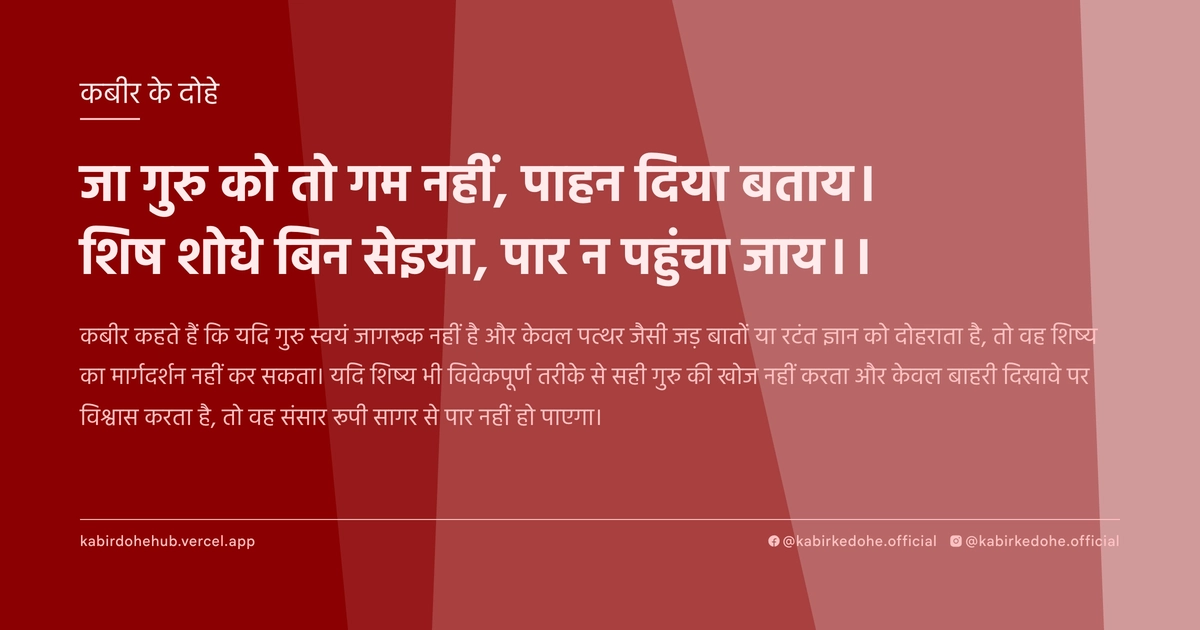
जा गुरु को तो गम नहीं, पाहन दिया बताय।
शिष शोधे बिन सेइया, पार न पहुंचा जाय।।
Ja guru ko to gam nahi, pahan diya batay. Shish shodhe bin seiya, paar na pahuncha jaaye.
इस पृष्ठ पर इस कबीर दोहे का अर्थ (meaning), हिंदी व्याख्या और अंग्रेज़ी अनुवाद, दार्शनिक विश्लेषण और व्यावहारिक जीवन सीख दी गई है। यह दोहा गुरु महत्व (The Guru's Importance) विषय से जुड़ा है — Kabir doha meaning and explanation in Hindi and English.
अर्थ (Meaning):
कबीर कहते हैं कि यदि गुरु स्वयं जागरूक नहीं है और केवल पत्थर जैसी जड़ बातों या रटंत ज्ञान को दोहराता है, तो वह शिष्य का मार्गदर्शन नहीं कर सकता। यदि शिष्य भी विवेकपूर्ण तरीके से सही गुरु की खोज नहीं करता और केवल बाहरी दिखावे पर विश्वास करता है, तो वह संसार रूपी सागर से पार नहीं हो पाएगा।
Kabir asserts that if a teacher lacks true inner realization and merely imparts rigid, stony, or rote knowledge, they cannot lead the seeker. Similarly, if the disciple fails to discern and seek a genuine guide, relying instead on superficial credentials, they will never cross the ocean of worldly existence to reach liberation.
व्याख्या (Interpretation):
यह दोहा गुरु-शिष्य परंपरा के यांत्रिक स्वरूप पर प्रहार करता है। 'पाहन' (पत्थर) यहाँ उस जड़ ज्ञान का प्रतीक है जो शास्त्रों में तो है लेकिन अनुभव में नहीं। यह निर्गुण भक्ति के उस सिद्धांत को दर्शाता है जहाँ सत्य किसी बाहरी पुस्तक में नहीं, बल्कि भीतर की चेतना में है। जब गुरु स्वयं माया के प्रभाव में होता है, तो वह केवल शब्दों का जाल बुनता है। अद्वैत वेदांत के अनुसार, जब तक अज्ञान का पर्दा नहीं हटता, तब तक कोई भी 'पार' नहीं जा सकता। यहाँ विरोधाभास यह है कि जिसे हम मार्गदर्शक मान रहे हैं, वह स्वयं अंधेरे में है। यह शिष्य को चेतावनी देता है कि अंधभक्ति आत्म-विनाश का मार्ग है और विवेक ही एकमात्र कुंजी है।
This couplet critiques the mechanical nature of the teacher-disciple relationship. 'Pahan' (stone) symbolizes rigid, rote knowledge—information that exists in scriptures but lacks living experience. It aligns with Nirgun Bhakti, where truth resides not in external texts but within consciousness. When a guru remains under the veil of Maya, they offer only a web of words. According to Advaita Vedanta, until the veil of ignorance is lifted, liberation is impossible. The central paradox lies in the seeker trusting a guide who is themselves lost in darkness. It warns that blind faith is a path to self-destruction, asserting that discernment (Viveka) is the only true key to transcendence.
दार्शनिक विश्लेषण (Philosophical Analysis):
कबीर का यह दृष्टिकोण उनके समय के धार्मिक पाखंड और औपचारिक शिक्षा प्रणाली के विरुद्ध एक विद्रोह था। उन्होंने देखा कि पंडित और मौलवी केवल शब्दों के रक्षक थे, सत्य के खोजी नहीं। यह विश्लेषण सूफीवाद के 'पीर' और 'मुरीद' के संबंध से मेल खाता है, जहाँ पीर का स्वयं 'फना' (अहंकार का विनाश) होना अनिवार्य है। यदि मार्गदर्शक स्वयं अहंकार में है, तो वह शिष्य को भी अहंकार की ओर ले जाएगा।
अद्वैत वेदांत के परिप्रेक्ष्य में, यह दोहा 'अविद्या' (अज्ञान) की चर्चा करता है। जब गुरु स्वयं को शरीर और मन मानता है, तो वह केवल भौतिक ज्ञान दे सकता है, आध्यात्मिक नहीं। कबीर यहाँ 'साधना' और 'सूचना' के बीच अंतर स्पष्ट कर रहे हैं। सूचना पत्थर की तरह स्थिर और मृत होती है, जबकि साधना जीवित और प्रवाहमान होती है।
सामाजिक स्तर पर, कबीर जाति और वंश आधारित गुरु परंपरा को चुनौती देते हैं। उनका तर्क है कि ज्ञान किसी विशेष कुल का विशेषाधिकार नहीं है, बल्कि वह है जो अनुभवसिद्ध हो। यह उस युग की रूढ़िवादिता पर प्रहार है जहाँ केवल पदवी को ही पात्रता मान लिया जाता था।
मनोवैज्ञानिक रूप से, यह 'पुष्टि पूर्वाग्रह' (Confirmation Bias) की चेतावनी है। शिष्य अक्सर वही गुरु चुनते हैं जो उनकी मौजूदा मान्यताओं की पुष्टि करें, न कि वह जो उन्हें चुनौती दें और उनके अहंकार को तोड़ें। वास्तविक परिवर्तन तब होता है जब गुरु शिष्य के भ्रम को नष्ट करता है, न कि उसे पुष्ट करता है।
अंततः, यह दोहा इस सत्य को स्थापित करता है कि मोक्ष का मार्ग केवल बाहरी निर्देशों से नहीं, बल्कि आंतरिक रूपांतरण से प्रशस्त होता है। यदि बीज (गुरु) ही मृत है, तो वृक्ष (शिष्य) कभी फल नहीं दे सकता। यह आत्म-साक्षात्कार की अनिवार्यता पर बल देता है।
Kabir’s perspective is a rebellion against the religious hypocrisy and formal educational systems of his era. He observed that the pundits and mullahs were mere custodians of words, not seekers of truth. This analysis resonates with the Sufi concept of the 'Pir' and 'Murid,' where the Pir must first undergo 'Fana' (annihilation of the ego). If the guide is trapped in ego, they can only lead the disciple toward further egoism.
From the lens of Advaita Vedanta, this couplet discusses 'Avidya' (ignorance). When a guru identifies solely with the body and mind, they can only impart material knowledge, not spiritual liberation. Kabir distinguishes between 'information' and 'realization.' Information is like a stone—static and dead—whereas realization is living and fluid.
Socially, Kabir challenges the caste- and lineage-based guru traditions. He argues that knowledge is not the prerogative of a specific clan but must be empirically experienced. This is a direct strike against the orthodoxy of his time, where titles were mistaken for true competence.
Psychologically, this serves as a warning against 'Confirmation Bias.' Disciples often choose gurus who validate their existing beliefs rather than those who challenge them and shatter their ego. True transformation occurs when the guru destroys the disciple's illusions rather than reinforcing them.
Ultimately, the couplet establishes that the path to liberation is paved not by external instructions, but by internal transformation. If the seed (the guru) is dead, the tree (the disciple) can never bear fruit. It emphasizes the absolute necessity of self-realization over blind adherence.
मूल संदेश (Core Message):
- अंधभक्ति आध्यात्मिक प्रगति की सबसे बड़ी बाधा है।
- सत्य अनुभव का विषय है, रटने का नहीं।
- गुरु की पात्रता उनके शब्दों में नहीं, उनके अस्तित्व में होती है।
- विवेक ही वह सेतु है जो शिष्य को सत्य तक ले जाता है।
- आंतरिक रूपांतरण के बिना बाहरी अनुष्ठान व्यर्थ हैं।
- Blind faith is the greatest obstacle to spiritual progress.
- Truth is a matter of experience, not of rote memorization.
- A guru's eligibility lies in their being, not in their words.
- Discernment is the bridge that leads the seeker to truth.
- External rituals are futile without internal transformation.
व्यावहारिक उदाहरण (Practical Example):
वाराणसी के एक पुराने घाट पर रामदीन नाम का एक वृद्ध बुनकर रहता था। वह जीवन भर एक ऐसे गुरु के पीछे चला जिसने उसे केवल कठिन मंत्रों को रटने और बाहरी कर्मकांडों को पूरा करने की शिक्षा दी। रामदीन ने अपनी पूरी जमापूंजी उन अनुष्ठानों में लगा दी, यह सोचकर कि वह मोक्ष पा लेगा।
उसका गुरु उसे बताता था कि केवल विशिष्ट वस्त्र पहनकर और विशेष दिशा में मुख करके प्रार्थना करने से ही ईश्वर मिलते हैं। रामदीन ने वर्षों तक इन 'पत्थर' जैसे नियमों का पालन किया, लेकिन उसके मन की अशांति और क्रोध कम नहीं हुआ। वह बाहर से धार्मिक था, लेकिन भीतर से अधूरा।
एक दिन, घाट पर एक फकीर आया जो बिना किसी बाहरी आडंबर के केवल मौन और प्रेम की बात करता था। उसने रामदीन को देखा और मुस्कुराते हुए कहा, 'तुम जिस ताले की चाबी बाहर खोज रहे हो, वह तुम्हारे भीतर की ईमानदारी में छिपी है।'
रामदीन को अचानक महसूस हुआ कि उसका गुरु उसे केवल 'पत्थर' (जड़ ज्ञान) दे रहा था, जबकि वह प्यासा था। उसने महसूस किया कि उसने कभी यह नहीं पूछा कि क्या उसका गुरु स्वयं शांत है या केवल शांति की बातें करता है।
उसने अपने गुरु के प्रति सम्मान तो रखा, लेकिन उनकी रटी-रटाई बातों पर विश्वास करना छोड़ दिया। उसने अपनी बुनाई के काम को ही अपनी साधना बना लिया, हर धागे में ईश्वर को देखने का प्रयास किया।
उसने पाया कि जब वह बिना किसी अहंकार के दूसरों की मदद करता है, तो उसे वह शांति मिलती है जो हज़ारों मंत्रों के जाप से नहीं मिली थी। उसने बाहरी दिखावे के बजाय आंतरिक सत्य को चुनना शुरू किया।
उसका व्यवहार बदल गया; वह अब दूसरों की आलोचना करने के बजाय उनकी पीड़ा को समझने लगा। उसके घर में अब शांति थी क्योंकि उसने 'पत्थर' को हटाकर 'प्रेम' को स्थापित किया था।
अंत में, रामदीन ने समझा कि सही गुरु वह नहीं जो रास्ता बताए, बल्कि वह है जो स्वयं वह रास्ता बन जाए। उसने अपनी चेतना के स्तर पर वह पारगमन किया जिसे वह वर्षों से बाहरी अनुष्ठानों में खोज रहा था।
On an ancient ghat in Varanasi lived an elderly weaver named Ramdin. For his entire life, he followed a guru who taught him only to memorize complex mantras and perform external rituals. Ramdin spent all his savings on these ceremonies, believing they were the only ticket to salvation.
His guru insisted that God could only be reached by wearing specific clothes and praying in a specific direction. For years, Ramdin followed these 'stony' rules, yet his inner turmoil and anger never subsided. He was religious on the outside, but empty within.
One day, a wandering fakir arrived at the ghat, speaking only of silence and love, devoid of any outward pomp. He looked at Ramdin and smiled, saying, 'The key to the lock you seek outside is hidden in the honesty within you.'
Ramdin suddenly realized that his guru had been giving him 'stones' (dead knowledge) while he was starving for truth. He realized he had never questioned whether his guru was actually peaceful or merely spoke of peace.
While maintaining respect for his teacher, he stopped believing in the rote instructions. He turned his weaving into his spiritual practice, attempting to see the Divine in every thread he wove.
He discovered that when he helped others without ego, he found a peace that thousands of chanted mantras had never provided. He chose internal truth over external display.
His behavior shifted; instead of criticizing others, he began to empathize with their pain. Peace finally entered his home because he had replaced the 'stone' with 'love.'
Ultimately, Ramdin understood that a true guru is not one who merely describes the path, but one who embodies the path. He achieved the transcendence of consciousness that he had spent years seeking through external rituals.
अभ्यास मार्गदर्शन (Practice Guidance):
- दैनिक आत्म-निरीक्षण: प्रतिदिन 15 मिनट मौन बैठें और विचार करें कि क्या आपके विश्वास आपके अपने अनुभव पर आधारित हैं या केवल दूसरों की बातों पर।
- विवेकपूर्ण चयन: किसी भी आध्यात्मिक मार्ग या गुरु को अपनाने से पहले उनके आचरण और आंतरिक शांति का अवलोकन करें, न कि उनकी उपाधियों का।
- जर्नलिंग प्रॉम्प्ट: 'मेरे जीवन में ऐसे कौन से विश्वास हैं जो पत्थर की तरह जड़ हो चुके हैं और मुझे आगे बढ़ने से रोक रहे हैं?'
- डायग्नोस्टिक चेकलिस्ट: यदि आप केवल नियमों के पालन से संतुष्ट हैं लेकिन आपके भीतर करुणा और शांति नहीं बढ़ रही है, तो आप 'जड़ ज्ञान' के जाल में हैं।
- Daily Self-Inquiry: Sit in silence for 15 minutes daily and reflect on whether your beliefs are based on personal experience or merely on the words of others.
- Discriminating Choice: Before adopting any spiritual path or guru, observe their conduct and inner peace rather than their titles or credentials.
- Journaling Prompt: 'Which beliefs in my life have become like stones—rigid and dead—preventing me from evolving?'
- Diagnostic Checklist: If you feel satisfied merely by following rules but lack an increase in compassion and inner peace, you are trapped in 'stony knowledge'.
चिंतन प्रश्न (Reflection Questions):
- क्या मैं किसी ऐसे व्यक्ति का अनुसरण कर रहा हूँ जिसने स्वयं उस गंतव्य को प्राप्त नहीं किया है जहाँ वह मुझे ले जाने का दावा करता है?
- मेरे जीवन में 'पत्थर' जैसा ज्ञान क्या है—वे कौन सी मान्यताएँ हैं जिन्हें मैं बिना प्रश्न किए ढो रहा हूँ?
- क्या मेरी आध्यात्मिक पहचान केवल दूसरों को दिखाने के लिए है, या यह मेरे एकांत में भी उतनी ही गहरी है?
- यदि मुझसे मेरे सभी धार्मिक लेबल छीन लिए जाएँ, तो मेरे भीतर क्या शेष बचेगा?
- मैं अपनी बौद्धिक श्रेष्ठता के अहंकार को कैसे पहचानूँ जो मुझे वास्तविक सीखने से रोकता है?
- Am I following someone who has not themselves reached the destination they claim to lead me toward?
- What is the 'stony' knowledge in my life—which beliefs am I carrying without ever questioning them?
- Is my spiritual identity merely for public display, or is it equally profound in my solitude?
- If all my religious labels were stripped away, what would remain within me?
- How do I recognize the ego of intellectual superiority that prevents me from truly learning?