
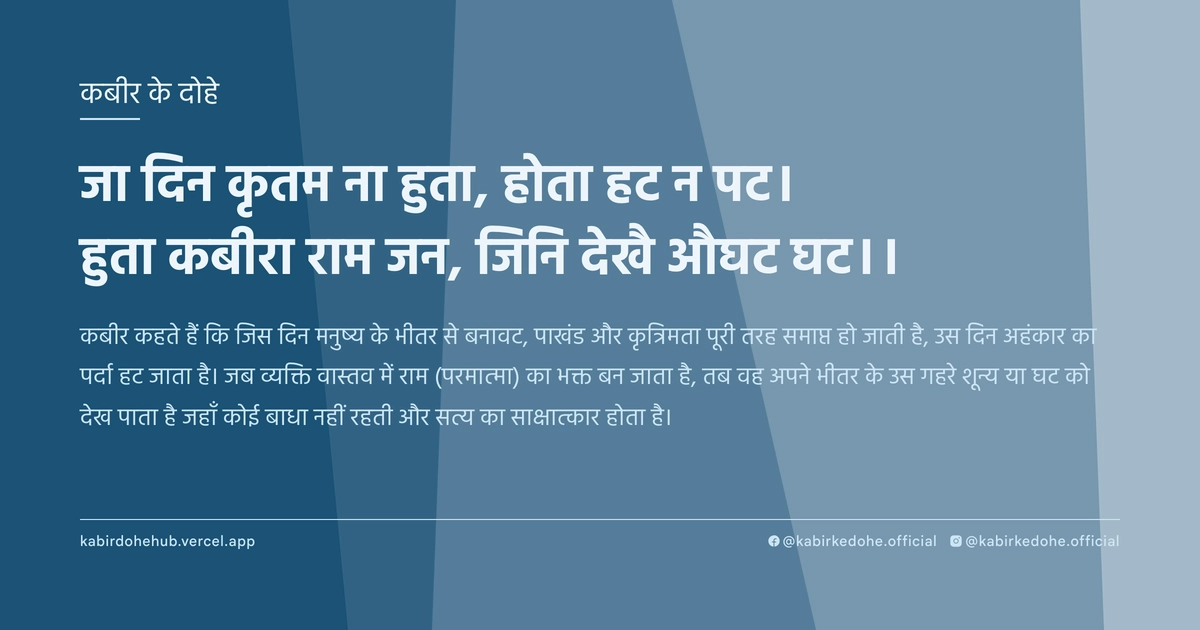
जा दिन कृतम ना हुता, होता हट न पट।
हुता कबीरा राम जन, जिनि देखै औघट घट।।
Ja din kritam na huta, hota hat na pat. Huta Kabira Ram jan, jini dekhe aughat ghat.
इस पृष्ठ पर इस कबीर दोहे का अर्थ (meaning), हिंदी व्याख्या और अंग्रेज़ी अनुवाद, दार्शनिक विश्लेषण और व्यावहारिक जीवन सीख दी गई है। यह दोहा सहज योग (Sahaja Yoga) विषय से जुड़ा है — Kabir doha meaning and explanation in Hindi and English.
अर्थ (Meaning):
कबीर कहते हैं कि जिस दिन मनुष्य के भीतर से बनावट, पाखंड और कृत्रिमता पूरी तरह समाप्त हो जाती है, उस दिन अहंकार का पर्दा हट जाता है। जब व्यक्ति वास्तव में राम (परमात्मा) का भक्त बन जाता है, तब वह अपने भीतर के उस गहरे शून्य या घट को देख पाता है जहाँ कोई बाधा नहीं रहती और सत्य का साक्षात्कार होता है।
Kabir asserts that the day artificiality, hypocrisy, and pretense vanish from a human being, the veil of ego is lifted. When one truly becomes a devotee of the Divine (Ram), they are able to perceive the profound inner vessel of the soul, devoid of obstacles, where the ultimate truth resides in its purest form.
व्याख्या (Interpretation):
इस दोहे का शाब्दिक अर्थ है कि बनावट के अभाव में ही सत्य का उदय होता है। यहाँ "कृतम" का अर्थ है सामाजिक मुखौटे और धार्मिक पाखंड। जब यह कृत्रिमता समाप्त होती है, तो "पट" यानी अहंकार का पर्दा गिर जाता है। यह निर्गुण भक्ति का सार है, जहाँ ईश्वर किसी मूर्ति में नहीं बल्कि शुद्ध चेतना में है। अद्वैत वेदांत के अनुसार, जब 'मैं' (अहंकार) मिटता है, तब केवल 'ब्रह्म' शेष रहता है। यह विरोधाभास है कि जिसे हम खोजने बाहर जाते हैं, वह हमारे भीतर ही है, बस बनावट की परतों के नीचे दबा हुआ है। आत्मा और परमात्मा का मिलन तभी संभव है जब बीच की सारी कृत्रिम दीवारें ढह जाएँ।
Literally, the verse suggests that truth emerges only in the absence of fabrication. "Kritam" refers to the social masks and religious hypocrisies we wear. When this artificiality ceases, the "Pat" or the veil of ego falls. This is the essence of Nirgun Bhakti, where the Divine is not found in idols but in pure consciousness. According to Advaita Vedanta, when the 'I' (ego) dissolves, only 'Brahman' remains. It is a profound paradox: that which we seek externally is hidden within us, buried under layers of pretense. The union of Atman and Brahman is only possible when all artificial barriers are demolished.
दार्शनिक विश्लेषण (Philosophical Analysis):
कबीर का यह दोहा उनके युग के कट्टरपंथी धार्मिक अनुष्ठानों और बाहरी दिखावे पर एक तीखा प्रहार है। उन्होंने देखा कि लोग तीर्थयात्राओं और माला जपने में व्यस्त थे, जबकि उनके हृदय घृणा और अहंकार से भरे थे। कबीर का दर्शन 'सहज' मार्ग का है, जो किसी बाहरी कर्मकांड की अपेक्षा आंतरिक शुद्धि पर जोर देता है।
यह विचार सूफीवाद के 'फना' (अहंकार का विनाश) के सिद्धांत से मेल खाता है, जहाँ साधक अपनी व्यक्तिगत पहचान को ईश्वर की इच्छा में विलीन कर देता है। कबीर यहाँ यह समझा रहे हैं कि भक्ति कोई बाहरी प्रदर्शन नहीं, बल्कि एक आंतरिक मनोवैज्ञानिक रूपांतरण है। जब तक हम 'भक्त' होने का नाटक करते हैं, हम वास्तव में भक्त नहीं होते; जिस क्षण नाटक समाप्त होता है, वहीं से वास्तविक भक्ति शुरू होती है।
अद्वैत वेदांत के परिप्रेक्ष्य में, यह 'माया' के पर्दे को हटाने की प्रक्रिया है। माया वह भ्रम है जो हमें यह विश्वास दिलाता है कि हम शरीर हैं या सामाजिक पदवियों से परिभाषित हैं। कबीर कहते हैं कि यह 'कृतम' या कृत्रिमता ही वह सबसे बड़ी बाधा है जो जीव को उसके वास्तविक स्वरूप से अलग करती है।
सामाजिक स्तर पर, कबीर जाति और वर्ण व्यवस्था को इसी 'कृतम' का हिस्सा मानते थे। उनके लिए ऊंच-नीच का भेद केवल एक सामाजिक मुखौटा था। जब व्यक्ति स्वयं को केवल एक 'राम जन' (ईश्वर का अंश) के रूप में देखता है, तो वह जातिगत श्रेष्ठता के भ्रम से मुक्त हो जाता है।
अंततः, यह दोहा हमें सिखाता है कि आध्यात्मिक प्रगति का अर्थ कुछ नया जोड़ना नहीं, बल्कि जो अनावश्यक है उसे हटाना है। सत्य कोई गंतव्य नहीं है जिसे प्राप्त किया जाए, बल्कि वह एक उपस्थिति है जो तब प्रकट होती है जब हम अपनी बनावट को त्याग देते हैं।
This couplet is a sharp critique of the rigid religious rituals and outward displays of piety prevalent during Kabir's era. He observed people immersed in pilgrimages and repetitive chanting while their hearts remained filled with hatred and ego. Kabir's philosophy is that of the 'Sahaj' (spontaneous) path, emphasizing internal purification over external ceremony.
This concept aligns with the Sufi principle of 'Fana' (annihilation of the self), where the seeker dissolves their personal identity into the Divine Will. Kabir explains that devotion is not an external performance but a profound psychological transformation. As long as we pretend to be 'devotees,' we are not; the moment the act ends, true devotion begins.
From the perspective of Advaita Vedanta, this is the process of lifting the veil of 'Maya.' Maya is the illusion that convinces us we are merely the body or defined by social titles. Kabir posits that this 'Kritam' or artificiality is the primary obstacle separating the individual soul from its true essence.
On a social level, Kabir viewed the caste system as a manifestation of this artificiality. To him, the distinctions of high and low were merely social masks. When a person perceives themselves solely as a 'Ram Jan' (a spark of the Divine), they are liberated from the illusion of caste superiority.
Ultimately, this verse teaches us that spiritual progress is not about adding something new, but about removing what is unnecessary. Truth is not a destination to be reached, but a presence that reveals itself once we discard our fabrications.
मूल संदेश (Core Message):
- बनावट सत्य की सबसे बड़ी शत्रु है।
- अहंकार का पर्दा गिरने पर ही परमात्मा दिखता है।
- भक्ति प्रदर्शन नहीं, बल्कि आंतरिक समर्पण है।
- मुखौटों को त्यागना ही वास्तविक आध्यात्मिक जागृति है।
- जब 'मैं' मिटता है, तब 'राम' प्रकट होते हैं।
- शुद्धता बाहरी कर्मकांडों में नहीं, आंतरिक ईमानदारी में है।
- Artificiality is the greatest enemy of Truth.
- The Divine is revealed only when the veil of ego falls.
- Devotion is not a performance, but an internal surrender.
- Shedding masks is the true act of spiritual awakening.
- When the 'I' vanishes, 'Ram' manifests.
- Purity lies not in rituals, but in inner honesty.
व्यावहारिक उदाहरण (Practical Example):
वाराणसी के एक पुराने घाट पर माधव नाम का एक वृद्ध बुनकर रहता था। वह शहर भर में अपनी ईमानदारी और सादगी के लिए जाना जाता था, लेकिन उसके मन में एक गहरा द्वंद्व था। वह हर दिन मंदिर जाता, घंटों पूजा करता और दूसरों को धर्म का उपदेश देता, लेकिन भीतर ही भीतर वह अपनी गरीबी और अपनी सामाजिक स्थिति को लेकर बहुत कुंठित था। वह दुनिया को यह दिखाना चाहता था कि वह एक महान भक्त है, इसलिए उसने एक विशेष प्रकार का धार्मिक आचरण अपना लिया था जो वास्तव में उसकी आंतरिक रिक्तता को छिपाने का एक मुखौटा था।
एक दिन, उसकी मुलाकात एक घुमंतू साधु से हुई जिसने माधव के चेहरे पर उस 'पवित्रता' के पीछे छिपे तनाव को भांप लिया। साधु ने उससे पूछा, "माधव, तुम इस भारी वस्त्र को क्यों ओढ़े हुए हो, जबकि धूप इतनी तेज है?" माधव ने कहा, "यह मेरी मर्यादा है, मेरी पहचान है।"
साधु मुस्कुराए और बोले, "मर्यादा वह है जो तुम्हें भीतर से मुक्त करे, वह नहीं जो तुम्हें एक बोझ की तरह ढोना पड़े। तुम्हारी भक्ति भी इस वस्त्र की तरह है—बाहर से सुंदर, लेकिन भीतर से तुम्हें घुटन दे रही है।"
माधव को पहली बार महसूस हुआ कि उसका पूरा धार्मिक जीवन एक 'कृतम' यानी बनावट थी। वह दूसरों की नजरों में 'भक्त' बनना चाहता था, न कि वास्तव में ईश्वर से जुड़ना चाहता था। उस रात माधव घंटों तक रोया और उसने अपने भीतर के उस अहंकार को स्वीकार किया जो उसे श्रेष्ठ दिखाने की कोशिश कर रहा था।
अगले दिन, माधव ने अपनी दिखावटी पूजा छोड़ दी। उसने अब मंदिर जाना बंद नहीं किया, लेकिन अब वह वहां यह दिखाने नहीं जाता था कि वह कितना बड़ा भक्त है। उसने अपनी सादगी को अपना लिया और दूसरों की मदद करना शुरू किया, बिना यह सोचे कि लोग उसके बारे में क्या कहेंगे।
जैसे ही उसने 'भक्त' होने का नाटक छोड़ा, उसे महसूस हुआ कि उसके भीतर एक अद्भुत शांति व्याप्त हो गई है। वह अब केवल राम का नाम नहीं ले रहा था, बल्कि वह हर इंसान में राम को देखने लगा था।
उसका अहंकार, जो एक भारी पर्दे की तरह उसकी दृष्टि को रोक रहा था, अब हट चुका था। वह अब वास्तव में एक 'राम जन' बन गया था, क्योंकि उसने अपनी बनावट को त्याग दिया था।
माधव की जिंदगी अब एक प्रदर्शन नहीं, बल्कि एक प्रार्थना बन गई थी। उसने पाया कि जब उसने खुद को दुनिया के सामने सिद्ध करना बंद किया, तभी वह वास्तव में स्वयं से और परमात्मा से मिल पाया।
On an old ghat in Varanasi lived an elderly weaver named Madhav. He was known throughout the city for his honesty and simplicity, yet a deep conflict raged within him. Every day he visited the temple, prayed for hours, and preached religion to others, but internally he was deeply frustrated by his poverty and social standing. He wanted the world to see him as a great devotee, so he adopted a specific religious persona—a mask to hide his inner void.
One day, he met a wandering monk who sensed the tension hidden behind Madhav's 'piety.' The monk asked, "Madhav, why do you wear this heavy cloak when the sun is so fierce?" Madhav replied, "This is my dignity, my identity."
The monk smiled and said, "Dignity is that which sets you free from within, not that which you must carry like a burden. Your devotion is like this cloak—beautiful on the outside, but suffocating you within."
For the first time, Madhav realized that his entire religious life was 'Kritam'—a fabrication. He wanted to be seen as a 'devotee' in the eyes of others, rather than actually connecting with the Divine. That night, Madhav wept for hours, acknowledging the ego that had been trying to make him appear superior.
The next day, Madhav abandoned his performative worship. He didn't stop visiting the temple, but he no longer went there to demonstrate how great a devotee he was. He embraced his simplicity and began helping others without worrying about public perception.
As soon as he stopped pretending to be a devotee, he felt a wonderful peace permeate his being. He was no longer just chanting the name of Ram; he began to see Ram in every human being.
His ego, which had been blocking his vision like a heavy curtain, had finally fallen. He had truly become a 'Ram Jan' because he had discarded his artificiality.
Madhav's life was no longer a performance, but a prayer. He discovered that when he stopped trying to prove himself to the world, he was finally able to meet himself and the Divine.
अभ्यास मार्गदर्शन (Practice Guidance):
- दैनिक आत्म-निरीक्षण: प्रतिदिन 15 मिनट मौन बैठें और विचार करें कि आज आपने कितनी बार अपनी वास्तविक भावनाओं को छिपाने के लिए 'सामाजिक मुखौटा' पहना।
- ईमानदार लेखन: एक निजी जर्नल रखें जहाँ आप अपनी उन इच्छाओं और ईर्ष्याओं को लिखें जिन्हें आप दुनिया के सामने 'पवित्र' होने के नाटक के कारण स्वीकार नहीं करते।
- अहंकार का विसर्जन: दिन में कम से कम एक बार ऐसा कार्य करें जिसमें आपको कोई श्रेय न मिले और कोई आपकी प्रशंसा न करे, ताकि आपकी 'पहचान' की भूख कम हो सके।
- निदान चेकलिस्ट: स्वयं से पूछें—क्या मैं यह कार्य इसलिए कर रहा हूँ क्योंकि यह सही है, या इसलिए कि लोग मुझे 'अच्छा' या 'धार्मिक' समझेंगे? यदि उत्तर दूसरा है, तो आप 'कृतम' में जी रहे हैं।
- Daily Self-Observation: Sit in silence for 15 minutes daily and reflect on how many times you wore a 'social mask' today to hide your true emotions.
- Honest Journaling: Maintain a private journal to record the desires and envies you refuse to acknowledge publicly due to the pretense of being 'pious.'
- Ego Dissolution: Perform at least one act of service daily that brings no credit or praise, specifically to starve the hunger for identity and recognition.
- Diagnostic Checklist: Ask yourself—'Am I doing this because it is right, or because I want people to perceive me as good or religious?' If the latter, you are living in 'Kritam'.
चिंतन प्रश्न (Reflection Questions):
- मेरे जीवन का वह कौन सा हिस्सा है जिसे मैं दुनिया के सामने 'आदर्श' दिखाता हूँ, जबकि भीतर मैं उससे बिल्कुल अलग हूँ?
- क्या मेरी धार्मिकता वास्तव में ईश्वर के प्रति प्रेम है, या यह केवल मेरी सामाजिक प्रतिष्ठा को बढ़ाने का एक साधन है?
- यदि कल मेरी सारी सामाजिक पहचान (पद, प्रतिष्ठा, धर्म) छीन ली जाए, तो मेरे पास क्या बचेगा?
- मैं किन लोगों के सामने सबसे अधिक 'बनावटी' होता हूँ और वह डर क्या है जो मुझे वास्तविक होने से रोकता है?
- क्या मैं अपनी कमियों को स्वीकार करने से डरता हूँ क्योंकि मुझे लगता है कि इससे मेरी 'पवित्र' छवि धूमिल हो जाएगी?
- मेरे भीतर का वह कौन सा 'पर्दा' है जो मुझे दूसरों में ईश्वर देखने से रोक रहा है?
- Which part of my life do I present as 'ideal' to the world, while being completely different within?
- Is my religiosity truly love for the Divine, or is it merely a tool to enhance my social status?
- If all my social identities (rank, prestige, religion) were stripped away tomorrow, what would remain of me?
- With whom am I most 'artificial,' and what is the fear that prevents me from being authentic?
- Do I fear acknowledging my flaws because I believe they will tarnish my 'pious' image?
- What is the 'veil' within me that prevents me from seeing the Divine in others?