
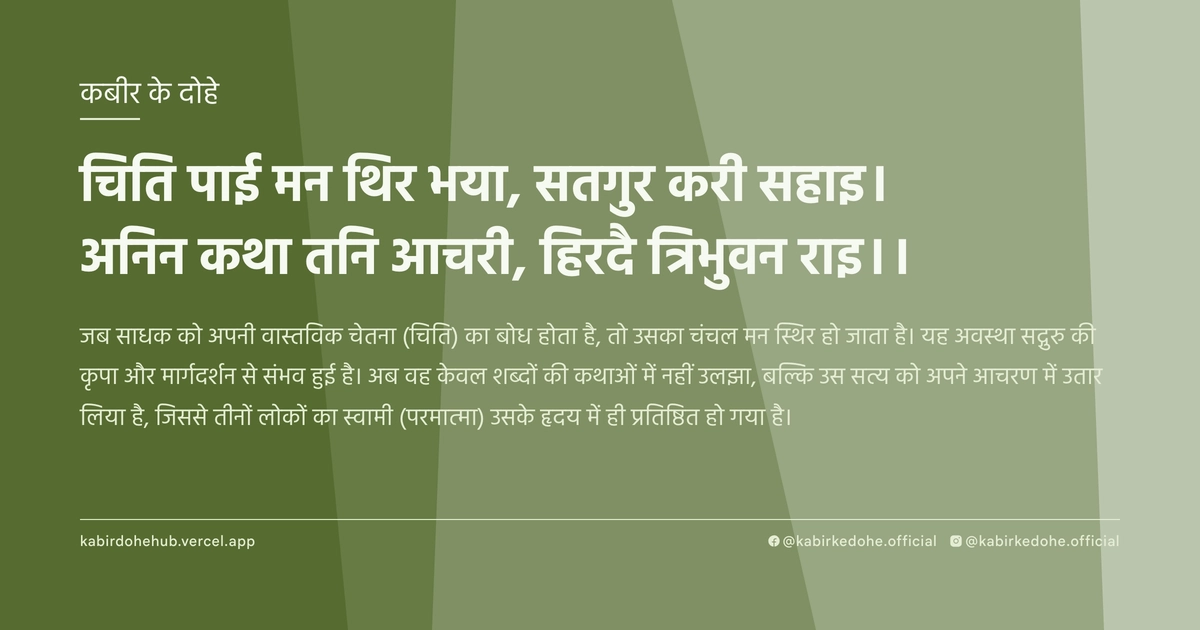
चिति पाई मन थिर भया, सतगुर करी सहाइ।
अनिन कथा तनि आचरी, हिरदै त्रिभुवन राइ।।
Chiti pai man thir bhaya, satgur kari sahai. Anin katha tani aachari, hirdae tribhuvan rai.
इस पृष्ठ पर इस कबीर दोहे का अर्थ (meaning), हिंदी व्याख्या और अंग्रेज़ी अनुवाद, दार्शनिक विश्लेषण और व्यावहारिक जीवन सीख दी गई है। यह दोहा गुरु महत्व (The Guru's Importance) विषय से जुड़ा है — Kabir doha meaning and explanation in Hindi and English.
अर्थ (Meaning):
जब साधक को अपनी वास्तविक चेतना (चिति) का बोध होता है, तो उसका चंचल मन स्थिर हो जाता है। यह अवस्था सद्गुरु की कृपा और मार्गदर्शन से संभव हुई है। अब वह केवल शब्दों की कथाओं में नहीं उलझा, बल्कि उस सत्य को अपने आचरण में उतार लिया है, जिससे तीनों लोकों का स्वामी (परमात्मा) उसके हृदय में ही प्रतिष्ठित हो गया है।
Once the seeker realizes the pure consciousness (Chiti), the restless mind attains absolute stillness. This transformation is made possible through the grace and guidance of the True Guru. No longer captivated by mere stories or theoretical scriptures, the seeker has embodied the truth in their conduct, resulting in the Lord of the three worlds residing eternally within their own heart.
व्याख्या (Interpretation):
यह दोहा चेतना के जागरण और मन के लय होने की प्रक्रिया का वर्णन करता है। 'चिति' यहाँ शुद्ध चैतन्य या आत्म-तत्व का प्रतीक है, जिसे प्राप्त करते ही द्वंद्व समाप्त हो जाते हैं। सद्गुरु यहाँ केवल एक व्यक्ति नहीं, बल्कि वह दिव्य ऊर्जा है जो अज्ञान के पर्दे को हटाती है। जब ज्ञान केवल बौद्धिक विमर्श (कथा) न रहकर व्यवहार (आचरण) बन जाता है, तब साधक को अनुभव होता है कि जिसे वह बाहर खोज रहा था, वह 'त्रिभुवन राइ' वास्तव में उसके हृदय के केंद्र में ही स्थित है। यह अद्वैत वेदांत के उस सत्य को दर्शाता है जहाँ आत्मा और ब्रह्म का भेद मिट जाता है। माया का प्रभाव तब समाप्त होता है जब बाहरी शोर आंतरिक मौन में बदल जाता है। अंततः, यह मन की स्थिरता और परमात्मा के साक्षात्कार के बीच के अटूट संबंध को स्पष्ट करता है।
This couplet describes the process of awakening consciousness and the subsequent dissolution of the restless mind. 'Chiti' symbolizes pure consciousness or the Atman; upon realizing this, all dualities vanish. The 'Satguru' here is not merely a physical teacher but the divine catalyst that removes the veil of ignorance. When knowledge transcends theoretical discourse (katha) and manifests as lived experience (aachari), the seeker realizes that the 'Lord of the Three Worlds' is not a distant deity but resides within the heart. This aligns with Advaita Vedanta, where the distinction between the individual soul and the Universal Brahman dissolves. The influence of Maya ceases when external noise is replaced by internal silence. Ultimately, it highlights the paradox that the furthest journey—to the divine—is actually a journey inward to the center of one's own being.
दार्शनिक विश्लेषण (Philosophical Analysis):
कबीर का यह दर्शन निर्गुण भक्ति की पराकाष्ठा है, जहाँ ईश्वर को किसी मूर्ति, मंदिर या मस्जिद में नहीं, बल्कि स्वयं की चेतना में खोजा जाता है। उनके समय में धर्म केवल कर्मकांडों और बाहरी आडंबरों तक सीमित था, जिसे कबीर ने सिरे से नकार दिया। उन्होंने तर्क दिया कि यदि परमात्मा सर्वव्यापी है, तो उसे बाहर खोजने का प्रयास व्यर्थ है। यह दृष्टिकोण सूफी मत के 'अनल हक़' (मैं ही सत्य हूँ) और वेदांत के 'अहं ब्रह्मास्मि' के अत्यंत निकट है।
यहाँ 'मन की स्थिरता' का अर्थ निष्क्रियता नहीं, बल्कि वह संतुलन है जहाँ इच्छाएं और अहंकार समाप्त हो जाते हैं। कबीर समझाते हैं कि आध्यात्मिक प्रगति केवल ग्रंथों को पढ़ने से नहीं, बल्कि उन्हें जीने से होती है। जब तक ज्ञान 'कथा' है, वह बोझ है; जब वह 'आचरण' बनता है, तब वह मुक्ति का मार्ग बन जाता है। यह मनोवैज्ञानिक रूपांतरण की वह अवस्था है जहाँ 'मैं' का विलोपन होता है और केवल 'वह' शेष रहता है।
कबीर ने जाति और वर्ग के बंधनों को तोड़कर यह संदेश दिया कि आत्म-साक्षात्कार का अधिकार हर उस व्यक्ति को है जो सत्य के प्रति समर्पित है। उन्होंने बताया कि अहंकार ही वह सबसे बड़ी बाधा है जो मनुष्य को उसके आंतरिक ईश्वर से अलग करती है। जब सद्गुरु की कृपा से यह अहंकार टूटता है, तब हृदय वह पवित्र स्थान बन जाता है जहाँ संपूर्ण ब्रह्मांड समाहित है।
इस विश्लेषण में यह स्पष्ट है कि कबीर केवल एक कवि नहीं, बल्कि एक मनोवैज्ञानिक थे जिन्होंने जाना कि मन की चंचलता ही दुख का मूल कारण है। उन्होंने 'चिति' (Pure Consciousness) को प्राप्त करने का मार्ग बताया, जो ध्यान और आत्म-निरीक्षण के माध्यम से संभव है। यह मार्ग किसी विशेष धर्म का नहीं, बल्कि मानवता के सार्वभौमिक सत्य का मार्ग है।
अंततः, यह दोहा हमें सिखाता है कि वास्तविक धर्म वह है जो हमें स्वयं से मिलाए। जब साधक अपने भीतर के शून्य में पूर्णता को पाता है, तब वह संसार के द्वंद्वों से ऊपर उठ जाता है। यह स्थिति मोक्ष की वह अवस्था है जहाँ व्यक्ति जीवित रहते हुए भी जीते-जी मुक्त (जीवन्मुक्ति) हो जाता है, क्योंकि उसका केंद्र अब बाहरी जगत नहीं, बल्कि आंतरिक अनंतता है।
Kabir's philosophy here represents the pinnacle of Nirgun Bhakti, where the Divine is sought not in idols, temples, or mosques, but within one's own consciousness. In his era, religion was largely reduced to ritualism and external displays, which Kabir vehemently rejected. He argued that if the Divine is omnipresent, searching for it externally is a futile endeavor. This perspective closely aligns with the Sufi concept of 'Anal Haq' (I am the Truth) and the Vedantic 'Aham Brahmasmi' (I am Brahman).
The 'stillness of the mind' mentioned is not a state of passivity, but a profound equilibrium where desires and the ego are extinguished. Kabir emphasizes that spiritual progress does not stem from the mere study of scriptures, but from embodying that truth in one's conduct. As long as knowledge remains a 'story' (katha), it is a burden; when it becomes 'conduct' (aachari), it becomes the path to liberation. This is a psychological transformation where the 'I' is annihilated, leaving only the 'Absolute'.
By dismantling caste and class barriers, Kabir asserted that the right to self-realization belongs to anyone sincerely devoted to the Truth. He identified the ego as the primary obstacle separating the human from the inner Divinity. When this ego is shattered by the grace of the Satguru, the heart becomes the sacred sanctuary where the entire universe resides.
In this analysis, it is evident that Kabir was not just a poet but a spiritual psychologist who recognized that the restlessness of the mind is the root of all suffering. He proposed the attainment of 'Chiti' (Pure Consciousness) through meditation and rigorous self-inquiry. This path transcends specific religious labels, offering a universal trajectory for all of humanity.
Ultimately, this couplet teaches us that true religion is that which reunites us with our own essence. When a seeker finds wholeness within the inner void, they rise above the dualities of the world. This state is known as Jivanmukti (liberation while living), where the individual's center of gravity shifts from the external world to the internal infinity.
मूल संदेश (Core Message):
- बाहरी शोर को शांत कर आंतरिक मौन को पहचानें।
- ज्ञान जब तक व्यवहार में न उतरे, वह केवल बोझ है।
- सद्गुरु वह प्रकाश है जो हमें स्वयं के भीतर ले जाता है।
- परमात्मा कोई बाहरी सत्ता नहीं, बल्कि शुद्ध चेतना है।
- मन की स्थिरता ही वास्तविक आध्यात्मिक उपलब्धि है।
- अहंकार का विलोपन ही ईश्वर के मिलन की एकमात्र शर्त है।
- Silence the external noise to recognize the internal stillness.
- Knowledge is a burden until it is translated into lived conduct.
- The True Guru is the light that leads us back to ourselves.
- The Divine is not an external entity, but pure consciousness.
- The stillness of the mind is the only true spiritual achievement.
- The annihilation of the ego is the sole condition for union with God.
व्यावहारिक उदाहरण (Practical Example):
वाराणसी के घाटों पर रहने वाले एक वृद्ध विधवा, जानकी की कहानी है। जानकी ने अपना पूरा जीवन कठोर नियमों, उपवासों और घंटों तक चलने वाले मंत्रोच्चार में बिता दिया था। वह मानती थी कि मोक्ष केवल बाहरी शुद्धता और कठिन तपस्या से मिलेगा। वह हर दिन गंगा स्नान करती और घंटों मंदिर में बैठती, लेकिन उसके मन में हमेशा यह डर रहता कि क्या वह पर्याप्त 'पवित्र' है। उसका मन अशांत था, और वह अक्सर दूसरों के आचरण पर टिप्पणी करती थी।
एक दिन उसकी मुलाकात एक घुमक्कड़ साधु से हुई, जो किसी मंदिर में नहीं गया, बल्कि चुपचाप एक पेड़ के नीचे बैठा था। जानकी ने उससे पूछा, "आप इतनी पूजा-पाठ क्यों नहीं करते? क्या आपको ईश्वर नहीं मिलते?" साधु ने मुस्कुराकर कहा, "माँ, तुम नदी में शरीर धो रही हो, लेकिन क्या तुमने अपने मन के भीतर की गंदगी को देखा है? ईश्वर मंदिर की दीवारों में नहीं, बल्कि उस शांति में है जो तब आती है जब तुम सोचना बंद कर देती हो।"
यह बात जानकी के हृदय पर गहरा प्रहार कर गई। उसने महसूस किया कि उसकी सारी पूजा केवल एक 'कथा' थी—एक ऐसा नाटक जिसे वह समाज को दिखाने के लिए कर रही थी। उसने तय किया कि वह अब केवल मंत्र नहीं रटेगी, बल्कि मौन का अभ्यास करेगी। उसने अपनी बाहरी दिखावे की तपस्या को छोड़कर अपने भीतर झांकना शुरू किया।
शुरुआत में यह बहुत कठिन था। उसका मन उसे पुराने ढर्रे पर लौटने के लिए उकसाता था। वह डरती थी कि यदि वह मंदिर नहीं गई, तो लोग क्या कहेंगे। लेकिन उसने धीरे-धीरे अपनी चेतना को वर्तमान क्षण में लाना शुरू किया। उसने पाया कि जब वह चुप होती है, तो उसके भीतर एक असीम शांति का अनुभव होता है, जो उसे किसी भी मंत्रोच्चार से नहीं मिला था।
समय के साथ, जानकी का व्यवहार बदलने लगा। वह अब दूसरों की गलतियाँ नहीं निकालती थी, बल्कि सबके प्रति करुणा से भर गई। उसकी शांति अब उसके चेहरे पर झलकने लगी थी। वह अब भी गंगा स्नान करती थी, लेकिन अब वह केवल शरीर नहीं, बल्कि अपनी आत्मा को उस अनंत चेतना में विलीन करने का प्रयास करती थी।
एक दिन, जब वह घाट पर बैठी थी, उसे महसूस हुआ कि वह और वह नदी, वह आकाश और वह परमात्मा अलग-अलग नहीं हैं। उसे वह 'चिति' प्राप्त हो गई थी। उसका मन पूरी तरह स्थिर हो गया था। अब उसे किसी बाहरी प्रमाण या गुरु के उपदेशों की आवश्यकता नहीं थी, क्योंकि वह स्वयं सत्य बन चुकी थी।
उसने महसूस किया कि जिसे वह जीवन भर बाहर खोज रही थी, वह उसके अपने ही हृदय में 'त्रिभुवन राइ' के रूप में विराजमान था। उसकी बाहरी तपस्या अब आंतरिक रूपांतरण में बदल चुकी थी। वह अब एक ऐसी स्थिति में थी जहाँ उसे न तो स्वर्ग का लालच था और न ही नरक का भय।
जानकी की यह यात्रा दिखाती है कि कैसे एक व्यक्ति कर्मकांडों के जाल से निकलकर वास्तविक चेतना की प्राप्ति करता है। उसका जीवन अब एक जीवित उदाहरण था कि सत्य शब्दों में नहीं, बल्कि आचरण में होता है। वह अब वाराणसी की गलियों में एक ऐसी ज्योति बन गई थी, जो बिना कुछ कहे दूसरों को शांति का मार्ग दिखाती थी।
This is the story of Janaki, an elderly widow living on the ghats of Varanasi. Janaki had spent her entire life adhering to rigid rules, fasting, and spending hours in chanting mantras. She believed that salvation could only be achieved through external purity and rigorous penance. Every day she bathed in the Ganges and sat in temples for hours, yet her mind was plagued by the fear of whether she was 'pure' enough. Her mind was restless, and she often judged the conduct of others.
One day, she encountered a wandering monk who did not enter any temple but sat silently under a tree. Janaki asked him, "Why do you not engage in such prayers? Do you not seek God?" The monk smiled and replied, "Mother, you are washing your body in the river, but have you looked at the filth within your own mind? God is not within the walls of a temple, but in the silence that arrives when you stop thinking."
These words struck a chord deep within Janaki. She realized that all her rituals were merely a 'story' (katha)—a performance she played for society. She decided that she would no longer just recite mantras but would practice silence. She abandoned the outward show of penance and began to look inward.
Initially, this was incredibly difficult. Her mind urged her to return to her old habits. She feared what people would say if she stopped visiting the temple. However, she gradually began to bring her consciousness into the present moment. She discovered that in silence, she experienced a boundless peace that no amount of chanting had ever provided.
Over time, Janaki's behavior began to change. She stopped criticizing others and became filled with compassion. Her inner peace began to radiate from her face. She still bathed in the Ganges, but now she sought to merge her soul with the infinite consciousness rather than just cleaning her skin.
One day, while sitting on the ghat, she felt that she, the river, the sky, and the Divine were not separate entities. She had attained that 'Chiti'. Her mind became completely still. She no longer needed external proofs or the sermons of gurus because she had become the Truth herself.
She realized that the one she had been searching for all her life was residing within her own heart as the 'Lord of the Three Worlds'. Her external penance had finally transformed into internal realization. She reached a state where neither the lure of heaven nor the fear of hell could touch her.
Janaki's journey illustrates how an individual escapes the trap of ritualism to achieve real consciousness. Her life became a living testament that truth does not lie in words, but in conduct. She became a beacon of light in the alleys of Varanasi, guiding others toward peace without uttering a single word.
अभ्यास मार्गदर्शन (Practice Guidance):
- प्रतिदिन 20 मिनट का 'साक्षी भाव' ध्यान करें, जहाँ आप अपने विचारों को बिना किसी निर्णय के केवल देखते रहें, जब तक कि मन स्थिर न हो जाए।
- एक 'आचरण डायरी' बनाएँ: दिन भर में आपने कितनी बार अपने ज्ञान को व्यवहार में बदला (जैसे क्रोध के समय मौन रहना) और कितनी बार केवल शब्दों तक सीमित रहे।
- स्व-पूछताछ (Self-Inquiry) का अभ्यास करें: जब भी मन विचलित हो, स्वयं से पूछें, "यह विचार कौन कर रहा है?" और उस विचार के पीछे छिपे दृष्टा को खोजने का प्रयास करें।
- निदान चेकलिस्ट (Diagnostic Checklist): क्या मैं अभी भी दूसरों के धर्म/आचरण की आलोचना कर रहा हूँ? क्या मेरी शांति बाहरी परिस्थितियों पर निर्भर है? यदि हाँ, तो इसका अर्थ है कि मैं अभी भी 'कथा' में हूँ, 'आचरण' में नहीं।
- Practice 20 minutes of 'Witness Consciousness' meditation daily, observing your thoughts without judgment until the mind attains a state of stillness.
- Maintain a 'Conduct Journal': Record instances where you translated your spiritual knowledge into action (e.g., choosing silence over anger) versus times you remained trapped in theoretical belief.
- Engage in Self-Inquiry: Whenever the mind becomes restless, ask yourself, "Who is the one thinking this thought?" and attempt to locate the observer behind the thought.
- Diagnostic Checklist: Am I still criticizing the rituals or conduct of others? Is my peace dependent on external circumstances? If yes, it indicates that I am still living in the 'story' (katha) rather than the 'embodiment' (aachari).
चिंतन प्रश्न (Reflection Questions):
- मेरे जीवन में 'धर्म' केवल एक सामाजिक पहचान है या यह मेरे व्यवहार में गहराई से रचा-बसा है?
- मैं अपनी आध्यात्मिक प्रगति को मापने के लिए किन बाहरी पैमानों का उपयोग करता हूँ, और वे कितने भ्रामक हैं?
- वह कौन सा आंतरिक डर है जो मुझे पूरी तरह से मौन होने और स्वयं का सामना करने से रोकता है?
- क्या मेरी 'भक्ति' वास्तव में ईश्वर के प्रति है, या यह मेरी अपनी छवि को 'पवित्र' बनाने का एक प्रयास है?
- यदि मेरे जीवन से सभी धार्मिक लेबल हटा दिए जाएँ, तो मेरे आचरण में क्या शेष बचेगा?
- मैं कितनी बार सत्य को बोलने के बजाय सत्य जैसा दिखने का ढोंग करता हूँ?
- Is 'religion' in my life merely a social identity, or is it deeply embedded in my actual behavior?
- What external metrics do I use to measure my spiritual progress, and how deceptive are they?
- What is the internal fear that prevents me from becoming completely silent and facing my true self?
- Is my 'devotion' truly toward the Divine, or is it an attempt to construct a 'holy' image of myself?
- If all religious labels were stripped away from my life, what would remain of my conduct?
- How often do I pretend to be truthful rather than actually embodying the truth?