
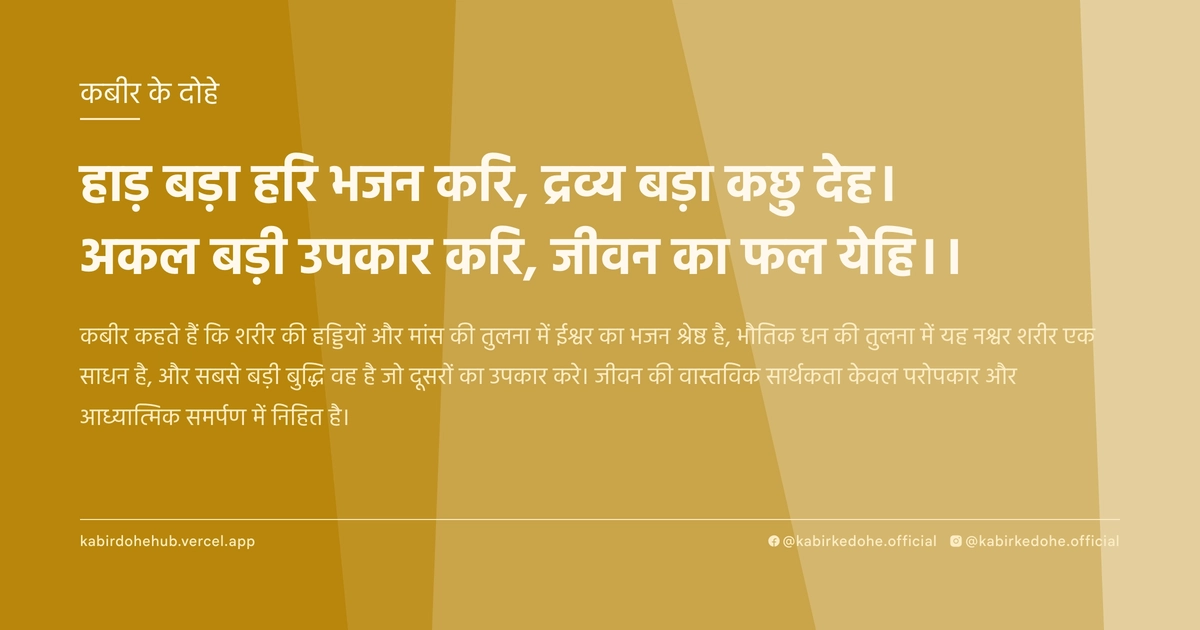
हाड़ बड़ा हरि भजन करि, द्रव्य बड़ा कछु देह।
अकल बड़ी उपकार करि, जीवन का फल येहि।।
Haad bada hari bhajan kari, dravya bada kachu deh. Akal badi upkaar kari, jeevan ka phal yehi.
इस पृष्ठ पर इस कबीर दोहे का अर्थ (meaning), हिंदी व्याख्या और अंग्रेज़ी अनुवाद, दार्शनिक विश्लेषण और व्यावहारिक जीवन सीख दी गई है। यह दोहा करुणा (Compassion) विषय से जुड़ा है — Kabir doha meaning and explanation in Hindi and English.
अर्थ (Meaning):
कबीर कहते हैं कि शरीर की हड्डियों और मांस की तुलना में ईश्वर का भजन श्रेष्ठ है, भौतिक धन की तुलना में यह नश्वर शरीर एक साधन है, और सबसे बड़ी बुद्धि वह है जो दूसरों का उपकार करे। जीवन की वास्तविक सार्थकता केवल परोपकार और आध्यात्मिक समर्पण में निहित है।
Kabir asserts that the devotion to the Divine is far superior to the mere physical existence of bone and flesh. While material wealth is fleeting, the body is a tool for spiritual growth. Ultimately, the highest intelligence is that which is used for the selfless service of others, as this is the true fruit of human life.
व्याख्या (Interpretation):
इस दोहे में कबीर भौतिकता और आध्यात्मिकता के बीच के द्वंद्व को स्पष्ट करते हैं। 'हाड़' और 'द्रव्य' शरीर और संपत्ति के प्रतीक हैं, जो अंततः नश्वर हैं। यहाँ 'हरि भजन' का अर्थ केवल कर्मकांड नहीं, बल्कि निर्गुण भक्ति है—उस निराकार सत्ता के साथ एकाकार होना। जब व्यक्ति अपनी बुद्धि (अकल) का उपयोग अहंकार की तुष्टि के बजाय 'उपकार' के लिए करता है, तो वह माया के बंधन से मुक्त हो जाता है। यह अद्वैत वेदांत के उस सिद्धांत को दर्शाता है जहाँ स्वयं को दूसरों में देखना ही वास्तविक ज्ञान है। आत्मा और परमात्मा का मिलन परोपकार के मार्ग से ही संभव है, क्योंकि सेवा ही अहंकार का विसर्जन है।
In this couplet, Kabir delineates the conflict between materialism and spirituality. 'Haad' (bone) and 'Dravya' (wealth) symbolize the physical and material realms, both of which are transient. 'Hari Bhajan' here does not refer to ritualistic prayer but to Nirgun Bhakti—the realization of the formless Absolute. When the intellect (Akal) is shifted from self-aggrandizement to 'Upkaar' (benevolence), the seeker transcends the veil of Maya. This aligns with Advaita Vedanta, where recognizing the self in others is the pinnacle of wisdom. The paradox is that the 'fruit of life' is found not in accumulation, but in the systematic annihilation of the ego through service, bridging the gap between Atman and Brahman.
दार्शनिक विश्लेषण (Philosophical Analysis):
कबीर का यह दृष्टिकोण उनके युग के कट्टरपंथी धार्मिक अनुष्ठानों और जातिगत श्रेष्ठता के विरुद्ध एक सशक्त प्रहार था। उन्होंने तर्क दिया कि मोक्ष किसी विशेष जाति में जन्म लेने या कठिन तपस्या से नहीं, बल्कि सरल हृदय और निस्वार्थ सेवा से मिलता है। यह दर्शन सूफीवाद के 'इश्क-ए-हकीकी' (दिव्य प्रेम) से मेल खाता है, जहाँ मानवता की सेवा ही ईश्वर की सच्ची इबादत है।
दार्शनिक स्तर पर, कबीर यहाँ 'साधन' और 'साध्य' के अंतर को समझा रहे हैं। शरीर और धन केवल साधन हैं; यदि इनका उपयोग केवल स्वयं के लिए किया जाए, तो वे बंधन बन जाते हैं। लेकिन यदि इन्हें परोपकार में लगाया जाए, तो ये मुक्ति के द्वार खोलते हैं। यह विचार कि 'बुद्धि' का उच्चतम स्तर 'उपकार' है, बौद्ध धर्म के करुणा सिद्धांत और वेदांत के लोक-संग्रह से प्रेरित है।
अहंकार (Ego) वह पर्दा है जो मनुष्य को उसकी वास्तविक प्रकृति से अलग करता है। जब व्यक्ति 'उपकार' करता है, तो वह 'मैं' और 'तू' के भेद को मिटाता है। यह मनोवैज्ञानिक रूपांतरण है जहाँ व्यक्ति अपनी पहचान को एक सीमित शरीर से बढ़ाकर संपूर्ण मानवता में विस्तारित करता है।
कबीर ritualism (कर्मकांड) को नकारते हुए आंतरिक शुद्धि पर बल देते हैं। उनके लिए 'भजन' का अर्थ है निरंतर जागरूकता और सजगता। वे चेतावनी देते हैं कि केवल शास्त्रों को पढ़ना या माला जपना व्यर्थ है यदि हृदय में करुणा नहीं है।
अंततः, यह दोहा जीवन के उद्देश्य को पुनर्परिभाषित करता है। जीवन का फल भौतिक उपलब्धियों में नहीं, बल्कि इस बात में है कि हमने अपनी चेतना को कितना विस्तृत किया। यह एक क्रांतिकारी आह्वान है कि हम अपनी जैविक और भौतिक सीमाओं से ऊपर उठकर सार्वभौमिक प्रेम को अपनाएं।
Kabir’s perspective serves as a potent critique of the rigid religious rituals and caste hierarchies prevalent during his era. He argued that liberation is not a byproduct of birthright or ascetic rigor, but of a simple heart and selfless service. This philosophy resonates deeply with the Sufi concept of 'Ishq-e-Haqiqi' (Divine Love), where serving humanity is viewed as the highest form of worship.
On a philosophical plane, Kabir distinguishes between the 'means' and the 'end.' The body and material wealth are merely instruments; if used solely for self-gratification, they become shackles. However, when channeled toward benevolence, they become gateways to liberation. The assertion that the highest intelligence is manifested as 'Upkaar' (benevolence) mirrors the Buddhist principle of Karuna (compassion) and the Vedantic ideal of Loka-Sangraha (universal welfare).
The Ego is the veil that separates the individual from their true nature. Through the act of selfless service, the practitioner dissolves the duality of 'I' and 'Thou.' This is a psychological metamorphosis where the identity expands from a limited biological entity to the collective consciousness of humanity.
Kabir explicitly rejects ritualism, emphasizing internal purification over external displays of piety. For him, 'Bhajan' is not a repetitive chant but a state of constant awareness and mindfulness. He warns that scriptural knowledge is hollow if it does not translate into active compassion.
Ultimately, this Doha redefines the purpose of existence. The 'fruit of life' is not found in material accumulation but in the expansion of consciousness. It is a revolutionary call to transcend biological and material limitations in favor of a universal, unconditional love.
मूल संदेश (Core Message):
- शरीर और संपत्ति केवल अस्थायी साधन हैं, साध्य नहीं।
- वास्तविक बुद्धिमत्ता अहंकार के विसर्जन में निहित है।
- परोपकार ही आत्मा का परमात्मा से मिलन का सेतु है।
- कर्मकांडों से ऊपर उठकर करुणा को अपनाना ही सच्ची भक्ति है।
- जीवन की सार्थकता संचय में नहीं, बल्कि वितरण में है।
- The body and wealth are temporary instruments, not the ultimate goal.
- True intelligence resides in the systematic dissolution of the ego.
- Benevolence is the bridge connecting the individual soul to the Universal.
- True devotion is transcending rituals to embody active compassion.
- The meaning of life is found in distribution, not accumulation.
व्यावहारिक उदाहरण (Practical Example):
वाराणसी के एक पुराने घाट पर रहने वाली जानकी एक वृद्ध विधवा थीं, जिन्होंने अपना पूरा जीवन दूसरों की सेवा में बिता दिया था, फिर भी उनके मन में एक टीस थी कि उन्होंने कभी कोई बड़ा तीर्थ नहीं किया। उनके पास बहुत कम संसाधन थे, लेकिन उनका हृदय करुणा से भरा था।
उसी घाट पर एक धनी व्यापारी आता था, जो हर साल हज़ारों रुपये दान करता था और अपनी दानवीरता का ढिंढोरा पीटता था। वह खुद को बहुत बुद्धिमान और धार्मिक मानता था क्योंकि वह शास्त्रों के श्लोक सुना सकता था।
एक बार शहर में भीषण बाढ़ आई। व्यापारी ने अपने धन से एक ऊँचा सुरक्षित घर बनाया और केवल अपने करीबियों को शरण दी। उसने सोचा कि उसकी बुद्धि ने उसे बचा लिया है।
दूसरी ओर, जानकी ने अपने छोटे से कमरे के दरवाजे सभी के लिए खोल दिए। उन्होंने अपनी बची-कुची रोटियाँ उन अजनबियों में बाँट दीं जिनके पास खाने को कुछ नहीं था।
बाढ़ के दौरान एक छोटा बच्चा गंभीर रूप से बीमार हो गया। व्यापारी ने उसे मदद देने से मना कर दिया क्योंकि उसे डर था कि बीमारी उसके घर में फैल जाएगी।
जानकी ने उस बच्चे को अपनी गोद में लिया, रात-भर जागकर उसकी सेवा की और अपनी पुरानी साड़ी के टुकड़े से उसके घावों को ढका।
जब बाढ़ उतरी, तो उस बच्चे के माता-पिता ने जानकी के चरणों में सिर झुकाया। उस क्षण जानकी को महसूस हुआ कि जिस 'तीर्थ' की तलाश में वह भटक रही थीं, वह तो उनके अपने घर के आंगन में ही था।
व्यापारी ने देखा कि लोग उसकी धन-संपदा की नहीं, बल्कि जानकी की निस्वार्थता की प्रशंसा कर रहे थे। उसे पहली बार अहसास हुआ कि उसकी 'बड़ी अकल' वास्तव में कितनी छोटी थी।
उसने महसूस किया कि उसने केवल अपने शरीर और धन को बचाया, जबकि जानकी ने अपनी आत्मा को विस्तृत किया। यह उसके लिए एक गहरा झटका था जिसने उसके अहंकार को तोड़ दिया।
व्यापारी ने अपनी जीवनशैली बदली और अब वह केवल दान नहीं देता, बल्कि स्वयं लोगों के दुखों में सहभागी होता है। उसने सीखा कि जीवन का असली फल उपकार में है, न कि संचय में।
Janaki was an elderly widow living on an ancient ghat in Varanasi, who had spent her life serving others yet felt a lingering sadness that she had never visited the great pilgrimage sites.
On the same ghat lived a wealthy merchant who donated thousands of rupees annually, loudly proclaiming his generosity. He considered himself highly intelligent and religious because he could recite complex scriptural verses.
One year, a devastating flood hit the city. The merchant used his wealth to build a high, secure shelter, admitting only his inner circle. He believed his intellect had successfully secured his survival.
Conversely, Janaki opened the doors of her tiny, humble room to everyone. She shared her meager portions of bread with strangers who had lost everything to the waters.
During the flood, a small child fell gravely ill. The merchant refused to help, fearing that the illness would infect his sanitized sanctuary.
Janaki took the child into her arms, stayed awake all night tending to him, and used strips of her old saree to bandage his wounds.
When the waters receded, the child's parents bowed in gratitude at Janaki's feet. In that moment, Janaki realized that the 'pilgrimage' she had longed for was happening right in her own courtyard.
The merchant observed that people did not praise his wealth, but Janaki's selflessness. For the first time, he realized that his 'great intellect' was actually infinitesimally small.
He understood that while he had saved his body and his gold, Janaki had expanded her soul. This realization acted as a spiritual catalyst, shattering his ego.
The merchant transformed his life; he stopped merely giving checks and started actively participating in the suffering of others. He learned that the true fruit of life lies in benevolence, not accumulation.
अभ्यास मार्गदर्शन (Practice Guidance):
- प्रतिदिन 20 मिनट मौन ध्यान करें, जहाँ आप अपने शरीर को केवल एक माध्यम (Instrument) के रूप में देखें, न कि अपनी पहचान के रूप में।
- एक 'निस्वार्थ सेवा डायरी' बनाएँ। प्रतिदिन एक ऐसा कार्य करें जिसका कोई सामाजिक या व्यक्तिगत लाभ न हो, और लिखें कि उस समय आपके अहंकार ने क्या प्रतिक्रिया दी।
- आत्म-पूछताछ (Self-Inquiry) करें: 'जब मैं किसी की मदद करता हूँ, तो क्या मैं अपनी श्रेष्ठता सिद्ध कर रहा हूँ या वास्तव में दूसरे के दुख को महसूस कर रहा हूँ?'
- डायग्नोस्टिक चेकलिस्ट: यदि आप किसी की मदद करने के बाद प्रशंसा की उम्मीद करते हैं, तो आप अभी भी 'द्रव्य' और 'अहंकार' के स्तर पर हैं। यदि मदद करने के बाद आप शांति और विस्मृति महसूस करते हैं, तो आप 'उपकार' के मार्ग पर हैं।
- Practice 20 minutes of silent meditation daily, viewing your body merely as an instrument rather than your primary identity.
- Maintain a 'Selfless Service Journal.' Perform one act daily that offers no social or personal gain, and record how your ego reacted during the process.
- Engage in Self-Inquiry: 'When I help someone, am I attempting to prove my superiority, or am I genuinely feeling the other's suffering?'
- Diagnostic Checklist: If you expect praise after helping, you are still operating at the level of 'material ego.' If you feel a sense of peace and anonymity, you are walking the path of true benevolence.
चिंतन प्रश्न (Reflection Questions):
- क्या मेरी 'परोपकार' की भावना वास्तव में निस्वार्थ है, या यह मेरे सामाजिक प्रभाव को बढ़ाने का एक सूक्ष्म तरीका है?
- यदि आज मेरा सारा धन और शारीरिक शक्ति चली जाए, तो मेरे व्यक्तित्व में क्या शेष बचेगा?
- मैं अपनी बुद्धि का उपयोग समस्याओं को सुलझाने के लिए करता हूँ या दूसरों पर अपनी श्रेष्ठता सिद्ध करने के लिए?
- मेरे जीवन का वह कौन सा हिस्सा है जहाँ मैं अभी भी 'शरीर' और 'वस्तुओं' को अपनी पहचान मानकर बैठा हूँ?
- क्या मैं उस व्यक्ति की सेवा कर सकता हूँ जो मुझसे घृणा करता है, बिना यह सोचे कि मैं 'महान' बन रहा हूँ?
- Is my sense of 'benevolence' truly selfless, or is it a subtle mechanism to increase my social capital?
- If all my wealth and physical strength were stripped away today, what would remain of my identity?
- Do I use my intellect to genuinely solve problems, or to establish a sense of superiority over others?
- Which part of my life is still clinging to the body and material possessions as the core of my identity?
- Can I serve someone who hates me without the internal narrative that I am being 'noble'?