
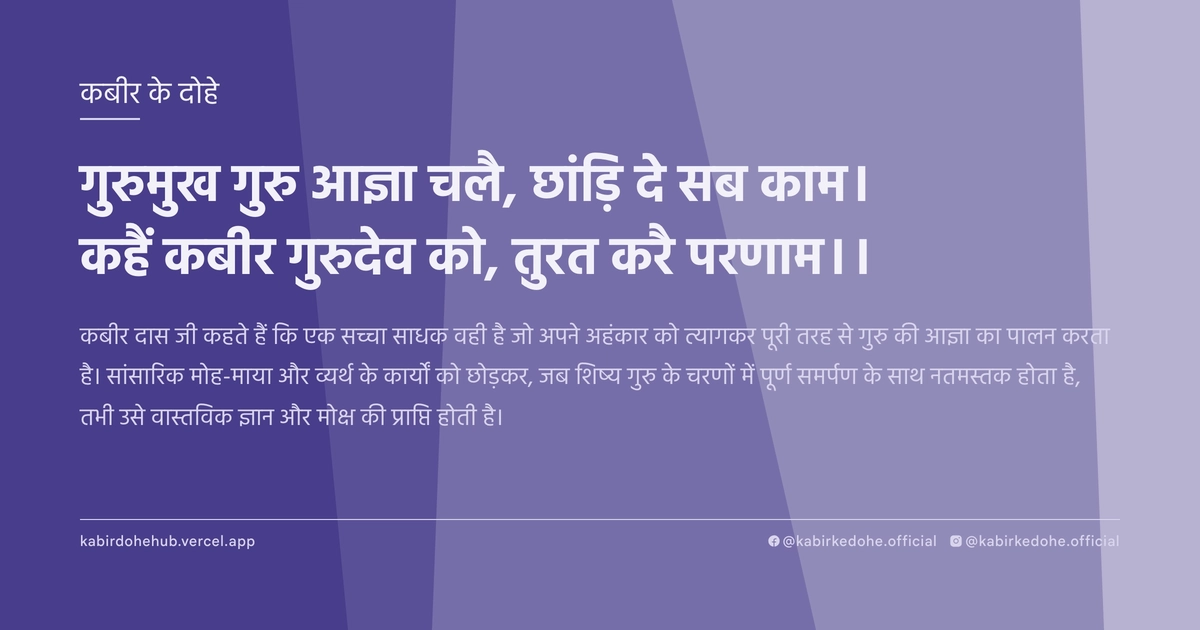
गुरुमुख गुरु आज्ञा चलै, छांड़ि दे सब काम।
कहैं कबीर गुरुदेव को, तुरत करै परणाम।।
Gurumukh guru aagya chale, chhand de sab kaam. Kahein Kabir gurudev ko, turat kare parnaam.
इस पृष्ठ पर इस कबीर दोहे का अर्थ (meaning), हिंदी व्याख्या और अंग्रेज़ी अनुवाद, दार्शनिक विश्लेषण और व्यावहारिक जीवन सीख दी गई है। यह दोहा गुरु महत्व (The Guru's Importance) विषय से जुड़ा है — Kabir doha meaning and explanation in Hindi and English.
अर्थ (Meaning):
कबीर दास जी कहते हैं कि एक सच्चा साधक वही है जो अपने अहंकार को त्यागकर पूरी तरह से गुरु की आज्ञा का पालन करता है। सांसारिक मोह-माया और व्यर्थ के कार्यों को छोड़कर, जब शिष्य गुरु के चरणों में पूर्ण समर्पण के साथ नतमस्तक होता है, तभी उसे वास्तविक ज्ञान और मोक्ष की प्राप्ति होती है।
Kabir suggests that a true seeker is one who abandons their ego and aligns themselves entirely with the guidance of the Guru. By letting go of worldly distractions and trivial pursuits, and offering unconditional surrender at the feet of the spiritual master, the disciple unlocks the gateway to ultimate truth and liberation.
व्याख्या (Interpretation):
इस दोहे का शाब्दिक अर्थ गुरु की आज्ञा के पालन से है, परंतु इसका गहरा आध्यात्मिक अर्थ 'अहंकार के विसर्जन' से है। यहाँ 'काम' का अर्थ केवल शारीरिक कार्य नहीं, बल्कि मानसिक कामनाएँ और मायावी आसक्तियाँ हैं। निर्गुण भक्ति में गुरु कोई व्यक्ति नहीं, बल्कि वह चेतना है जो आत्मा को ब्रह्म से मिलाती है। जब शिष्य 'परणाम' करता है, तो वह वास्तव में अपने सीमित 'मैं' को असीमित 'तत्व' में विलीन कर रहा होता। यह अद्वैत वेदांत के उस सिद्धांत को दर्शाता है जहाँ ज्ञाता और ज्ञान के बीच का पर्दा गिर जाता है। यह समर्पण ही वह सेतु है जो जीव को शिव में परिवर्तित करता है।
While the literal meaning focuses on obedience to a teacher, the metaphorical depth lies in the 'dissolution of the ego'. 'Kaam' here refers not just to labor, but to the psychological cravings and illusory attachments of Maya. In the realm of Nirgun Bhakti, the Guru is not merely a physical person but the awakened consciousness that bridges the gap between the Atman and Brahman. The act of 'parnaam' (bowing) symbolizes the surrender of the limited individual identity into the infinite universal truth. This reflects the Advaita Vedanta principle where the duality between the seeker and the sought vanishes. Such surrender is the only alchemy capable of transforming the mundane self into the divine essence.
दार्शनिक विश्लेषण (Philosophical Analysis):
कबीर का यह दोहा उस युग की उपज है जहाँ धर्म केवल कर्मकांडों और बाहरी आडंबरों तक सीमित था। कबीर ने मंदिर-मस्जिद के विवादों से ऊपर उठकर 'आंतरिक गुरु' की अवधारणा पर बल दिया। उनका यह संदेश सूफी मत के 'पीर' और वेदांत के 'गुरु' के समन्वय जैसा है, जहाँ पूर्ण समर्पण (Fana) के बिना सत्य की प्राप्ति असंभव है।
यहाँ 'सब काम' छोड़ने का अर्थ संसार का त्याग नहीं, बल्कि उस मानसिक बोझ का त्याग है जो हमें वर्तमान क्षण से दूर रखता है। कबीर तर्क देते हैं कि जब तक मनुष्य अपनी बुद्धि के अहंकार में डूबा रहता है, वह सत्य को नहीं देख सकता क्योंकि बुद्धि केवल तर्क करती है, अनुभव नहीं करती।
यह दर्शन अद्वैत वेदांत के इस विचार से मेल खाता है कि अज्ञानता (Avidya) ही बंधन का कारण है। गुरु वह प्रकाश है जो इस अज्ञान को मिटाता है। बिना मार्गदर्शन के, साधक माया के जाल में और अधिक उलझ जाता है।
सामाजिक स्तर पर, कबीर ने जाति और वर्ण व्यवस्था को चुनौती दी। उनके लिए गुरु की आज्ञा सर्वोपरि थी क्योंकि वह आज्ञा किसी सामाजिक मर्यादा से नहीं, बल्कि आध्यात्मिक सत्य से प्रेरित थी। यह एक क्रांतिकारी कदम था जिसने भक्ति को लोकतांत्रिक बनाया।
अंततः, यह दोहा मनोवैज्ञानिक रूपांतरण की बात करता है। जब हम किसी उच्चतर सत्ता या मार्गदर्शक के प्रति समर्पित होते हैं, तो हमारा अहंकार कम होता है, जिससे हृदय में करुणा और प्रेम का संचार होता है। यही वह बिंदु है जहाँ व्यक्तिगत इच्छाएँ सार्वभौमिक इच्छा में बदल जाती हैं।
This couplet emerges from an era where religion was stifled by rigid rituals and external displays of piety. Kabir transcends the temple-mosque divide by emphasizing the 'Internal Guru'. His message mirrors the Sufi concept of 'Fana' (annihilation of self) and the Vedantic necessity of a guide, suggesting that truth is unattainable without total surrender.
'Leaving all work' does not imply a physical abandonment of society, but a psychological release of the cravings and mental noise that distance us from the present. Kabir argues that as long as a human is imprisoned by the ego of the intellect, they cannot perceive truth, for the intellect only reasons while the soul experiences.
This aligns with Advaita Vedanta's premise that Avidya (ignorance) is the root of bondage. The Guru acts as the catalyst of light that dissolves this darkness. Without such guidance, the seeker often becomes further entangled in the intricate webs of Maya.
On a socio-cultural level, Kabir challenged the oppressive caste hierarchy. By placing the Guru's command above all, he asserted that spiritual authority transcends social status. This was a radical democratization of spirituality, making liberation accessible to the lowest of the low.
Ultimately, the verse describes a psychological metamorphosis. By surrendering to a higher consciousness, the ego shrinks, creating space for compassion and universal love. This is the precise moment where individual desire is subsumed by the cosmic will, leading to an integrated state of being.
मूल संदेश (Core Message):
- अहंकार का त्याग ही वास्तविक ज्ञान का द्वार है।
- बाहरी कर्मकांडों से ऊपर उठकर आंतरिक समर्पण को चुनें।
- गुरु केवल व्यक्ति नहीं, बल्कि सत्य की ओर ले जाने वाली चेतना है।
- जब 'मैं' मिटता है, तभी 'वह' प्रकट होता है।
- पूर्ण समर्पण ही मानसिक द्वंद्व का एकमात्र समाधान है।
- सत्य तर्क से नहीं, बल्कि अनुभव और विश्वास से मिलता है।
- The dissolution of ego is the only gateway to authentic wisdom.
- Choose internal surrender over the hollow shell of external rituals.
- The Guru is not a person, but the consciousness leading toward Truth.
- Only when the 'I' vanishes does the 'Divine' manifest.
- Total surrender is the sole remedy for psychological conflict.
- Truth is not reached through logic, but through experience and faith.
व्यावहारिक उदाहरण (Practical Example):
वाराणसी के एक पुराने घाट पर रहने वाली एक वृद्ध विधवा, जानकी, का जीवन केवल पूजा-पाठ और कठोर नियमों में बीता था। वह मानती थी कि मोक्ष केवल शास्त्रों के कठिन पालन से मिलेगा।
एक दिन उसकी मुलाकात एक फकीर से हुई जिसने उसे केवल एक बात कही: 'अपने भीतर की करुणा को जगाओ और बिना किसी शर्त के दूसरों की सेवा करो, यही असली पूजा है।'
जानकी को यह बात अजीब लगी क्योंकि वह सालों से मंत्र जाप कर रही थी। उसका अहंकार उसे कह रहा था कि वह फकीर गलत है और वह स्वयं अधिक ज्ञानी है।
लेकिन फकीर की आँखों में एक ऐसी शांति थी जिसने जानकी के भीतर के द्वंद्व को शांत कर दिया। उसने तय किया कि वह अपनी सारी पूर्व-धारणाएँ छोड़कर इस फकीर की बात मानेगी।
उसने अपने कठोर नियमों को छोड़ा और घाट पर आने वाले बीमारों और भूखों की सेवा करना शुरू किया। उसने अपने 'ज्ञान' के अहंकार को त्याग दिया।
शुरुआत में उसे कठिनाई हुई, क्योंकि उसका मन बार-बार उसे पुराने ढर्रे पर लौटने को कहता था। वह अपनी 'धार्मिक श्रेष्ठता' को याद करती थी।
परंतु जैसे-जैसे उसने सेवा में खुद को विलीन किया, उसे महसूस हुआ कि वह शांति जो वह मंत्रों में ढूंढ रही थी, वह दूसरों के आँसू पोंछने में मिल रही है।
एक दिन उसे एहसास हुआ कि फकीर वास्तव में उसका 'गुरु' था, जिसने उसे कर्मकांड के पिंजरे से निकालकर प्रेम के खुले आकाश में पहुँचा दिया।
जानकी अब केवल एक विधवा नहीं थी जो मोक्ष की प्रतीक्षा कर रही थी, बल्कि वह स्वयं एक जीवंत प्रेम बन चुकी थी।
उसका 'परणाम' केवल फकीर के चरणों में नहीं था, बल्कि उस सत्य के प्रति था जिसने उसे स्वयं से परिचित कराया।
Janaki, an elderly widow living on the ancient ghats of Varanasi, had spent her entire life adhering to rigid rituals and strict scriptural laws. She believed liberation was only possible through the meticulous performance of orthodox rites.
One day, she encountered a wandering Sufi mystic who told her simply: 'Awaken the compassion within and serve others without condition; that is the only true worship.'
Janaki found this absurd. She had spent decades chanting mantras and fasting. Her ego whispered that this stranger was ignorant and that she was spiritually superior.
However, there was a profound stillness in the mystic's eyes that silenced Janaki's inner turmoil. She decided to set aside her preconceived notions and follow his guidance completely.
She abandoned her rigid schedule of rituals and began caring for the sick and hungry who washed up on the ghats. She consciously surrendered her 'intellectual' pride.
Initially, she struggled. Her mind constantly urged her to return to her old habits, clinging to the comfort of her perceived religious superiority.
But as she immersed herself in selfless service, she discovered that the peace she had sought through mantras was actually found in wiping the tears of another.
One day, she realized the mystic was her true Guru, not because he gave her a new ritual, but because he freed her from the cage of ritualism into the expanse of love.
Janaki was no longer just a widow waiting for salvation; she had become a living embodiment of compassion.
Her 'parnaam' was not just a physical bow to the mystic, but a total surrender to the truth that had finally introduced her to her own soul.
अभ्यास मार्गदर्शन (Practice Guidance):
- प्रतिदिन 20 मिनट मौन रहकर यह विचार करें कि आपका 'अहंकार' आपको सत्य को देखने से कैसे रोक रहा है।
- एक डायरी लिखें जिसमें उन क्षणों को दर्ज करें जब आपने अपनी बुद्धि के बजाय अंतर्ज्ञान या किसी योग्य मार्गदर्शक की सलाह मानी और उसका परिणाम क्या रहा।
- व्यवहार परिवर्तन: दिन में कम से कम एक बार अपनी इच्छा के विपरीत जाकर किसी की निस्वार्थ मदद करें, यह मानकर कि यह 'ईश्वरीय आज्ञा' है।
- निदान चेकलिस्ट: क्या मैं अभी भी सही होने की जिद कर रहा हूँ? क्या मैं दूसरों की सलाह को अपने अहंकार के चश्मे से देख रहा हूँ? क्या मेरा समर्पण केवल बाहरी है या आंतरिक भी?
- Spend 20 minutes daily in silence, contemplating how your 'ego' acts as a veil preventing you from perceiving the ultimate truth.
- Maintain a journal recording instances where you chose intuition or the guidance of a mentor over your own intellectual pride, noting the outcome.
- Behavioral Shift: Once a day, perform an act of selfless service that contradicts your immediate desire, treating it as a 'divine command'.
- Diagnostic Checklist: Am I still insisting on being 'right'? Am I filtering guidance through the lens of my ego? Is my surrender merely performative or deeply internal?
चिंतन प्रश्न (Reflection Questions):
- मेरा वह कौन सा 'काम' या मोह है जिसे मैं छोड़ने से सबसे अधिक डरता हूँ?
- क्या मैं वास्तव में किसी के मार्गदर्शन के लिए तैयार हूँ, या मैं केवल अपनी मान्यताओं की पुष्टि करने वाले गुरु की तलाश कर रहा हूँ?
- मेरी सार्वजनिक छवि (Digital/Social Ego) मेरे आंतरिक शून्य को कैसे छिपाती है?
- क्या मेरा समर्पण वास्तव में मुक्ति के लिए है, या यह जिम्मेदारी से बचने का एक तरीका है?
- यदि मेरा सारा ज्ञान और पद छीन लिया जाए, तो मेरे भीतर क्या बचेगा?
- मैं अपनी श्रेष्ठता की भावना को किस तरह से पोषित करता हूँ?
- What is the specific 'work' or attachment that I am most terrified to let go of?
- Am I truly open to guidance, or am I merely searching for a Guru who validates my existing biases?
- How does my public persona (Digital/Social Ego) mask the void within me?
- Is my surrender a genuine quest for liberation, or is it a subconscious escape from responsibility?
- If all my knowledge and status were stripped away, what would remain of my essence?
- In what subtle ways do I continue to nourish my sense of superiority?