
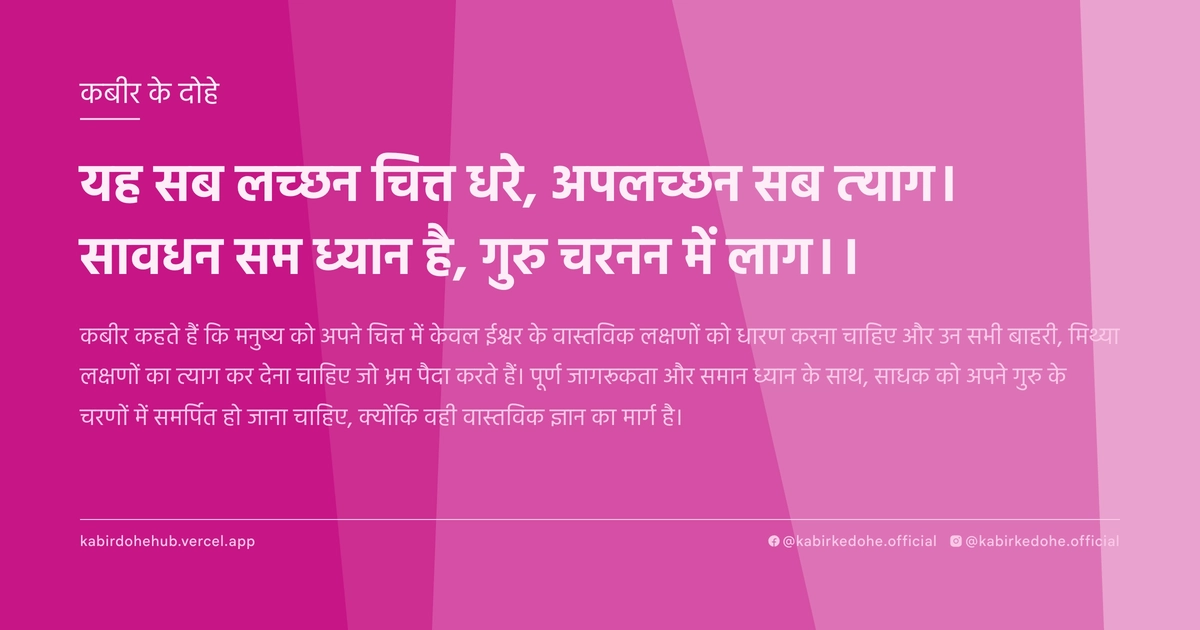
यह सब लच्छन चित्त धरे, अपलच्छन सब त्याग।
सावधन सम ध्यान है, गुरु चरनन में लाग।।
Yeh sab lachhan chitt dhare, apalachhan sab tyag. Savdhan sam dhyan hai, guru charnan me laag.
इस पृष्ठ पर इस कबीर दोहे का अर्थ (meaning), हिंदी व्याख्या और अंग्रेज़ी अनुवाद, दार्शनिक विश्लेषण और व्यावहारिक जीवन सीख दी गई है। यह दोहा ध्यान (Meditation) विषय से जुड़ा है — Kabir doha meaning and explanation in Hindi and English.
अर्थ (Meaning):
कबीर कहते हैं कि मनुष्य को अपने चित्त में केवल ईश्वर के वास्तविक लक्षणों को धारण करना चाहिए और उन सभी बाहरी, मिथ्या लक्षणों का त्याग कर देना चाहिए जो भ्रम पैदा करते हैं। पूर्ण जागरूकता और समान ध्यान के साथ, साधक को अपने गुरु के चरणों में समर्पित हो जाना चाहिए, क्योंकि वही वास्तविक ज्ञान का मार्ग है।
Kabir instructs the seeker to anchor their consciousness solely in the true attributes of the Divine while renouncing all superficial, illusory traits that lead to distraction. With unwavering alertness and equanimity of focus, one must surrender to the feet of the Guru, for that is the only gateway to authentic liberation.
व्याख्या (Interpretation):
इस दोहे का शाब्दिक अर्थ है कि बाहरी दिखावे को छोड़कर आंतरिक सत्य को अपनाना। यहाँ 'लक्षण' का अर्थ उन गुणों से है जो आत्मा को परमात्मा से जोड़ते हैं, जबकि 'अपलक्षण' वे सांसारिक मोह-माया और अहंकार हैं जो हमें सत्य से दूर ले जाते हैं। यह निर्गुण भक्ति का सार है, जहाँ ईश्वर किसी मूर्ति या आकार में नहीं, बल्कि शुद्ध चेतना में व्याप्त है। माया वह पर्दा है जो हमें 'अपलक्षण' को सत्य मानने पर मजबूर करता है। जब साधक इस द्वैत को समझकर अद्वैत वेदांत की स्थिति में पहुँचता है, तो उसे अनुभव होता है कि वह स्वयं ब्रह्म है। गुरु यहाँ केवल एक व्यक्ति नहीं, बल्कि वह प्रकाश है जो अज्ञान के अंधकार को मिटाकर आत्मा का साक्षात्कार कराता है। यह विरोधाभास है कि जिसे हम बाहर खोज रहे हैं, वह हमारे भीतर ही है, बस दृष्टि बदलने की आवश्यकता है।
Literally, the verse urges the abandonment of external pretenses in favor of internal truth. 'Lachhan' refers to the divine attributes that align the soul with the Absolute, while 'apalachhan' represents the illusory traits of the ego and worldly attachments. This is the essence of Nirgun Bhakti, where the Divine is not a form but a formless, omnipresent consciousness. Maya acts as the veil, tricking the soul into mistaking the transient for the eternal. As the seeker transitions toward Advaita Vedanta, the realization dawns that the individual Atman and the universal Brahman are one. The Guru here is not merely a physical teacher but the illuminating principle that dissolves the darkness of ignorance. The central paradox lies in the fact that the destination is the starting point; the seeker is already the sought, requiring only the removal of the ego's interference.
दार्शनिक विश्लेषण (Philosophical Analysis):
कबीर का यह काल सामाजिक और धार्मिक कट्टरता का समय था, जहाँ कर्मकांड और बाहरी दिखावे को ही धर्म मान लिया गया था। उन्होंने इस दोहे के माध्यम से ritualism (कर्मकांड) पर कड़ा प्रहार किया है। उनके अनुसार, तिलक लगाना, माला फेरना या विशेष वस्त्र पहनना 'अपलक्षण' हैं, जो केवल अहंकार को बढ़ाते हैं। यह दृष्टिकोण सूफी मत के 'फना' (अहंकार का विनाश) और अद्वैत वेदांत के 'अहं ब्रह्मास्मि' से मेल खाता है।
दार्शनिक स्तर पर, कबीर यहाँ चित्त की शुद्धि की बात कर रहे हैं। जब तक चित्त सांसारिक इच्छाओं और पहचानों (जाति, धर्म, पद) से भरा रहता है, तब तक वह सत्य को ग्रहण नहीं कर सकता। यह मनोवैज्ञानिक रूपांतरण की प्रक्रिया है जहाँ व्यक्ति अपनी 'सामाजिक पहचान' को त्यागकर 'ब्रह्मांडीय पहचान' को अपनाता है।
भक्ति आंदोलन के संदर्भ में, कबीर ने ईश्वर को मंदिर या मस्जिद से निकालकर मनुष्य के हृदय में स्थापित किया। उन्होंने तर्क दिया कि यदि ईश्वर सर्वव्यापी है, तो उसे किसी विशेष लक्षण या बाहरी ढांचे में सीमित करना उसे छोटा करना है।
सूफीवाद के प्रभाव में, यहाँ 'गुरु के चरणों में लगना' केवल शारीरिक समर्पण नहीं, बल्कि पूर्ण विश्वास (तवक्कुल) और अहंकार के विसर्जन का प्रतीक है। यह वह बिंदु है जहाँ साधक की अपनी इच्छा समाप्त होती है और दैवीय इच्छा का आरम्भ होता है।
अंततः, यह दोहा हमें सिखाता है कि आध्यात्मिक प्रगति बाहरी संचय में नहीं, बल्कि आंतरिक विसर्जन में है। जो जितना अधिक 'छोड़ता' है, वह उतना ही अधिक 'पाता' है। यह शून्य की अवस्था है, जहाँ से पूर्णता का जन्म होता है।
Kabir lived during an era of intense religious dogmatism, where ritualism was mistaken for spirituality. Through this verse, he launches a scathing critique of external piety. He posits that symbols like tilaks, prayer beads, or specific attire are 'apalachhan'—superficial traits that nourish the ego rather than the soul. This aligns with the Sufi concept of 'Fana' (annihilation of the self) and the Advaita Vedanta realization of 'Aham Brahmasmi' (I am Brahman).
Philosophically, Kabir addresses the purification of the 'Chitta' (consciousness). As long as the mind is cluttered with worldly desires and social identities—caste, creed, or status—it remains incapable of perceiving the Absolute. This is a process of psychological transmutation where the individual sheds the 'social mask' to uncover the 'cosmic identity'.
Within the Bhakti movement, Kabir liberated the Divine from the confines of temples and mosques, placing the Absolute within the human heart. He argued that if God is omnipresent, restricting the Divine to specific forms or rituals is a limitation of the Infinite.
Influenced by Sufism, the act of 'surrendering to the Guru' is not a physical act of subservience but a symbol of total trust (Tawakkul) and the dissolution of the individual will into the Divine Will. It is the precise moment where the 'I' ceases to exist, allowing the Truth to emerge.
Ultimately, this Doha teaches that spiritual evolution is not about accumulation but subtraction. The more one renounces the illusory, the more one attains the Real. It is the state of 'Shunya' (void), from which the 'Purna' (fullness) is born.
मूल संदेश (Core Message):
- बाहरी दिखावा आध्यात्मिक प्रगति का सबसे बड़ा अवरोध है।
- सत्य केवल तब प्रकट होता है जब अहंकार का विसर्जन होता है।
- गुरु वह सेतु है जो सीमित 'मैं' को अनंत 'ब्रह्म' से जोड़ता है।
- वास्तविक भक्ति कर्मकांडों में नहीं, बल्कि चित्त की शुद्धता में है।
- जब हम अपनी पहचान खो देते हैं, तभी हम वास्तव में स्वयं को पाते हैं।
- External pretension is the greatest obstacle to spiritual evolution.
- Truth manifests only when the ego is completely dissolved.
- The Guru is the bridge connecting the limited 'I' to the infinite 'Brahman'.
- Authentic devotion lies in the purity of consciousness, not in rituals.
- Only by losing our constructed identity do we truly find our essence.
व्यावहारिक उदाहरण (Practical Example):
एक समय की बात है, बनारस के घाटों पर माधव नाम का एक वृद्ध बुनकर रहता था। माधव अपनी कला में निपुण था और शहर भर में उसके बनाए कपड़ों की माँग थी। लेकिन माधव के भीतर एक गहरा असंतोष था। वह घंटों मंदिर में बैठता, कठिन व्रत करता और अपनी जाति के बड़े पंडितों के साथ बैठकर शास्त्रों पर चर्चा करता। उसे लगता था कि वह बहुत बड़ा भक्त है क्योंकि वह बाहरी नियमों का पालन पूरी निष्ठा से करता था।
एक दिन उसकी मुलाकात एक फकीर से हुई, जो घाट की सीढ़ियों पर चुपचाप बैठा था। फकीर के पास न कोई माला थी, न माथे पर तिलक। माधव ने गर्व से कहा, 'मैं दिन में चार बार पूजा करता हूँ और शास्त्रों का ज्ञाता हूँ, फिर भी मुझे वह शांति नहीं मिली जो आपके चेहरे पर दिखती है।'
फकीर मुस्कुराया और बोला, 'माधव, तुम जिस शांति को खोज रहे हो, वह उन नियमों के नीचे दबी हुई है जिन्हें तुम ढो रहे हो। तुम अपनी पहचान एक 'पंडित' या 'भक्त' के रूप में बना रहे हो, यही तुम्हारा 'अपलक्षण' है। तुम वस्त्र बुनते हो, लेकिन अपने चित्त के धागों को उलझा रखा है।'
माधव को पहले तो यह बात चुभी, लेकिन उसने गौर किया कि उसकी सारी भक्ति वास्तव में उसके अहंकार को संतुष्ट कर रही थी। वह यह दिखाना चाहता था कि वह कितना 'पवित्र' है। वह फकीर के पास वापस गया और पूछा, 'तो मैं क्या करूँ?'
फकीर ने कहा, 'अपने भीतर के उस बुनकर को देखो जो बिना किसी नाम, बिना किसी जाति और बिना किसी फल की इच्छा के केवल प्रेम के लिए काम करता है। जब तुम यह भूल जाओगे कि तुम 'माधव' हो या 'बुनकर', तब तुम उस अनंत से जुड़ोगे।'
माधव ने अगले कुछ महीनों तक बाहरी दिखावे को पूरी तरह त्याग दिया। उसने पूजा करना बंद नहीं किया, लेकिन अब वह यह नहीं देखता था कि लोग उसे देख रहे हैं या नहीं। उसने अपने अहंकार की परतों को उतारना शुरू किया।
एक दिन, जब वह एक गरीब के लिए बिना किसी शुल्क के कपड़ा बुन रहा था, उसे अचानक एक असीम शांति का अनुभव हुआ। उसे महसूस हुआ कि वह और वह गरीब व्यक्ति अलग नहीं हैं। वह 'अपलक्षण' (अहंकार) पूरी तरह मिट चुका था।
माधव अब केवल एक बुनकर नहीं था, वह एक जीवित ध्यान बन चुका था। उसने सीखा कि गुरु का अर्थ केवल निर्देश देना नहीं, बल्कि वह दर्पण होना है जिसमें हम अपनी असलियत देख सकें। उसका जीवन अब बाहरी आडंबरों से मुक्त होकर आंतरिक प्रकाश से भर गया था।
Once, in the ghats of Varanasi, lived an elderly weaver named Madhav. Madhav was a master of his craft, and his fabrics were coveted across the city. However, inside, he harbored a deep restlessness. He spent hours in temples, observed rigorous fasts, and engaged in scholarly debates with high-caste priests. He believed he was a great devotee because he adhered strictly to every external ritual.
One day, he encountered a wandering dervish sitting silently on the stone steps of the river. The dervish wore no beads and bore no sectarian mark on his forehead. Madhav, with a hint of pride, said, 'I pray four times a day and am well-versed in the scriptures, yet I lack the peace that radiates from your face.'
The dervish smiled and replied, 'Madhav, the peace you seek is buried beneath the very rules you carry. You are crafting an identity as a "priest" or a "devotee"; this is your "apalachhan"—your illusory trait. You weave cloth, but you have tangled the threads of your own consciousness.'
Initially, Madhav felt offended, but he soon realized that his devotion was merely a tool to satisfy his ego. He wanted the world to see how "pure" he was. He returned to the dervish and asked, 'Then what must I do?'
The dervish replied, 'Observe the weaver within you who works without a name, without a caste, and without desire for reward—only for the sake of love. When you forget that you are "Madhav" or a "weaver," you will merge with the Infinite.'
For the next few months, Madhav consciously discarded all external pretenses. He did not stop his prayers, but he ceased caring whether anyone noticed his piety. He began peeling away the layers of his social identity.
One day, while weaving a garment for a destitute man without charging a single coin, a sudden, overwhelming sense of peace washed over him. He felt that there was no difference between himself and the poor man. The "apalachhan" of the ego had vanished.
Madhav was no longer just a weaver; he had become a living meditation. He understood that the Guru is not merely an instructor but a mirror reflecting one's true essence. His life, once cluttered with ritual, was now illuminated by an inner light.
अभ्यास मार्गदर्शन (Practice Guidance):
- दैनिक आत्म-निरीक्षण: प्रतिदिन 20 मिनट मौन बैठें और विचार करें कि आज आपने कितनी बार अपनी 'सामाजिक पहचान' (पद, प्रतिष्ठा, धर्म) का उपयोग दूसरों से श्रेष्ठ दिखने के लिए किया।
- साक्षी भाव का अभ्यास: जब भी क्रोध या अहंकार जागे, तो स्वयं से पूछें—'यह कौन है जो क्रोध कर रहा है? क्या यह मेरी आत्मा है या मेरा निर्मित अहंकार?'
- सेवा का गुप्त अभ्यास: सप्ताह में एक बार ऐसा कार्य करें जिससे किसी की मदद हो, लेकिन यह सुनिश्चित करें कि किसी को भी पता न चले कि वह कार्य आपने किया है।
- डायग्नोस्टिक चेकलिस्ट: यदि आप दूसरों के निर्णय से विचलित होते हैं या अपनी उपलब्धियों पर गर्व महसूस करते हैं, तो समझें कि 'अपलक्षण' अभी भी हावी है। यदि आप हर व्यक्ति में एक ही चेतना देखते हैं, तो आप सही मार्ग पर हैं।
- Daily Self-Inquiry: Spend 20 minutes in silence daily, reflecting on how many times you used your 'social identity' (status, rank, religion) to feel superior to others.
- Practice of Witness Consciousness: Whenever anger or pride arises, ask yourself—'Who is the one experiencing this? Is it the eternal soul or the constructed ego?'
- Anonymous Service: Once a week, perform an act of kindness ensuring that no one, including the recipient, knows you were the source. This kills the 'doer' identity.
- Diagnostic Checklist: If you are easily swayed by external validation or feel a surge of pride in your achievements, the 'apalachhan' is still dominant. If you perceive the same consciousness in every being, you are aligning with the truth.
चिंतन प्रश्न (Reflection Questions):
- यदि आपसे आपकी डिग्री, आपका पद और आपका पारिवारिक नाम छीन लिया जाए, तो आपके पास क्या बचेगा?
- आपकी कौन सी ऐसी 'धार्मिक' या 'नैतिक' आदतें हैं जो वास्तव में आपको दूसरों से श्रेष्ठ महसूस कराने के लिए हैं?
- क्या आप वास्तव में सत्य की खोज कर रहे हैं, या आप केवल एक 'सत्य खोजने वाले' की छवि बनाना चाहते हैं?
- आपके जीवन का वह कौन सा हिस्सा है जिसे आप दुनिया से छिपाते हैं, और क्या वह हिस्सा आपके 'अपलक्षण' का हिस्सा है?
- क्या आप बिना किसी पुरस्कार या पहचान के किसी की सेवा करने में सक्षम हैं, या आपकी सेवा में भी एक गुप्त सौदा छिपा है?
- If your degrees, your professional title, and your family name were stripped away, what would actually remain of you?
- Which of your 'religious' or 'moral' habits are actually designed to make you feel superior to others?
- Are you truly seeking the Truth, or are you merely trying to cultivate the image of a 'truth-seeker'?
- What part of your life do you hide from the world, and is that hidden shadow a part of your 'apalachhan'?
- Are you capable of serving another without any reward or recognition, or is there a hidden transaction in your kindness?