
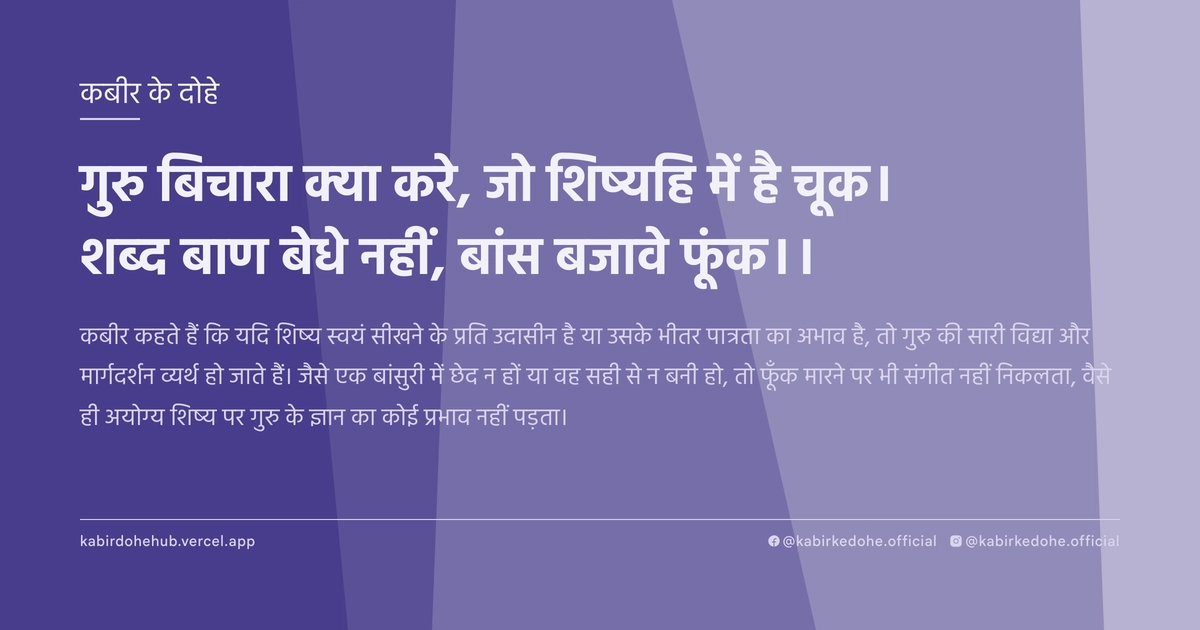
गुरु बिचारा क्या करे, जो शिष्यहि में है चूक।
शब्द बाण बेधे नहीं, बांस बजावे फूंक।।
Guru vichaara kya kare, jo shishyahin mein hai chook. Shabd baan bedhe nahin, baans bajaave phook.
इस पृष्ठ पर इस कबीर दोहे का अर्थ (meaning), हिंदी व्याख्या और अंग्रेज़ी अनुवाद, दार्शनिक विश्लेषण और व्यावहारिक जीवन सीख दी गई है। यह दोहा गुरु महत्व (The Guru's Importance) विषय से जुड़ा है — Kabir doha meaning and explanation in Hindi and English.
अर्थ (Meaning):
कबीर कहते हैं कि यदि शिष्य स्वयं सीखने के प्रति उदासीन है या उसके भीतर पात्रता का अभाव है, तो गुरु की सारी विद्या और मार्गदर्शन व्यर्थ हो जाते हैं। जैसे एक बांसुरी में छेद न हों या वह सही से न बनी हो, तो फूँक मारने पर भी संगीत नहीं निकलता, वैसे ही अयोग्य शिष्य पर गुरु के ज्ञान का कोई प्रभाव नहीं पड़ता।
Kabir asserts that if a disciple is lacking in readiness or is fundamentally flawed in their intent, the guru's efforts become futile. Just as blowing into a bamboo pipe that is not properly crafted yields no music, the potent arrows of the guru's spiritual words cannot pierce the heart of a disciple who is closed or unprepared.
व्याख्या (Interpretation):
यहाँ 'चूक' केवल गलती नहीं, बल्कि आध्यात्मिक जड़ता और अहंकार है। गुरु को 'बिचारा' कहना इस विडंबना को दर्शाता है कि ज्ञान देने वाला सक्षम है, परंतु ग्रहण करने वाला पात्र रिक्त या बंद है। 'शब्द बाण' निर्गुण भक्ति की उस शक्ति का प्रतीक है जो अज्ञान के पर्दे को चीर देती है। जब शिष्य का अहंकार (माया) हावी होता है, तो वह सत्य के प्रति बहरा हो जाता है। यह दोहा आत्मा और परमात्मा के मिलन में 'पात्रता' के महत्व को रेखांकित करता है, जहाँ बिना समर्पण के ज्ञान केवल शब्दों का शोर बनकर रह जाता है।
The term 'chook' refers not merely to a mistake, but to spiritual inertia and the density of the ego. Describing the Guru as 'bichara' (helpless) highlights the paradox where the teacher is capable, but the vessel is closed. The 'word-arrows' symbolize the piercing power of Nirgun Bhakti that shatters the illusions of Maya. When the ego dominates, the disciple becomes deaf to the Truth. This verse emphasizes the necessity of 'readiness' in the Advaita tradition; without total surrender, the transmission of wisdom remains a superficial exercise, like blowing air into a lifeless reed.
दार्शनिक विश्लेषण (Philosophical Analysis):
कबीर का यह दोहा मध्यकालीन भारत के उस दौर का है जब गुरु-शिष्य परंपरा अत्यंत औपचारिक हो गई थी। कबीर ने यहाँ कर्मकांडीय शिक्षा के बजाय आंतरिक रूपांतरण पर जोर दिया है। वे स्पष्ट करते हैं कि ज्ञान कोई वस्तु नहीं है जिसे एक व्यक्ति दूसरे को 'दे' सके; बल्कि यह एक आंतरिक जागृति है जिसे गुरु केवल प्रेरित कर सकता है।
अद्वैत वेदांत के परिप्रेक्ष्य में, गुरु वह दर्पण है जो शिष्य को उसके वास्तविक स्वरूप (ब्रह्म) की याद दिलाता है। यदि शिष्य का दर्पण धूल (अहंकार और वासनाओं) से ढका है, तो गुरु का प्रकाश उसमें परावर्तित नहीं होगा। यह स्थिति 'अविद्या' की है, जहाँ जीव स्वयं को शरीर और मन मान बैठता है।
सूफी मत के 'मुर्शिद' और 'मुरीद' के संबंध में भी यही सत्य लागू होता है। जब तक मुरीद अपने 'नफ्स' (अहंकार) को मिटाकर शून्य नहीं होता, तब तक ईश्वरीय प्रेम का नूर उसके भीतर प्रवेश नहीं कर सकता। कबीर यहाँ यह चेतावनी दे रहे हैं कि बाहरी अनुशासन के बजाय आंतरिक पात्रता अनिवार्य है।
सामाजिक स्तर पर, कबीर ने जाति और कुल के अहंकार को चुनौती दी। वे मानते थे कि यदि कोई उच्च कुल का व्यक्ति भी अहंकार से भरा है, तो वह एक अनपढ़ लेकिन समर्पित व्यक्ति की तुलना में कम योग्य है। यहाँ 'पात्रता' का अर्थ सामाजिक स्थिति नहीं, बल्कि हृदय की विनम्रता है।
अंततः, यह दोहा मनोवैज्ञानिक रूपांतरण की बात करता है। जब तक शिष्य अपनी पुरानी पहचान और पूर्वग्रहों को छोड़ने के लिए तैयार नहीं होता, तब तक नया ज्ञान केवल बौद्धिक बोझ बन जाता है। वास्तविक ज्ञान वह है जो अहंकार का विनाश करे, न कि उसे और पुष्ट करे।
This doha emerges from a medieval Indian era where the Guru-Shishya tradition had become overly formalized and ritualistic. Kabir shifts the focus from external pedagogy to internal transformation, asserting that knowledge is not a commodity to be transferred, but an awakening to be triggered.
From the lens of Advaita Vedanta, the Guru acts as a mirror reflecting the disciple's true nature as Brahman. If the disciple's mirror is clouded by the dust of 'Avidya' (ignorance) and 'Ahankara' (ego), the light of truth cannot reflect. The 'chook' mentioned is the fundamental misidentification of the Self with the limited body and mind.
This mirrors the Sufi concept of the Murshid and Murid. Until the Murid annihilates the 'Nafs' (lower self/ego), the divine light of Ishq cannot permeate. Kabir warns that external adherence to a teacher is useless without the internal alchemy of surrender.
Socially, Kabir challenged the hegemony of caste and lineage. He argued that a person of high birth, if arrogant, is spiritually inferior to an illiterate but humble seeker. Here, 'readiness' is defined not by social status or academic prowess, but by the purity and openness of the heart.
Psychologically, the verse addresses the resistance to change. When a student clings to their preconceived notions and intellectual pride, the Guru's words become mere noise. True knowledge is that which dissolves the ego; if the ego remains, the 'word-arrow' fails to pierce the veil of illusion.
मूल संदेश (Core Message):
- अहंकार ज्ञान के मार्ग में सबसे बड़ी बाधा है।
- पात्रता के बिना मार्गदर्शन केवल शोर है।
- समर्पण ही वह कुंजी है जो हृदय के द्वार खोलती है।
- बौद्धिक ज्ञान और आत्मिक बोध में गहरा अंतर है।
- गुरु केवल मार्ग दिखाता है, चलना शिष्य को ही पड़ता है।
- शून्यता ही पूर्णता की पहली शर्त है।
- Ego is the primary obstruction on the path to enlightenment.
- Guidance without receptivity is nothing more than noise.
- Surrender is the only key that unlocks the doors of the heart.
- There is a profound gulf between intellectual data and spiritual realization.
- The Guru shows the path, but the walking must be done by the disciple.
- Emptiness of self is the first prerequisite for divine fullness.
व्यावहारिक उदाहरण (Practical Example):
वाराणसी के एक पुराने घाट पर रामदीन नाम का एक वृद्ध बुनकर रहता था। वह अपने काम में निपुण था, लेकिन उसे अपनी कला पर इतना घमंड था कि वह किसी की सलाह नहीं सुनता था।
एक दिन एक घुमक्कड़ संत उसके पास आए और उसे जीवन की नश्वरता और अहंकार के त्याग के बारे में बताया। संत ने उसे समझाया कि जैसे धागे को सुलझना पड़ता है तभी कपड़ा बनता है, वैसे ही मन को सुलझाना पड़ता है तभी ईश्वर मिलता है।
रामदीन ने उनकी बातों को अनसुना कर दिया। उसने सोचा, 'मैं इस शहर का सबसे बेहतरीन बुनकर हूँ, मुझे एक साधारण साधु क्या सिखाएगा?'
संत ने मुस्कुराते हुए उसे एक पुराना, बिना छेद वाला बांस का टुकड़ा दिया और कहा, 'इसे बजाकर सुनाओ।' रामदीन ने पूरी ताकत से फूँक मारी, लेकिन कोई आवाज नहीं निकली।
संत ने कहा, 'यही तुम्हारी स्थिति है। तुम्हारे भीतर ज्ञान की फूँक तो लग रही है, लेकिन तुम्हारे अहंकार ने तुम्हारे हृदय के छिद्र बंद कर दिए हैं। तुम एक बंद बांस की तरह हो।'
रामदीन को पहली बार अपनी गलती का अहसास हुआ। उसने महसूस किया कि उसकी कुशलता केवल बाहरी थी, जबकि भीतर वह आध्यात्मिक रूप से शून्य और कठोर था।
उसने अपनी कला का अहंकार त्याग कर संत के चरणों में समर्पण किया। उसने अपनी बुनाई को अब केवल जीविका नहीं, बल्कि एक साधना बना लिया।
धीरे-धीरे उसका स्वभाव शांत हो गया और वह दूसरों की मदद करने लगा। उसकी कला में अब एक नई गहराई थी क्योंकि वह अब अहंकार से नहीं, बल्कि प्रेम से बुनता था।
उसने सीखा कि गुरु का ज्ञान तभी काम करता है जब शिष्य स्वयं को एक खाली बांसुरी बना ले, ताकि परमात्मा का संगीत उसमें गूँज सके।
रामदीन का जीवन अब एक संगीत बन चुका था, जहाँ वह स्वयं को मिटाकर उस अनंत सत्य में विलीन हो गया था।
On an ancient ghat in Varanasi lived Ramdeen, an elderly weaver. He was a master of his craft, but his pride in his skill had grown so immense that he dismissed all outside advice.
One day, a wandering saint arrived and spoke to him about the transience of life and the necessity of shedding the ego. The saint explained that just as threads must be untangled to weave a cloth, the mind must be untangled to find the Divine.
Ramdeen ignored him. He thought, 'I am the finest weaver in this city; what could a simple monk possibly teach me?'
Smiling, the saint handed him a piece of old bamboo that had no holes in it and asked him to play a melody on it. Ramdeen blew into it with all his might, but no sound emerged.
The saint remarked, 'This is your current state. The breath of knowledge is being blown into you, but your ego has plugged all the holes of your heart. You are like a closed bamboo.'
For the first time, Ramdeen realized his blindness. He understood that while he was technically skilled, he was spiritually rigid and closed.
He surrendered his pride at the saint's feet. He stopped viewing his weaving as mere labor and began treating it as a spiritual discipline (Sadhana).
Gradually, his temperament softened, and he began helping others. His art acquired a new depth because he no longer wove from a place of pride, but from a place of love.
He learned that a Guru's wisdom only works when the disciple transforms themselves into a hollow flute, allowing the Divine music to flow through them.
Ramdeen's life became a melody, where he dissolved his individual identity into the vastness of the Universal Truth.
अभ्यास मार्गदर्शन (Practice Guidance):
- प्रतिदिन 15 मिनट मौन अभ्यास करें, जहाँ आप केवल सुनने की क्षमता विकसित करें, बोलने की नहीं।
- एक 'अहंकार डायरी' बनाएँ: दिन भर में जब भी आपको लगे कि आप दूसरों से श्रेष्ठ हैं या किसी की सलाह नहीं मान रहे, उसे लिखें और विश्लेषण करें कि वह कौन सा अहंकार था।
- स्व-पूछताछ (Self-Inquiry): स्वयं से पूछें, 'क्या मैं वास्तव में सीखना चाहता हूँ, या मैं केवल अपनी मौजूदा मान्यताओं की पुष्टि चाहता हूँ?'
- निदान चेकलिस्ट: यदि आप किसी की आलोचना करते समय क्रोधित होते हैं या ज्ञान को केवल बौद्धिक चर्चा मानते हैं, तो समझें कि आपका 'बांस' अभी भी बंद है।
- Practice 15 minutes of absolute silence daily, focusing on the capacity to listen rather than the urge to speak.
- Maintain an 'Ego Journal': Record moments during the day when you felt superior to others or resisted a helpful suggestion, then analyze the root of that resistance.
- Self-Inquiry: Ask yourself, 'Do I truly wish to learn, or am I merely seeking validation for my existing beliefs?'
- Diagnostic Checklist: If you react with anger to criticism or treat spiritual wisdom as a mere intellectual exercise, recognize that your 'bamboo' remains closed.
चिंतन प्रश्न (Reflection Questions):
- मेरे जीवन में वह कौन सा 'बंद छेद' है जो मुझे सत्य को सुनने से रोक रहा है?
- क्या मैं गुरु की तलाश कर रहा हूँ, या केवल अपनी प्रशंसा करने वाले की?
- मेरी डिजिटल पहचान (Social Media Ego) मेरे वास्तविक आध्यात्मिक विकास में कैसे बाधा डाल रही है?
- जब मुझे मेरी कमियाँ बताई जाती हैं, तो मेरा पहला रिएक्शन रक्षात्मक (defensive) होता है या जिज्ञासु?
- क्या मैं वास्तव में बदलने के लिए तैयार हूँ, या मैं केवल बदलने का नाटक कर रहा हूँ?
- What is the specific 'closed hole' in my being that prevents the truth from resonating?
- Am I searching for a Guru, or merely for someone who validates my current ego?
- How does my digital identity and curated online persona obstruct my authentic spiritual growth?
- When my flaws are pointed out, is my immediate reaction defensive or genuinely curious?
- Am I truly prepared for transformation, or am I merely performing the act of seeking?