
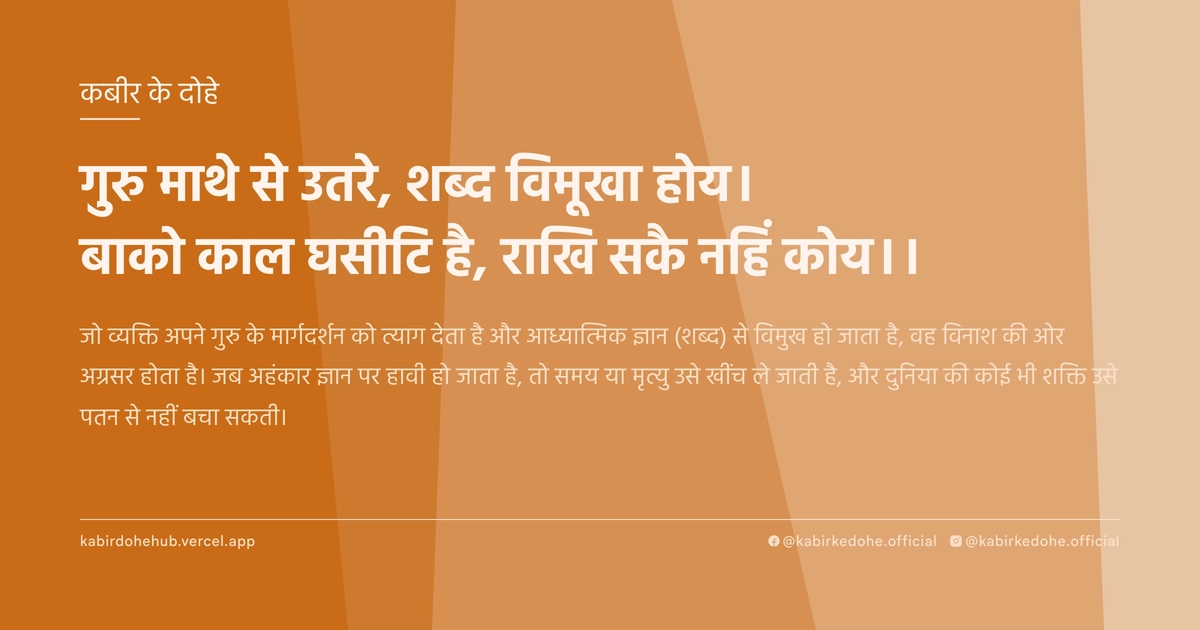
गुरु माथे से उतरे, शब्द विमूखा होय।
बाको काल घसीटि है, राखि सकै नहिं कोय।।
Guru maathe se utare, shabd vimookha hoye. Baako kaal ghasiti hai, raakh sakai nahin koy.
इस पृष्ठ पर इस कबीर दोहे का अर्थ (meaning), हिंदी व्याख्या और अंग्रेज़ी अनुवाद, दार्शनिक विश्लेषण और व्यावहारिक जीवन सीख दी गई है। यह दोहा गुरु महत्व (The Guru's Importance) विषय से जुड़ा है — Kabir doha meaning and explanation in Hindi and English.
अर्थ (Meaning):
जो व्यक्ति अपने गुरु के मार्गदर्शन को त्याग देता है और आध्यात्मिक ज्ञान (शब्द) से विमुख हो जाता है, वह विनाश की ओर अग्रसर होता है। जब अहंकार ज्ञान पर हावी हो जाता है, तो समय या मृत्यु उसे खींच ले जाती है, और दुनिया की कोई भी शक्ति उसे पतन से नहीं बचा सकती।
One who discards the guidance of the Guru and turns away from the sacred Word (Shabd) invites spiritual ruin. When a seeker abandons the path of truth for the illusions of ego, time and death inevitably drag them toward oblivion, and no earthly or divine power can shield them from this consequence.
व्याख्या (Interpretation):
शाब्दिक अर्थ में, यह दोहा गुरु के प्रति अनादर की चेतावनी है। परंतु आध्यात्मिक स्तर पर, 'गुरु' केवल एक व्यक्ति नहीं, बल्कि वह अंतर्ज्ञान या 'शब्द' है जो अज्ञान के अंधकार को मिटाता है। 'माथे से उतरना' अहंकार के उदय का प्रतीक है, जहाँ साधक यह मानने लगता है कि वह अब गुरु से ऊपर है। यह विमुखता वास्तव में आत्मा का परमात्मा से विच्छेद है। निर्गुण भक्ति के संदर्भ में, जब साधक 'शब्द' (नाद या आंतरिक ध्वनि) को खो देता है, तो वह माया के जाल में पुनः फंस जाता है। यह विरोधाभास है कि ज्ञान की प्राप्ति ही अक्सर अहंकार को जन्म देती है, जो अंततः साधक को उसी शून्य में धकेल देती है जिससे वह निकलना चाहता था। यहाँ 'काल' केवल मृत्यु नहीं, बल्कि वह समय है जो अज्ञानता के कारण व्यर्थ गया, जो अंततः विनाशकारी सिद्ध होता है।
Literally, this couplet warns against the betrayal of the teacher. Metaphorically, the 'Guru' represents not just a human guide, but the primordial consciousness or the 'Shabd' (Divine Word) that dispels the darkness of ignorance. 'Descending from the head' symbolizes the rise of the ego, where the seeker erroneously believes they have surpassed the need for guidance. This alienation is, in essence, the severance of the Atman from Brahman. In the context of Nirgun Bhakti, when a practitioner loses touch with the 'Shabd' (the inner sonic vibration of truth), they fall back into the grip of Maya. It is a profound paradox: the initial acquisition of knowledge often fuels a spiritual pride that becomes the very obstacle to liberation. Here, 'Kaal' (Time/Death) is not merely physical demise, but the inevitable spiritual decay that occurs when one turns away from the Eternal Truth, leaving the soul vulnerable and unprotected.
दार्शनिक विश्लेषण (Philosophical Analysis):
कबीर का यह दोहा मध्यकालीन भारत के उस सामाजिक-धार्मिक परिवेश की प्रतिक्रिया है जहाँ गुरु-शिष्य परंपरा को केवल औपचारिक अनुष्ठानों तक सीमित कर दिया गया था। कबीर ने बाहरी आडंबरों और जाति-आधारित श्रेष्ठता का खंडन करते हुए 'शब्द' की प्रधानता पर जोर दिया। उनके लिए गुरु वह है जो साधक को 'सहज' अवस्था तक पहुँचाए, न कि वह जो केवल शास्त्रों का पाठ कराए।
अद्वैत वेदांत के दृष्टिकोण से, यह दोहा जीव और ब्रह्म के बीच के पर्दे को हटाने की प्रक्रिया पर चर्चा करता है। जब साधक 'शब्द विमूखा' होता है, तो वह पुनः द्वैत (duality) में गिर जाता है। वह स्वयं को शरीर और मन समझने लगता है, जबकि सत्य यह है कि वह शुद्ध चेतना है। यह विस्मृति ही सबसे बड़ा पतन है।
सूफी मत के 'मुर्शिद' (मार्गदर्शक) की अवधारणा के साथ इसका गहरा संबंध है। सूफीवाद में भी माना जाता है कि बिना एक योग्य मार्गदर्शक के, साधक 'नफ्स' (अहंकार) के जाल में फंसकर भटक सकता है। कबीर यहाँ चेतावनी दे रहे हैं कि आध्यात्मिक यात्रा में 'अहंकार' सबसे घातक शत्रु है, जो ज्ञान के शिखर पर पहुँचकर भी व्यक्ति को नीचे गिरा सकता है।
कबीर का विरोध केवल बाहरी गुरुओं से नहीं, बल्कि उस आंतरिक अहंकार से है जो कहता है 'मैं जान गया हूँ'। यह 'मैं' ही वह दीवार है जो साधक को मोक्ष से दूर करती है। जब ज्ञान का उपयोग अहंकार की तुष्टि के लिए किया जाता है, तो वह ज्ञान बंधन बन जाता है, मुक्ति नहीं।
अंततः, यह दोहा मनोवैज्ञानिक रूपांतरण की आवश्यकता पर बल देता है। यह सिखाता है कि विनम्रता केवल एक गुण नहीं, बल्कि आध्यात्मिक अस्तित्व की अनिवार्य शर्त है। बिना विनम्रता के, ज्ञान एक बोझ है जो अंततः व्यक्ति को मानसिक और आध्यात्मिक पतन की ओर ले जाता है, जहाँ वह स्वयं को अकेला और असहाय पाता है।
This couplet by Kabir is a reaction to the socio-religious climate of medieval India, where the Guru-Shishya tradition had been reduced to mere formal rituals. Kabir rejected external pomposity and caste-based superiority, emphasizing the primacy of the 'Shabd' (the Word). For him, a true Guru is one who leads the seeker to the state of 'Sahaj' (spontaneous enlightenment), rather than one who merely recites scriptures.
From the perspective of Advaita Vedanta, this verse discusses the process of removing the veil between the Jiva (individual soul) and Brahman (Universal Consciousness). When a seeker becomes 'Shabd Vimookha' (alienated from the Word), they fall back into the trap of duality. They begin to identify with the body and mind, forgetting their true nature as pure consciousness. This spiritual amnesia is the ultimate downfall.
There is a profound resonance here with the Sufi concept of the 'Murshid' (spiritual guide). Sufism posits that without a qualified guide, a seeker can easily be misled by the 'Nafs' (the lower ego). Kabir warns that in the spiritual journey, the ego is the most lethal enemy, capable of dragging a person down even after they have reached the heights of knowledge.
Kabir's critique is not merely directed at external teachers, but at the internal arrogance that whispers, 'I have attained it all.' This 'I' is the wall that separates the seeker from liberation. When knowledge is used to nourish the ego, it ceases to be a bridge to freedom and instead becomes a chain of bondage.
Ultimately, this couplet emphasizes the necessity of psychological transformation. It teaches that humility is not just a moral virtue but an essential condition for spiritual existence. Without humility, knowledge is a burden that inevitably leads to mental and spiritual collapse, leaving the individual isolated and vulnerable to the forces of decay.
मूल संदेश (Core Message):
- अहंकार ज्ञान का अंत है, विनम्रता उसकी शुरुआत।
- गुरु केवल व्यक्ति नहीं, सत्य की ओर ले जाने वाला मार्ग है।
- शब्द से विमुख होना स्वयं की आत्मा से विमुख होना है।
- अध्यात्म में 'मैं' का मिटना ही वास्तविक प्राप्ति है।
- समय केवल उन्हीं को नष्ट करता है जो सत्य को त्याग देते हैं।
- Ego is the end of knowledge; humility is its beginning.
- The Guru is not just a person, but the path leading to Truth.
- To turn away from the Word is to turn away from one's own soul.
- In spirituality, the annihilation of 'I' is the only true attainment.
- Time destroys only those who have abandoned the Eternal Truth.
व्यावहारिक उदाहरण (Practical Example):
वाराणसी के एक पुराने घाट पर रहने वाले माधव नाम के एक वृद्ध बुनकर थे। माधव ने वर्षों तक एक संत के सानिध्य में रहकर ध्यान और सत्य की खोज की थी। धीरे-धीरे उन्हें आध्यात्मिक अनुभवों की प्राप्ति हुई और उनके चेहरे पर एक अलौकिक शांति छा गई।
जैसे-जैसे उनकी ख्याति बढ़ी, लोग उन्हें 'ज्ञानी' मानने लगे। माधव, जो कभी विनम्र थे, अब इस प्रशंसा के जाल में फंस गए। उन्हें लगने लगा कि अब उन्हें किसी मार्गदर्शन की आवश्यकता नहीं है। उन्होंने अपने गुरु के बताए मार्ग—सेवा और सरलता—को छोड़ दिया और स्वयं को एक महान शिक्षक के रूप में स्थापित करने लगे।
वे अब दूसरों को उपदेश देने में अधिक समय बिताते थे और स्वयं के भीतर झांकना बंद कर चुके थे। उनके भीतर का 'शब्द' शांत हो गया और उसकी जगह 'अहंकार' का शोर गूंजने लगा। वे अब केवल शब्दों के खेल में उलझ गए थे, अनुभव से दूर हो चुके थे।
एक दिन, उनके जीवन में एक कठिन संकट आया। उनके परिवार में गंभीर बीमारी फैली और उनकी आर्थिक स्थिति बिगड़ गई। जिस समय उन्हें आंतरिक शांति और धैर्य की सबसे अधिक आवश्यकता थी, उन्होंने पाया कि उनका मन अशांत है और वे गहरे अवसाद में डूब रहे हैं।
वे उन पुराने मंत्रों और ध्यान विधियों को याद करने की कोशिश करने लगे, लेकिन उनका मन अब उनमें एकाग्र नहीं हो पा रहा था। उन्होंने महसूस किया कि जिस अहंकार ने उन्हें गुरु के मार्ग से विमुख किया था, उसने उनके भीतर की उस आध्यात्मिक शक्ति को भी नष्ट कर दिया है जो उन्हें कठिन समय में सहारा देती।
वे अब उस शांति को तरस रहे थे जो उन्हें तब मिलती थी जब वे केवल एक शिष्य थे। उन्होंने महसूस किया कि ज्ञान का घमंड उन्हें एक ऐसे अंधेरे कुएं में ले आया है जहाँ से बाहर निकलने का कोई रास्ता नहीं दिख रहा था।
तभी उन्हें अपने गुरु की एक बात याद आई: 'ज्ञान जब तक समर्पण में नहीं बदलता, वह केवल एक बोझ है।' इस अहसास ने उन्हें झकझोर दिया। उन्होंने अपनी सारी प्रतिष्ठा और 'ज्ञानी' होने के मुखौटे को उतार फेंका और पुनः एक साधारण सेवक बन गए।
माधव ने फिर से घाट की सफाई करना और बीमारों की सेवा करना शुरू किया। जब उन्होंने अपना 'मैं' मिटाया, तब जाकर उन्हें वह 'शब्द' पुनः सुनाई दिया जो उनके भीतर खो गया था। इस प्रकार, अहंकार के पतन के बाद ही उनका वास्तविक आध्यात्मिक पुनर्जन्म हुआ।
In the ancient ghats of Varanasi lived an elderly weaver named Madhav. For years, Madhav had lived under the guidance of a realized saint, practicing meditation and seeking the ultimate truth. Over time, he began to have profound spiritual experiences, and a divine serenity radiated from his countenance.
As his reputation grew, people began to hail him as a 'Jnani' (a knower of truth). Madhav, who was once humble, fell into the trap of this praise. He began to believe that he no longer required guidance and that he had surpassed his teacher. He abandoned the path of service and simplicity prescribed by his Guru and sought to establish himself as a grand master.
He spent more time delivering lectures to others than looking within. The 'Shabd' (inner word) within him grew silent, replaced by the deafening noise of the ego. He became entangled in the intellectual gymnastics of spirituality, losing touch with actual lived experience.
One day, a severe crisis struck his life. A devastating illness swept through his family, and his financial stability collapsed. At the very moment he needed inner peace and resilience the most, he found his mind fragmented and his spirit sinking into a deep depression.
He tried to recall the ancient mantras and meditation techniques, but his mind could no longer concentrate. He realized that the same arrogance that had alienated him from his Guru's path had also eroded the spiritual strength that once sustained him during hardships.
He longed for the peace he possessed when he was merely a disciple. He felt that the pride of knowledge had led him into a dark pit from which there seemed to be no escape.
Suddenly, he remembered a phrase his Guru had once whispered: 'Knowledge, until it transforms into surrender, is merely a burden.' This realization shook him to his core. He stripped away his reputation and the mask of the 'learned man' and returned to being a simple servant.
Madhav began cleaning the ghats again and serving the sick. Only when he annihilated his 'I' did he hear the 'Shabd' once more, which had been lost in the noise of pride. Thus, only after the collapse of his ego did his true spiritual rebirth occur.
अभ्यास मार्गदर्शन (Practice Guidance):
- प्रतिदिन 20 मिनट मौन रहकर यह विचार करें कि आपके जीवन में कौन से 'अहंकार' के रूप (जैसे पद, ज्ञान, या सुंदरता) आपको सत्य से दूर कर रहे हैं।
- एक 'अहंकार डायरी' लिखें: जब भी आप किसी को खुद से कमतर महसूस कराएं या अपनी उपलब्धि पर गर्व करें, उसे लिखें और फिर विश्लेषण करें कि यह भावना आपको कैसे सीमित कर रही है।
- सेवा का अभ्यास: सप्ताह में एक बार ऐसा कार्य करें जिसमें आपकी कोई पहचान न हो और आप पूरी तरह से एक 'शिष्य' या 'सेवक' की भूमिका में हों।
- निदान चेकलिस्ट: क्या आप दूसरों की सलाह को 'पुराना' या 'अनावश्यक' मानने लगे हैं? क्या आप अपनी उपलब्धियों का श्रेय केवल स्वयं को देते हैं? यदि हाँ, तो आप 'शब्द विमूखा' होने की दिशा में बढ़ रहे हैं।
- Spend 20 minutes in absolute silence daily, contemplating which forms of ego (such as status, knowledge, or beauty) are creating a barrier between you and the Truth.
- Maintain an 'Ego Journal': Whenever you feel superior to someone or take excessive pride in an achievement, record it and analyze how this feeling limits your spiritual growth.
- Practice Anonymity: Once a week, engage in a task where your identity is completely hidden and you function solely in the role of a 'disciple' or 'servant'.
- Diagnostic Checklist: Have you started dismissing others' advice as 'outdated' or 'unnecessary'? Do you attribute all your successes solely to your own effort? If yes, you are drifting toward becoming 'Shabd Vimookha'.
चिंतन प्रश्न (Reflection Questions):
- क्या मेरा 'आध्यात्मिक ज्ञान' मुझे दूसरों के प्रति अधिक करुणामयी बना रहा है, या अधिक निर्णयात्मक?
- यदि आज मेरी सारी सामाजिक और बौद्धिक पहचान छीन ली जाए, तो मेरे भीतर क्या बचेगा?
- मैं किन लोगों को 'अयोग्य' मानता हूँ, और क्या यह निर्णय मेरे अपने अहंकार की उपज है?
- क्या मैं वास्तव में सत्य की खोज कर रहा हूँ, या मैं केवल अपनी श्रेष्ठता की पुष्टि चाहता हूँ?
- मेरे जीवन का वह कौन सा क्षेत्र है जहाँ मैं 'गुरु' (मार्गदर्शन) को पूरी तरह नकार चुका हूँ?
- Is my 'spiritual knowledge' making me more compassionate toward others, or more judgmental?
- If all my social and intellectual identities were stripped away today, what would remain within me?
- Whom do I consider 'unworthy,' and is this judgment a product of my own ego?
- Am I truly seeking the Truth, or am I merely seeking validation of my own superiority?
- In which area of my life have I completely rejected guidance or the possibility of being a student?