
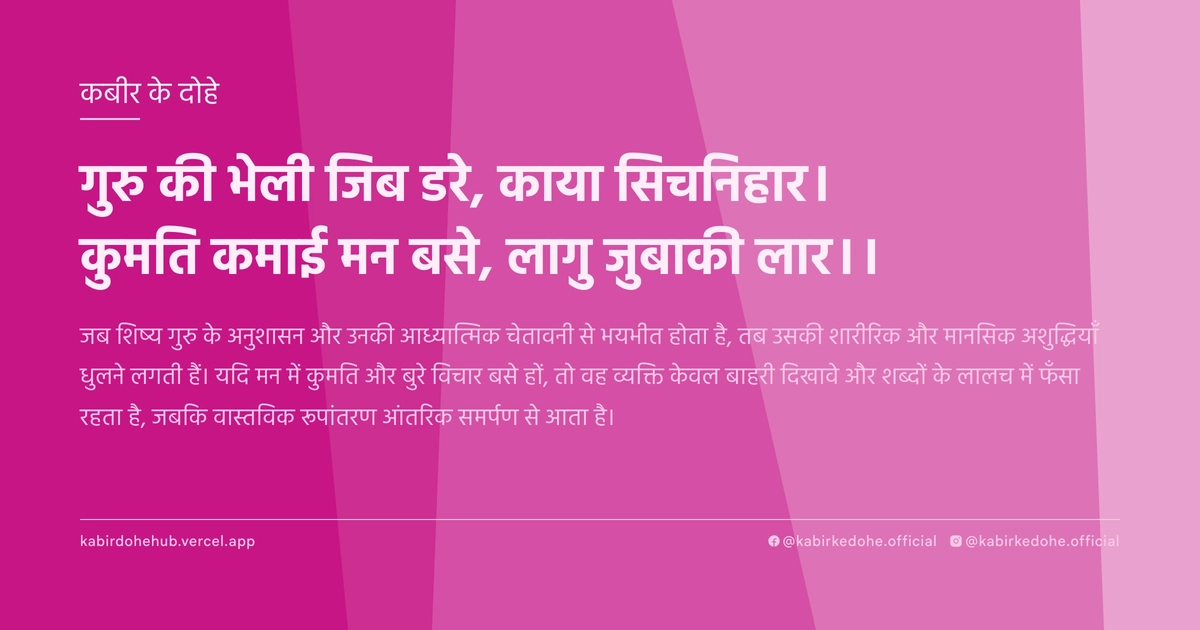
गुरु की भेली जिब डरे, काया सिचनिहार।
कुमति कमाई मन बसे, लागु जुबाकी लार।।
Guru ki bheli jib dare, kaaya sichnihaar. Kumati kamayi man base, laagu jubaaki laar.
इस पृष्ठ पर इस कबीर दोहे का अर्थ (meaning), हिंदी व्याख्या और अंग्रेज़ी अनुवाद, दार्शनिक विश्लेषण और व्यावहारिक जीवन सीख दी गई है। यह दोहा मन नियंत्रण (Mind Control) विषय से जुड़ा है — Kabir doha meaning and explanation in Hindi and English.
अर्थ (Meaning):
जब शिष्य गुरु के अनुशासन और उनकी आध्यात्मिक चेतावनी से भयभीत होता है, तब उसकी शारीरिक और मानसिक अशुद्धियाँ धुलने लगती हैं। यदि मन में कुमति और बुरे विचार बसे हों, तो वह व्यक्ति केवल बाहरी दिखावे और शब्दों के लालच में फँसा रहता है, जबकि वास्तविक रूपांतरण आंतरिक समर्पण से आता है।
When a seeker trembles before the spiritual discipline and stern warnings of the Guru, the physical and mental impurities of the body begin to be cleansed. However, if the mind remains inhabited by distorted intellect and egoic desires, the seeker merely chases the superficial allure of words and rhetoric, failing to achieve true internal transformation.
व्याख्या (Interpretation):
यह दोहा गुरु और शिष्य के बीच के गहन मनोवैज्ञानिक और आध्यात्मिक संबंध को दर्शाता है। 'डरे' शब्द यहाँ साधारण भय नहीं, बल्कि 'श्रद्धापूर्ण भय' (reverential awe) है, जो अहंकार के विसर्जन के लिए आवश्यक है। जब साधक का अहंकार गुरु की उपस्थिति में टूटता है, तब 'काया सिचनिहार' अर्थात आत्मा का शुद्धिकरण शुरू होता है। यह निर्गुण भक्ति का सार है, जहाँ बाहरी कर्मकांडों के बजाय आंतरिक शुद्धि पर बल दिया गया है। माया यहाँ 'कुमति' के रूप में प्रकट होती है, जो व्यक्ति को सत्य के बजाय शब्दों के मोह (जुबाकी लार) में उलझाए रखती है। यह अद्वैत वेदांत के उस सिद्धांत को पुष्ट करता है कि जब तक 'मैं' (अहंकार) जीवित है, तब तक ब्रह्म का अनुभव असंभव है।
This couplet illuminates the profound psychological and spiritual dynamic between the Guru and the disciple. The word 'dare' (fear) does not signify terror, but rather 'reverential awe,' which is essential for the dissolution of the ego. When the seeker's pride collapses in the presence of the Master, 'kaya sichnihar'—the cleansing of the existential vessel—commences. This aligns with Nirgun Bhakti, emphasizing internal purification over external ritualism. Maya manifests here as 'kumati' (distorted intellect), trapping the individual in the allure of superficial rhetoric ('jubaki lar') rather than the silence of Truth. It reinforces the Advaita Vedanta principle that as long as the 'I' (ego) persists, the realization of the non-dual Brahman remains obscured.
दार्शनिक विश्लेषण (Philosophical Analysis):
कबीर का यह दर्शन मध्यकालीन भारत के उस समय का है जब धर्म केवल कर्मकांडों और जातिगत श्रेष्ठता तक सीमित था। कबीर ने इस व्यवस्था को चुनौती देते हुए यह स्थापित किया कि मोक्ष किसी मंदिर या मस्जिद में नहीं, बल्कि गुरु के मार्गदर्शन में अहंकार के विसर्जन में है। यहाँ 'गुरु' केवल एक व्यक्ति नहीं, बल्कि वह चेतना है जो अज्ञान के पर्दे को हटाती है।
सूफी मत के 'पीर-मुरीद' संबंध की तरह, कबीर यहाँ पूर्ण समर्पण की बात करते हैं। जब तक शिष्य अपनी बुद्धि (कुमति) को श्रेष्ठ मानता है, वह केवल शब्दों का खेल खेलता है। यह बौद्धिक अहंकार ही है जो सत्य और साधक के बीच की सबसे बड़ी दीवार है।
अद्वैत वेदांत के परिप्रेक्ष्य में, यह दोहा 'माया' के सूक्ष्म जाल को समझाता है। माया केवल बाहरी दुनिया नहीं है, बल्कि वह आंतरिक भ्रम है जो हमें यह विश्वास दिलाता है कि हम शरीर हैं। जब गुरु का प्रहार इस भ्रम को तोड़ता है, तब आत्मा अपनी मूल शुद्धता को प्राप्त करती है।
कबीर यहाँ 'जुबाकी लार' के माध्यम से उन पाखंडियों पर प्रहार करते हैं जो केवल शास्त्रार्थ में निपुण हैं लेकिन जिनके आचरण में सत्य नहीं है। उनके लिए ज्ञान वह नहीं जो याद किया जाए, बल्कि वह है जो जिया जाए।
अंततः, यह विश्लेषण हमें बताता है कि आध्यात्मिक प्रगति के लिए 'बौद्धिक समझ' से अधिक 'भावनात्मक समर्पण' की आवश्यकता होती है। अहंकार का विसर्जन ही वह एकमात्र द्वार है जिससे होकर साधक शून्य की अवस्था में प्रवेश करता है और स्वयं को परमात्मा में विलीन पाता है।
Kabir’s philosophy emerged during a medieval Indian era where religion was largely reduced to ritualistic performance and caste-based hierarchy. Challenging this structure, Kabir established that liberation is found not in temples or mosques, but in the dissolution of the ego under the guidance of a true Guru. Here, the 'Guru' is not merely a person, but the awakened consciousness that strips away the veil of ignorance.
Mirroring the Sufi 'Pir-Murid' relationship, Kabir emphasizes absolute surrender. As long as the disciple clings to their own distorted intellect (kumati), they engage only in a linguistic game. This intellectual arrogance is the primary barrier between the seeker and the Truth.
From the lens of Advaita Vedanta, this doha explains the subtle trap of 'Maya.' Maya is not just the external world, but the internal delusion that identifies the self with the physical body. When the Guru’s insight shatters this illusion, the Atman recovers its primordial purity.
Through the phrase 'jubaki lar,' Kabir critiques the hypocrites who are masters of scholarly debate but devoid of lived truth. For Kabir, knowledge is not something to be memorized, but something to be embodied through experience.
Ultimately, this analysis reveals that spiritual progression requires 'emotional surrender' far more than 'intellectual comprehension.' The annihilation of the ego is the only gateway through which the seeker enters the state of Shunya (void) and merges with the Universal Consciousness.
मूल संदेश (Core Message):
- अहंकार का विसर्जन ही वास्तविक आध्यात्मिक जागृति का एकमात्र द्वार है।
- शब्दों का ज्ञान और सत्य का अनुभव दो अलग-अलग धरातल हैं।
- गुरु का कठोर अनुशासन वास्तव में आत्मा के लिए करुणा का उच्चतम रूप है।
- बाहरी शुद्धता एक भ्रम है; वास्तविक शुद्धि आंतरिक वैराग्य से आती है।
- जब 'मैं' मिटता है, तभी 'वह' (परमात्मा) प्रकट होता है।
- The dissolution of ego is the only gateway to genuine spiritual awakening.
- Intellectual knowledge of truth and the actual experience of truth exist on different planes.
- The stern discipline of a Guru is, in reality, the highest form of compassion for the soul.
- External purity is an illusion; true cleansing arises from internal detachment.
- Only when the 'I' vanishes does the 'Divine' manifest.
व्यावहारिक उदाहरण (Practical Example):
एक समय की बात है, बनारस के घाटों पर रहने वाला एक वृद्ध विधवा, जिसे लोग 'माई' कहते थे, अत्यंत धार्मिक थी। वह दिन-भर मंत्र जाप करती और कठोर व्रत रखती थी, लेकिन उसके मन में यह गहरा अहंकार था कि वह शहर की सबसे पवित्र स्त्री है। वह अन्य महिलाओं को तुच्छ समझती थी।
एक दिन उसकी मुलाकात एक फकीर से हुई, जिसने उसे देखा और मुस्कुराकर कहा, 'माई, तुम्हारी माला के दाने तो चमक रहे हैं, लेकिन तुम्हारा हृदय अभी भी कालिख से भरा है।'
माई को यह बात चुभी। उसने तर्क दिया कि उसने कितने कठिन व्रत किए हैं। फकीर ने शांति से उत्तर दिया, 'व्रत शरीर को सुखाते हैं, अहंकार को नहीं। तुम ईश्वर को नहीं, अपनी पवित्रता की छवि को पूज रही हो।'
यह शब्द माई के लिए एक वज्रपात की तरह थे। पहली बार उसे महसूस हुआ कि उसकी सारी भक्ति केवल एक मुखौटा थी। वह फकीर के चरणों में गिर पड़ी और फूट-फूट कर रोने लगी।
उसका वह 'डर' या विस्मय वास्तव में उसके अहंकार का टूटना था। उसने महसूस किया कि वह अब तक केवल 'जुबाकी लार' यानी शब्दों और रीति-रिवाजों के मोह में थी।
अगले कुछ महीनों में माई का व्यवहार पूरी तरह बदल गया। उसने अपनी श्रेष्ठता का भाव त्याग दिया और उन लोगों की सेवा करने लगी जिन्हें वह पहले तुच्छ समझती थी।
उसने पाया कि जब उसने खुद को 'पवित्र' मानना बंद किया, तब वह वास्तव में शुद्ध होने लगी। उसकी आंतरिक शांति अब किसी व्रत पर निर्भर नहीं थी।
उसने सीखा कि गुरु का वह कड़वा शब्द ही वास्तव में वह औषधि थी जिसने उसकी आत्मा की गंदगी को साफ किया।
अब वह घाट पर केवल माला नहीं फेरती थी, बल्कि हर दुखी व्यक्ति में उसी परमात्मा को देखती थी।
माई का जीवन अब एक प्रदर्शन नहीं, बल्कि एक मौन प्रार्थना बन गया था, जहाँ अहंकार पूरी तरह विलीन हो चुका था।
Once, on the ghats of Varanasi, lived an elderly widow known as 'Mai.' She was deeply religious, spending her days in mantra chanting and rigorous fasting. However, she harbored a profound ego, believing herself to be the most pious woman in the city, often looking down upon others.
One day, she encountered a wandering fakir who looked at her and smiled, saying, 'Mai, the beads of your rosary are shining, but your heart is still stained with soot.'
Mai was offended. She argued about the severity of her fasts and the length of her prayers. The fakir replied calmly, 'Fasts wither the body, not the ego. You are not worshipping God; you are worshipping the image of your own piety.'
These words struck Mai like a thunderbolt. For the first time, she realized that her entire spiritual practice was merely a mask. She collapsed at the fakir's feet, weeping uncontrollably.
That 'fear' or awe she felt was actually the shattering of her ego. She realized she had been trapped in 'jubaki lar'—the allure of words and the vanity of rituals.
Over the following months, Mai's behavior transformed completely. She abandoned her sense of superiority and began serving the very people she had previously despised.
She discovered that once she stopped trying to be 'holy,' she actually began to become pure. Her inner peace was no longer dependent on the rigor of her fasts.
She understood that the fakir's harsh words were the only medicine capable of cleansing the grime of her soul.
Now, she didn't just rotate her beads on the ghats; she saw the Divine in every suffering soul she encountered.
Mai's life ceased to be a performance and became a silent prayer, where the ego had finally vanished into the void.
अभ्यास मार्गदर्शन (Practice Guidance):
- प्रतिदिन 20 मिनट मौन बैठें और विचार करें कि आपकी कौन सी 'धार्मिक' या 'नैतिक' आदतें वास्तव में आपके अहंकार को संतुष्ट कर रही हैं।
- एक डायरी लिखें जिसमें उन क्षणों को दर्ज करें जब किसी ने आपकी गलती बताई और आपने उसे सुधारने के बजाय तर्क (कुमति) का सहारा लिया।
- व्यवहार परिवर्तन: दिन में कम से कम एक बार किसी ऐसे व्यक्ति की निस्वार्थ सेवा करें जिसे आप मानसिक रूप से अपने से छोटा समझते हैं।
- निदान चेकलिस्ट: क्या आप अपनी उपलब्धियों का जिक्र दूसरों के सामने करते हैं? क्या आप दूसरों की गलतियों पर तुरंत निर्णय लेते हैं? यदि हाँ, तो आप अभी भी 'जुबाकी लार' में हैं।
- Spend 20 minutes in daily silence, contemplating which of your 'religious' or 'moral' habits are actually serving to nourish your ego.
- Maintain a journal recording moments when someone pointed out your flaw and you responded with intellectual justification (kumati) instead of humility.
- Behavioral Shift: Once a day, perform a selfless act of service for someone you subconsciously perceive as inferior to yourself.
- Diagnostic Checklist: Do you frequently mention your spiritual or moral achievements to others? Do you judge others instantly? If yes, you are still trapped in 'jubaki lar' (superficiality).
चिंतन प्रश्न (Reflection Questions):
- क्या मेरी आध्यात्मिकता वास्तव में मुझे विनम्र बना रही है, या यह मेरे अहंकार को एक नया 'धार्मिक' रूप दे रही है?
- मैं किन शब्दों या सिद्धांतों के पीछे छिपता हूँ ताकि मुझे अपने वास्तविक आंतरिक अंधकार का सामना न करना पड़े?
- यदि आज मेरी सारी सामाजिक और धार्मिक पहचान छीन ली जाए, तो मेरे भीतर क्या बचेगा?
- क्या मैं सत्य को खोजना चाहता हूँ, या मैं केवल यह साबित करना चाहता हूँ कि मैं सही हूँ?
- मेरे जीवन में 'गुरु' का अर्थ क्या है—एक व्यक्ति, एक पुस्तक, या वह आंतरिक आवाज जो मुझे असहज करती है?
- Is my spirituality actually making me humble, or is it merely giving my ego a new 'religious' identity?
- Which words or doctrines do I hide behind to avoid facing my own internal darkness?
- If all my social and religious identities were stripped away today, what would remain of me?
- Do I truly seek the Truth, or am I merely seeking validation that I am right?
- What does 'Guru' mean in my life—a person, a book, or that internal voice that makes me uncomfortable?