
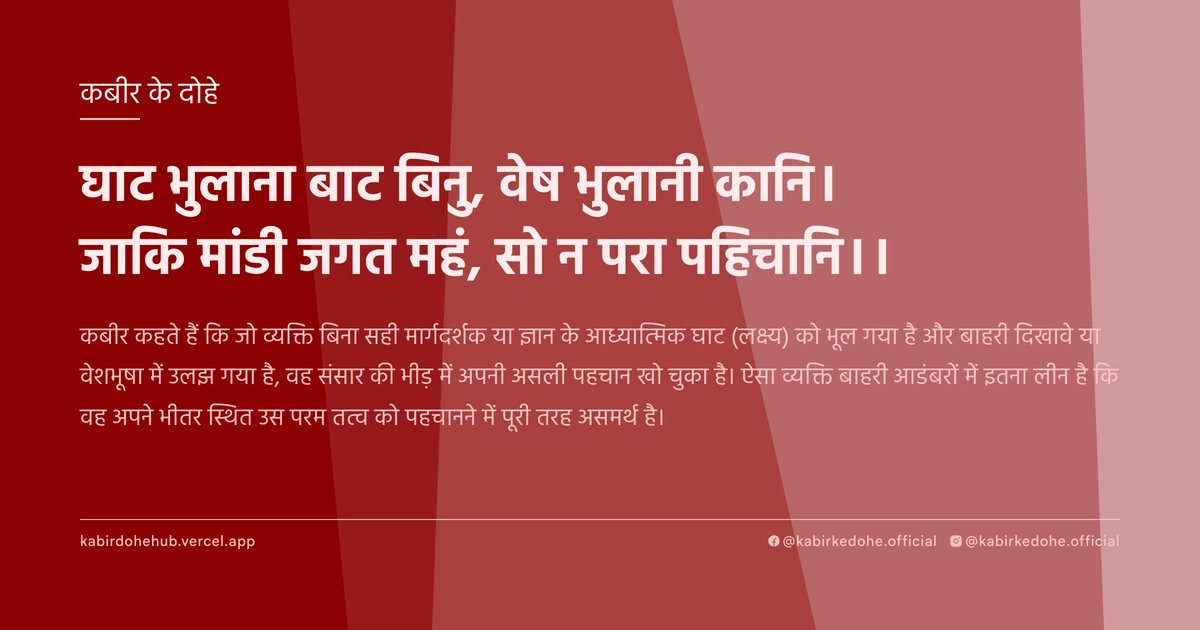
घाट भुलाना बाट बिनु, वेष भुलानी कानि।
जाकि मांडी जगत महं, सो न परा पहिचानि।।
Ghat bhulana baat binu, vesh bhulani kaani. Jaak maandi jagat mahan, so na para pahichani.
इस पृष्ठ पर इस कबीर दोहे का अर्थ (meaning), हिंदी व्याख्या और अंग्रेज़ी अनुवाद, दार्शनिक विश्लेषण और व्यावहारिक जीवन सीख दी गई है। यह दोहा आत्मनिरीक्षण (Self-introspection) विषय से जुड़ा है — Kabir doha meaning and explanation in Hindi and English.
अर्थ (Meaning):
कबीर कहते हैं कि जो व्यक्ति बिना सही मार्गदर्शक या ज्ञान के आध्यात्मिक घाट (लक्ष्य) को भूल गया है और बाहरी दिखावे या वेशभूषा में उलझ गया है, वह संसार की भीड़ में अपनी असली पहचान खो चुका है। ऐसा व्यक्ति बाहरी आडंबरों में इतना लीन है कि वह अपने भीतर स्थित उस परम तत्व को पहचानने में पूरी तरह असमर्थ है।
Kabir asserts that one who forgets the spiritual destination (the ghat) due to a lack of true guidance and becomes obsessed with outward appearances and ritualistic attire is utterly lost. Such a person is so entangled in the superficial noise of the world that they fail to recognize the divine essence residing within themselves.
व्याख्या (Interpretation):
यहाँ 'घाट' का अर्थ केवल नदी का किनारा नहीं, बल्कि वह आध्यात्मिक अवस्था है जहाँ आत्मा परमात्मा से मिलती है। 'बाट' का अर्थ है वह सही मार्ग या गुरु का ज्ञान जिसके बिना लक्ष्य अप्राप्य है। कबीर समझाते हैं कि जब मनुष्य बाहरी 'वेश' यानी सामाजिक स्थिति, धार्मिक वस्त्रों या पाखंडी पहचान को ही सत्य मान लेता है, तो वह माया के जाल में फंस जाता है। यह स्थिति अद्वैत वेदांत के उस भ्रम की तरह है जहाँ जीव स्वयं को ब्रह्म से अलग मानकर अहंकार (Ego) का पोषण करता है। निर्गुण भक्ति के अनुसार, ईश्वर किसी विशेष पोशाक या मंदिर में नहीं, बल्कि शुद्ध चेतना में है। इस प्रकार, बाहरी दिखावे की 'मांडी' (भीड़/बाजार) व्यक्ति को उसकी आंतरिक वास्तविकता से दूर ले जाती है, जिससे वह स्वयं को और उस परम सत्य को पहचानने की क्षमता खो देता है।
Here, 'Ghat' does not merely signify a riverbank but represents the spiritual threshold where the soul merges with the Divine. 'Baat' refers to the authentic path or the grace of a Guru, without which the destination remains elusive. Kabir explains that when a human mistakes 'Vesh'—outward appearances, social status, or ritualistic attire—for truth, they fall prey to Maya (illusion). This mirrors the Advaita Vedanta concept where the Jiva (individual soul) perceives itself as separate from Brahman due to ignorance. In Nirgun Bhakti, the Divine is not found in specific garments or temples but in pure consciousness. Consequently, the 'Maandi' (the marketplace of worldly vanity) distracts the seeker, creating a veil of ego that prevents the recognition of the Atman, leading to a profound spiritual amnesia regarding one's true nature.
दार्शनिक विश्लेषण (Philosophical Analysis):
कबीर का यह दोहा उनके युग के गहरे सामाजिक और धार्मिक पाखंड पर एक तीखा प्रहार है। 15वीं शताब्दी में, धर्म अक्सर बाहरी प्रतीकों—जैसे माला, तिलक, विशेष वस्त्र और जातिगत पहचान—तक सीमित हो गया था। कबीर ने इस 'वेश' की संस्कृति को खारिज किया क्योंकि यह मनुष्य को आंतरिक रूपांतरण के बजाय बाहरी प्रदर्शन की ओर धकेलता है। उनका दर्शन इस बात पर जोर देता है कि सत्य किसी संस्था या पोशाक का मोहताज नहीं है।
दार्शनिक स्तर पर, यह दोहा अद्वैत वेदांत के 'अविद्या' (अज्ञान) के सिद्धांत से जुड़ा है। जब हम बाहरी पहचान को अपनी वास्तविक पहचान मान लेते हैं, तो हम उस अद्वैत सत्य को भूल जाते हैं कि हम और ईश्वर एक ही हैं। कबीर यहाँ चेतावनी दे रहे हैं कि जो व्यक्ति केवल 'दिखने' में साधु है, वह वास्तव में आध्यात्मिक रूप से अंधा है। यह सूफी मत के 'फना' (अहंकार का विनाश) के विचार के समान है, जहाँ जब तक 'मैं' (अहंकार) जीवित है, तब तक 'वह' (परमात्मा) प्रकट नहीं हो सकता।
कबीर की अस्वीकृति केवल धर्म तक सीमित नहीं थी, बल्कि यह जाति व्यवस्था के प्रति भी थी। जाति भी एक प्रकार का 'वेश' है जो मनुष्य को उसकी मानवीय और दैवीय समानता से दूर करता है। वे तर्क देते हैं कि जब तक व्यक्ति अपनी सामाजिक पहचान के अहंकार में डूबा है, वह उस सार्वभौमिक चेतना को नहीं पा सकता जो सभी सीमाओं से परे है।
मनोवैज्ञानिक रूप से, यह दोहा 'पहचान के संकट' की बात करता है। हम अक्सर अपनी सामाजिक भूमिकाओं (पिता, पुत्र, अधिकारी, भक्त) को ही अपनी संपूर्ण पहचान मान लेते हैं। कबीर इसे एक भ्रम कहते हैं। वे चाहते हैं कि साधक अपनी इन सभी परतों को उतार फेंके और उस नग्न सत्य का सामना करे जो मौन और निराकार है।
अंततः, यह दोहा हमें सिखाता है कि आध्यात्मिक यात्रा बाहरी यात्रा नहीं, बल्कि आंतरिक यात्रा है। यदि आप बाहर खोज रहे हैं, तो आप केवल 'वेश' देख रहे हैं। यदि आप भीतर देखते हैं, तो आप 'घाट' तक पहुँच जाते हैं। यह भौतिकता से आध्यात्मिकता की ओर, और बहुलता से एकता की ओर संक्रमण का आह्वान है।
This couplet is a piercing critique of the social and religious hypocrisy prevalent during Kabir's era. In the 15th century, spirituality had largely devolved into a collection of outward symbols—beads, tilaks, specific garments, and caste markers. Kabir rejected this culture of 'Vesh' (appearance) because it pushed the individual toward performative piety rather than internal transformation. His philosophy posits that Truth is not hostage to any institution or attire.
Philosophically, this aligns with the Advaita Vedanta concept of 'Avidya' (ignorance). When we mistake our external identity for our essential nature, we forget the non-dual truth that the individual soul and the Universal Consciousness are one. Kabir warns that one who is merely a 'saint' in appearance is spiritually blind. This resonates with the Sufi concept of 'Fana' (annihilation of the self), where the 'I' (ego) must perish for the Divine to be realized.
Kabir's rejection extended beyond ritualism to the caste system. Caste is another form of 'Vesh'—a social garment that obscures the fundamental equality of all humans. He argues that as long as a person is immersed in the vanity of their social standing, they cannot access the universal consciousness that transcends all boundaries.
Psychologically, the verse addresses the 'crisis of identity.' We often conflate our social roles—parent, professional, devotee—with our total being. Kabir identifies this as a delusion. He urges the seeker to strip away these layers of identity to face the naked truth that is silent and formless.
Ultimately, the doha teaches that the spiritual journey is not an external migration but an internal descent. Seeking outside leads only to the observation of 'Vesh' (masks). Looking within leads to the 'Ghat' (the destination). It is a call to transition from materiality to spirituality, and from multiplicity to oneness.
मूल संदेश (Core Message):
- बाहरी दिखावा आध्यात्मिक प्रगति का प्रमाण नहीं है।
- सच्चा मार्ग आंतरिक मौन और अहंकार के त्याग से मिलता है।
- सामाजिक पहचान एक मुखौटा है, आत्मा ही एकमात्र सत्य है।
- ईश्वर को खोजने के लिए किसी विशेष पोशाक की आवश्यकता नहीं है।
- जब 'मैं' मिटता है, तभी 'वह' (परमात्मा) प्रकट होता है।
- सादगी ही उच्चतम आध्यात्मिक परिष्कार है।
- External display is not evidence of spiritual progress.
- The true path is found through internal silence and ego dissolution.
- Social identity is a mask; the soul is the only truth.
- No specific attire is required to find the Divine.
- When the 'I' vanishes, the 'He' (Universal Truth) appears.
- Simplicity is the highest form of spiritual refinement.
व्यावहारिक उदाहरण (Practical Example):
वाराणसी के एक पुराने मोहल्ले में माधव नाम का एक बुनकर रहता था। माधव अपनी ईमानदारी और सादगी के लिए जाना जाता था, लेकिन उसके मन में एक गहरी तड़प थी कि वह ईश्वर को कैसे पाए। उसने देखा कि शहर के बड़े-बड़े पंडित और मौलवी रेशमी वस्त्र पहनते थे, लंबी मालाएँ जपते थे और उनके चेहरे पर एक विशेष प्रकार का तेज होता था। माधव ने सोचा कि शायद ईश्वर तक पहुँचने का रास्ता इन्हीं वस्त्रों और कठिन अनुष्ठानों से होकर जाता है।
उसने अपनी सारी जमापूंजी लगाकर एक महंगा भगवा वस्त्र खरीदा और दिन-भर आँखें बंद करके मंत्र जपने लगा। वह अब खुद को एक 'ज्ञानी' समझने लगा था। वह लोगों को उपदेश देने लगा कि कैसे बाहरी शुद्धता और विशेष वेशभूषा से मोक्ष मिलता है। धीरे-धीरे वह अपने परिवार की जरूरतों को नजरअंदाज करने लगा और केवल अपनी 'साधु' वाली छवि को निखारने में लग गया।
एक दिन, माधव की मुलाकात एक वृद्ध फकीर से हुई जो फटे हुए कपड़ों में था और सड़क किनारे बैठा था। फकीर ने माधव के महंगे वस्त्रों और उसके दिखावटी व्यवहार को देखा और मुस्कुराते हुए कहा, "बेटा, तुमने लिबास तो बदल लिया, लेकिन क्या तुमने अपनी रूह का रंग बदला? तुम इस रेशमी कपड़े में खुद को ढूँढ रहे हो, जबकि तुम खुद एक पर्दा बन गए हो।"
माधव को पहले तो गुस्सा आया, लेकिन फकीर की आँखों में एक ऐसी शांति थी जो उसने किसी बड़े पंडित में नहीं देखी थी। फकीर ने उससे पूछा, "यदि तुम इस भगवे वस्त्र को उतार दो, तो क्या तुम अब भी भक्त रहोगे? या तुम्हारी भक्ति इस कपड़े के साथ उतर जाएगी?"
यह प्रश्न माधव के लिए एक बिजली के झटके जैसा था। उसे अहसास हुआ कि वह पिछले कई महीनों से केवल एक 'भक्त की भूमिका' निभा रहा था, वह वास्तव में भक्त बना नहीं था। वह 'वेश' के मोह में इतना अंधा हो गया था कि वह भूल गया था कि ईश्वर हृदय की सरलता और प्रेम में बसता है, न कि महंगे कपड़ों में।
माधव ने उसी क्षण अपने दिखावटी अहंकार को त्याग दिया। उसने वापस अपने साधारण सूती कपड़े पहने और अपने काम (बुनाई) को ही अपनी प्रार्थना बना लिया। उसने समझा कि जब वह पूरी ईमानदारी से धागों को बुनता है, तो वह वास्तव में परमात्मा के साथ जुड़ रहा होता है।
अब माधव किसी को उपदेश नहीं देता था, बल्कि उसकी सेवा और करुणा उसके व्यक्तित्व में झलकने लगी। लोग अब उसके वस्त्रों को नहीं, बल्कि उसकी शांति और प्रेम को देखने लगे।
उसने जान लिया कि 'घाट' (ईश्वर) तक पहुँचने का रास्ता बाहरी वेशभूषा से नहीं, बल्कि अहंकार के विसर्जन और आंतरिक सत्य की पहचान से होकर जाता है। माधव अब वास्तव में 'पहचान' गया था।
In an ancient neighborhood of Varanasi lived a weaver named Madhav. Madhav was known for his honesty and simplicity, but he harbored a deep longing to find God. He observed the city's high priests and scholars who wore fine silks, carried long prayer beads, and carried an aura of spiritual authority. Madhav concluded that the path to the Divine must lie through these specific garments and rigorous rituals.
Using all his meager savings, he bought an expensive saffron robe and spent his days chanting mantras with closed eyes. He began to perceive himself as a 'knower' of truth. He started preaching to others that salvation is achieved through external purity and specific attire. Gradually, he neglected his family's needs, focusing solely on polishing his image as a 'sage.'
One day, Madhav encountered an elderly fakir dressed in tattered rags, sitting by the roadside. The fakir observed Madhav's costly robes and performative piety and smiled, saying, "Son, you have changed your clothes, but have you changed the color of your soul? You are searching for yourself within this silk, while you have become a curtain yourself."
Madhav was initially offended, but he noticed a profound peace in the fakir's eyes that he had never seen in the high priests. The fakir asked, "If you strip away this saffron cloth, would you still be a devotee? Or would your devotion slide off with the fabric?"
This question struck Madhav like a bolt of lightning. He realized that for months, he had merely been playing the 'role' of a devotee; he had not actually become one. He had become so blinded by the 'Vesh' (appearance) that he forgot God resides in the simplicity and love of the heart, not in expensive attire.
In that moment, Madhav renounced his performative ego. He returned to his simple cotton clothes and turned his craft—weaving—into his prayer. He understood that when he wove the threads with absolute honesty and presence, he was truly connecting with the Divine.
Madhav stopped preaching. Instead, his service and compassion began to radiate from his personality. People stopped looking at his clothes and started noticing his peace and love.
He learned that the 'Ghat' (the destination) is reached not through external adornments, but through the dissolution of the ego and the recognition of internal truth. Madhav had finally 'recognized' himself.
अभ्यास मार्गदर्शन (Practice Guidance):
- दैनिक आत्म-अवलोकन: प्रतिदिन 15 मिनट मौन बैठें और विचार करें कि आज आपने कितनी बार अपनी 'सामाजिक पहचान' (पद, प्रतिष्ठा, छवि) को अपनी वास्तविक पहचान माना।
- सादा जीवन अभ्यास: सप्ताह में एक दिन ऐसा चुनें जब आप अपनी सबसे साधारण पोशाक पहनें और यह महसूस करें कि आपकी गरिमा आपके कपड़ों से नहीं, बल्कि आपके चरित्र से आती है।
- जर्नलिंग प्रॉम्प्ट: लिखें—'यदि मेरी सारी बाहरी उपलब्धियाँ और पहचान छीन ली जाएँ, तो मेरे भीतर क्या बचेगा?'
- निदान चेकलिस्ट: क्या मैं दूसरों के सामने अपनी आध्यात्मिक या नैतिक श्रेष्ठता दिखाने की कोशिश करता हूँ? क्या मैं लोगों को उनके पहनावे या जाति से आंकता हूँ? यदि हाँ, तो आप 'वेश' के जाल में हैं।
- Daily Self-Observation: Spend 15 minutes in silence daily, reflecting on how many times you mistook your 'social identity' (status, title, image) for your true self.
- Simplicity Practice: Choose one day a week to wear your simplest attire and consciously feel that your dignity comes from your character, not your clothing.
- Journaling Prompt: Write—'If all my external achievements and identities were stripped away, what would remain within me?'
- Diagnostic Checklist: Do I try to project spiritual or moral superiority to others? Do I judge people based on their attire or caste? If yes, you are trapped in the illusion of 'Vesh'.
चिंतन प्रश्न (Reflection Questions):
- मेरी वह कौन सी 'डिजिटल पहचान' है जिसे मैं अपनी वास्तविक पहचान मान बैठा हूँ?
- मैं अपनी छवि को बनाए रखने के लिए अपनी आत्मा के किन हिस्सों को दबा रहा हूँ?
- क्या मेरी भक्ति दूसरों को प्रभावित करने का एक साधन है या स्वयं को मिटाने का?
- यदि मैं पूरी दुनिया के सामने अपनी सभी उपाधियाँ खो दूँ, तो क्या मैं अभी भी खुद को मूल्यवान मानूँगा?
- मेरे भीतर का वह कौन सा 'वेश' है जो मुझे दूसरों के प्रति करुणा रखने से रोकता है?
- क्या मैं सत्य की खोज कर रहा हूँ, या केवल सत्य दिखने की कोशिश कर रहा हूँ?
- Which 'digital identity' have I mistaken for my actual self?
- Which parts of my soul am I suppressing to maintain my public image?
- Is my devotion a tool to impress others or a means to dissolve myself?
- If I lost all my titles before the world, would I still find myself valuable?
- What 'mask' within me prevents me from feeling genuine compassion for others?
- Am I searching for the Truth, or merely trying to appear truthful?