
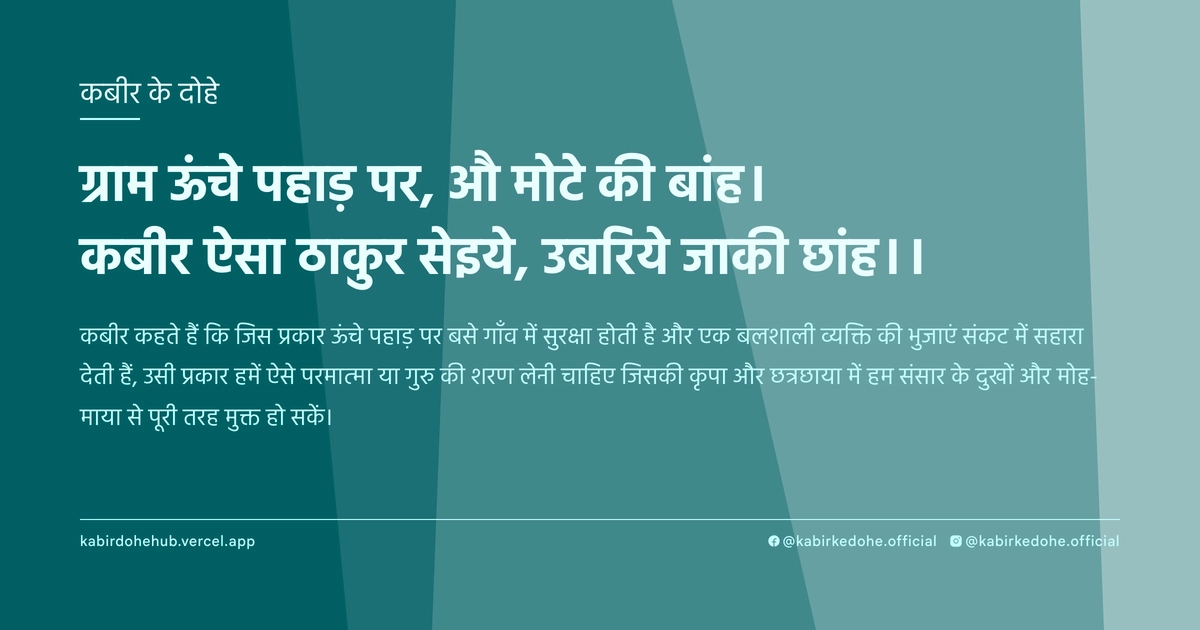
ग्राम ऊंचे पहाड़ पर, औ मोटे की बांह।
कबीर ऐसा ठाकुर सेइये, उबरिये जाकी छांह।।
Graam oonche pahaad par, au mote ki baanh. Kabir aisa thakur seiye, ubariye jaaki chhaanh.
इस पृष्ठ पर इस कबीर दोहे का अर्थ (meaning), हिंदी व्याख्या और अंग्रेज़ी अनुवाद, दार्शनिक विश्लेषण और व्यावहारिक जीवन सीख दी गई है। यह दोहा गुरु महत्व (The Guru's Importance) विषय से जुड़ा है — Kabir doha meaning and explanation in Hindi and English.
अर्थ (Meaning):
कबीर कहते हैं कि जिस प्रकार ऊंचे पहाड़ पर बसे गाँव में सुरक्षा होती है और एक बलशाली व्यक्ति की भुजाएं संकट में सहारा देती हैं, उसी प्रकार हमें ऐसे परमात्मा या गुरु की शरण लेनी चाहिए जिसकी कृपा और छत्रछाया में हम संसार के दुखों और मोह-माया से पूरी तरह मुक्त हो सकें।
Kabir suggests that just as a village situated atop a high mountain remains safe from floods and a strong arm provides unwavering protection in distress, one should seek refuge in a Divine Power or Guru whose spiritual shelter is vast and potent enough to liberate the soul from the tribulations of worldly existence.
व्याख्या (Interpretation):
इस दोहे में 'ऊंचा पहाड़' और 'मोटी बांह' सुरक्षा और स्थिरता के प्रतीक हैं। शाब्दिक अर्थ में यह एक सुरक्षित आश्रय की खोज है, परंतु आध्यात्मिक स्तर पर यह निर्गुण भक्ति की ओर संकेत करता है। यहाँ 'ठाकुर' का अर्थ किसी मूर्ति या व्यक्ति से नहीं, बल्कि उस सर्वव्यापी चेतना (ब्रह्म) से है जो माया के तूफानों से ऊपर है। यह अद्वैत वेदांत के उस सत्य को दर्शाता है जहाँ आत्मा जब परमात्मा की शरण में जाती है, तो वह द्वैत के भ्रम से मुक्त हो जाती है। यह विरोधाभास है कि पूर्ण समर्पण के माध्यम से ही वास्तविक स्वतंत्रता प्राप्त होती है।
In this couplet, the 'high mountain' and 'strong arm' serve as metaphors for stability and absolute protection. While the literal meaning seeks a safe haven, the spiritual essence points toward Nirgun Bhakti. The term 'Thakur' here does not refer to an idol or a person, but to the Omnipresent Consciousness (Brahman) that transcends the storms of Maya. It aligns with Advaita Vedanta, suggesting that when the Atman merges with the Absolute, the illusion of duality vanishes. The central paradox presented is that only through total surrender to the Infinite can one achieve true liberation from the finite.
दार्शनिक विश्लेषण (Philosophical Analysis):
कबीर का यह दोहा उस युग की सामाजिक और धार्मिक जड़ता पर प्रहार करता है जहाँ लोग बाहरी कर्मकांडों और कमजोर संप्रदायों में विश्वास करते थे। कबीर ने स्पष्ट किया कि केवल नाम लेने या माला फेरने से मुक्ति नहीं मिलती; इसके लिए एक ऐसी 'शक्ति' या 'बोध' की आवश्यकता है जो वास्तव में अचल हो। यह सूफी मत के 'फना' (अहंकार का विनाश) और वेदांत के 'ब्रह्म सत्यं जगन्मिथ्या' के करीब है।
यहाँ 'पहाड़' का प्रतीक अहंकार के विनाश के बाद प्राप्त होने वाली उच्च चेतना है। कबीर यह समझाते हैं कि जब तक मनुष्य सांसारिक मोह की निचली घाटियों में भटकता रहेगा, वह माया के प्रवाह में बह जाएगा। केवल वह जो स्वयं को उस निराकार सत्ता के प्रति समर्पित कर देता है, वही सुरक्षित रह सकता है।
यह विश्लेषण दर्शाता है कि कबीर जाति और धर्म के भेदभाव को नकारते हुए एक सार्वभौमिक आध्यात्मिक शरण की बात कर रहे हैं। उनके लिए 'ठाकुर' वह आंतरिक प्रकाश है जो हर मनुष्य के भीतर है, लेकिन जिसे जगाने के लिए एक समर्थ मार्गदर्शक की आवश्यकता होती है।
मनोवैज्ञानिक स्तर पर, यह दोहा असुरक्षा की भावना को आध्यात्मिक विश्वास में बदलने की प्रक्रिया है। जब मनुष्य यह महसूस करता है कि वह इस विशाल ब्रह्मांड में अकेला नहीं है, बल्कि एक अनंत शक्ति का हिस्सा है, तो उसका भय समाप्त हो जाता है।
अंततः, यह दोहा हमें सिखाता है कि सच्ची भक्ति वह नहीं जो माँगती है, बल्कि वह है जो स्वयं को मिटाकर उस विराट सत्ता में विलीन हो जाती है। यह कर्मकांडीय धर्म से ऊपर उठकर अनुभवजन्य धर्म की स्थापना है।
Kabir's couplet strikes at the social and religious inertia of his era, where people clung to superficial rituals and fragile sectarian identities. He clarifies that mere chanting or bead-counting does not grant liberation; rather, one requires a 'Power' or 'Awareness' that is truly immutable. This resonates with the Sufi concept of 'Fana' (annihilation of the ego) and the Vedantic truth of 'Brahman is the only reality, the world is an illusion.'
The symbol of the 'mountain' represents the elevated consciousness attained after the destruction of the ego. Kabir explains that as long as a human wanders in the low valleys of worldly attachment, they will be swept away by the currents of Maya. Only those who surrender to the Formless Absolute can remain secure.
This analysis reveals that Kabir, rejecting caste and religious divides, advocates for a universal spiritual refuge. For him, the 'Thakur' is the inner light present in every human, though it requires a potent guide to be awakened.
On a psychological level, this verse describes the process of transforming existential insecurity into spiritual faith. When a person realizes they are not an isolated entity but a part of an infinite consciousness, their fear dissipates.
Ultimately, the couplet teaches that true devotion is not about asking for favors, but about erasing the self to merge with the Vastness. It is a shift from ritualistic religion to an experiential spirituality.
मूल संदेश (Core Message):
- बाहरी सहारे क्षणभंगुर हैं; केवल आंतरिक आध्यात्मिक शक्ति स्थायी है।
- अहंकार का त्याग ही उस ऊंचे पहाड़ पर पहुँचने का एकमात्र मार्ग है।
- सच्ची सुरक्षा किसी व्यक्ति में नहीं, बल्कि निराकार ब्रह्म के साथ एकात्मता में है।
- माया के तूफानों से बचने के लिए आत्म-ज्ञान की छत्रछाया अनिवार्य है।
- समर्पण कमजोरी नहीं, बल्कि अनंत शक्ति से जुड़ने का सर्वोच्च साहस है।
- External supports are ephemeral; only internal spiritual strength is permanent.
- The renunciation of ego is the only path to reach the high mountain.
- True security lies not in a person, but in oneness with the Formless Brahman.
- The shelter of self-knowledge is essential to survive the storms of Maya.
- Surrender is not weakness, but the supreme courage to connect with Infinite Power.
व्यावहारिक उदाहरण (Practical Example):
एक समय की बात है, बनारस के घाटों पर रहने वाला एक वृद्ध बुनकर था जिसका नाम माधव था। माधव दिन भर कपड़े बुनता, लेकिन उसका मन हमेशा इस बात से परेशान रहता कि उसका जीवन व्यर्थ जा रहा है। वह कई पंडितों के पास गया, कई तीर्थ यात्राएं कीं, लेकिन उसके भीतर की बेचैनी कम नहीं हुई। उसे लगता था कि वह जीवन के तूफानों में एक छोटी सी नाव की तरह है जो कभी भी डूब सकती है।
एक दिन उसकी मुलाकात एक फकीर से हुई जो नदी के किनारे शांत बैठा था। माधव ने अपनी व्यथा सुनाई कि वह सुरक्षा और शांति की तलाश में है। फकीर ने उसे कबीर का यह दोहा सुनाया और कहा, 'माधव, तुम बाहर सुरक्षा ढूंढ रहे हो, जबकि सुरक्षा उस पहाड़ पर है जहाँ अहंकार नहीं पहुँच सकता।'
माधव ने पूछा, 'वह पहाड़ कहाँ है?' फकीर ने मुस्कुराकर कहा, 'वह पहाड़ तुम्हारे भीतर की वह स्थिरता है जो तब आती है जब तुम यह मान लेते हो कि तुम यह शरीर या यह नाम नहीं, बल्कि उस अनंत का हिस्सा हो।'
शुरुआत में माधव को यह बात समझ नहीं आई। वह फिर भी अपने पुराने ढर्रे पर चलता रहा। लेकिन धीरे-धीरे उसने ध्यान लगाना शुरू किया। उसने महसूस किया कि जब वह बुनता है, तो वह केवल कपड़ा नहीं बुन रहा, बल्कि वह उस परमात्मा की इच्छा को बुन रहा है।
एक दिन उसके घर में भीषण आग लग गई। उसकी सारी जमापूंजी और कपड़े जल गए। पड़ोसियों ने देखा कि माधव रोने के बजाय शांत खड़ा था। जब उससे पूछा गया, तो उसने कहा, 'मेरा असली घर तो उस ऊंचे पहाड़ पर है, जिसे आग नहीं छू सकती।'
माधव का यह परिवर्तन अचानक नहीं था। यह उस 'मोटी बांह' यानी ईश्वरीय विश्वास का परिणाम था जिसने उसे मानसिक रूप से इतना शक्तिशाली बना दिया था कि बाहरी नुकसान उसे विचलित नहीं कर सकते थे।
उसने अब दूसरों की मदद करना शुरू किया। वह उन लोगों को सांत्वना देता जो छोटी-छोटी बातों पर टूट जाते थे। उसने सीखा कि असली सुरक्षा किसी बीमा या धन में नहीं, बल्कि उस निराकार सत्ता के साथ एकात्म होने में है।
माधव अब एक साधारण बुनकर नहीं था; वह एक जीवित उदाहरण बन गया था कि कैसे एक व्यक्ति संसार में रहते हुए भी संसार से ऊपर उठ सकता है। उसकी शांति अब उसकी सबसे बड़ी संपत्ति थी।
अंत में, माधव ने महसूस किया कि जिस 'ठाकुर' की वह तलाश कर रहा था, वह कोई बाहरी देवता नहीं, बल्कि उसके भीतर की वह जागृत चेतना थी जिसने उसे माया के बंधनों से मुक्त कर दिया था।
उसकी कहानी हमें सिखाती है कि जब हम अपनी पहचान को सीमित 'मैं' से हटाकर विराट 'ब्रह्म' से जोड़ते हैं, तो हम वास्तव में उस सुरक्षित छांव में आ जाते हैं जहाँ डर का कोई अस्तित्व नहीं रहता।
Once, in the ghats of Varanasi, lived an elderly weaver named Madhav. Madhav spent his days weaving cloth, but his mind was plagued by the feeling that his life was meaningless. He visited many priests and undertook numerous pilgrimages, yet his inner restlessness persisted. He felt like a tiny boat in a storm, liable to sink at any moment.
One day, he encountered a wandering dervish sitting peacefully by the river. Madhav shared his distress, explaining his search for security and peace. The dervish recited Kabir's couplet and told him, 'Madhav, you seek security outside, but true security lies on that mountain where the ego cannot reach.'
Madhav asked, 'Where is that mountain?' The dervish smiled and replied, 'That mountain is the stillness within you that emerges when you realize you are not this body or this name, but a part of the Infinite.'
At first, Madhav did not comprehend this. He continued his old routines. However, gradually, he began to practice mindfulness. He realized that while weaving, he wasn't just creating cloth, but was weaving the will of the Divine.
One day, a devastating fire broke out in his home. All his savings and fabrics were incinerated. Neighbors noticed that instead of wailing, Madhav stood calmly. When asked, he replied, 'My true home is on that high mountain, which fire cannot touch.'
Madhav's transformation was not sudden. It was the result of leaning on the 'strong arm' of divine faith, which had made him mentally resilient enough that external losses could not shake him.
He began helping others, offering solace to those who broke down over trivial matters. He learned that real security does not lie in insurance or wealth, but in becoming one with the Formless Absolute.
Madhav was no longer just a weaver; he became a living testament to how one can live in the world while remaining above it. His peace became his greatest asset.
Eventually, Madhav realized that the 'Thakur' he had been searching for was not an external deity, but the awakened consciousness within him that had liberated him from the bonds of Maya.
His story teaches us that when we shift our identity from the limited 'I' to the vast 'Brahman,' we enter that secure shelter where fear ceases to exist.
अभ्यास मार्गदर्शन (Practice Guidance):
- प्रतिदिन 20 मिनट मौन ध्यान करें, जहाँ आप स्वयं को एक छोटे बिंदु के बजाय एक अनंत आकाश के रूप में महसूस करें।
- एक डायरी लिखें जिसमें उन स्थितियों का वर्णन करें जहाँ आपने डर महसूस किया, और फिर विश्लेषण करें कि वह डर आपके 'अहंकार' (Ego) के कारण था या वास्तविक आवश्यकता के कारण।
- व्यवहार परिवर्तन: जब भी कोई कठिन परिस्थिति आए, तुरंत प्रतिक्रिया देने के बजाय स्वयं से कहें, 'मैं उस विराट सत्ता की छांव में हूँ, यह परिस्थिति क्षणभंगुर है।'
- निदान चेकलिस्ट: क्या आप अभी भी बाहरी प्रशंसा या सुरक्षा (पैसा, पद) पर निर्भर हैं? यदि हाँ, तो आप अभी भी 'निचली घाटी' में हैं। क्या आप संकट में भी आंतरिक स्थिरता महसूस करते हैं? यदि हाँ, तो आप 'पहाड़' की ओर बढ़ रहे हैं।
- Practice 20 minutes of silent meditation daily, visualizing yourself not as a small point, but as an infinite sky.
- Maintain a journal documenting moments of fear, analyzing whether that fear stemmed from the 'Ego' or a genuine necessity.
- Behavioral Shift: Whenever a crisis arises, instead of reacting impulsively, tell yourself, 'I am under the shelter of the Infinite; this situation is ephemeral.'
- Diagnostic Checklist: Are you still dependent on external validation or security (money, status)? If yes, you are still in the 'low valley.' Do you feel internal stability even amidst chaos? If yes, you are ascending the 'mountain.'
चिंतन प्रश्न (Reflection Questions):
- मेरी सुरक्षा की भावना किन भौतिक चीजों से जुड़ी है, और यदि वे कल चले जाएं, तो मेरा 'मैं' क्या बचेगा?
- क्या मैं वास्तव में ईश्वर की शरण चाहता हूँ, या मैं केवल अपनी इच्छाओं की पूर्ति के लिए एक शक्तिशाली रक्षक की तलाश कर रहा हूँ?
- मेरे जीवन का वह 'निचला क्षेत्र' कौन सा है जहाँ मैं अभी भी डर और असुरक्षा के कारण भटक रहा हूँ?
- क्या मेरा आध्यात्मिक अभ्यास केवल एक सामाजिक मुखौटा है, या यह वास्तव में मेरे अहंकार को मिटा रहा है?
- यदि मैं पूरी तरह से निराकार सत्ता को समर्पित हो जाऊं, तो मुझे किस चीज को खोने का सबसे अधिक डर है?
- To which material objects is my sense of security tied, and if they vanished tomorrow, what would remain of my 'I'?
- Do I truly seek the refuge of the Divine, or am I merely searching for a powerful protector to fulfill my desires?
- What is the 'low valley' in my life where I am still wandering due to fear and insecurity?
- Is my spiritual practice merely a social mask, or is it genuinely eroding my ego?
- If I were to surrender completely to the Formless Absolute, what is the one thing I fear losing the most?