
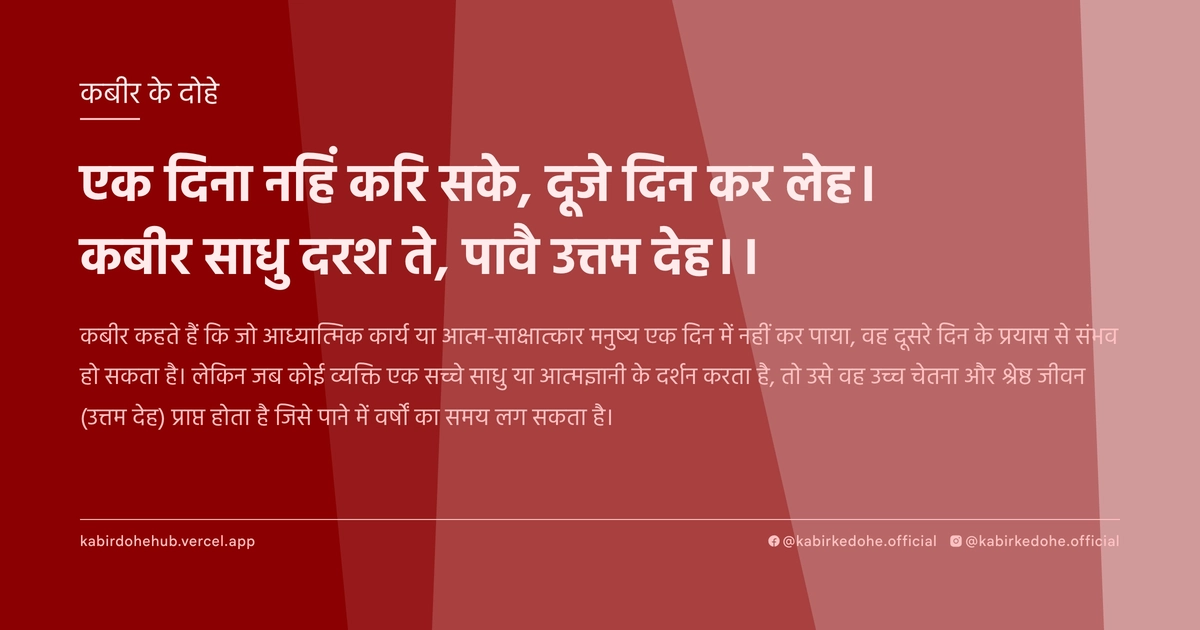
एक दिना नहिं करि सके, दूजे दिन कर लेह।
कबीर साधु दरश ते, पावै उत्तम देह।।
Ek dina nahin kari sake, dooje din kar leh. Kabir sadhu darash te, paave uttam deh.
इस पृष्ठ पर इस कबीर दोहे का अर्थ (meaning), हिंदी व्याख्या और अंग्रेज़ी अनुवाद, दार्शनिक विश्लेषण और व्यावहारिक जीवन सीख दी गई है। यह दोहा गुरु महत्व (The Guru's Importance) विषय से जुड़ा है — Kabir doha meaning and explanation in Hindi and English.
अर्थ (Meaning):
कबीर कहते हैं कि जो आध्यात्मिक कार्य या आत्म-साक्षात्कार मनुष्य एक दिन में नहीं कर पाया, वह दूसरे दिन के प्रयास से संभव हो सकता है। लेकिन जब कोई व्यक्ति एक सच्चे साधु या आत्मज्ञानी के दर्शन करता है, तो उसे वह उच्च चेतना और श्रेष्ठ जीवन (उत्तम देह) प्राप्त होता है जिसे पाने में वर्षों का समय लग सकता है।
Kabir suggests that while spiritual progress often feels slow and incremental—where what could not be achieved in one day might be attempted the next—the catalyst for true transformation is the encounter with a realized soul. By witnessing a true Sadhu, one attains a 'superior body' or a higher state of consciousness, bypassing the tedious struggle of the ego.
व्याख्या (Interpretation):
शाब्दिक अर्थ में यह दोहा सत्संग की महिमा बताता है, परंतु गहरा अर्थ 'उत्तम देह' के रूप में है। यहाँ देह का अर्थ भौतिक शरीर नहीं, बल्कि 'सूक्ष्म शरीर' या चेतना का वह स्तर है जो माया से मुक्त है। यह निर्गुण भक्ति का सार है जहाँ गुरु का दर्शन केवल बाहरी मिलन नहीं, बल्कि साधक के भीतर सोई हुई चेतना का जागरण है। अद्वैत वेदांत के अनुसार, जब एक जागृत आत्मा दूसरे को देखती है, तो अज्ञान का पर्दा हट जाता है। यह विरोधाभास है कि जिसे हम वर्षों की तपस्या से खोजते हैं, वह एक क्षण के सही मार्गदर्शन से प्राप्त हो सकता है। यह माया के प्रभाव को नष्ट करने की प्रक्रिया है।
Literally, the verse praises the company of saints, but metaphorically, 'uttam deh' (superior body) refers not to the physical form, but to the refined subtle body or a heightened state of consciousness liberated from Maya. In the context of Nirgun Bhakti, the 'darshan' of a Sadhu is not a mere physical meeting but a spiritual transmission that awakens the dormant Atman. According to Advaita Vedanta, the gaze of a realized master acts as a mirror, dissolving the illusion of duality. The central paradox is that while spiritual evolution is often viewed as a linear, lifelong struggle, a single moment of authentic alignment with a master can trigger an instantaneous quantum leap in consciousness, annihilating the ego's resistance.
दार्शनिक विश्लेषण (Philosophical Analysis):
कबीर का यह दोहा उस युग की उपज है जहाँ कर्मकांड और बाहरी आडंबर चरम पर थे। कबीर ने स्पष्ट किया कि मोक्ष किसी मंदिर, मस्जिद या कठिन व्रत से नहीं, बल्कि आंतरिक रूपांतरण से मिलता है। यहाँ 'साधु' वह है जिसने स्वयं को जान लिया है, न कि वह जिसने गेरुआ वस्त्र पहना है। यह सूफी मत के 'पीर' और वेदांत के 'गुरु' के सिद्धांत का संगम है, जहाँ ज्ञान का हस्तांतरण हृदय से हृदय तक होता है।
ऐतिहासिक रूप से, कबीर ने जाति और वर्ग की दीवारों को ढहाया। उनके लिए 'उत्तम देह' वह है जो अहंकार से मुक्त है। जब हम किसी आत्मज्ञानी के संपर्क में आते हैं, तो हमारा 'अहं' छोटा होने लगता है और हम यह महसूस करते हैं कि हम अलग नहीं, बल्कि उसी सार्वभौमिक चेतना का हिस्सा हैं। यह मनोवैज्ञानिक परिवर्तन है जहाँ साधक अपनी सीमित पहचान को त्यागकर अनंतता में विलीन होता है।
अद्वैत वेदांत के परिप्रेक्ष्य में, यह दोहा 'अविद्या' (अज्ञान) के विनाश की बात करता है। हम अक्सर सोचते हैं कि हम कल कुछ करेंगे, लेकिन कल कभी नहीं आता। साधु का दर्शन उस 'कल' को 'आज' में बदल देता है। यह समय की रैखिक धारणा को चुनौती देता है और क्षणिक बोध की शक्ति पर जोर देता है।
सूफीवाद में इसे 'इश्क-ए-हकीकी' की ओर पहला कदम माना जाता है। एक मुर्शिद (गुरु) की उपस्थिति शिष्य के भीतर की जंग को शांत करती है। कबीर यहाँ यह चेतावनी भी दे रहे हैं कि बिना मार्गदर्शन के आध्यात्मिक यात्रा भटकाव भरी हो सकती है।
अंततः, यह दोहा ritualism (कर्मकांड) के विरुद्ध एक प्रहार है। यह बताता है कि बाहरी शुद्धता के बजाय आंतरिक पवित्रता महत्वपूर्ण है। 'उत्तम देह' का अर्थ है एक ऐसा व्यक्तित्व जो करुणा, सत्य और प्रेम से ओत-प्रोत हो, जो केवल ज्ञान के वास्तविक अनुभव से ही संभव है।
This Doha emerges from an era dominated by rigid ritualism and caste hierarchies. Kabir asserts that liberation is not found in temples, mosques, or ascetic penance, but through internal transformation. The 'Sadhu' here is not a person in saffron robes, but one who has realized the Self. This aligns the teaching with the Sufi concept of the 'Pir' and the Vedantic 'Guru,' where knowledge is transmitted heart-to-heart rather than through scriptures.
Historically, Kabir dismantled the barriers of caste and class. For him, the 'superior body' is one devoid of ego. When an individual encounters a realized soul, the ego shrinks, and the realization dawns that the individual is not separate but an extension of the universal consciousness. This is a psychological shift from a limited identity to an infinite existence.
From the lens of Advaita Vedanta, this verse addresses the destruction of 'Avidya' (ignorance). Humans often procrastinate spiritual growth, believing it will happen 'tomorrow.' The presence of a master collapses this temporal illusion, turning 'tomorrow' into 'now.' It challenges the linear perception of time and emphasizes the power of a single moment of authentic insight.
In Sufism, this is seen as the first step toward 'Ishq-e-Haqiqi' (Divine Love). The presence of a Murshid silences the internal conflict of the disciple. Kabir warns that without such guidance, the spiritual path can be a labyrinth of confusion and ego-inflation.
Ultimately, the verse is a critique of ritualism. It posits that internal purity outweighs external piety. The 'superior body' represents a persona saturated with compassion, truth, and love—a state achievable only through the direct experience of Truth, not through the imitation of piety.
मूल संदेश (Core Message):
- अहंकार समय के भ्रम में फंसा रहता है।
- सच्चा रूपांतरण बाहरी प्रयास से नहीं, आंतरिक जागरण से आता है।
- एक जागृत आत्मा का सानिध्य अज्ञान की परतों को हटा देता है।
- मोक्ष भविष्य का लक्ष्य नहीं, वर्तमान की अनुभूति है।
- चेतना का उत्थान ही वास्तविक 'उत्तम देह' की प्राप्ति है।
- The ego remains trapped in the illusion of time.
- True transformation comes from inner awakening, not external effort.
- The presence of an awakened soul strips away layers of ignorance.
- Liberation is not a future goal, but a present realization.
- The elevation of consciousness is the true attainment of the 'superior body'.
व्यावहारिक उदाहरण (Practical Example):
वाराणसी के एक पुराने घाट पर माधव नाम का एक वृद्ध नाविक रहता था। माधव का पूरा जीवन केवल नाव चलाने और पर्यटकों को घुमाने में बीता था। वह स्वभाव से क्रोधी था और हमेशा अपनी किस्मत को कोसता रहता था। उसे लगता था कि उसका जीवन व्यर्थ है और वह कभी शांति नहीं पा सकेगा। वह हर दिन सोचता था कि कल से वह ध्यान करेगा, कल से वह शांत रहेगा, लेकिन वह 'कल' कभी नहीं आया।
एक दिन, उसकी नाव पर एक शांत, तेजस्वी संन्यासी सवार हुए। संन्यासी ने कुछ नहीं कहा, बस माधव की आँखों में गहराई से देखा और मंद मुस्कान के साथ गंगा की लहरों की ओर इशारा किया। उस मौन संवाद में, माधव को अचानक महसूस हुआ कि वह लहरों से लड़ने की कोशिश कर रहा है, जबकि उसे बस लहरों के साथ बहना था।
उस संन्यासी की उपस्थिति ने माधव के भीतर एक ऐसा कंपन पैदा किया जिसने उसके वर्षों के क्रोध को एक क्षण में पिघला दिया। उसे समझ आया कि वह जिस शांति को किताबों या भविष्य के वादों में खोज रहा था, वह उसके भीतर ही थी, बस उसे जगाने के लिए एक 'जागृत दृष्टि' की आवश्यकता थी।
माधव का व्यवहार पूरी तरह बदल गया। अब वह केवल नाव नहीं चलाता था, बल्कि नाव पर आने वाले हर व्यक्ति से प्रेम और विनम्रता से बात करता था। उसकी आँखों में अब क्रोध नहीं, बल्कि एक असीम करुणा थी।
गाँव के लोग हैरान थे कि जो माधव सबको गाली देता था, वह अब सबको आशीर्वाद दे रहा है। उन्होंने पूछा कि यह चमत्कार कैसे हुआ? माधव ने बस इतना कहा, 'मैंने वर्षों तक खुद को बदलने की कोशिश की, पर एक सच्चे इंसान की एक झलक ने मुझे बदल दिया।'
उसने अपनी नाव का नाम 'शांति' रख दिया। अब वह नाव केवल नदी पार नहीं कराती थी, बल्कि लोगों के मन की उथल-पुथल को शांत करने का माध्यम बन गई थी।
माधव ने महसूस किया कि उसकी 'देह' अब बदल चुकी थी। उसका शरीर वही था, लेकिन उसकी चेतना अब 'उत्तम' हो चुकी थी। वह अब जीवन के बोझ को ढो नहीं रहा था, बल्कि जीवन का उत्सव मना रहा था।
यह माधव की कहानी है, जो हमें सिखाती है कि सही मार्गदर्शन और सत्संग का एक क्षण, अकेले किए गए वर्षों के संघर्ष से अधिक शक्तिशाली हो सकता है।
On an ancient ghat in Varanasi lived an elderly boatman named Madhav. Madhav's entire life had been spent rowing boats and ferrying tourists. He was temperamentally angry and constantly cursed his fate, feeling that his life was wasted and peace was an unattainable luxury. Every day he told himself, 'Tomorrow I will meditate, tomorrow I will be calm,' but that 'tomorrow' never arrived.
One day, a serene and radiant monk boarded his boat. The monk said nothing; he simply looked deeply into Madhav's eyes and pointed toward the ripples of the Ganges with a gentle smile. In that silent exchange, Madhav suddenly realized that he had been fighting the currents of his life, whereas he was meant to flow with them.
The presence of that monk triggered a vibration within Madhav that melted years of accumulated rage in a single moment. He understood that the peace he had sought in books or future promises was already within him; it only required the 'awakened gaze' of another to be triggered.
Madhav's behavior transformed completely. He no longer just rowed a boat; he spoke to every passenger with profound love and humility. The anger in his eyes was replaced by an infinite compassion.
The villagers were astonished that the man who once hurled insults was now offering blessings. When asked how this miracle happened, Madhav simply replied, 'I spent years trying to change myself, but a single glimpse of a true soul changed me.'
He renamed his boat 'Shanti' (Peace). Now, his boat did not just cross the river; it became a medium for calming the turbulence in people's minds.
Madhav felt that his 'body' had changed. While his physical form remained the same, his consciousness had become 'superior' (uttam). He was no longer carrying the burden of life; he was celebrating it.
This is the story of Madhav, illustrating that a single moment of authentic guidance and spiritual company can be more powerful than years of solitary struggle.
अभ्यास मार्गदर्शन (Practice Guidance):
- प्रतिदिन 15 मिनट मौन रहकर यह विचार करें कि आपका 'अहंकार' आपको किस तरह से 'कल' के जाल में फंसाता है।
- एक 'साक्षी जर्नल' बनाएँ: लिखें कि दिन भर में कब आपने प्रतिक्रिया दी और कब आप एक 'साधु' की तरह तटस्थ रहे।
- व्यवहार परिवर्तन: किसी ऐसे व्यक्ति की मदद करें जिसे आप नापसंद करते हैं, यह देखने के लिए कि क्या आपका अहंकार पिघल रहा है।
- निदान चेकलिस्ट: यदि आप अभी भी 'कल' पर निर्भर हैं, तो आप माया में हैं। यदि आप वर्तमान क्षण में शांति महसूस करते हैं, तो आप 'उत्तम देह' की ओर बढ़ रहे हैं।
- Spend 15 minutes daily in silence, contemplating how your 'ego' traps you in the illusion of 'tomorrow.'
- Maintain a 'Witness Journal': Record moments when you reacted impulsively versus when you remained neutral, like a realized soul.
- Behavioral Shift: Perform an act of service for someone you dislike to observe if your ego is dissolving.
- Diagnostic Checklist: If you are still relying on 'tomorrow' for peace, you are in Maya. If you feel stillness in the present moment, you are transitioning toward the 'superior body'.
चिंतन प्रश्न (Reflection Questions):
- आप अपनी आध्यात्मिक प्रगति के लिए किस 'कल' का इंतज़ार कर रहे हैं?
- क्या आपकी 'पवित्रता' केवल बाहरी दिखावा है या आपके भीतर का क्रोध वास्तव में शांत हुआ है?
- यदि आज आपकी मृत्यु हो जाए, तो क्या आपकी वर्तमान 'देह' (चेतना) वास्तव में 'उत्तम' है?
- आप किन लोगों को 'साधु' मानते हैं—उनके वस्त्रों के कारण या उनके प्रभाव के कारण?
- आपका डिजिटल व्यक्तित्व (Social Media Ego) आपकी वास्तविक आत्मा को कितना छुपा रहा है?
- Which 'tomorrow' are you waiting for to begin your spiritual progress?
- Is your 'piety' merely an external performance, or has the anger within you truly subsided?
- If you were to die today, is your current 'body' (consciousness) truly 'superior'?
- Who do you categorize as a 'Sadhu'—based on their attire or their actual impact on your soul?
- How much is your digital persona (social media ego) obscuring your authentic self?