
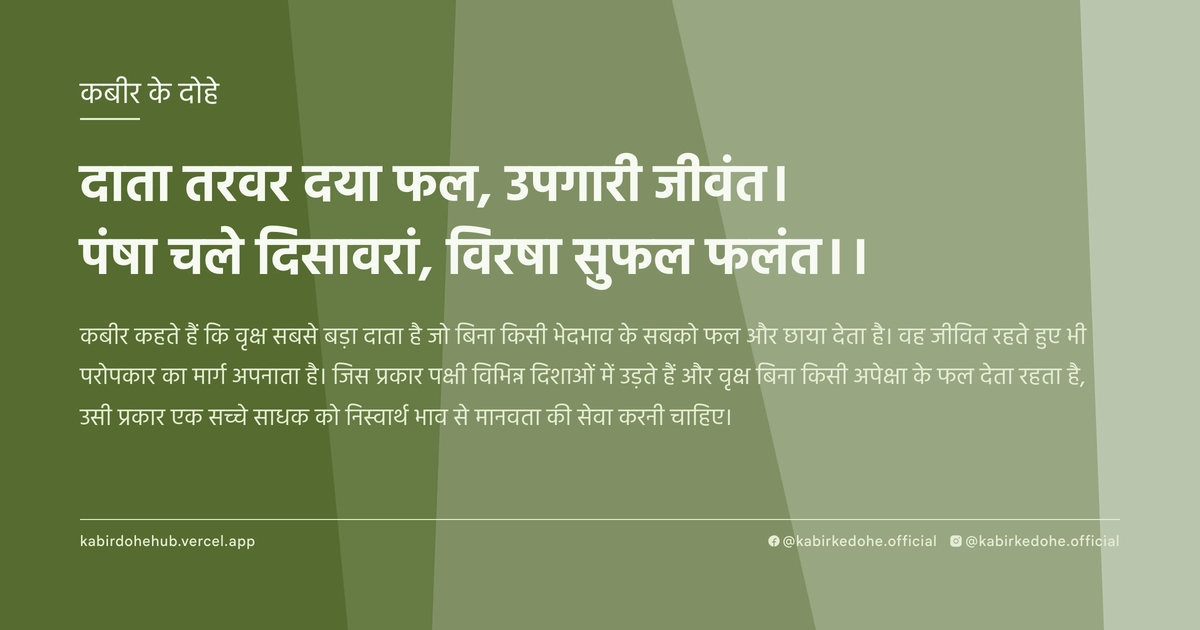
दाता तरवर दया फल, उपगारी जीवंत।
पंषा चले दिसावरां, विरषा सुफल फलंत।।
Data tarvar daya phal, upagari jeevanth. Pansha chale disavaran, virsha suphal phalanth.
इस पृष्ठ पर इस कबीर दोहे का अर्थ (meaning), हिंदी व्याख्या और अंग्रेज़ी अनुवाद, दार्शनिक विश्लेषण और व्यावहारिक जीवन सीख दी गई है। यह दोहा करुणा (Compassion) विषय से जुड़ा है — Kabir doha meaning and explanation in Hindi and English.
अर्थ (Meaning):
कबीर कहते हैं कि वृक्ष सबसे बड़ा दाता है जो बिना किसी भेदभाव के सबको फल और छाया देता है। वह जीवित रहते हुए भी परोपकार का मार्ग अपनाता है। जिस प्रकार पक्षी विभिन्न दिशाओं में उड़ते हैं और वृक्ष बिना किसी अपेक्षा के फल देता रहता है, उसी प्रकार एक सच्चे साधक को निस्वार्थ भाव से मानवता की सेवा करनी चाहिए।
Kabir proclaims that the tree is the ultimate giver, offering fruits and shade to all without discrimination. It embodies the spirit of selfless service throughout its existence. Just as birds fly in all directions and the tree continues to bear fruit without expectation, a true seeker must serve humanity with an unconditional and selfless heart.
व्याख्या (Interpretation):
इस दोहे का शाब्दिक अर्थ प्रकृति की उदारता से शुरू होता है, लेकिन इसका आध्यात्मिक संकेत 'निस्वार्थ कर्म' की ओर है। यहाँ 'तरवर' (वृक्ष) केवल एक पौधा नहीं, बल्कि उस पूर्णता का प्रतीक है जो अपनी प्रकृति के अनुसार देना जानती है। यह निर्गुण भक्ति के उस सिद्धांत को दर्शाता है जहाँ ईश्वर किसी मंदिर या मस्जिद में नहीं, बल्कि उस करुणा में है जो बिना किसी शर्त के प्रवाहित होती है। माया हमें यह सिखाती है कि हम केवल वही दें जब हमें कुछ मिले, लेकिन कबीर यहाँ 'अद्वैत' की बात कर रहे हैं—जहाँ देने वाला और लेने वाला एक ही चेतना के दो रूप हैं। जब अहंकार मिट जाता है, तब व्यक्ति स्वयं एक वृक्ष बन जाता है, जो केवल इसलिए फल देता है क्योंकि देना ही उसका स्वभाव है। यह विरोधाभास है कि जो जितना अधिक त्यागता है, वह उतना ही अधिक पूर्ण होता जाता है।
The literal meaning begins with the generosity of nature, but the spiritual pointer is toward 'Nishkama Karma' or selfless action. Here, the 'Tarvar' (tree) is not merely a plant, but a symbol of that spiritual wholeness which knows how to give by its very nature. This reflects the principle of Nirgun Bhakti, where the Divine is found not in temples or mosques, but in the compassion that flows without condition. Maya teaches us to give only when we receive, but Kabir speaks of 'Advaita'—where the giver and the receiver are two forms of the same consciousness. When the ego is annihilated, the individual becomes a tree, bearing fruit simply because giving is its inherent nature. It is a divine paradox: the more one renounces, the more complete one becomes.
दार्शनिक विश्लेषण (Philosophical Analysis):
कबीर का यह दर्शन उनके युग के कठोर सामाजिक और धार्मिक विभाजन के विरुद्ध एक प्रतिक्रिया था। उस समय कर्मकांड और जातिगत श्रेष्ठता का बोलबाला था, जहाँ दान भी अक्सर अपनी सामाजिक स्थिति को ऊँचा करने के लिए किया जाता था। कबीर ने इस 'दिखावे के दान' को नकारते हुए प्रकृति के सहज धर्म को सामने रखा। वे तर्क देते हैं कि यदि एक जड़ वृक्ष बिना किसी जाति, धर्म या वर्ग के भेद के सबको फल दे सकता है, तो मनुष्य, जिसे बुद्धि मिली है, वह भेदभाव क्यों करता है?
दार्शनिक स्तर पर, यह सूफीवाद के 'इश्क-ए-हकीकी' (ईश्वरीय प्रेम) और अद्वैत वेदांत के 'सर्वं खल्विदं ब्रह्म' (सब कुछ ब्रह्म है) के करीब है। जब हम दूसरे की सेवा करते हैं, तो हम वास्तव में अपनी ही आत्मा के विस्तार की सेवा कर रहे होते हैं। कबीर के लिए, परोपकार केवल एक नैतिक कार्य नहीं है, बल्कि यह अहंकार (I-ness) को मिटाने की एक मनोवैज्ञानिक प्रक्रिया है। जब 'मैं' मिटता है, तब केवल 'दाता' बचता है।
यहाँ 'फल' का अर्थ केवल भौतिक वस्तु नहीं, बल्कि ज्ञान और करुणा है। कबीर यह समझाना चाहते हैं कि आध्यात्मिक प्रगति तब तक असंभव है जब तक व्यक्ति स्वयं को दूसरों से अलग मानता है। ritualism (कर्मकांड) बाहरी दिखावा है, जबकि 'दया' आंतरिक रूपांतरण है। वे हमें सिखाते हैं कि वास्तविक भक्ति मंदिर की मूर्तियों में नहीं, बल्कि एक भूखे को भोजन कराने या एक दुखी को सहारा देने में है।
यह विश्लेषण हमें यह समझने में मदद करता है कि कबीर का मार्ग 'सहज' मार्ग था। उन्होंने जटिल दर्शन के बजाय जीवन के सरल उदाहरणों का उपयोग किया ताकि एक साधारण बुनकर भी सत्य को समझ सके। उनके लिए, प्रकृति ही सबसे बड़ी गुरु है क्योंकि प्रकृति कभी भेदभाव नहीं करती।
अंततः, यह दोहा हमें इस सत्य की ओर ले जाता है कि मुक्ति बाहरी यात्राओं में नहीं, बल्कि हृदय के विस्तार में है। जब हृदय इतना बड़ा हो जाए कि उसमें पूरी दुनिया समा सके, तब व्यक्ति वास्तव में 'जीवंत' होता है। यही वह अवस्था है जहाँ मनुष्य और ईश्वर के बीच का अंतर समाप्त हो जाता है।
Kabir's philosophy here is a reaction against the rigid social and religious divisions of his era. At a time when ritualism and caste superiority prevailed, charity was often performed to elevate one's social standing. Kabir rejects this 'performative charity' and presents the spontaneous dharma of nature. He argues that if a rooted tree can give fruit to all without discrimination of caste, religion, or class, why does man, endowed with intellect, persist in bias?
On a philosophical level, this aligns with the Sufi concept of 'Ishq-e-Haqiqi' (Divine Love) and the Advaita Vedanta principle of 'Sarvam Khalvidam Brahma' (All this is Brahman). When we serve another, we are essentially serving the expansion of our own soul. For Kabir, altruism is not merely a moral act, but a psychological process of annihilating the ego (the 'I-ness'). When the 'I' vanishes, only the 'Giver' remains.
Here, 'fruit' does not signify a mere physical object, but knowledge and compassion. Kabir explains that spiritual progress is impossible as long as an individual perceives themselves as separate from others. Ritualism is an external facade, whereas 'Daya' (compassion) is an internal transformation. He teaches that true devotion is not found in temple idols, but in feeding the hungry or supporting the distressed.
This analysis reveals that Kabir's path was the 'Sahaj' (natural) path. He used simple life examples instead of complex metaphysics so that even a common weaver could grasp the truth. For him, nature is the greatest guru because nature never discriminates.
Ultimately, this doha leads us to the truth that liberation is not found in external pilgrimages, but in the expansion of the heart. When the heart becomes large enough to encompass the entire world, the individual becomes truly 'alive.' This is the state where the distinction between the human and the Divine dissolves.
मूल संदेश (Core Message):
- अहंकार वह दीवार है जो हमें मानवता से अलग करती है।
- सच्ची सेवा वह है जहाँ देने वाले का अस्तित्व मिट जाए।
- प्रकृति का धर्म निस्वार्थता है, मनुष्य को भी यही अपनाना चाहिए।
- करुणा ही वह सेतु है जो आत्मा को परमात्मा से जोड़ता है।
- जब आप बिना शर्त देते हैं, तब आप वास्तव में मुक्त होते हैं।
- Ego is the wall that separates us from our shared humanity.
- True service occurs when the identity of the giver dissolves.
- Selflessness is the law of nature; humans must embrace it.
- Compassion is the bridge connecting the Atman to the Brahman.
- When you give without condition, you attain true liberation.
व्यावहारिक उदाहरण (Practical Example):
राजस्थान के एक छोटे से गाँव में रामू नाम का एक किसान रहता था। रामू के पास एक छोटा सा खेत था, लेकिन उसका हृदय बहुत विशाल था। गाँव के अन्य किसान अपनी फसल को केवल मुनाफे के लिए देखते थे और पानी के लिए आपस में झगड़ते थे। रामू ने अपने खेत के किनारे एक बड़ा बरगद का पेड़ लगाया था और उसके चारों ओर फलदार वृक्ष लगाए थे।
गाँव के जमींदार ने रामू का मजाक उड़ाया कि वह अपनी कीमती जमीन पर ऐसे पेड़ क्यों लगा रहा है जिनसे उसे कोई सीधा पैसा नहीं मिलता। रामू बस मुस्कुराता और कहता, "साहब, यह पेड़ मेरा नहीं, इस मिट्टी का कर्ज है।"
एक समय ऐसा आया जब गाँव में भीषण अकाल पड़ा। फसलें सूख गईं और पानी के स्रोत खत्म हो गए। लोग भूख और प्यास से तड़पने लगे। जमींदार ने अपने अनाज के गोदाम बंद कर लिए ताकि वह ऊँचे दामों पर बेच सके। लेकिन रामू के पेड़ अब फल देने लगे थे।
रामू ने उन पेड़ों के नीचे एक बड़ा चबूतरा बनाया और आने वाले हर राहगीर, पशु और भूखे ग्रामीण के लिए फल और छाया उपलब्ध कराई। उसने कभी यह नहीं पूछा कि आने वाला कौन है या वह किस जाति का है।
एक दिन, एक अहंकारी व्यापारी उस गाँव से गुजरा। वह बहुत अमीर था लेकिन उसके मन में शांति नहीं थी। उसने देखा कि रामू बिना किसी लाभ के सबको खिला रहा है। उसने रामू से पूछा, "तुम्हें इससे क्या मिलता है? न धन, न सम्मान।"
रामू ने शांति से उत्तर दिया, "जब मैं किसी भूखे को फल देता हूँ, तो मुझे महसूस होता है कि मेरा अपना पेट भर गया है। जब कोई छाया में सुकून पाता है, तो मेरी आत्मा को ठंडक मिलती है। मैं केवल उस वृक्ष की नकल कर रहा हूँ जो मुझे जीवन भर देता रहा।"
व्यापारी को पहली बार समझ आया कि असली अमीरी बैंक बैलेंस में नहीं, बल्कि देने की क्षमता में है। उसने महसूस किया कि उसका सारा धन उसे अकेला कर चुका था, जबकि रामू का 'निस्वार्थ दान' उसे पूरे गाँव का प्रिय बना चुका था।
उस व्यापारी ने अपना जीवन बदल लिया। उसने अपने शहरों में अस्पताल और मुफ्त पाठशालाएं बनवाईं, लेकिन इस बार उसने अपना नाम उन पर नहीं लिखा। उसने सीखा कि असली फल वह है जो दूसरों के जीवन में मिठास घोले, बिना यह याद रखे कि वह किसने दिया।
In a small village in Rajasthan lived a farmer named Ramu. Ramu had a tiny plot of land, but his heart was vast. Other farmers in the village viewed their crops only through the lens of profit and fought bitterly over water rights. Ramu, however, had planted a massive banyan tree at the edge of his field, surrounded by various fruit-bearing trees.
The village landlord mocked Ramu, asking why he wasted precious land on trees that yielded no direct monetary profit. Ramu would simply smile and say, "Sir, this tree is not mine; it is a debt I owe to this soil."
A time came when a severe famine struck the village. Crops withered and water sources vanished. People suffered from hunger and thirst. The landlord locked his granaries to sell the grain at exorbitant prices. But Ramu's trees had begun to bear fruit.
Ramu built a large platform beneath the trees and provided fruit and shade to every passing traveler, animal, and hungry villager. He never asked who the person was or which caste they belonged to.
One day, an arrogant merchant passed through the village. He was immensely wealthy but lacked inner peace. He observed Ramu feeding everyone without any expectation of gain. He asked, "What do you get out of this? Neither money nor fame."
Ramu replied calmly, "When I give a fruit to a hungry person, I feel as though my own stomach is full. When someone finds peace in the shade, my soul feels cooled. I am merely imitating the tree that has given to me throughout my life."
For the first time, the merchant realized that true wealth lies not in a bank balance, but in the capacity to give. He felt that his riches had isolated him, while Ramu's 'selfless giving' had made him beloved by the entire village.
The merchant transformed his life. He established hospitals and free schools in his cities, but this time, he did not put his name on them. He learned that the real fruit is that which adds sweetness to others' lives, without the giver remembering the act.
अभ्यास मार्गदर्शन (Practice Guidance):
- दैनिक अभ्यास: प्रतिदिन कम से कम एक ऐसा कार्य करें जिसके बदले में आपको कुछ भी (धन, प्रशंसा या आभार) न मिले। इसे 'गुप्त दान' की तरह करें।
- आत्म-चिंतन: रात को सोने से पहले जर्नल में लिखें—'आज मैंने अपनी किस इच्छा या अहंकार को दूसरों की खुशी के लिए त्यागा?'
- व्यवहार परिवर्तन: जब भी आप किसी की मदद करें, तो मन में यह भाव लाएं कि 'मैं नहीं, बल्कि वह परमात्मा मेरे माध्यम से उसकी मदद कर रहा है' ताकि 'कर्ता' का भाव मिट जाए।
- डायग्नोस्टिक चेकलिस्ट: क्या मैं मदद करने के बाद उम्मीद करता हूँ कि सामने वाला मुझे धन्यवाद दे? क्या मैं केवल उन्हीं की मदद करता हूँ जो मेरे समान हैं? यदि हाँ, तो आप अभी भी माया के प्रभाव में हैं।
- Daily Practice: Perform at least one act of kindness daily for which you receive absolutely nothing in return (no money, no praise, no gratitude). Treat it as a 'secret offering'.
- Self-Inquiry: Before sleeping, journal the following: 'Which of my desires or ego-driven needs did I sacrifice today for the happiness of another?'
- Behavioral Shift: Whenever you help someone, cultivate the thought: 'It is not I, but the Divine working through me,' to dissolve the sense of being the 'doer'.
- Diagnostic Checklist: Do I expect a 'thank you' after helping? Do I only help those who are similar to me? If yes, you are still under the influence of Maya.
चिंतन प्रश्न (Reflection Questions):
- क्या मेरा दान वास्तव में निस्वार्थ है, या मैं केवल अपनी 'अच्छी छवि' का पोषण कर रहा हूँ?
- यदि दुनिया से मेरी सारी उपलब्धियाँ और पहचान छीन ली जाए, तो क्या मुझमें दूसरों को देने के लिए कुछ बचेगा?
- मैं किन लोगों की मदद करने से कतराता हूँ, और वह कतराहट मेरे भीतर के किस पूर्वाग्रह से उपजी है?
- क्या मैं अपनी डिजिटल पहचान (सोशल मीडिया) पर अपनी उदारता का प्रदर्शन करके अपनी आत्मा को छोटा कर रहा हूँ?
- मेरे जीवन का वह कौन सा 'फल' है जिसे मैं अभी भी दूसरों से साझा करने में डरता हूँ?
- Is my charity truly selfless, or am I merely nourishing my 'good image'?
- If all my achievements and identities were stripped away, would there be anything left in me to give to others?
- Who are the people I hesitate to help, and from which internal bias does that hesitation arise?
- Am I diminishing my soul by showcasing my generosity on my digital identity (social media)?
- What is that 'fruit' in my life that I am still afraid to share with others?