
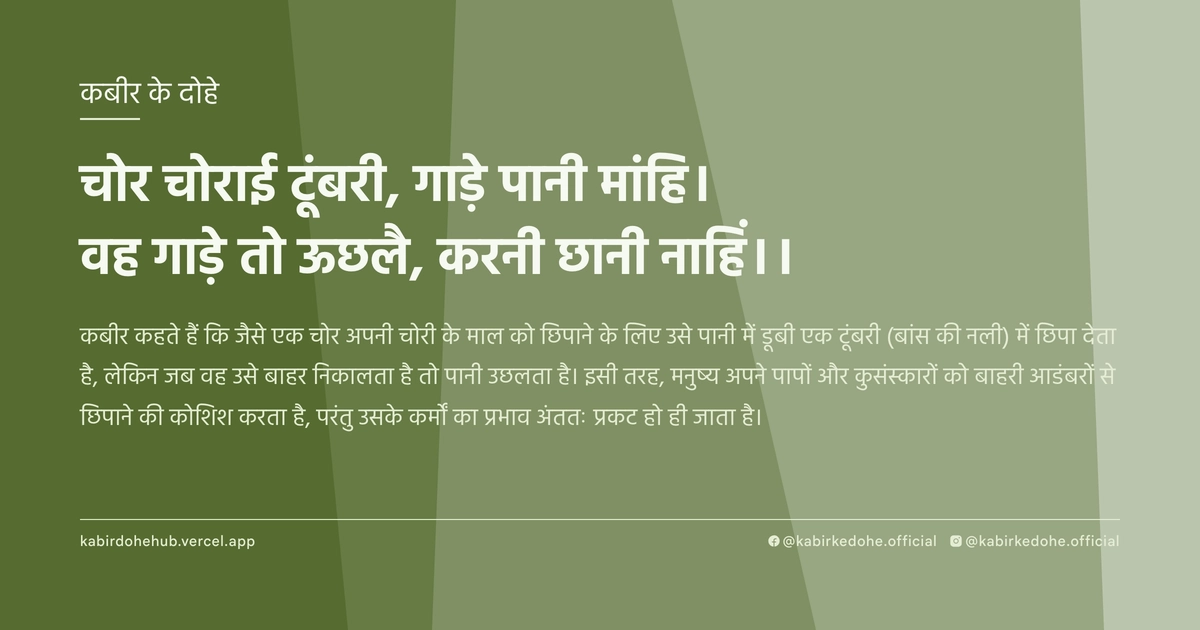
चोर चोराई टूंबरी, गाड़े पानी मांहि।
वह गाड़े तो ऊछलै, करनी छानी नाहिं।।
Chor chorai tunbari, gaade paani maahin. Vah gaade to uchhalai, karani chhani nahin.
इस पृष्ठ पर इस कबीर दोहे का अर्थ (meaning), हिंदी व्याख्या और अंग्रेज़ी अनुवाद, दार्शनिक विश्लेषण और व्यावहारिक जीवन सीख दी गई है। यह दोहा आत्मनिरीक्षण (Self-introspection) विषय से जुड़ा है — Kabir doha meaning and explanation in Hindi and English.
अर्थ (Meaning):
कबीर कहते हैं कि जैसे एक चोर अपनी चोरी के माल को छिपाने के लिए उसे पानी में डूबी एक टूंबरी (बांस की नली) में छिपा देता है, लेकिन जब वह उसे बाहर निकालता है तो पानी उछलता है। इसी तरह, मनुष्य अपने पापों और कुसंस्कारों को बाहरी आडंबरों से छिपाने की कोशिश करता है, परंतु उसके कर्मों का प्रभाव अंततः प्रकट हो ही जाता है।
Kabir observes that just as a thief attempts to hide his stolen loot inside a bamboo tube (tunbari) submerged in water, the act of retrieving it causes the water to splash and reveal the secret. Similarly, a human may try to conceal their sins and ego through outward piety, but the residue of their actions inevitably surfaces, exposing the truth of their inner state.
व्याख्या (Interpretation):
यह दोहा आत्मा और अहंकार के बीच के द्वंद्व का चित्रण है। यहाँ 'टूंबरी' मानव मन का प्रतीक है और 'पानी' माया या सांसारिक प्रपंच का। चोर वह अहंकार है जो सत्य को छिपाकर स्वयं को श्रेष्ठ दिखाने का प्रयास करता है। कबीर समझाते हैं कि बाहरी दिखावा (जैसे तिलक, माला या व्रत) केवल एक आवरण है। जब कर्मों का हिसाब होता है या कठिन परिस्थितियाँ आती हैं, तो वह 'उछल' यानी प्रतिक्रिया के रूप में बाहर आता है। यह निर्गुण भक्ति का सार है कि ईश्वर बाहरी कर्मकांडों से नहीं, बल्कि आंतरिक शुद्धि से प्रसन्न होते हैं। अद्वैत वेदांत के अनुसार, जब तक द्वैत (मैं और मेरा) रहता है, तब तक सत्य छिपा रहता है, लेकिन सत्य को छिपाना असंभव है क्योंकि वह स्वयं प्रकाशमान है।
This couplet serves as a profound metaphor for the struggle between the soul and the ego. The 'tunbari' (bamboo tube) represents the human mind, and the 'water' symbolizes Maya or the illusions of the material world. The 'thief' is the ego, which attempts to conceal its spiritual bankruptcy behind a facade of righteousness. Kabir posits that external rituals—be it beads, tilaks, or fasting—are merely superficial covers. When the moment of reckoning arrives, the 'splash' occurs, meaning the latent effects of one's actions (Karmas) inevitably manifest. In the context of Nirgun Bhakti, this emphasizes that the Formless Divine is not deceived by outward piety. From the lens of Advaita Vedanta, as long as the illusion of duality persists, the truth remains hidden, yet the attempt to hide the Truth is futile because Truth is inherently self-luminous and eventually dissolves all deception.
दार्शनिक विश्लेषण (Philosophical Analysis):
कबीर का यह दोहा उनके युग के धार्मिक पाखंड पर एक तीखा प्रहार है। 15वीं शताब्दी में, धर्म केवल बाहरी प्रतीकों और जातिगत श्रेष्ठता तक सीमित हो गया था। कबीर ने इस 'धार्मिक चोरी' को उजागर किया, जहाँ लोग मंदिर और मस्जिदों में जाते थे लेकिन उनके हृदय में घृणा और अहंकार भरा था। वे तर्क देते हैं कि आध्यात्मिक प्रगति केवल बाहरी क्रियाओं से नहीं, बल्कि आंतरिक रूपांतरण से आती है।
दार्शनिक स्तर पर, यह सूफी मत के 'नफ्स' (अहंकार) के विनाश और अद्वैत वेदांत के 'माया' के पर्दे को हटाने के समान है। जब तक मनुष्य यह मानता है कि वह शरीर है या किसी विशेष जाति का सदस्य है, वह एक 'चोर' की तरह सत्य को छिपा रहा होता है। कबीर का संदेश है कि कर्मों की शुद्धि के बिना मोक्ष संभव नहीं है।
यहाँ 'पानी' का उपयोग बहुत सूक्ष्म है। पानी पवित्रता का प्रतीक भी है और गहराई का भी। चोर पानी का उपयोग छिपाने के लिए करता है, लेकिन पानी की प्रकृति ही ऐसी है कि वह हलचल को प्रकट कर देता है। यह मनोवैज्ञानिक सत्य है कि दमित भावनाएं और गुप्त पाप अंततः व्यवहार में प्रकट होते हैं।
कबीर ritualism (कर्मकांड) को इसलिए नकारते हैं क्योंकि वह अहंकार को पोषण देता है। जब कोई कहता है 'मैंने यह व्रत किया है', तो वह वास्तव में अपनी 'चोरी' (अहंकार) को छिपा रहा होता है। वास्तविक भक्ति वह है जहाँ 'मैं' पूरी तरह मिट जाए।
अंततः, यह दोहा हमें आत्म-निरीक्षण की ओर ले जाता है। यह चेतावनी देता है कि ब्रह्मांडीय न्याय (Cosmic Justice) अटल है। आप दुनिया को धोखा दे सकते हैं, लेकिन अपनी अंतरात्मा और उस निराकार ईश्वर को नहीं, जो आपके हर विचार का साक्षी है।
Kabir’s couplet is a searing critique of the religious hypocrisy prevalent during his era. In the 15th century, spirituality had largely devolved into a performance of external symbols and caste-based superiority. Kabir exposes this 'spiritual theft,' where individuals frequented temples and mosques while harboring hatred and arrogance within. He argues that genuine spiritual evolution is impossible through external acts alone; it requires a fundamental internal transmutation.
Philosophically, this aligns with the Sufi concept of annihilating the 'Nafs' (the lower self/ego) and the Advaita Vedanta principle of piercing the veil of 'Maya.' As long as a person identifies with their physical body or social status, they are acting as the 'thief,' attempting to hide the singular Truth of existence behind a fragmented identity. Kabir asserts that liberation is unattainable without the purification of one's actions and intentions.
The imagery of 'water' is particularly nuanced. Water symbolizes both purity and depth. While the thief uses it as a shroud, the inherent nature of water is to ripple and splash, thereby betraying the secret. This mirrors the psychological truth that repressed shadows and hidden transgressions inevitably leak into one's behavior and subconscious patterns.
Kabir rejects ritualism because it often serves as a fuel for the ego. When a practitioner boasts of their fasts or pilgrimages, they are merely hiding their 'theft'—the lack of genuine love and compassion. True devotion is the state where the 'I' is completely dissolved into the Divine.
Ultimately, the verse steers the seeker toward rigorous self-inquiry. It warns that Cosmic Justice is immutable. One may deceive the world, but one cannot deceive the inner witness or the Formless Divine, who is the silent observer of every thought and impulse.
मूल संदेश (Core Message):
- बाहरी दिखावा आंतरिक रिक्तता को नहीं भर सकता।
- अहंकार द्वारा छिपाया गया सत्य अंततः विस्फोट बनकर निकलता है।
- सच्ची भक्ति कर्मकांडों में नहीं, बल्कि चरित्र की ईमानदारी में है।
- माया का पर्दा केवल तब हटता है जब हम स्वयं को स्वीकार करते हैं।
- ईश्वर बाहरी प्रतीकों से परे, हृदय की पारदर्शिता देखते हैं।
- External piety cannot fill an internal void of integrity.
- Truth concealed by ego eventually erupts as a reckoning.
- Genuine devotion resides in character, not in rituals.
- The veil of Maya lifts only when we embrace our raw truth.
- The Divine looks beyond symbols to the transparency of the heart.
व्यावहारिक उदाहरण (Practical Example):
एक समय की बात है, वाराणसी के घाटों पर माधव नाम का एक पुराना बुनकर रहता था। माधव पूरे शहर में अपनी ईमानदारी और धर्मपरायणता के लिए जाना जाता था। वह हर दिन मंदिर जाता, लंबी माला जपता और सबको नैतिकता का पाठ पढ़ाता। लोग उसे 'संत' मानने लगे थे।
लेकिन माधव के मन के भीतर एक गहरा अंधेरा था। वह अपने व्यापार में कपड़े की गुणवत्ता के साथ धोखाधड़ी करता था। वह घटिया धागों का उपयोग करता और उन्हें उच्च श्रेणी का बताकर बेचता। उसने इस चोरी को अपनी 'धार्मिक छवि' की टूंबरी में छिपा रखा था। उसे लगता था कि उसकी पूजा और दान उसके पापों को धो देंगे।
एक दिन शहर में एक घुमंतू फकीर आया, जिसकी आँखें दर्पण की तरह थीं। वह माधव के पास गया और उसके द्वारा बुने गए एक रेशमी वस्त्र को छुआ। फकीर ने मुस्कुराते हुए कहा, 'माधव, यह वस्त्र सुंदर है, लेकिन इसमें छिपा हुआ धागा झूठ बोल रहा है।'
माधव पहले तो क्रोधित हुआ और अपनी धार्मिक उपलब्धियों का बखान करने लगा। उसने कहा, 'मैं दिन में दस बार ईश्वर का नाम लेता हूँ, मैं कैसे झूठा हो सकता हूँ?'
फकीर ने शांति से जवाब दिया, 'जैसे पानी में डूबी नली से माल निकालते समय पानी उछलता है, वैसे ही तुम्हारा क्रोध तुम्हारी धार्मिकता के पर्दे को फाड़ रहा है। तुम्हारी माला तुम्हारे हाथ में है, लेकिन तुम्हारी चोरी तुम्हारी वाणी में झलक रही है।'
यह बात माधव के हृदय में बिजली की तरह कौंधी। उसे एहसास हुआ कि वह अब तक केवल एक 'चोर' था जिसने धर्म का चोला पहन रखा था। उसकी सारी पूजा केवल उसके अहंकार को संतुष्ट करने का साधन थी।
उस रात माधव सो नहीं सका। उसने अपनी टूंबरी को बाहर निकाला—अर्थात उसने अपने भीतर के झूठ को स्वीकार किया। उसने तय किया कि वह अब केवल बाहरी दिखावा नहीं करेगा।
अगले दिन से माधव ने अपने व्यापार के तरीके बदल दिए। उसने ग्राहकों को सच बताना शुरू किया और अपनी कमाई का एक बड़ा हिस्सा उन लोगों की मदद में लगाया जिन्हें उसने ठगा था।
उसकी धार्मिकता अब मंदिर की दीवारों तक सीमित नहीं थी, बल्कि उसके धागों की ईमानदारी में झलकने लगी। वह अब 'संत' कहलाने की इच्छा नहीं रखता था, क्योंकि वह जान गया था कि असली शांति दिखावे में नहीं, बल्कि सत्य के साथ जीने में है।
माधव का जीवन अब एक ऐसी नदी बन गया था जिसमें कोई कचरा नहीं था, केवल पारदर्शिता थी। उसने सीखा कि ईश्वर को प्रसन्न करने के लिए माला की नहीं, बल्कि मन की शुद्धि की आवश्यकता होती है।
Once, on the ghats of Varanasi, lived an old weaver named Madhav. Madhav was renowned throughout the city for his perceived honesty and piety. He visited the temple daily, chanted long rosaries, and lectured everyone on morality. The townspeople regarded him as a living saint.
However, within Madhav's heart lay a deep darkness. In his weaving business, he committed a subtle fraud, using inferior threads while claiming they were of the highest quality. He had hidden this 'theft' inside the 'tunbari' of his religious persona. He believed that his prayers and donations would wash away his sins.
One day, a wandering fakir arrived in the city, possessing eyes like mirrors. He approached Madhav and touched a silk cloth woven by him. The fakir smiled and said, 'Madhav, this cloth is beautiful, but the hidden thread is lying.'
Madhav was initially enraged and began boasting of his religious achievements. He exclaimed, 'I invoke the name of God ten times a day; how could I possibly be a liar?'
The fakir replied calmly, 'Just as water splashes when a hidden tube is pulled out, your anger is tearing through the veil of your piety. The rosary is in your hand, but the theft is leaking through your speech.'
These words struck Madhav like a bolt of lightning. He realized that he had been a 'thief' all along, merely wearing the cloak of religion. All his rituals were nothing more than tools to satisfy his ego.
Madhav could not sleep that night. He decided to 'pull out the tunbari'—meaning he acknowledged the lies within him. He vowed that he would no longer rely on outward appearances.
From the next day, Madhav transformed his business. He began being honest with his customers and used a significant portion of his earnings to compensate those he had cheated.
His piety was no longer confined to temple walls; it began to reflect in the honesty of his threads. He no longer desired to be called a 'saint,' for he understood that true peace lies not in prestige, but in alignment with Truth.
Madhav's life became like a river with no debris, only transparency. He learned that pleasing the Divine requires not a rosary, but a purified mind.
He spent the rest of his days in quiet service, discovering that the joy of a clear conscience is far greater than the applause of a thousand deceived admirers.
अभ्यास मार्गदर्शन (Practice Guidance):
- दैनिक आत्म-निरीक्षण: प्रतिदिन 15 मिनट मौन बैठें और विचार करें कि आज आपने अपनी छवि बचाने के लिए कौन सा छोटा झूठ बोला या कौन सा सच छिपाया।
- अहंकार का विसर्जन: जब भी आप किसी की प्रशंसा पाएं, तुरंत याद करें कि आपकी उपलब्धियां सामूहिक प्रयास का परिणाम हैं, न कि केवल आपके व्यक्तिगत अहंकार का।
- सत्य का अभ्यास: एक सप्ताह तक यह संकल्प लें कि आप किसी भी स्थिति में 'सुविधाजनक झूठ' (Convenient Lie) नहीं बोलेंगे, चाहे वह कितना भी छोटा क्यों न हो।
- डायग्नोस्टिक चेकलिस्ट: क्या मैं दूसरों के सामने जो हूँ, अकेले में भी वही हूँ? क्या मेरी धार्मिक क्रियाएं मुझे विनम्र बना रही हैं या मैं दूसरों से श्रेष्ठ महसूस कर रहा हूँ? क्या मैं अपनी गलतियों को 'ईश्वरीय इच्छा' कहकर छिपा रहा हूँ?
- Daily Self-Audit: Spend 15 minutes in silence each day reflecting on the small lies you told or truths you concealed today simply to protect your public image.
- Dissolution of Ego: Whenever you receive praise, immediately remind yourself that your achievements are a result of collective efforts and grace, not just your individual ego.
- The Truth Vow: For one week, commit to avoiding 'convenient lies,' no matter how insignificant they seem, to observe how the ego reacts when the mask is removed.
- Diagnostic Checklist: Am I the same person in solitude as I am in public? Do my spiritual practices make me humble, or do they make me feel superior to others? Am I masking my mistakes by labeling them as 'divine will'?
चिंतन प्रश्न (Reflection Questions):
- मेरे जीवन में वह कौन सी 'टूंबरी' है जिसमें मैंने अपनी कमियों को छिपा रखा है?
- क्या मेरी सामाजिक और धार्मिक पहचान मेरे वास्तविक स्वरूप को ढकने का एक साधन है?
- जब मैं दूसरों की आलोचना करता हूँ, तो क्या मैं वास्तव में उनके दोष देख रहा हूँ या अपनी ही छाया (Shadow) को उनमें प्रतिबिंबित कर रहा हूँ?
- यदि आज मेरी सारी बाहरी उपलब्धियां और पहचान छीन ली जाएं, तो मेरे पास क्या बचेगा?
- क्या मैं सत्य को इसलिए स्वीकार नहीं करता क्योंकि वह मेरी निर्मित छवि (Digital/Social Ego) को नष्ट कर देगा?
- What is the 'tunbari' in my life where I have hidden my flaws and insecurities?
- Is my social or religious identity merely a tool to mask my authentic, flawed self?
- When I criticize others, am I seeing their faults or projecting my own hidden shadows onto them?
- If all my external achievements and labels were stripped away today, what would remain of me?
- Am I avoiding the Truth because it threatens to demolish the curated image I present to the world?