
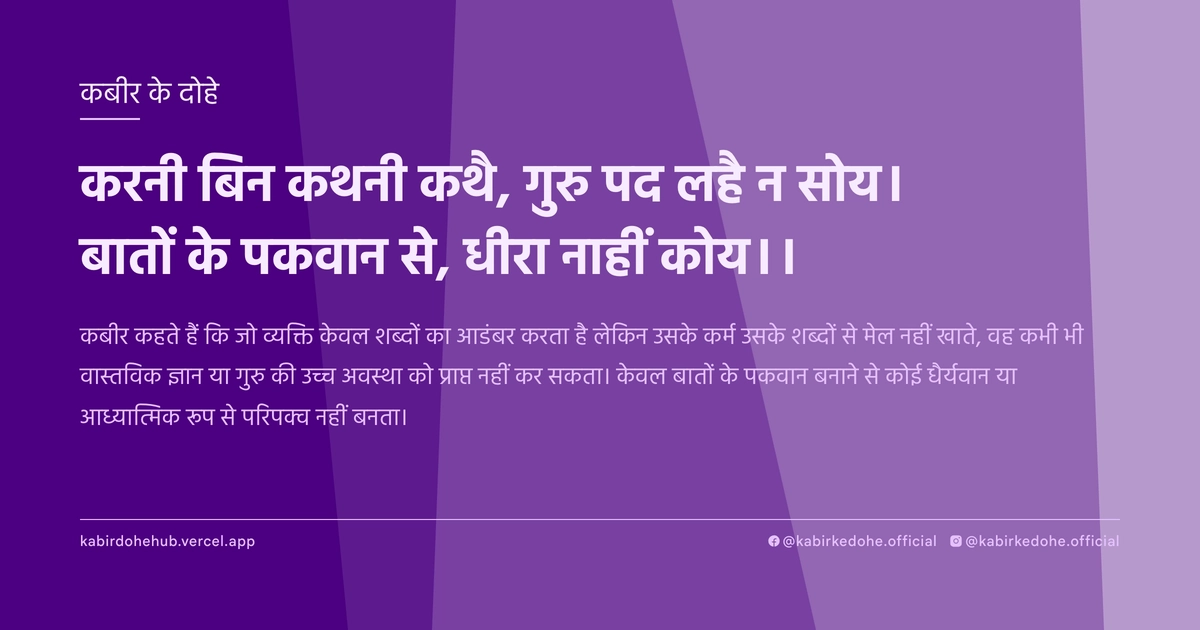
करनी बिन कथनी कथै, गुरु पद लहै न सोय।
बातों के पकवान से, धीरा नाहीं कोय।।
Karani bin kathni kathai, guru pad lahai na soy. Baaton ke pakwan se, dheera naahin koy.
इस पृष्ठ पर इस कबीर दोहे का अर्थ (meaning), हिंदी व्याख्या और अंग्रेज़ी अनुवाद, दार्शनिक विश्लेषण और व्यावहारिक जीवन सीख दी गई है। यह दोहा गुरु महत्व (The Guru's Importance) विषय से जुड़ा है — Kabir doha meaning and explanation in Hindi and English.
अर्थ (Meaning):
कबीर कहते हैं कि जो व्यक्ति केवल शब्दों का आडंबर करता है लेकिन उसके कर्म उसके शब्दों से मेल नहीं खाते, वह कभी भी वास्तविक ज्ञान या गुरु की उच्च अवस्था को प्राप्त नहीं कर सकता। केवल बातों के पकवान बनाने से कोई धैर्यवान या आध्यात्मिक रूप से परिपक्व नहीं बनता।
Kabir asserts that one who speaks eloquently but fails to act upon those words can never attain the true state of enlightenment or the grace of a Guru. Mere verbal delicacies and intellectual gymnastics do not cultivate true patience or spiritual maturity.
व्याख्या (Interpretation):
इस दोहे का शाब्दिक अर्थ है कि बिना कर्म के केवल बोलना व्यर्थ है। रूपकात्मक रूप से, 'बातों के पकवान' उस बौद्धिक अहंकार को दर्शाते हैं जहाँ साधक शास्त्रों की चर्चा तो करता है परंतु अपने अहंकार को नहीं मिटाता। यह निर्गुण भक्ति के उस सिद्धांत पर आधारित है जहाँ ईश्वर बाहरी अनुष्ठानों में नहीं, बल्कि आंतरिक सत्य और आचरण में बसता है। यहाँ 'गुरु पद' का अर्थ केवल एक व्यक्ति नहीं, बल्कि उस चेतना की अवस्था है जहाँ आत्मा और परमात्मा का द्वैत समाप्त हो जाता है। माया हमें शब्दों के जाल में उलझाए रखती है, जबकि सत्य केवल अनुभव और आचरण (Sadhana) के माध्यम से प्रकट होता है।
Literally, the verse warns against the void between speech and action. Metaphorically, 'verbal delicacies' represent the intellectual vanity where a seeker discusses scriptures without dismantling the ego. This aligns with Nirgun Bhakti, where the Divine resides not in external rituals but in internal truth and conduct. The 'Guru's position' refers not merely to a teacher, but to a state of consciousness where the duality between Atman and Brahman dissolves. Maya traps the seeker in a web of linguistic constructs, whereas Truth manifests only through lived experience and disciplined action (Sadhana), highlighting the paradox that the most profound truths are often those that cannot be spoken, only lived.
दार्शनिक विश्लेषण (Philosophical Analysis):
कबीर का यह दोहा उनके युग के धार्मिक पाखंड और केवल किताबी ज्ञान पर आधारित विद्वत्ता पर एक तीखा प्रहार है। उन्होंने देखा कि पंडित और मौलवी शब्दों के जाल बुनते थे, लेकिन उनके जीवन में करुणा और सत्य का अभाव था। यह दृष्टिकोण अद्वैत वेदांत के उस सिद्धांत से मेल खाता है जहाँ 'ज्ञान' केवल सूचना नहीं, बल्कि 'साक्षात्कार' है। जब तक व्यक्ति अपने अहंकार (I-ness) को कर्म के माध्यम से नहीं गलाता, तब तक वह सत्य तक नहीं पहुँच सकता।
सूफी मत में इसे 'फना' की प्रक्रिया कहा गया है, जहाँ व्यक्ति अपनी झूठी पहचान को मिटाकर सत्य में विलीन हो जाता है। कबीर यहाँ यह स्पष्ट करते हैं कि आध्यात्मिक प्रगति का पैमाना आपकी शब्दावली नहीं, बल्कि आपका चरित्र है। वे कर्मकांडीय धर्म को नकारते हुए 'सहज मार्ग' की बात करते हैं, जहाँ जीवन ही पूजा बन जाता है।
मनोवैज्ञानिक स्तर पर, यह दोहा 'संज्ञानात्मक विसंगति' (Cognitive Dissonance) को संबोधित करता है। जब हम वह बोलते हैं जो हम नहीं हैं, तो हम अपने भीतर एक आंतरिक संघर्ष पैदा करते हैं जो आध्यात्मिक विकास को रोकता है। कबीर का संदेश है कि शब्दों का त्याग कर मौन और कर्म की ओर बढ़ें।
ऐतिहासिक रूप से, कबीर ने जाति और धर्म की सीमाओं को तोड़ने के लिए 'कर्म' को प्रधानता दी। उनके लिए एक साधारण जुलाहा जो सत्य जीता है, वह उस विद्वान से श्रेष्ठ है जो केवल शास्त्रों का पाठ करता है। यह सामाजिक समानता का एक आध्यात्मिक आधार प्रदान करता है।
अंततः, यह विश्लेषण हमें यह समझाता है कि सत्य कोई गंतव्य नहीं है जिसे शब्दों से पाया जा सके, बल्कि यह एक निरंतर चलने वाली प्रक्रिया है। जो व्यक्ति अपनी कथनी और करनी को एक कर लेता है, वही वास्तव में 'धीरा' या स्थिर बुद्धि वाला कहलाता है।
This couplet is a piercing critique of the religious hypocrisy and bookish erudition prevalent during Kabir's era. He observed scholars and clerics weaving intricate webs of words while remaining devoid of compassion and integrity in their personal lives. This aligns with Advaita Vedanta, where 'Jnana' (knowledge) is not the accumulation of information, but a direct 'Sakshatkar' (realization) of the Self.
In Sufism, this process is akin to 'Fana,' the annihilation of the false ego to merge with the Ultimate Truth. Kabir clarifies that the metric of spiritual progress is not one's vocabulary, but one's character. He rejects ritualistic religion in favor of the 'Sahaj Marg' (the Natural Path), where life itself becomes an act of worship.
Psychologically, the verse addresses 'cognitive dissonance.' When there is a gap between our projected identity (speech) and our actual behavior, we create an internal conflict that obstructs spiritual evolution. Kabir urges the seeker to move beyond the noise of words toward the silence of action.
Historically, Kabir prioritized 'Karma' (action) to dismantle caste and religious hierarchies. To him, a humble weaver living in truth is superior to a learned scholar who merely recites scriptures. This provides a spiritual foundation for social equality, asserting that divinity is accessed through purity of conduct, not birth or title.
Ultimately, this analysis reveals that Truth is not a destination reachable through linguistic maps, but a continuous process of embodiment. One who synchronizes their speech with their actions achieves 'Sthitaprajna' or a stable, enlightened intellect, transcending the illusion of the ego.
मूल संदेश (Core Message):
- शब्द केवल संकेत हैं, सत्य आचरण में है।
- बौद्धिक अहंकार आध्यात्मिक प्रगति का सबसे बड़ा अवरोध है।
- सत्य वह नहीं जो कहा जाए, सत्य वह है जो जिया जाए।
- अहंकार को मिटाने का एकमात्र तरीका निस्वार्थ कर्म है।
- आंतरिक रूपांतरण बाहरी प्रदर्शन से कहीं अधिक मूल्यवान है।
- Words are mere signposts; Truth resides in conduct.
- Intellectual vanity is the greatest obstacle to spiritual growth.
- Truth is not what is spoken, but what is lived.
- The only way to dissolve the ego is through selfless action.
- Internal transformation is infinitely more valuable than external display.
व्यावहारिक उदाहरण (Practical Example):
वाराणसी के एक पुराने घाट पर माधव नाम का एक वृद्ध व्यक्ति रहता था, जो खुद को बहुत बड़ा आध्यात्मिक गुरु मानता था। वह दिन भर आने जाने वाले तीर्थयात्रियों को अहिंसा, त्याग और प्रेम पर लंबे-लंबे व्याख्यान देता था। उसकी बातें इतनी प्रभावशाली थीं कि लोग उसे 'ज्ञानी' मानकर उसके चरणों में झुकते थे।
लेकिन माधव का निजी जीवन अलग था। वह अपने घर में काम करने वाले लड़के पर छोटी-छोटी बातों पर चिल्लाता था और अपने पड़ोसियों के साथ मामूली विवादों में भी कड़वे शब्दों का प्रयोग करता था। उसकी कथनी और करनी में एक गहरी खाई थी।
एक दिन, एक साधारण सा दिखने वाला साधु उसके पास आया। उसने माधव के प्रवचनों को सुना और फिर चुपचाप उसके घर के बाहर बैठे उस लड़के को देखा, जिसे माधव ने अभी-अभी बुरी तरह डांटा था। साधु ने माधव से कहा, 'आपके शब्दों के पकवान बहुत स्वादिष्ट हैं, लेकिन आपका स्वाद कड़वा है।'
माधव को पहले तो गुस्सा आया, लेकिन जब उसने साधु की आँखों में देखा, तो उसे अपनी असलियत नज़र आई। उसे महसूस हुआ कि वह केवल शब्दों का व्यापार कर रहा था, जबकि उसका हृदय अभी भी अहंकार और क्रोध से भरा था।
उस रात माधव सो नहीं पाया। उसे कबीर का यह दोहा याद आया कि बिना करनी के कथनी व्यर्थ है। उसने महसूस किया कि वह अब तक केवल एक 'अभिनेता' था, साधक नहीं।
अगले दिन से माधव ने प्रवचन देना बंद कर दिया। उसने तय किया कि वह पहले अपने व्यवहार को बदलेगा। उसने उस लड़के से माफी मांगी और अपने पड़ोसियों की मदद करना शुरू किया।
महीनों बीत गए। अब माधव के पास बोलने के लिए बड़े शब्द नहीं थे, लेकिन उसकी आँखों में एक अजीब सी शांति थी। लोग अब उसकी बातों के लिए नहीं, बल्कि उसकी करुणा के लिए उसके पास आने लगे।
उसने सीखा कि असली 'गुरु पद' वह नहीं है जिसे दुनिया मान्यता दे, बल्कि वह है जिसे आत्मा स्वयं स्वीकार करे। उसकी कथनी और करनी अब एक हो चुकी थीं।
माधव का जीवन अब एक जीवित उदाहरण बन गया था। उसने जाना कि मौन रहकर सेवा करना, हजारों शब्दों के प्रवचनों से कहीं अधिक शक्तिशाली है।
अंत में, माधव ने पाया कि जब अहंकार मिटता है, तब शब्द अपने आप सत्य हो जाते हैं। यही उसका वास्तविक रूपांतरण था।
On an ancient ghat in Varanasi lived an elderly man named Madhav, who considered himself a great spiritual master. He spent his days delivering long, eloquent lectures on non-violence, renunciation, and love to the visiting pilgrims. His words were so persuasive that people bowed to him, believing him to be a realized soul.
However, Madhav's private life told a different story. He would scream at the young boy who helped him with chores over the smallest mistakes and used caustic language in petty disputes with his neighbors. There was a profound chasm between his speech and his actions.
One day, a simple-looking monk arrived. He listened to Madhav's discourse and then silently observed the young boy, whom Madhav had just harshly reprimanded. The monk turned to Madhav and said, 'The delicacies of your words are very tasty, but your actual taste is bitter.'
Madhav was initially enraged, but as he looked into the monk's eyes, he saw his own reflection. He realized he had been trading in words while his heart remained imprisoned by ego and anger.
That night, Madhav could not sleep. Kabir's words echoed in his mind: speech without action is futile. He realized he had been a mere actor, not a seeker.
From the next day, Madhav stopped giving lectures. He decided to first transform his behavior. He apologized to the boy and began helping his neighbors without expectation.
Months passed. Madhav no longer possessed grand vocabulary, but there was a strange, luminous peace in his eyes. People began visiting him not for his words, but for the palpable compassion he radiated.
He learned that the true 'Guru's position' is not one granted by public acclaim, but one acknowledged by the soul. His speech and action had finally synchronized.
Madhav's life became a living testament. He discovered that serving in silence is far more powerful than a thousand spoken sermons.
In the end, Madhav found that when the ego dissolves, words naturally become truth. This was his true transformation.
अभ्यास मार्गदर्शन (Practice Guidance):
- दैनिक आत्म-निरीक्षण: हर रात सोने से पहले एक सूची बनाएं कि आज आपने क्या कहा और वास्तव में क्या किया। जहाँ अंतर हो, उसे स्वीकार करें।
- मौन का अभ्यास: दिन में कम से कम एक घंटा 'मौन' रहें। शब्दों के बिना केवल अपने कार्यों से प्रेम और करुणा व्यक्त करने का प्रयास करें।
- जर्नलिंग प्रॉम्प्ट: 'मेरे जीवन का वह कौन सा क्षेत्र है जहाँ मैं दूसरों को सलाह देता हूँ लेकिन स्वयं उसका पालन नहीं करता?' इस पर गहराई से लिखें।
- डायग्नोस्टिक चेकलिस्ट: क्या मैं अपनी छवि (Image) को बचाने के लिए शब्दों का सहारा ले रहा हूँ? क्या मेरी शांति केवल तब तक रहती है जब तक कोई मुझे चुनौती नहीं देता? यदि हाँ, तो आप अभी भी 'बातों के पकवान' में हैं।
- Daily Self-Audit: Before sleep, list what you spoke today versus what you actually did. Acknowledge the gaps without judgment.
- Practice of Silence: Maintain absolute silence for at least one hour daily. Attempt to express love and compassion solely through actions, without words.
- Journaling Prompt: 'In which area of my life do I offer advice to others that I fail to implement myself?' Explore this contradiction deeply.
- Diagnostic Checklist: Am I using words to protect my public image? Does my peace vanish the moment I am challenged? If yes, you are still consuming 'verbal delicacies'.
चिंतन प्रश्न (Reflection Questions):
- क्या मेरी आध्यात्मिक पहचान केवल मेरी शब्दावली और पढ़े हुए ग्रंथों पर टिकी है?
- यदि मेरे शब्द छीन लिए जाएं, तो क्या मेरा व्यवहार अभी भी मुझे एक 'अच्छा इंसान' साबित करेगा?
- मैं अपनी डिजिटल पहचान (Social Media) पर जो आदर्श प्रस्तुत करता हूँ, क्या वे मेरे एकांत के व्यवहार से मेल खाते हैं?
- मैं कितनी बार सत्य बोलने के बजाय 'सही लगने' वाले शब्दों का चुनाव करता हूँ?
- मेरे जीवन का वह कौन सा 'पकवान' है जिसे मैं दूसरों को परोसता हूँ लेकिन स्वयं नहीं चखता?
- Is my spiritual identity merely dependent on my vocabulary and the texts I have read?
- If my words were stripped away, would my behavior still prove me to be a 'good person'?
- Do the ideals I project in my digital identity align with my behavior in solitude?
- How often do I choose words that 'sound right' over words that are true?
- What is that 'delicacy' in my life that I serve to others but refuse to taste myself?