
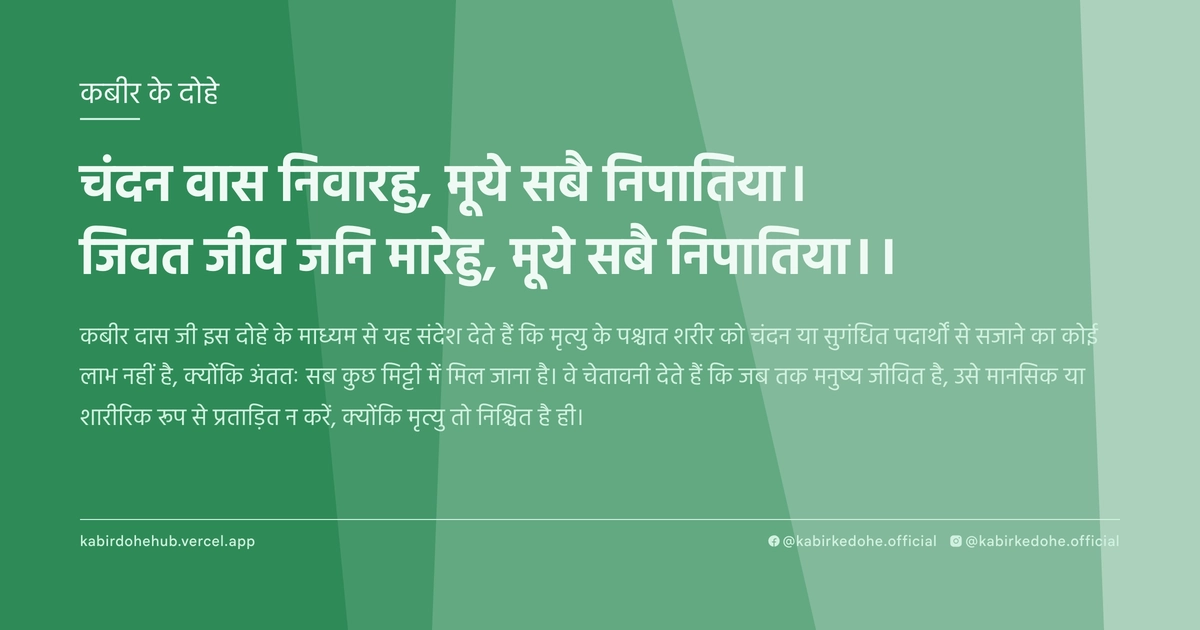
चंदन वास निवारहु, मूये सबै निपातिया।
जिवत जीव जनि मारेहु, मूये सबै निपातिया।।
Chandan vaas nivarahu, mooye sabai nipaatiya. Jivat jeev jani maarehu, mooye sabai nipaatiya.
इस पृष्ठ पर इस कबीर दोहे का अर्थ (meaning), हिंदी व्याख्या और अंग्रेज़ी अनुवाद, दार्शनिक विश्लेषण और व्यावहारिक जीवन सीख दी गई है। यह दोहा करुणा (Compassion) विषय से जुड़ा है — Kabir doha meaning and explanation in Hindi and English.
अर्थ (Meaning):
कबीर दास जी इस दोहे के माध्यम से यह संदेश देते हैं कि मृत्यु के पश्चात शरीर को चंदन या सुगंधित पदार्थों से सजाने का कोई लाभ नहीं है, क्योंकि अंततः सब कुछ मिट्टी में मिल जाना है। वे चेतावनी देते हैं कि जब तक मनुष्य जीवित है, उसे मानसिक या शारीरिक रूप से प्रताड़ित न करें, क्योंकि मृत्यु तो निश्चित है ही।
Kabir emphasizes that adorning a dead body with sandalwood or perfumes is futile, as everything eventually decays into dust. He urges us not to kill or torment a living soul through hatred or violence, reminding us that death is an inevitable destination for all beings.
व्याख्या (Interpretation):
इस दोहे का शाब्दिक अर्थ श्मशान की रीति और मृत शरीर के श्रृंगार पर प्रहार है। रूपकात्मक रूप से, 'चंदन' यहाँ उस बाहरी आडंबर और पाखंड का प्रतीक है जिसे हम समाज में अपनी छवि सुधारने के लिए उपयोग करते हैं। 'मूये सबै निपातिया' यह दर्शाता है कि भौतिक शरीर नश्वर है और अंततः शून्य में विलीन हो जाता है। यह निर्गुण भक्ति का सार है, जहाँ आत्मा को शरीर से अलग माना गया है। कबीर यहाँ माया के उस भ्रम को तोड़ रहे हैं जहाँ मनुष्य मृत्यु के बाद के कर्मकांडों पर अधिक ध्यान देता है, जबकि जीवित रहते हुए करुणा और प्रेम का अभाव रखता है। यह अद्वैत वेदांत के उस सत्य की ओर संकेत है कि हम सब एक ही चेतना के अंश हैं, अतः किसी जीव को कष्ट देना स्वयं को कष्ट देने के समान है।
Literally, the verse critiques the ritual of applying sandalwood to a corpse. Metaphorically, 'Sandalwood' represents the external veneers and social masks we wear to project a curated identity. 'Mooye sabai nipaatiya' signifies the absolute transience of the physical form, which inevitably dissolves into the void. This aligns with Nirgun Bhakti, where the soul is distinguished from the perishable body. Kabir dismantles the illusion of Maya, highlighting the paradox where humans invest in post-mortem rituals while neglecting compassion for the living. It echoes Advaita Vedanta's non-duality: since all beings are manifestations of the same Brahman, harming another is an act of self-destruction. The central paradox is the human tendency to honor the dead while dehumanizing the living.
दार्शनिक विश्लेषण (Philosophical Analysis):
कबीर का यह दोहा उनके युग के कट्टरपंथी धार्मिक वातावरण और कर्मकांडीय अंधविश्वासों के विरुद्ध एक सशक्त विद्रोह है। उस समय समाज में मृत्यु के बाद के अनुष्ठानों को मोक्ष का साधन माना जाता था, जिसे कबीर ने पूरी तरह खारिज कर दिया। वे तर्क देते हैं कि यदि ईश्वर या सत्य की प्राप्ति करनी है, तो वह जीवित अवस्था में करुणा और प्रेम के माध्यम से संभव है, न कि मृत शरीर पर चंदन लगाकर।
दार्शनिक स्तर पर, यह सूफीवाद के 'फना' (अहंकार का विनाश) और अद्वैत वेदांत के 'अहं ब्रह्मास्मि' के करीब है। कबीर का मानना था कि जब हम यह समझ लेते हैं कि मृत्यु अटल है, तो हमारा अहंकार स्वतः कम होने लगता है। अहंकार ही वह पर्दा है जो हमें दूसरे जीव में उसी ईश्वर को देखने से रोकता है जिसे हम मंदिर या मस्जिद में खोजते हैं।
कबीर यहाँ 'जीव' को मारने की बात केवल शारीरिक हत्या के संदर्भ में नहीं, बल्कि मानसिक और भावनात्मक हिंसा के संदर्भ में भी कर रहे हैं। जाति, धर्म और वर्ग के नाम पर किया गया भेदभाव भी एक प्रकार की 'जीव हत्या' है। वे सामाजिक स्तरीकरण को नकारते हुए मानवता को सर्वोच्च धर्म मानते हैं।
यह विश्लेषण हमें यह समझने में मदद करता है कि कबीर का मार्ग केवल वैराग्य का नहीं, बल्कि सक्रिय करुणा का मार्ग है। वे कहते हैं कि यदि आप वास्तव में आध्यात्मिक हैं, तो आपकी करुणा केवल अपने परिवार या समुदाय तक सीमित नहीं होनी चाहिए, बल्कि समस्त चराचर जगत के लिए होनी चाहिए।
अंततः, यह दोहा हमें भौतिकता के मोह से मुक्त कर आंतरिक शुद्धि की ओर ले जाता है। यह सिखाता है कि बाहरी सजावट (चंदन) आत्मा की गंदगी को नहीं धो सकती। केवल प्रेम और अहिंसा ही वह माध्यम हैं जिनसे मनुष्य अपनी वास्तविक प्रकृति को पहचान सकता है और उस निराकार ब्रह्म में विलीन हो सकता है।
This couplet is a fierce rebellion against the ritualistic orthodoxy and superstitious environment of Kabir's era. During his time, post-mortem rituals were viewed as gateways to salvation, a notion Kabir vehemently rejects. He argues that spiritual liberation is achieved through compassion and love while alive, not through the application of sandalwood to a lifeless body.
Philosophically, this resonates with the Sufi concept of 'Fana' (annihilation of the ego) and the Advaita Vedanta realization of 'Aham Brahmasmi' (I am Brahman). Kabir suggests that acknowledging the inevitability of death naturally erodes the ego. The ego is the veil that prevents us from recognizing the Divine within another human being, while we fruitlessly search for it in temples or mosques.
Kabir's warning against 'killing the living soul' extends beyond physical homicide to include psychological and emotional violence. Discrimination based on caste, creed, or class is framed as a form of spiritual murder. By rejecting social stratification, he establishes humanity as the supreme religion.
This analysis reveals that Kabir's path is not one of passive escapism but of active compassion. He asserts that true spirituality cannot be parochial; it must encompass all sentient beings. To love only one's own kind is not devotion, but a refined form of selfishness.
Ultimately, the verse guides us from the attachment to materiality toward internal purification. It teaches that external adornments (sandalwood) cannot cleanse the impurities of the soul. Only love and non-violence are the tools capable of unveiling one's true nature and facilitating the merger with the Formless Absolute.
मूल संदेश (Core Message):
- बाहरी आडंबर व्यर्थ हैं, आंतरिक करुणा ही सत्य है।
- अहंकार का त्याग ही वास्तविक आध्यात्मिक प्रगति है।
- जीवित रहते हुए प्रेम देना, मृत्यु के बाद पूजा से श्रेष्ठ है।
- सभी जीव एक ही चेतना का हिस्सा हैं, अतः हिंसा व्यर्थ है।
- मृत्यु की जागरूकता हमें विनम्र और दयालु बनाती है।
- सच्ची भक्ति कर्मकांडों में नहीं, बल्कि मानवता की सेवा में है।
- External rituals are futile; internal compassion is the only truth.
- The annihilation of ego is the only real spiritual progress.
- Offering love to the living is superior to worshiping the dead.
- All beings share one consciousness; therefore, all violence is futile.
- Awareness of death renders us humble and profoundly kind.
- True devotion lies not in rituals, but in the service of humanity.
व्यावहारिक उदाहरण (Practical Example):
वाराणसी के एक पुराने घाट पर रामदीन नाम का एक वृद्ध नाविक रहता था। वह जीवन भर लोगों को नदी पार कराने और अंतिम संस्कारों में मदद करने का काम करता था। रामदीन का स्वभाव चिड़चिड़ा था और वह अक्सर अपने छोटे सहयोगियों और गरीब मज़दूरों पर चिल्लाता था, उन्हें नीचा दिखाता था और उनके काम में कमियाँ निकालता था। वह खुद को बहुत अनुभवी मानता था और दूसरों को तुच्छ समझता था।
एक दिन उसने देखा कि एक बहुत अमीर परिवार अपने मृत परिजन के शरीर पर भारी मात्रा में चंदन और महंगे इत्र लगा रहा था। वह दृश्य देखकर रामदीन को कबीर का यह दोहा याद आया। उसने सोचा कि जिस व्यक्ति को ये लोग अभी इतना सजा रहे हैं, वह तो अब कुछ महसूस ही नहीं कर सकता। लेकिन वह खुद उन जीवित लोगों को कितना दुख दे रहा है जो उसके साथ काम करते हैं।
उसे अचानक महसूस हुआ कि वह अपनी श्रेष्ठता के अहंकार में उन लोगों की आत्मा को 'मार' रहा था जो उसके प्रति समर्पित थे। उसे अपनी गलती का अहसास हुआ कि मृत शरीर को चंदन लगाना आसान है, लेकिन जीवित हृदय में प्रेम जगाना कठिन और अधिक महत्वपूर्ण है।
अगले दिन से रामदीन का व्यवहार पूरी तरह बदल गया। उसने अपने सहयोगियों से माफी मांगी और उन्हें सम्मान देना शुरू किया। उसने देखा कि जब उसने दूसरों के प्रति करुणा दिखाई, तो उसका अपना मानसिक तनाव कम हो गया और उसे एक अनजानी शांति मिलने लगी।
उसने महसूस किया कि असली 'चंदन' तो वह प्रेम है जो हम जीवित रहते हुए दूसरों को देते हैं। वह अब केवल नाव नहीं चलाता था, बल्कि लोगों के बीच सद्भाव पैदा करने का माध्यम बन गया था।
उसने अपने जीवन की सारी जमापूंजी से उन मज़दूरों के बच्चों की शिक्षा का प्रबंध किया जिन्हें वह पहले डांटता था। उसके चेहरे पर अब एक ऐसी चमक थी जो किसी बाहरी इत्र से नहीं आ सकती थी।
गाँव के लोग हैरान थे कि एक कठोर व्यक्ति इतना कोमल कैसे हो गया। रामदीन ने बस इतना कहा, 'मैंने मृत शरीर को सजाना छोड़कर, जीवित आत्माओं को संवारना सीख लिया है।'
यह बदलाव उसके जीवन की सबसे बड़ी उपलब्धि बनी। उसने पाया कि जब हम दूसरों के अस्तित्व का सम्मान करते हैं, तो हम वास्तव में अपने स्वयं के अस्तित्व को सार्थक बनाते हैं।
रामदीन की कहानी यह सिखाती है कि अहंकार का त्याग और करुणा का अभ्यास ही वास्तविक मोक्ष है।
अंत में, वह नाविक जिसे लोग केवल एक मज़दूर समझते थे, अपने क्षेत्र का सबसे सम्मानित और आध्यात्मिक व्यक्ति बन गया।
On an ancient ghat in Varanasi lived an elderly boatman named Ramdeen. For decades, he ferried passengers and assisted in funeral rites. Ramdeen was known for his irritable temperament; he frequently belittled his young assistants and poor laborers, shouting at them and mocking their shortcomings. He viewed himself as superior due to his experience and treated others as insignificant.
One afternoon, he witnessed a wealthy family lavishly adorning a deceased relative's body with expensive sandalwood paste and rare perfumes. As he watched, Kabir's verse flashed through his mind. He realized that the person being decorated felt nothing, yet he spent his days inflicting pain on living beings who looked up to him.
He suddenly understood that in his arrogance, he was 'killing' the spirits of those around him. He recognized the irony: it is easy to apply sandalwood to a corpse, but far more difficult and vital to cultivate love within a living heart.
From the next day, Ramdeen's behavior underwent a radical transformation. He apologized to his assistants and began treating them with genuine respect. He discovered that by extending compassion, his own internal turmoil subsided, replaced by an unfamiliar sense of peace.
He realized that the true 'sandalwood' is the love we offer to the living. He ceased being just a boatman and became a catalyst for harmony among the ghat workers.
Using his modest savings, he funded the education of the children of the laborers he had once mistreated. A radiance appeared on his face—a glow that no external perfume could ever provide.
The locals were astonished by this change in a man once known for his hardness. Ramdeen simply replied, 'I have stopped decorating the dead and started nurturing the living.'
This shift became the greatest achievement of his life. He found that by honoring the existence of others, he finally gave meaning to his own existence.
Ramdeen's story illustrates that the abandonment of ego and the practice of compassion are the only true paths to liberation.
Ultimately, the boatman, once dismissed as a mere laborer, became the most respected and spiritually grounded figure in his community.
अभ्यास मार्गदर्शन (Practice Guidance):
- दैनिक करुणा अभ्यास: प्रतिदिन कम से कम एक व्यक्ति या जीव के प्रति ऐसा कार्य करें जिससे उन्हें मानसिक शांति मिले, बिना किसी अपेक्षा के।
- आत्म-निरीक्षण जर्नल: हर रात लिखें कि आज आपने अनजाने में किस व्यक्ति के प्रति कठोरता दिखाई और वह व्यवहार आपके किस अहंकार से प्रेरित था।
- मौन चिंतन: प्रतिदिन 15 मिनट इस विचार पर ध्यान केंद्रित करें कि 'मृत्यु अटल है', ताकि वर्तमान क्षण में प्रेम और क्षमा की प्राथमिकता बढ़ सके।
- निदान चेकलिस्ट: क्या मैं दूसरों की गलतियों पर तुरंत क्रोध करता हूँ? क्या मैं केवल उन्हीं का सम्मान करता हूँ जो मेरे काम के हैं? यदि हाँ, तो आप 'जीव हत्या' (मानसिक रूप से) कर रहे हैं।
- Daily Compassion Practice: Perform at least one act of kindness for another being daily, focusing on providing mental peace without expecting anything in return.
- Self-Inquiry Journaling: Every night, record instances where you were harsh toward someone and analyze which part of your ego drove that behavior.
- Silent Contemplation: Spend 15 minutes daily meditating on the inevitability of death to prioritize love and forgiveness in the present moment.
- Diagnostic Checklist: Do I react with immediate anger to others' mistakes? Do I only respect those who are useful to me? If yes, you are practicing 'spiritual killing' of others' dignity.
चिंतन प्रश्न (Reflection Questions):
- मैं अपनी सार्वजनिक छवि को 'चंदन' की तरह कैसे सजाता हूँ, जबकि मेरा आंतरिक स्वभाव कैसा है?
- क्या मैं उन लोगों को मानसिक रूप से प्रताड़ित करता हूँ जिन्हें मैं अपने से छोटा समझता हूँ?
- यदि मुझे पता हो कि आज मेरा अंतिम दिन है, तो मैं अपने रिश्तों में क्या बदलाव करूँगा?
- मेरे जीवन के कौन से पूर्वाग्रह दूसरों की आत्मा की गरिमा को कम कर रहे हैं?
- क्या मेरी आध्यात्मिकता केवल पूजा-पाठ तक सीमित है या वह मेरे व्यवहार में करुणा बनकर दिखती है?
- मैं अपनी डिजिटल पहचान (सोशल मीडिया) के माध्यम से किस प्रकार के 'आडंबर' का प्रदर्शन कर रहा हूँ?
- How do I adorn my public persona like 'sandalwood' while neglecting my internal nature?
- Do I mentally torment those whom I perceive as inferior or less capable?
- If I knew today was my final day, what immediate changes would I make in my relationships?
- Which of my hidden biases are eroding the dignity of other souls?
- Is my spirituality limited to rituals, or does it manifest as tangible compassion in my behavior?
- What kind of 'ritualistic adornment' am I projecting through my digital identity and social media?