
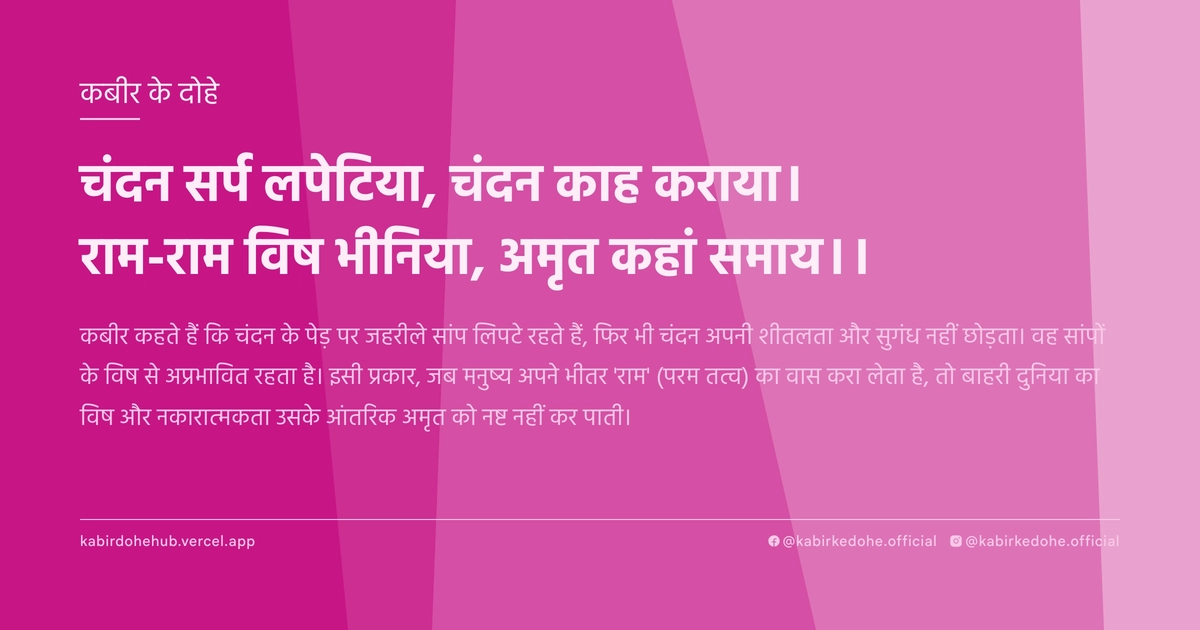
चंदन सर्प लपेटिया, चंदन काह कराया।
राम-राम विष भीनिया, अमृत कहां समाय।।
Chandan sarp lapetiya, chandan kaah karaya. Ram-Ram vish bhiniya, amrit kahan samaye.
इस पृष्ठ पर इस कबीर दोहे का अर्थ (meaning), हिंदी व्याख्या और अंग्रेज़ी अनुवाद, दार्शनिक विश्लेषण और व्यावहारिक जीवन सीख दी गई है। यह दोहा माया (Maya) विषय से जुड़ा है — Kabir doha meaning and explanation in Hindi and English.
अर्थ (Meaning):
कबीर कहते हैं कि चंदन के पेड़ पर जहरीले सांप लिपटे रहते हैं, फिर भी चंदन अपनी शीतलता और सुगंध नहीं छोड़ता। वह सांपों के विष से अप्रभावित रहता है। इसी प्रकार, जब मनुष्य अपने भीतर 'राम' (परम तत्व) का वास करा लेता है, तो बाहरी दुनिया का विष और नकारात्मकता उसके आंतरिक अमृत को नष्ट नहीं कर पाती।
Kabir observes that poisonous snakes coil around the sandalwood tree, yet the tree remains unaffected, continuing to emanate its cooling fragrance. Similarly, when a seeker anchors themselves in the divine essence of 'Ram', the poisons of the external world—hatred, greed, and malice—cannot penetrate or diminish the internal nectar of spiritual bliss.
व्याख्या (Interpretation):
यह दोहा द्वैत और अद्वैत के बीच के संघर्ष को दर्शाता है। यहाँ 'चंदन' शुद्ध चेतना (Atman) का प्रतीक है और 'सर्प' संसार की माया और विकारों का। literal अर्थ यह है कि चंदन सांपों को नहीं रोकता, बल्कि अपनी प्रकृति में स्थिर रहता है। आध्यात्मिक स्तर पर, यह निर्गुण भक्ति का सार है: ईश्वर को किसी बाहरी मंदिर में नहीं, बल्कि अपने स्वभाव में ढूँढना। जब साधक अपनी पहचान को अहंकार से हटाकर ब्रह्म में विलीन करता है, तो वह 'अमृत' प्राप्त करता है। यह विरोधाभास है कि विष के बीच रहकर भी अमृतमय बने रहना ही वास्तविक मोक्ष है।
This couplet illustrates the tension between duality and non-duality. The 'Sandalwood' symbolizes pure consciousness (Atman), while the 'Serpents' represent the illusions of Maya and worldly vices. Literally, the tree does not fight the snakes; it simply remains steadfast in its nature. Spiritually, this is the essence of Nirgun Bhakti: finding the Divine not in external shrines, but within one's own nature. When a seeker shifts identity from the ego to Brahman, they attain 'Amrit' (immortal nectar). The central paradox is that achieving liberation means remaining blissful and fragrant even while enveloped by the toxicity of existence.
दार्शनिक विश्लेषण (Philosophical Analysis):
कबीर का यह दर्शन सामाजिक और धार्मिक पाखंडों के विरुद्ध एक सशक्त प्रहार है। उनके समय में धर्म बाहरी कर्मकांडों और जातिगत श्रेष्ठता तक सीमित था। कबीर ने 'राम' शब्द का प्रयोग किसी व्यक्ति विशेष के लिए नहीं, बल्कि उस निराकार सत्ता के लिए किया जो कण-कण में व्याप्त है। यह दृष्टिकोण अद्वैत वेदांत के करीब है, जहाँ आत्मा और परमात्मा की एकता पर बल दिया गया है।
यहाँ सांपों का लिपटना समाज के उन दबावों और नकारात्मकताओं का प्रतीक है जो एक व्यक्ति को उसकी मूल प्रकृति से भटकाने का प्रयास करते हैं। कबीर तर्क देते हैं कि यदि हम बाहरी दुनिया को बदलने की कोशिश करेंगे, तो हम कभी शांत नहीं होंगे। वास्तविक परिवर्तन आंतरिक स्थिरता से आता है। यह सूफी मत के 'फना' (अहंकार का विनाश) के समान है, जहाँ व्यक्ति अपनी व्यक्तिगत इच्छाओं को ईश्वर की इच्छा में लीन कर देता है।
इस दोहे में 'विष' केवल बाहरी शत्रु नहीं, बल्कि आंतरिक विकार जैसे काम, क्रोध और लोभ हैं। जब तक साधक इन विकारों से लड़ता है, वह उनमें उलझा रहता है। लेकिन जब वह 'राम-नाम' या आत्म-साक्षात्कार के माध्यम से अपनी चेतना को ऊपर उठा लेता है, तो वह विष को अमृत में बदलने की क्षमता विकसित कर लेता है।
कबीर का यह संदेश यह है कि पवित्रता बाहरी वातावरण पर निर्भर नहीं करती। एक संत गंदी नाली के पास बैठकर भी पवित्र रह सकता है, ठीक वैसे ही जैसे चंदन सांपों के बीच रहकर भी सुगंधित रहता है। यह विचार व्यक्ति को परिस्थितियों का दास बनने के बजाय अपनी आंतरिक स्थिति का स्वामी बनाता है।
अंततः, यह विश्लेषण हमें सिखाता है कि आध्यात्मिक विकास का अर्थ दुनिया से भागना नहीं, बल्कि दुनिया में रहते हुए उससे अछूता रहना है। यह 'स्थितप्रज्ञ' होने की अवस्था है, जहाँ सुख-दुख और मान-अपमान का प्रभाव समाप्त हो जाता है और केवल शुद्ध चैतन्य शेष रहता है।
Kabir's philosophy here serves as a potent critique of the social and religious hypocrisies of his era. During his time, religion was largely reduced to external rituals and caste-based hierarchies. Kabir utilized the term 'Ram' not to refer to a mythological deity, but to the formless, omnipresent Absolute that permeates every atom of existence. This perspective aligns closely with Advaita Vedanta, emphasizing the fundamental unity of Atman and Brahman.
The coiling of the serpents symbolizes the societal pressures and negative influences that attempt to divert an individual from their true nature. Kabir argues that attempting to change the external world is a futile endeavor that leads to perpetual unrest. True transformation originates from internal stability and alignment with the Truth.
This mirrors the Sufi concept of 'Fana' (the annihilation of the ego), where the individual self is dissolved into the Divine Will. The 'poison' mentioned is not merely external enmity, but internal impurities such as lust, anger, and greed. As long as the seeker fights these vices with ego, they remain entangled in them. However, through 'Ram-Nam' or self-realization, one develops the alchemy to transmute this poison into nectar.
Kabir asserts that purity is not contingent upon the external environment. A saint can remain pure even while sitting by a sewage drain, just as sandalwood remains fragrant despite the presence of snakes. This insight empowers the individual to stop being a slave to circumstances and instead become the master of their internal state.
Ultimately, this analysis reveals that spiritual evolution is not about escaping the world, but about remaining untouched by it while living within it. This is the state of the 'Sthitapragya' (the steady-minded), where the fluctuations of pleasure and pain, honor and dishonor, cease to exist, leaving only pure, unadulterated consciousness.
मूल संदेश (Core Message):
- बाहरी नकारात्मकता केवल एक परीक्षा है, आपकी आंतरिक शांति आपका गंतव्य है।
- प्रतिक्रिया देना अहंकार है, प्रतिक्रिया न देना आत्म-साक्षात्कार है।
- संसार का विष केवल उसे प्रभावित करता है जो अपनी प्रकृति को भूल चुका है।
- परम तत्व (राम) का आश्रय ही एकमात्र वास्तविक सुरक्षा कवच है।
- पवित्रता परिस्थितियों में नहीं, बल्कि चेतना की गहराई में निहित है।
- External negativity is but a test; your internal peace is the ultimate destination.
- Reacting is an act of ego; non-reaction is an act of self-realization.
- The world's poison only affects those who have forgotten their true nature.
- Shelter in the Absolute (Ram) is the only authentic shield against suffering.
- Purity resides not in circumstances, but in the depths of one's consciousness.
व्यावहारिक उदाहरण (Practical Example):
एक समय की बात है, वाराणसी के घाटों पर माधव नाम का एक वृद्ध बुनकर रहता था। माधव अपनी ईमानदारी और शांत स्वभाव के लिए जाना जाता था, लेकिन उसके पड़ोस में रहने वाले कुछ लोग उससे अत्यधिक ईर्ष्या करते थे। वे लोग अक्सर उसे नीचा दिखाने की कोशिश करते, उसके काम की बुराई करते और यहाँ तक कि उसके परिवार के बारे में झूठी अफवाहें फैलाते थे।
माधव के जीवन में यह 'विष' हर दिन बरसता था। उसके पड़ोसी उसे मानसिक रूप से प्रताड़ित करते थे ताकि वह अपना धैर्य खो दे और उनके साथ झगड़े में पड़ जाए। लेकिन माधव ने कबीर के इस दोहे को अपने जीवन का आधार बना लिया था। वह जानता था कि यदि वह क्रोध करेगा, तो वह भी उसी विष का हिस्सा बन जाएगा।
वह सुबह उठकर चुपचाप अपने करघे पर बैठता और ईश्वर के ध्यान में लीन होकर कपड़े बुनता। जब पड़ोसी उसे अपशब्द कहते, तो वह मंद मुस्कान के साथ उन्हें देखता और अपने काम में लगा रहता। वह उनके प्रति नफरत नहीं करता था, बल्कि उनके प्रति करुणा महसूस करता था क्योंकि वह देख सकता था कि वे लोग अपने ही क्रोध की आग में जल रहे हैं।
एक दिन, पड़ोसियों ने मिलकर माधव के घर के सामने कचरा डालना शुरू कर दिया। उन्होंने सोचा कि अब माधव चुप नहीं रहेगा। लेकिन माधव ने बिना किसी शिकायत के, शांति से उस कचरे को साफ किया और उस जगह पर कुछ सुंदर फूल लगा दिए। उसकी इस प्रतिक्रिया ने पड़ोसियों को अंदर से झकझोर दिया।
वे हैरान थे कि कोई व्यक्ति इतनी नफरत के बीच रहकर भी इतना शांत और प्रेमपूर्ण कैसे हो सकता है। उनमें से एक व्यक्ति, जो माधव को सबसे ज्यादा परेशान करता था, उसके पास आया और पूछा, 'तुम हमें जवाब क्यों नहीं देते? क्या तुम्हें डर नहीं लगता या तुम मूर्ख हो?'
माधव ने शांति से उत्तर दिया, 'भाई, यदि कोई मुझे जहर दे और मैं उसे पी लूँ, तो मरने वाला मैं ही होऊँगा। मैंने तय किया है कि मैं अपने भीतर अमृत रखूँगा, ताकि बाहर का जहर मुझे छू न सके। मेरी शांति मेरा कवच है।'
यह 'कबीर ट्विस्ट' था जिसने उस व्यक्ति के अहंकार को तोड़ दिया। उसे एहसास हुआ कि माधव की शक्ति उसके चुप रहने में नहीं, बल्कि उसकी आंतरिक स्थिरता में थी। वह व्यक्ति पहली बार माधव के चरणों में झुक गया और अपनी गलतियों की माफी मांगी।
धीरे-धीरे, माधव की इस 'चंदन' जैसी प्रकृति ने पूरे मोहल्ले का वातावरण बदल दिया। जो लोग पहले नफरत फैलाते थे, वे अब शांति और क्षमा की बातें करने लगे। माधव ने साबित कर दिया कि बिना किसी युद्ध के, केवल अपने स्वभाव को शुद्ध रखकर दुनिया के विष को अमृत में बदला जा सकता है।
माधव का जीवन अब केवल कपड़ों की बुनाई नहीं था, बल्कि वह मानवीय संबंधों की एक ऐसी चादर बुन रहा था जिसमें प्रेम और सहिष्णुता के धागे पिरोए हुए थे। उसने सिखाया कि जब हम स्वयं को राम (परम सत्य) में विलीन कर लेते हैं, तो बाहरी दुनिया की कड़वाहट हमें प्रभावित करना बंद कर देती है।
Once, on the ghats of Varanasi, lived an elderly weaver named Madhav. Madhav was known for his honesty and serene nature, but a few of his neighbors harbored deep resentment and jealousy toward him. They constantly tried to belittle him, criticized his craftsmanship, and spread malicious rumors about his family.
This 'poison' rained upon Madhav's life daily. His neighbors mentally tormented him, hoping he would lose his patience and engage in a conflict. However, Madhav had anchored his life in the wisdom of this specific Kabir Doha. He understood that if he responded with anger, he would simply become another vessel for that same poison.
Every morning, he would sit quietly at his loom, weaving fabric while immersed in the remembrance of the Divine. When neighbors hurled insults, he would respond with a gentle smile and return to his work. He felt no hatred for them; instead, he felt compassion, recognizing that they were burning in the fire of their own rage.
One day, the neighbors conspired to dump filth and garbage right in front of Madhav's doorstep. They believed that this would finally provoke him. But Madhav, without a single word of complaint, calmly cleaned the area and planted beautiful, fragrant flowers in its place.
This reaction shook the neighbors to their core. They were bewildered by how a person could remain so peaceful and loving amidst such concentrated hatred. One man, who had been the primary instigator, approached him and asked, 'Why don't you fight back? Are you afraid, or are you simply a fool?'
Madhav replied softly, 'Brother, if someone offers me poison and I drink it, I am the one who dies. I have decided to keep the nectar of peace within me, so that the external poison cannot touch my soul. My stillness is my shield.'
This was the 'Kabir Twist' that shattered the man's ego. He realized that Madhav's strength lay not in his silence, but in his internal stability. For the first time, the man bowed at Madhav's feet and sought forgiveness for his actions.
Gradually, Madhav's 'sandalwood-like' nature transformed the entire neighborhood. Those who once spread hatred began to speak of peace and forgiveness. Madhav proved that without any conflict, simply by refining one's own nature, the poison of the world can be transmuted into nectar.
Madhav's life was no longer just about weaving cloth; he was weaving a tapestry of human relationships threaded with love and tolerance. He demonstrated that when we merge our identity with the Absolute (Ram), the bitterness of the external world ceases to affect us.
His story serves as a timeless reminder that the most powerful response to hatred is not counter-hatred, but an unwavering commitment to one's own inner purity and fragrance.
अभ्यास मार्गदर्शन (Practice Guidance):
- प्रतिदिन 20 मिनट 'साक्षी भाव' (Witness Consciousness) का अभ्यास करें, जहाँ आप अपने विचारों और बाहरी शोर को बिना प्रतिक्रिया दिए केवल देखें।
- एक 'प्रतिक्रिया जर्नल' बनाएँ: दिन भर में जब भी कोई आपको क्रोधित करे, तो लिखें कि आपने उस 'विष' को कैसे संभाला और क्या आप चंदन की तरह स्थिर रहे।
- व्यवहार परिवर्तन: जब कोई आप पर चिल्लाए, तो तुरंत जवाब देने के बजाय 3 गहरी साँसें लें और मन में कहें 'यह उनका विष है, मेरा अमृत नहीं'।
- निदान चेकलिस्ट: क्या मैं दूसरों की राय से विचलित होता हूँ? क्या मेरी शांति बाहरी परिस्थितियों पर निर्भर है? यदि हाँ, तो मुझे अपनी आंतरिक जड़ों को और गहरा करने की आवश्यकता है।
- Practice 'Sakshi Bhav' (Witness Consciousness) for 20 minutes daily, observing your thoughts and external noise without reacting to them.
- Maintain a 'Reaction Journal': Record instances where someone tried to provoke you and analyze whether you remained steadfast like sandalwood or succumbed to the poison.
- Behavioral Shift: When faced with aggression, instead of an immediate response, take three deep breaths and mentally affirm, 'This is their poison, not my nectar.'
- Diagnostic Checklist: Do I feel disturbed by others' opinions? Is my peace contingent upon external circumstances? If yes, it is a sign that I need to deepen my internal spiritual roots.
चिंतन प्रश्न (Reflection Questions):
- मेरे जीवन में वे 'सांप' कौन हैं जिन्हें मैं हटाने की कोशिश कर रहा हूँ, जबकि मुझे केवल 'चंदन' बनने की आवश्यकता है?
- क्या मेरी अच्छाई केवल तब तक है जब तक दुनिया मेरे प्रति अच्छी है? क्या यह वास्तविक करुणा है या केवल एक सौदा?
- मेरे भीतर का वह कौन सा हिस्सा है जो अभी भी बाहरी प्रशंसा या आलोचना के लिए तड़पता है?
- यदि मैं अपनी सामाजिक पहचान (पद, प्रतिष्ठा, जाति) को हटा दूँ, तो क्या मेरे पास कोई ऐसा 'अमृत' है जो मुझे स्थिर रख सके?
- मैं अपनी डिजिटल पहचान (सोशल मीडिया) पर जो छवि दिखाता हूँ, क्या वह मेरे आंतरिक सत्य के साथ मेल खाती है या वह केवल एक मुखौटा है?
- Who are the 'serpents' in my life that I am trying to remove, when I should instead focus on becoming the 'sandalwood'?
- Is my kindness only present as long as the world is kind to me? Is this true compassion or merely a social transaction?
- Which part of me still craves external validation or feels wounded by criticism?
- If I strip away my social identity (status, prestige, caste), do I possess an internal 'nectar' that can keep me stable?
- Does the image I project in my digital identity align with my internal truth, or is it merely a curated mask?