
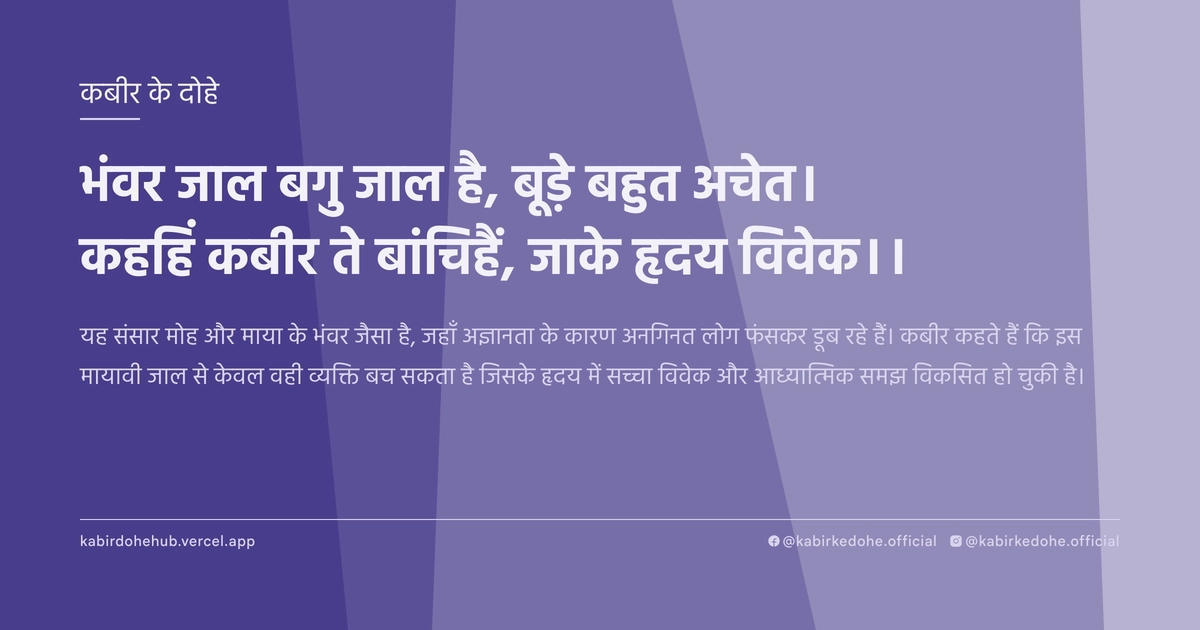
भंवर जाल बगु जाल है, बूड़े बहुत अचेत।
कहहिं कबीर ते बांचिहैं, जाके हृदय विवेक।।
Bhanwar jaal bagu jaal hai, bude bahut acheth. Kahahin kabir te banchihain, jake hriday vivek.
इस पृष्ठ पर इस कबीर दोहे का अर्थ (meaning), हिंदी व्याख्या और अंग्रेज़ी अनुवाद, दार्शनिक विश्लेषण और व्यावहारिक जीवन सीख दी गई है। यह दोहा जागृति (The Wake-up Call) विषय से जुड़ा है — Kabir doha meaning and explanation in Hindi and English.
अर्थ (Meaning):
यह संसार मोह और माया के भंवर जैसा है, जहाँ अज्ञानता के कारण अनगिनत लोग फंसकर डूब रहे हैं। कबीर कहते हैं कि इस मायावी जाल से केवल वही व्यक्ति बच सकता है जिसके हृदय में सच्चा विवेक और आध्यात्मिक समझ विकसित हो चुकी है।
This world is like a swirling vortex of attachment and illusion, where countless unconscious souls are drowning in ignorance. Kabir asserts that only those who possess true discernment and spiritual wisdom within their hearts can escape this intricate web of existence.
व्याख्या (Interpretation):
शाब्दिक रूप से, कबीर एक बगुले और जाल का रूपक उपयोग कर रहे हैं, जहाँ बगुला (मन) मछली (सत्य) की तलाश में है लेकिन स्वयं जाल (माया) में फंस जाता है। यह 'भंवर' संसार की उन अंतहीन इच्छाओं का प्रतीक है जो मनुष्य को चक्रवात की तरह खींचती हैं। यहाँ 'अचेत' होना केवल नींद नहीं, बल्कि आध्यात्मिक मूर्च्छा है जहाँ व्यक्ति शरीर और अहंकार को ही सत्य मान बैठता है। यह स्थिति अद्वैत वेदांत के 'माया' सिद्धांत को दर्शाती है, जहाँ वास्तविक ब्रह्म की उपस्थिति एक भ्रमित पर्दे के पीछे छिपी होती है। विवेक का अर्थ यहाँ केवल बौद्धिक ज्ञान नहीं, बल्कि वह अंतर्दृष्टि है जो नश्वर और शाश्वत के बीच अंतर कर सके। अंततः, यह दोहा बताता है कि मुक्ति बाहरी कर्मकांडों से नहीं, बल्कि आंतरिक जागरूकता के जागरण से संभव है।
Literally, Kabir employs the metaphor of a heron and a net, where the heron (the mind) seeks the fish (truth) but becomes ensnared in the net (Maya). The 'vortex' symbolizes the endless cycle of worldly desires that pull the human soul inward like a whirlpool. Being 'unconscious' (acheth) refers not to physical sleep, but to a spiritual stupor where one mistakes the transient body and ego for the ultimate reality. This aligns with the Advaita Vedanta concept of Maya, where the true Brahman is obscured by a veil of illusion. 'Vivek' or discernment here is not mere intellectual knowledge, but the profound insight capable of distinguishing between the ephemeral and the eternal. Ultimately, the couplet posits that liberation is achieved not through external rituals, but through the awakening of internal consciousness.
दार्शनिक विश्लेषण (Philosophical Analysis):
कबीर का यह दोहा उस युग की उपज है जब समाज कर्मकांडों और बाहरी आडंबरों में गहरे डूबा हुआ था। उन्होंने स्पष्ट किया कि चाहे वह मंदिर हो या मस्जिद, यदि हृदय में विवेक नहीं है, तो मनुष्य केवल एक नए प्रकार के जाल में फंस रहा है। यह दृष्टिकोण सूफी मत के 'फना' (अहंकार का विनाश) और भक्ति आंदोलन के 'निर्गुण' मार्ग का संगम है, जहाँ ईश्वर को किसी आकार में नहीं, बल्कि शुद्ध चेतना के रूप में अनुभव किया जाता है।
दार्शनिक स्तर पर, 'भंवर' उस मनोवैज्ञानिक स्थिति को दर्शाता है जहाँ मनुष्य अपनी ही वासनाओं और सामाजिक अपेक्षाओं के चक्र में घूमता रहता है। वह जितना बाहर निकलने का प्रयास करता है, उतना ही गहराई में डूबता जाता है क्योंकि वह समाधान को बाहरी दुनिया में खोज रहा होता है। कबीर यहाँ चेतावनी देते हैं कि बिना आत्म-ज्ञान के किया गया कोई भी प्रयास केवल भ्रम को बढ़ाता है।
अद्वैत वेदांत के अनुसार, आत्मा और ब्रह्म एक ही हैं, लेकिन 'अविद्या' (अज्ञान) के कारण हम स्वयं को अलग और सीमित महसूस करते हैं। यह अलगाव ही वह 'जाल' है। जब विवेक जागता है, तो यह बोध होता है कि जाल और मछली दोनों ही एक ही चेतना के विभिन्न रूप हैं, और इस बोध के साथ ही जाल का अस्तित्व समाप्त हो जाता है।
कबीर का विद्रोह केवल सामाजिक नहीं, बल्कि संज्ञानात्मक था। उन्होंने तर्क दिया कि जाति, धर्म और संप्रदाय केवल मानसिक सीमाएं हैं जो मनुष्य को उसकी वास्तविक प्रकृति से दूर रखती हैं। उनके लिए, विवेक वह तलवार है जो इन कृत्रिम सीमाओं को काट देती है।
अंततः, यह विश्लेषण हमें सिखाता है कि आध्यात्मिक प्रगति का अर्थ अधिक जानकारी एकत्र करना नहीं, बल्कि उन भ्रमों को हटाना है जो हमें सत्य देखने से रोकते हैं। यह 'अचेत' अवस्था से 'चेत' अवस्था की ओर संक्रमण है, जहाँ व्यक्ति कर्ता होने के अहंकार को त्याग कर केवल एक साक्षी (Witness) बन जाता है।
This couplet is a product of an era where society was deeply immersed in ritualism and external ostentation. Kabir clarifies that whether it be a temple or a mosque, if there is no discernment in the heart, the individual is merely becoming trapped in a different kind of net. This perspective is a confluence of the Sufi concept of 'Fana' (annihilation of the ego) and the 'Nirgun' path of the Bhakti movement, where the Divine is experienced not as a form, but as pure consciousness.
On a philosophical level, the 'vortex' represents the psychological state where a human revolves within the cycle of their own cravings and social expectations. The more they struggle to escape externally, the deeper they sink because they seek the solution in the outer world. Kabir warns that any effort made without self-knowledge only amplifies the illusion.
According to Advaita Vedanta, the Atman and Brahman are one, but due to 'Avidya' (ignorance), we perceive ourselves as separate and limited. This perceived separation is the 'net'. When Vivek awakens, the realization dawns that both the net and the fish are manifestations of the same consciousness, and with this realization, the net ceases to exist.
Kabir's rebellion was not merely social, but cognitive. He argued that caste, religion, and sect are merely mental boundaries that keep a human away from their true nature. For him, discernment is the sword that cuts through these artificial limitations.
Ultimately, this analysis teaches us that spiritual progress is not about accumulating more information, but about removing the delusions that prevent us from seeing the truth. It is a transition from the state of being 'unconscious' to 'conscious,' where the individual relinquishes the ego of being the 'doer' and becomes a mere Witness.
मूल संदेश (Core Message):
- अज्ञानता का भंवर हमें केवल विनाश की ओर ले जाता है।
- बाहरी संघर्ष अक्सर आंतरिक भ्रम का परिणाम होते हैं।
- विवेक वह एकमात्र कुंजी है जो माया के ताले खोलती है।
- शांति संघर्ष में नहीं, बल्कि सही समझ में निहित है।
- स्वयं को जानना ही सबसे बड़ी मुक्ति है।
- The vortex of ignorance leads only toward spiritual destruction.
- External struggles are often the result of internal delusions.
- Discernment is the only key that unlocks the shackles of Maya.
- Peace lies not in fighting, but in right understanding.
- Knowing oneself is the ultimate liberation.
व्यावहारिक उदाहरण (Practical Example):
एक समय की बात है, वाराणसी के घाटों पर माधव नाम का एक वृद्ध नाविक रहता था। माधव अपनी पूरी जिंदगी नाव चलाने में बिता चुका था, लेकिन उसका मन हमेशा इस बात से परेशान रहता था कि वह जीवन में कुछ 'बड़ा' हासिल नहीं कर पाया। वह अमीर व्यापारियों को देखता और सोचता कि काश उसके पास भी वैसा ही वैभव होता। वह अधिक धन कमाने के लालच में अपनी नाव को खतरनाक भंवरों वाले इलाकों में ले जाने लगा, जहाँ मछलियाँ अधिक थीं लेकिन जोखिम भी ज्यादा था।
एक दिन, एक भीषण तूफान आया और माधव की नाव एक शक्तिशाली भंवर में फंस गई। वह जितना जोर से चप्पू चलाता, नाव उतनी ही तेजी से गोल-गोल घूमकर नीचे की ओर खिंचती जाती। वह चिल्लाया, गिड़गिड़ाया और अपनी पूरी ताकत लगा दी, लेकिन वह जितना संघर्ष करता, भंवर उसे उतना ही गहराई में ले जाता। वह पूरी तरह 'अचेत' था, यह न समझते हुए कि उसका संघर्ष ही उसे और नीचे धकेल रहा है।
तभी उसे किनारे पर बैठे एक शांत साधु की आवाज सुनाई दी, "माधव, चप्पू चलाना बंद करो! बस शांत होकर पानी के बहाव को समझो।"
माधव ने पहली बार डर को छोड़कर अपनी आँखें बंद कीं और महसूस किया कि वह जिस दिशा में संघर्ष कर रहा था, वह उसे केंद्र की ओर ले जा रहा था। उसने अपनी सांसों पर ध्यान केंद्रित किया और अचानक उसे समझ आया कि यदि वह नाव को एक विशेष कोण पर छोड़ दे और लहरों के साथ तालमेल बिठा ले, तो वह बाहर निकल सकता है।
जैसे ही उसने संघर्ष करना बंद किया और 'विवेक' का उपयोग कर पानी की गति को समझा, नाव धीरे-धीरे भंवर के प्रभाव से मुक्त होने लगी। उसने महसूस किया कि अब तक वह जिस 'सफलता' और 'धन' के पीछे भाग रहा था, वह वास्तव में एक मानसिक भंवर था जिसने उसे कभी शांति नहीं दी।
उस दिन के बाद, माधव ने अपनी नाव चलाना जारी रखा, लेकिन अब वह केवल जीविका के लिए काम करता था, लालच के लिए नहीं। उसने समझा कि जीवन की असली जीत बाहरी संपत्ति में नहीं, बल्कि आंतरिक स्थिरता में है।
उसने घाट पर आने वाले अन्य नाविकों को भी सिखाया कि कैसे जीवन के तूफानों में घबराने के बजाय, शांत रहकर सही दिशा का चुनाव करना चाहिए।
माधव अब एक समृद्ध नाविक नहीं था, लेकिन वह वाराणसी का सबसे शांत और संतुष्ट व्यक्ति बन गया था। उसका 'विवेक' ही उसका सबसे बड़ा खजाना बन गया था।
Once, on the ghats of Varanasi, lived an elderly boatman named Madhav. Madhav had spent his entire life rowing, yet his mind was perpetually troubled by the feeling that he had achieved nothing 'great' in life. He would watch wealthy merchants and wish for similar opulence. Driven by the greed for more wealth, he began taking his boat into dangerous vortex areas where fish were abundant but the risks were high.
One day, a fierce storm struck, and Madhav's boat became trapped in a powerful whirlpool. The harder he rowed, the faster the boat spun and was pulled downward. He screamed, pleaded, and exerted all his strength, but his very struggle pushed him deeper into the vortex. He was completely 'unconscious,' failing to realize that his resistance was the very thing dragging him down.
Just then, he heard the voice of a serene monk sitting on the shore: "Madhav, stop rowing! Just be still and understand the flow of the water."
For the first time, Madhav let go of his fear, closed his eyes, and realized that the direction in which he was fighting was actually pulling him toward the center. He focused on his breath and suddenly understood that if he positioned the boat at a specific angle and aligned himself with the current, he could escape.
As soon as he stopped struggling and applied 'Vivek' (discernment) to understand the water's movement, the boat slowly began to free itself from the vortex's grip. He realized that the 'success' and 'wealth' he had been chasing were actually a mental whirlpool that had never granted him peace.
After that day, Madhav continued rowing, but now he worked for sustenance, not for greed. He understood that life's true victory lies not in external possessions, but in internal stability.
He began teaching other boatmen on the ghats how to choose the right direction by remaining calm instead of panicking during life's storms.
Madhav was no longer a wealthy boatman, but he became the most peaceful and contented man in Varanasi. His 'Vivek' became his greatest treasure.
अभ्यास मार्गदर्शन (Practice Guidance):
- प्रतिदिन 20 मिनट 'साक्षी भाव' का अभ्यास करें: अपने विचारों को बिना किसी निर्णय के देखें, जैसे आप किसी नदी के किनारे खड़े होकर पानी को बहते देख रहे हों।
- स्व-पूछताछ जर्नल: हर रात लिखें कि आज दिन भर में किन क्षणों में आप 'अचेत' (प्रतिक्रियाशील) थे और कहाँ आप 'विवेक' (जागरूक) के साथ कार्य कर पाए।
- मौन व्रत: सप्ताह में एक बार कम से कम 3 घंटे का पूर्ण मौन धारण करें ताकि बाहरी शोर कम हो और आंतरिक विवेक की आवाज सुनाई दे।
- डायग्नोस्टिक चेकलिस्ट: क्या मैं वर्तमान स्थिति से लड़ रहा हूँ? क्या मेरी इच्छाएं मुझे मानसिक तनाव दे रही हैं? क्या मैं अपनी पहचान अपनी उपलब्धियों से जोड़ रहा हूँ? यदि हाँ, तो आप 'भंवर' में हैं।
- Practice 'Witness Consciousness' for 20 minutes daily: Observe your thoughts without judgment, as if you are standing on a riverbank watching the water flow by.
- Self-Inquiry Journaling: Every night, record the moments you were 'unconscious' (reactive) and the moments you acted with 'Vivek' (awareness).
- Vow of Silence: Observe complete silence for at least 3 hours once a week to diminish external noise and allow the voice of internal discernment to emerge.
- Diagnostic Checklist: Am I fighting the current of the present moment? Are my desires causing me mental distress? Am I tying my identity to my achievements? If yes, you are in the 'vortex'.
चिंतन प्रश्न (Reflection Questions):
- वह कौन सा 'मानसिक भंवर' है जिसमें आप बार-बार फंसते हैं, जबकि आप जानते हैं कि वह व्यर्थ है?
- आपकी सार्वजनिक छवि (Public Identity) और आपके आंतरिक सत्य के बीच कितना बड़ा अंतर है?
- क्या आपकी डिजिटल उपस्थिति (Social Media) आपके अहंकार के जाल को और मजबूत कर रही है?
- यदि आपकी सभी उपलब्धियां और पद छीन लिए जाएं, तो आपके पास 'विवेक' के रूप में क्या बचेगा?
- आप किन पूर्वाग्रहों के कारण सत्य को देखने में असमर्थ हैं?
- What is the 'mental vortex' you repeatedly fall into, even though you know it is futile?
- How wide is the gap between your public identity and your internal truth?
- Is your digital presence (social media) strengthening the net of your ego?
- If all your achievements and titles were stripped away, what would remain of your 'Vivek'?
- Which hidden biases are preventing you from seeing the absolute truth?