
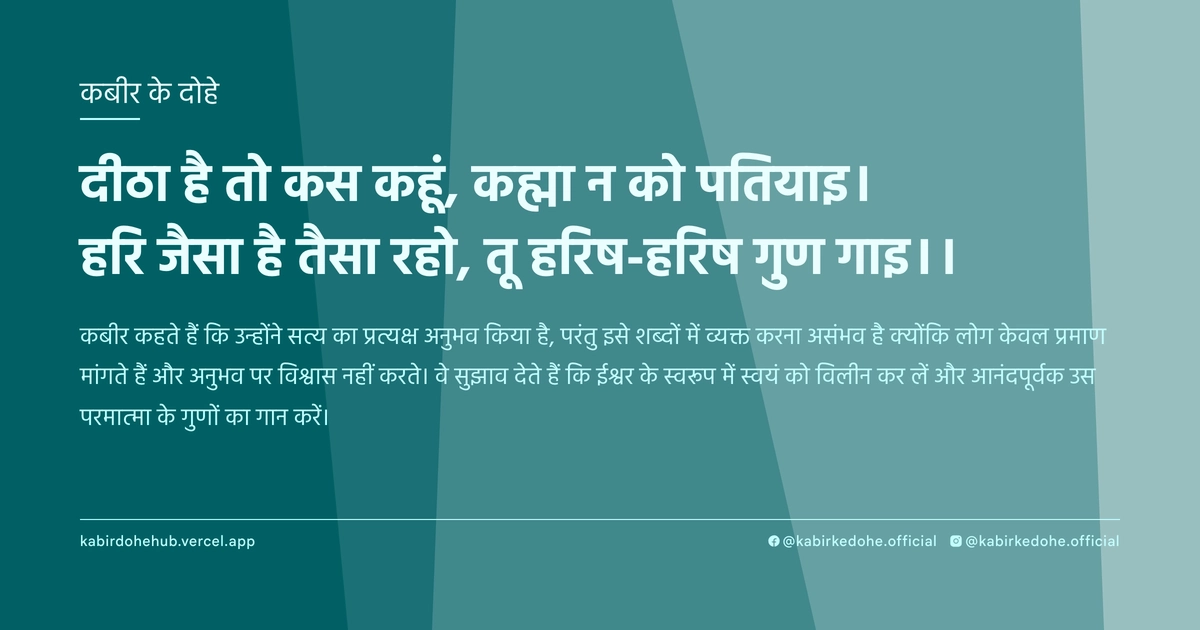
दीठा है तो कस कहूं, कह्मा न को पतियाइ।
हरि जैसा है तैसा रहो, तू हरिष-हरिष गुण गाइ।।
Deetha hai to kas kahun, kahma na ko patiyai. Hari jaisa hai taisa raho, tu harish-harish gun gaai.
इस पृष्ठ पर इस कबीर दोहे का अर्थ (meaning), हिंदी व्याख्या और अंग्रेज़ी अनुवाद, दार्शनिक विश्लेषण और व्यावहारिक जीवन सीख दी गई है। यह दोहा निर्गुण ब्रह्म (Nirguna Brahman) विषय से जुड़ा है — Kabir doha meaning and explanation in Hindi and English.
अर्थ (Meaning):
कबीर कहते हैं कि उन्होंने सत्य का प्रत्यक्ष अनुभव किया है, परंतु इसे शब्दों में व्यक्त करना असंभव है क्योंकि लोग केवल प्रमाण मांगते हैं और अनुभव पर विश्वास नहीं करते। वे सुझाव देते हैं कि ईश्वर के स्वरूप में स्वयं को विलीन कर लें और आनंदपूर्वक उस परमात्मा के गुणों का गान करें।
Kabir asserts that he has personally witnessed the Divine Truth, yet he finds it impossible to articulate because the world relies on intellectual proof rather than direct experience. He advises the seeker to align their own existence with the nature of the Divine and dwell in the joyful celebration of those eternal attributes.
व्याख्या (Interpretation):
यह दोहा प्रत्यक्ष अनुभव (अपरोक्षानुभूति) और भाषाई सीमाओं के बीच के संघर्ष को दर्शाता है। 'दीठा' शब्द यहाँ केवल आँखों से देखने को नहीं, बल्कि आत्म-साक्षात्कार को इंगित करता है। कबीर समझाते हैं कि सत्य अनिर्वचनीय है; जब तक साधक स्वयं उस अवस्था में नहीं पहुँचता, शब्द केवल भ्रम पैदा करते हैं। यहाँ 'हरि' का अर्थ किसी साकार देवता से नहीं, बल्कि उस निर्गुण तत्व से है जो सर्वव्यापी है। जब व्यक्ति अपनी अहंकार-युक्त पहचान को मिटाकर उस निराकार ब्रह्म के साथ एकाकार हो जाता है, तब द्वैत समाप्त हो जाता है। यह अद्वैत वेदांत की उस स्थिति को दर्शाता है जहाँ ज्ञाता, ज्ञान और ज्ञेय एक हो जाते हैं।
This couplet illustrates the tension between direct experiential realization (Aparokshanubhuti) and the limitations of language. The word 'Deetha' (seen) refers not to physical sight, but to spiritual awakening. Kabir explains that Truth is ineffable; until the seeker reaches that state, words only create further illusions. Here, 'Hari' does not refer to a anthropomorphic deity, but to the Nirgun (formless) element that permeates everything. When an individual dissolves their ego-driven identity and merges with this formless Brahman, duality vanishes. This reflects the Advaita Vedanta state where the knower, the known, and the knowledge become one, resolving the paradox of the human condition.
दार्शनिक विश्लेषण (Philosophical Analysis):
कबीर का यह दृष्टिकोण उनके युग के कट्टरपंथी धार्मिक ढांचे के विरुद्ध एक विद्रोह था। उस समय धर्म केवल शास्त्रों के पाठ और कर्मकांडों तक सीमित था। कबीर ने तर्क दिया कि मोक्ष किसी पुस्तक या पुरोहित के माध्यम से नहीं, बल्कि आंतरिक अनुभव से प्राप्त होता है। यह विचार सूफी मत के 'फना' (अहंकार का विनाश) और अद्वैत वेदांत के 'अहं ब्रह्मास्मि' के करीब है।
वे ritualism (कर्मकांड) को पूरी तरह नकारते हैं क्योंकि बाहरी क्रियाएं मन के भीतर के अंधकार को नहीं मिटा सकतीं। उनके लिए 'हरि' वह मौन संगीत है जो हृदय की गहराइयों में बजता है। जब कबीर कहते हैं 'हरि जैसा रहो', तो वे वास्तव में आत्म-विलय की बात कर रहे हैं। यह मनोवैज्ञानिक रूपांतरण की प्रक्रिया है जहाँ 'मैं' का विलोपन होता है और केवल 'वह' शेष रहता है।
ऐतिहासिक रूप से, कबीर ने जाति और धर्म की दीवारों को गिराने के लिए इस सार्वभौमिक सत्य का सहारा लिया। यदि ईश्वर निराकार है और सबके भीतर है, तो बाहरी पहचानें अर्थहीन हो जाती हैं। यह विश्लेषण स्पष्ट करता है कि कबीर केवल एक कवि नहीं, बल्कि एक मनोवैज्ञानिक थे जो जानते थे कि सत्य को बताया नहीं जा सकता, केवल जिया जा सकता है।
अक्सर लोग इस दोहे को केवल भक्ति गीत मान लेते हैं, परंतु यह वास्तव में ज्ञान मार्ग (Jnana Marga) और प्रेम मार्ग (Bhakti Marga) का संश्लेषण है। यह सिखाता है कि बिना अनुभव के ज्ञान केवल बौद्धिक अहंकार है।
अंततः, यह दोहा साधक को बाहरी प्रमाणों की खोज छोड़कर अंतर्मुखी होने की प्रेरणा देता है। यह उस बिंदु की ओर इशारा करता है जहाँ शब्द समाप्त होते हैं और मौन बोलना शुरू करता है।
Kabir's perspective was a direct rebellion against the rigid religious frameworks of his era. During his time, spirituality was confined to scriptural recitation and ritualistic performance. Kabir argued that liberation is not achieved through books or priests, but through direct internal experience. This aligns closely with the Sufi concept of 'Fana' (annihilation of the self) and the Advaita Vedanta realization of 'Aham Brahmasmi' (I am Brahman).
He completely rejects ritualism because external actions cannot erase the internal darkness of the mind. For him, 'Hari' is the silent music vibrating in the depths of the heart. When Kabir urges the seeker to 'be like Hari,' he is speaking of total self-absorption into the Divine. This is a process of psychological transformation where the 'I' is dissolved, leaving only the Absolute.
Historically, Kabir used this universal truth to dismantle the walls of caste and creed. If the Divine is formless and resides within everyone, external identities become meaningless. This analysis clarifies that Kabir was not merely a poet, but a spiritual psychologist who understood that Truth cannot be taught; it can only be lived.
Common literalist interpretations often mistake this for a simple hymn of devotion, but it is actually a synthesis of the Path of Knowledge (Jnana Marga) and the Path of Devotion (Bhakti Marga). It teaches that knowledge without experience is merely intellectual vanity.
Ultimately, this couplet inspires the seeker to stop searching for external proofs and turn inward. It points toward the threshold where words end and silence begins to speak.
मूल संदेश (Core Message):
- शब्द सत्य की ओर इशारा करते हैं, वे स्वयं सत्य नहीं हैं।
- अनुभव ही एकमात्र वास्तविक प्रमाण है, तर्क केवल एक पर्दा है।
- ईश्वर के बारे में जानना और ईश्वर होना दो अलग अवस्थाएं हैं।
- अहंकार का विसर्जन ही परमात्मा के साथ एकाकार होने की कुंजी है।
- सच्ची भक्ति बाहरी प्रदर्शन नहीं, बल्कि आंतरिक रूपांतरण है।
- मौन वह भाषा है जिसे परमात्मा समझता है और जिसमें वह बोलता है।
- Words point toward the Truth; they are not the Truth itself.
- Experience is the only authentic proof; logic is merely a veil.
- Knowing about the Divine and being the Divine are two different states.
- The dissolution of ego is the only key to merging with the Absolute.
- True devotion is not an external display, but an internal transformation.
- Silence is the language the Divine understands and speaks.
व्यावहारिक उदाहरण (Practical Example):
वाराणसी के एक पुराने घाट पर रामदीन नाम का एक वृद्ध मल्लाह रहता था। वह जीवन भर नाव चलाता रहा और उसने देखा कि लोग मोक्ष की तलाश में गंगा में डुबकी लगाते हैं, लेकिन उनके चेहरे पर वही पुराना तनाव और क्रोध रहता है। रामदीन ने कई पंडितों को सुना जो शास्त्रों के हवाले से स्वर्ग-नरक की बातें करते थे।
रामदीन को हमेशा लगता था कि कुछ है जो इन शब्दों से परे है। वह अक्सर चुपचाप नदी की लहरों को देखता और महसूस करता कि वह लहरें, वह पानी और वह स्वयं अलग नहीं हैं। उसने कभी कोई शास्त्र नहीं पढ़ा, लेकिन उसने मौन में उस शांति को 'देख' लिया था जिसे लोग ढूंढ रहे थे।
एक दिन एक विद्वान पंडित उसकी नाव पर सवार हुआ। पंडित ने रामदीन से पूछा, 'क्या तुम जानते हो कि ईश्वर कहाँ है? मैं तुम्हें शास्त्रों के प्रमाण दे सकता हूँ।' रामदीन मुस्कुराया और चुप रहा। उसने महसूस किया कि यदि वह बोलेगा, तो वह पंडित के बौद्धिक जाल में फंस जाएगा।
पंडित ने उसे अनपढ़ समझकर उपेक्षा की। लेकिन जैसे-जैसे नाव बीच धारा में पहुँची, एक गहरा सन्नाटा छा गया। रामदीन ने बस अपनी आँखें बंद कीं और एक गहरी मुस्कान के साथ पंडित की ओर देखा। उस मुस्कान में एक ऐसी तृप्ति थी जिसे पंडित ने अपनी सारी किताबों में नहीं पाया था।
पंडित ने पूछा, 'तुम्हारी इस शांति का रहस्य क्या है?' रामदीन ने बस इतना कहा, 'साहब, जो देखा है वह कहा नहीं जाता, बस जिया जाता है।'
पंडित को पहले तो यह बात अजीब लगी, लेकिन धीरे-धीरे उसे एहसास हुआ कि वह शब्दों के पीछे भाग रहा था, जबकि रामदीन उस सत्य के साथ जी रहा था।
रामदीन ने पंडित को सिखाया कि ईश्वर के बारे में बात करना और ईश्वर में होना दो अलग बातें हैं। उसने पंडित को बाहरी प्रमाणों की भूख छोड़कर अपने भीतर के मौन को सुनने की चुनौती दी।
इस 'कबीर ट्विस्ट' ने पंडित के अहंकार को तोड़ दिया। उसने महसूस किया कि उसका ज्ञान केवल एक बोझ था। उसने अपनी किताबों को किनारे रखा और पहली बार वास्तव में नदी के संगीत को सुना।
पंडित का व्यवहार बदल गया; वह अब दूसरों को उपदेश देने के बजाय उनके साथ मौन में बैठना सीख गया।
रामदीन की सादगी ने एक विद्वान को यह सिखाया कि सत्य शब्दों का मोहताज नहीं होता, वह केवल अनुभव की गहराई में मिलता है।
On an ancient ghat in Varanasi lived an elderly boatman named Ramdeen. He spent his life rowing and observed people diving into the Ganges in search of salvation, yet their faces remained etched with the same old stress and anger. Ramdeen heard many pundits speak of heaven and hell, citing scriptures as absolute proof.
Ramdeen always felt there was something beyond these words. He would often gaze silently at the river's ripples, feeling that the waves, the water, and himself were not separate. He had never read a scripture, but in silence, he had 'seen' the peace that others were desperately seeking.
One day, a learned scholar boarded his boat. The scholar asked, 'Do you know where God is? I can provide you with scriptural proofs.' Ramdeen smiled and remained silent. He realized that if he spoke, he would be trapped in the scholar's intellectual web.
The scholar dismissed him as illiterate. However, as the boat reached the middle of the stream, a profound silence descended. Ramdeen simply closed his eyes and looked at the scholar with a deep, serene smile. That smile held a contentment the scholar had never found in all his books.
The scholar asked, 'What is the secret of your peace?' Ramdeen replied simply, 'Sir, what has been seen cannot be told; it can only be lived.'
At first, the scholar found this absurd, but gradually he realized he had been chasing words while Ramdeen was living the Truth.
Ramdeen taught the scholar that talking about God and being in God are two entirely different things. He challenged the scholar to stop hungering for external proofs and start listening to the silence within.
This 'Kabir Twist' shattered the scholar's ego. He realized his knowledge was merely a burden. He set aside his books and, for the first time, actually heard the music of the river.
The scholar's behavior transformed; instead of lecturing others, he learned to sit with them in silence.
Ramdeen's simplicity taught a learned man that Truth is not dependent on words; it is found only in the depths of experience.
अभ्यास मार्गदर्शन (Practice Guidance):
- दैनिक मौन अभ्यास: प्रतिदिन 20 मिनट पूर्ण मौन में बैठें, जहाँ आप न केवल शब्दों को, बल्कि विचारों को भी रोकने का प्रयास करें।
- स्व-पूछताछ जर्नल: लिखें कि आप किन चीजों के लिए बाहरी प्रमाण खोजते हैं और क्या वह खोज आपके आंतरिक विश्वास को कमजोर कर रही है।
- अहंकार की पहचान: जब भी आप किसी को अपनी आध्यात्मिक उपलब्धियों के बारे में बताएं, रुकें और देखें कि क्या यह 'मैं' को संतुष्ट करने के लिए है।
- डायग्नोस्टिक चेकलिस्ट: क्या आप सत्य को शब्दों में परिभाषित करने की कोशिश कर रहे हैं? (यदि हाँ, तो आप अभी भी द्वैत में हैं)। क्या आप बिना किसी कारण के आनंदित महसूस करते हैं? (यदि हाँ, तो आप 'हरि' के गुणों को जी रहे हैं)।
- Daily Silence Practice: Sit in complete silence for 20 minutes daily, attempting to still not only words but the very movement of thoughts.
- Self-Inquiry Journaling: Document the things for which you seek external validation and analyze if this search is weakening your internal conviction.
- Ego Recognition: Whenever you feel the urge to describe your spiritual achievements to others, pause and observe if this is merely to feed the 'I'.
- Diagnostic Checklist: Are you trying to define Truth in words? (If yes, you are still in duality). Do you feel a sense of joy without any external cause? (If yes, you are embodying the attributes of the Divine).
चिंतन प्रश्न (Reflection Questions):
- क्या मेरी आध्यात्मिक पहचान केवल दूसरों को प्रभावित करने का एक साधन बन गई है?
- यदि मैं अपनी सभी उपाधियों और ज्ञान को हटा दूँ, तो मेरे भीतर क्या शेष बचेगा?
- मैं सत्य को शब्दों में खोजने की कोशिश क्यों करता हूँ, जबकि वह मेरे अनुभव में मौजूद है?
- मेरे जीवन का कौन सा हिस्सा अभी भी 'प्रमाण' और 'तर्क' की तलाश में भटक रहा है?
- क्या मैं वास्तव में उस निराकार तत्व को महसूस कर सकता हूँ, या मैं केवल उसकी कल्पना कर रहा हूँ?
- मेरी डिजिटल पहचान (सोशल मीडिया) मेरे वास्तविक आंतरिक मौन को कैसे बाधित करती है?
- Has my spiritual identity become merely a tool to impress others?
- If I strip away all my titles and knowledge, what remains within me?
- Why do I persist in seeking Truth through words when it exists in my experience?
- Which part of my life is still wandering in search of 'proof' and 'logic'?
- Can I truly feel the formless element, or am I merely imagining it?
- How does my digital identity (social media) disrupt my actual internal silence?