
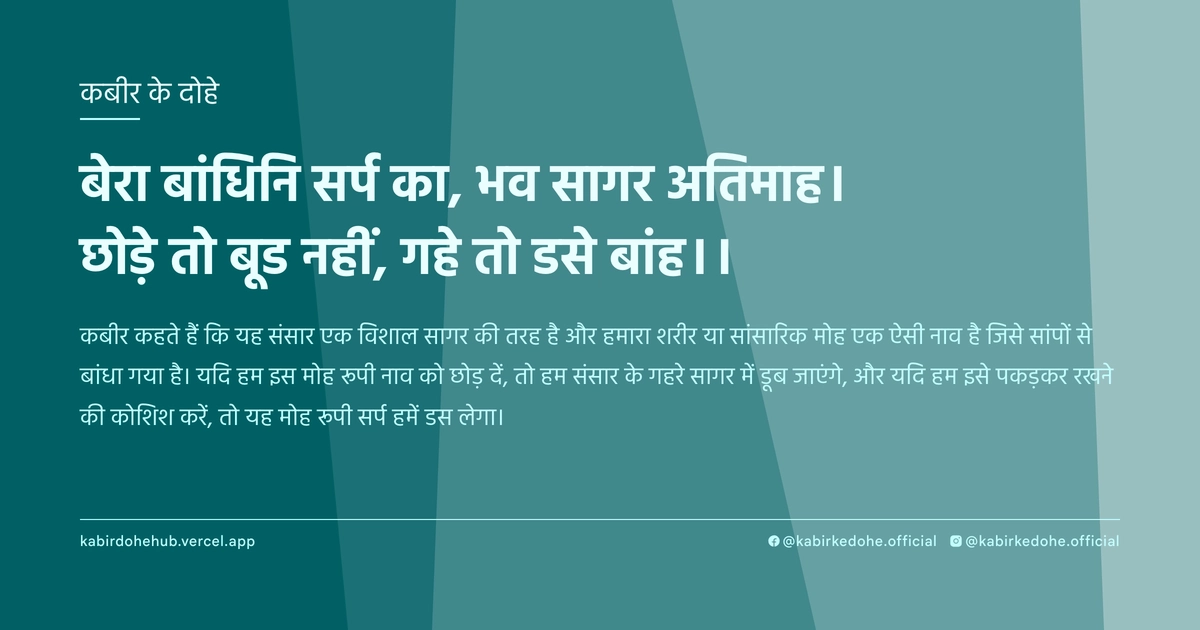
बेरा बांधिनि सर्प का, भव सागर अतिमाह।
छोड़े तो बूड नहीं, गहे तो डसे बांह।।
Bera bandhini sarp ka, bhav sagar atimah. Chhode to bood nahi, gahe to dase baanh.
इस पृष्ठ पर इस कबीर दोहे का अर्थ (meaning), हिंदी व्याख्या और अंग्रेज़ी अनुवाद, दार्शनिक विश्लेषण और व्यावहारिक जीवन सीख दी गई है। यह दोहा माया (Maya) विषय से जुड़ा है — Kabir doha meaning and explanation in Hindi and English.
अर्थ (Meaning):
कबीर कहते हैं कि यह संसार एक विशाल सागर की तरह है और हमारा शरीर या सांसारिक मोह एक ऐसी नाव है जिसे सांपों से बांधा गया है। यदि हम इस मोह रूपी नाव को छोड़ दें, तो हम संसार के गहरे सागर में डूब जाएंगे, और यदि हम इसे पकड़कर रखने की कोशिश करें, तो यह मोह रूपी सर्प हमें डस लेगा।
Kabir describes the world as a vast, treacherous ocean and our worldly attachments as a boat bound by serpents. He posits a spiritual paradox: if one abandons the boat of material attachment, they risk drowning in the depths of existence; yet, if one clings to it for safety, the serpents of desire and ego will inevitably strike and poison the soul.
व्याख्या (Interpretation):
यह दोहा मानव अस्तित्व के मूलभूत द्वंद्व को दर्शाता है। यहाँ 'भव सागर' पुनर्जन्म और दुखों के चक्र का प्रतीक है। 'सर्प' हमारी वासनाओं और अहंकार का प्रतिनिधित्व करते हैं जो हमें संसार से बांधे रखते हैं। शाब्दिक अर्थ यह है कि हम न तो पूरी तरह संसार को त्याग सकते हैं और न ही इसमें पूरी तरह डूब सकते हैं। यह निर्गुण भक्ति का वह मार्ग है जहाँ साधक को 'सहज' अवस्था प्राप्त करनी होती है। माया का भ्रम हमें यह विश्वास दिलाता है कि बाहरी वस्तुएं हमें सुरक्षा प्रदान करेंगी, जबकि वास्तव में वे ही बंधन हैं। अद्वैत वेदांत के अनुसार, जब तक हम स्वयं को शरीर और मन से अलग नहीं देखते, हम इस द्वंद्व में फंसे रहते हैं। अंततः, यह दोहा हमें सिखाता है कि मुक्ति न तो पलायन में है और न ही आसक्ति में, बल्कि साक्षी भाव में है।
This couplet encapsulates the fundamental paradox of human existence. The 'Bhav Sagar' (Ocean of Existence) symbolizes the cycle of birth, death, and suffering. The 'serpents' represent the latent desires and the ego that bind the soul to the material plane. Literally, it suggests that we are caught in a catch-22: abandoning the world leads to spiritual drowning, while clinging to it leads to the poison of attachment. This aligns with Nirgun Bhakti, where the seeker must transcend the duality of acceptance and rejection. Maya, the cosmic illusion, tricks the individual into believing that material anchors provide security, whereas they are actually the source of bondage. From the perspective of Advaita Vedanta, this struggle persists as long as the Atman identifies with the limited ego. The central paradox is that the very tool we use to navigate life (the ego/body) is the predator that destroys our spiritual peace.
दार्शनिक विश्लेषण (Philosophical Analysis):
कबीर का यह दोहा उनके युग के धार्मिक पाखंड और कर्मकांड के विरुद्ध एक सशक्त प्रहार है। उस समय समाज बाहरी अनुष्ठानों और तीर्थयात्राओं को मुक्ति का मार्ग मानता था, लेकिन कबीर ने स्पष्ट किया कि असली संघर्ष आंतरिक है। वे बताते हैं कि मोक्ष किसी बाहरी स्थान पर जाने से नहीं, बल्कि मन के भीतर के द्वंद्व को सुलझाने से मिलता है।
यहाँ अद्वैत वेदांत का प्रभाव स्पष्ट है, जहाँ जीव और ब्रह्म की एकता पर जोर दिया गया है। जब तक मनुष्य स्वयं को 'कर्ता' मानता है, वह इस सर्प रूपी मोह के जाल में फंसा रहता है। कबीर का दर्शन सूफीवाद के 'फना' (अहंकार का विनाश) के करीब है, जहाँ व्यक्ति अपनी व्यक्तिगत पहचान को मिटाकर सार्वभौमिक सत्य में विलीन हो जाता है।
ritualism का विरोध करते हुए कबीर यह समझाते हैं कि माला जपना या व्रत रखना तब तक व्यर्थ है जब तक कि व्यक्ति अपनी वासनाओं के 'सर्प' को नहीं पहचानता। वे एक मनोवैज्ञानिक परिवर्तन की बात करते हैं जहाँ भय और आसक्ति का स्थान जागरूकता ले लेती है।
यह दोहा इस बात की गहराई से व्याख्या करता है कि संसार का त्याग (Sannyasa) केवल शारीरिक नहीं होना चाहिए। यदि कोई व्यक्ति जंगल में जाकर भी मन में संसार की इच्छाएं रखता है, तो वह अभी भी उस सर्प को पकड़े हुए है। वास्तविक त्याग मानसिक विरक्ति है।
अंततः, कबीर हमें उस 'तीसरे मार्ग' की ओर ले जाते हैं जिसे 'सहज मार्ग' कहा जाता है। यह वह स्थिति है जहाँ व्यक्ति संसार में रहते हुए भी उससे अछूता रहता है, जैसे कमल का पत्ता पानी में रहकर भी गीला नहीं होता। यह अहंकार का पूर्ण विलोपन है, जिससे सर्प का विष समाप्त हो जाता है।
Kabir's couplet serves as a profound critique of the ritualistic and dogmatic religious landscape of his era. During the 15th century, spiritual liberation was often reduced to external pilgrimages and rigid caste-based rituals. Kabir dismantles this by shifting the battlefield from the external world to the internal psyche, asserting that the true struggle is the war against one's own attachments.
There is a strong resonance with Advaita Vedanta here, emphasizing the non-duality of the self and the absolute. The 'serpents' are the manifestations of the ego (Ahankara) and latent desires (Vasanas). As long as the individual perceives themselves as a separate entity acting upon the world, they remain trapped in the paradox of the boat. The philosophical core is that the ego is both the vehicle and the predator.
Connecting this to Sufism, Kabir echoes the concept of 'Fana'—the annihilation of the self in the Divine. The struggle described is not against the world, but against the illusion of ownership. The 'poison' is the suffering that arises when we try to possess that which is inherently transient.
Kabir rejects the literalist interpretation of renunciation. He argues that physical asceticism is a facade if the mind remains anchored in desire. A monk in a cave who longs for recognition is still clutching the serpent. True liberation is an internal alchemy where attachment is transformed into witness-consciousness (Sakshi).
Psychologically, this represents the tension between the need for security (the boat) and the desire for freedom (the ocean). The resolution lies in the 'Sahaja' state—a natural, effortless way of being where one operates in the world without being owned by it. This is the ultimate psychological transformation: moving from a state of fear and grasping to a state of surrender and flow.
मूल संदेश (Core Message):
- अहंकार की पकड़ ही दुखों का मूल कारण है।
- संसार का त्याग बाहरी नहीं, बल्कि आंतरिक विरक्ति है।
- नियंत्रण की इच्छा वास्तव में एक सूक्ष्म बंधन है।
- भय और आसक्ति एक ही सिक्के के दो पहलू हैं।
- मुक्ति तब मिलती है जब हम 'पकड़ने' की आदत छोड़ देते हैं।
- साक्षी भाव ही भव सागर से पार उतरने की एकमात्र नाव है।
- The grip of the ego is the primary source of all suffering.
- True renunciation is internal detachment, not external abandonment.
- The desire for control is a subtle but potent form of bondage.
- Fear and attachment are merely two sides of the same coin.
- Liberation occurs the moment we cease the habit of grasping.
- Witness-consciousness is the only true vessel to cross the ocean of existence.
व्यावहारिक उदाहरण (Practical Example):
एक समय की बात है, वाराणसी के घाटों पर माधव नाम का एक वृद्ध बुनकर रहता था। माधव अपनी कला में निपुण था, लेकिन उसका मन हमेशा इस चिंता में रहता था कि उसके बाद उसके बेटों का क्या होगा। उसने अपनी पूरी संपत्ति और मान-सम्मान को एक ऐसी 'नाव' की तरह संजोया था, जिसे वह अपने बच्चों के भविष्य के लिए सुरक्षित रखना चाहता था।
वह अपने बेटों पर अत्यधिक नियंत्रण रखता था, उन्हें हर छोटी बात के लिए टोकता और उनकी इच्छाओं को दबा देता। उसे लगता था कि वह उन्हें सुरक्षा दे रहा है, लेकिन वास्तव में वह मोह के सर्प को कसकर पकड़े हुए था। उसके बेटे उससे दूर होते गए और घर में तनाव का माहौल बन गया।
एक दिन माधव की मुलाकात एक घुमक्कड़ साधु से हुई। साधु ने माधव की बेचैनी को देखा और उसे यह दोहा सुनाया। माधव ने पूछा, "महाराज, मैं तो अपने बच्चों का भला चाहता हूँ, फिर यह सर्प कहाँ है?"
साधु ने मुस्कुराकर कहा, "माधव, तुम्हारी सुरक्षा की भावना ही वह सर्प है। तुम उन्हें प्यार नहीं कर रहे, बल्कि अपनी इच्छाओं को उन पर थोप रहे हो। तुम डरते हो कि अगर तुमने नियंत्रण छोड़ा तो वे डूब जाएंगे, लेकिन तुम्हारा यही नियंत्रण उन्हें डस रहा है।"
माधव को अपनी गलती का एहसास हुआ। उसने महसूस किया कि वह जिस 'सुरक्षा' की नाव को पकड़े हुए था, उसने उसके और उसके बच्चों के बीच एक जहरीली दीवार खड़ी कर दी थी।
अगले कुछ महीनों में, माधव ने धीरे-धीरे अपने बेटों को स्वतंत्र निर्णय लेने की अनुमति दी। उसने अपनी संपत्ति के प्रति मोह छोड़ा और उन्हें अपनी गलतियों से सीखने दिया।
शुरुआत में उसे बहुत डर लगा कि सब कुछ बिखर जाएगा, लेकिन जैसे ही उसने उस 'सर्प' को छोड़ा, उसके बेटों का उसके प्रति सम्मान और प्रेम वापस लौट आया।
माधव ने पाया कि जब उसने पकड़ छोड़ दी, तो वह डूबा नहीं, बल्कि उसके जीवन में एक ऐसी शांति आई जो उसने पहले कभी महसूस नहीं की थी। उसने सीखा कि वास्तविक प्रेम नियंत्रण में नहीं, बल्कि मुक्ति में है।
In the ancient lanes of Varanasi, there lived an elderly weaver named Madhav. Madhav was a master of his craft, but his heart was perpetually heavy with anxiety regarding his sons' future. He had spent his entire life building a 'boat' of wealth, reputation, and strict discipline, believing this was the only way to ensure his children's security.
He exercised absolute control over his sons, stifling their ambitions and questioning every decision they made. In his mind, he was protecting them from the 'ocean' of life's failures. However, this protective instinct had morphed into a suffocating grip of attachment—the very serpent Kabir spoke of.
His sons grew resentful, and the home became a place of silent warfare. One evening, while sitting by the Ganges, Madhav encountered a wandering mystic who noticed the deep creases of worry on the weaver's brow. The mystic recited the doha: "Bera bandhini sarp ka..."
Confused, Madhav asked, "How can my love for my children be a serpent? I only wish for their well-being." The mystic replied, "Madhav, your 'protection' is actually a form of possession. You are not loving your sons; you are loving your image of them. By clutching the boat of control, you are poisoning the relationship."
This revelation struck Madhav like a bolt of lightning. He realized that his fear of their failure was actually his own fear of losing his legacy. He was holding the serpent so tightly that he couldn't see the poison seeping into his children's souls.
Over the following months, Madhav consciously practiced the art of letting go. He stopped dictating their career paths and allowed them to make their own mistakes, offering guidance only when asked.
Initially, he felt a terrifying sense of instability, as if he were drowning without his boat. But as he surrendered his need for control, a miraculous transformation occurred: his sons, feeling trusted and respected, began to gravitate toward him with genuine affection.
Madhav discovered that by releasing the 'serpent' of attachment, he didn't sink into the ocean of chaos. Instead, he found a profound inner stillness. He learned that true love is not a grip, but an open hand.
अभ्यास मार्गदर्शन (Practice Guidance):
- दैनिक साक्षी अभ्यास: दिन में तीन बार 5 मिनट के लिए बैठें और अपने मन में उठने वाली 'पकड़ने' की इच्छाओं (जैसे किसी व्यक्ति को नियंत्रित करना या किसी वस्तु का मोह) को केवल देखें, उन्हें बदलने की कोशिश न करें।
- आत्म-पूछताछ जर्नल: हर रात लिखें—"आज मैंने किस चीज़ को इतनी मजबूती से पकड़ा कि मुझे डर लगने लगा?" और फिर लिखें, "यदि मैं इसे छोड़ दूँ, तो सबसे बुरा क्या होगा?"
- व्यवहारिक परिवर्तन: इस सप्ताह किसी ऐसे व्यक्ति के साथ जो आपसे असहमत है, अपनी बात मनवाने की कोशिश न करें। उनके दृष्टिकोण को बिना किसी निर्णय के स्वीकार करें।
- निदान चेकलिस्ट: आप जानते हैं कि आप 'सर्प' को पकड़े हुए हैं यदि: 1. आप किसी की खुशी अपनी शर्तों पर चाहते हैं। 2. किसी चीज़ के खोने के विचार से आपको घबराहट होती है। 3. आप दूसरों की गलतियों पर अत्यधिक क्रोधित होते हैं क्योंकि वे आपकी योजना के अनुसार नहीं चले।
- Daily Witnessing Practice: Three times a day, sit for 5 minutes and simply observe the urge to 'grasp' or 'control' (whether a person, an outcome, or an emotion) without attempting to change it.
- Self-Inquiry Journaling: Each night, record: "What did I cling to today out of fear?" followed by "What is the absolute worst-case scenario if I let this go?"
- Behavioral Shift: For one week, consciously refrain from trying to convince someone who disagrees with you. Practice accepting their perspective without the need to correct it.
- Diagnostic Checklist: You are 'clutching the serpent' if: 1. You derive satisfaction from others following your specific expectations. 2. The thought of losing a material or emotional anchor causes physical anxiety. 3. You feel intense anger when life deviates from your planned trajectory.
चिंतन प्रश्न (Reflection Questions):
- मेरी वह कौन सी 'सुरक्षित नाव' है जिसे मैं इतनी मजबूती से पकड़े हुए हूँ कि मैं अपने जीवन के वास्तविक प्रवाह को महसूस नहीं कर पा रहा?
- क्या मेरा प्रेम वास्तव में दूसरे की मुक्ति चाहता है, या वह केवल मेरी अपनी भावनात्मक जरूरतों को पूरा करने का एक साधन है?
- डिजिटल युग में, मेरी 'ऑनलाइन पहचान' वह सर्प तो नहीं जिसे मैं अपनी गरिमा मानकर पकड़े हुए हूँ, जबकि वह मेरी मानसिक शांति को डस रहा है?
- यदि मैं आज अपनी सभी उपलब्धियों और रिश्तों के प्रति मोह छोड़ दूँ, तो मेरे भीतर क्या बचेगा?
- मैं किन गुप्त पूर्वाग्रहों (biases) को सत्य मानकर पकड़े हुए हूँ, जो मुझे दूसरों को वास्तव में देखने से रोक रहे हैं?
- क्या मैं वास्तव में स्वतंत्र हूँ, या मैं केवल उन बंधनों का चयन कर रहा हूँ जो मुझे कम दर्द देते हैं?
- What is the 'safe boat' in my life that I am clutching so tightly that I can no longer feel the actual flow of existence?
- Does my love truly seek the liberation of the other, or is it merely a tool to satisfy my own emotional needs?
- In this digital age, is my 'online persona' the serpent I mistake for dignity, while it secretly poisons my mental peace?
- If I were to let go of all my achievements and relational attachments today, what would remain of 'me'?
- What hidden biases am I clinging to as 'truth', which prevent me from seeing others as they truly are?
- Am I genuinely free, or have I simply chosen the chains that feel the least restrictive?