
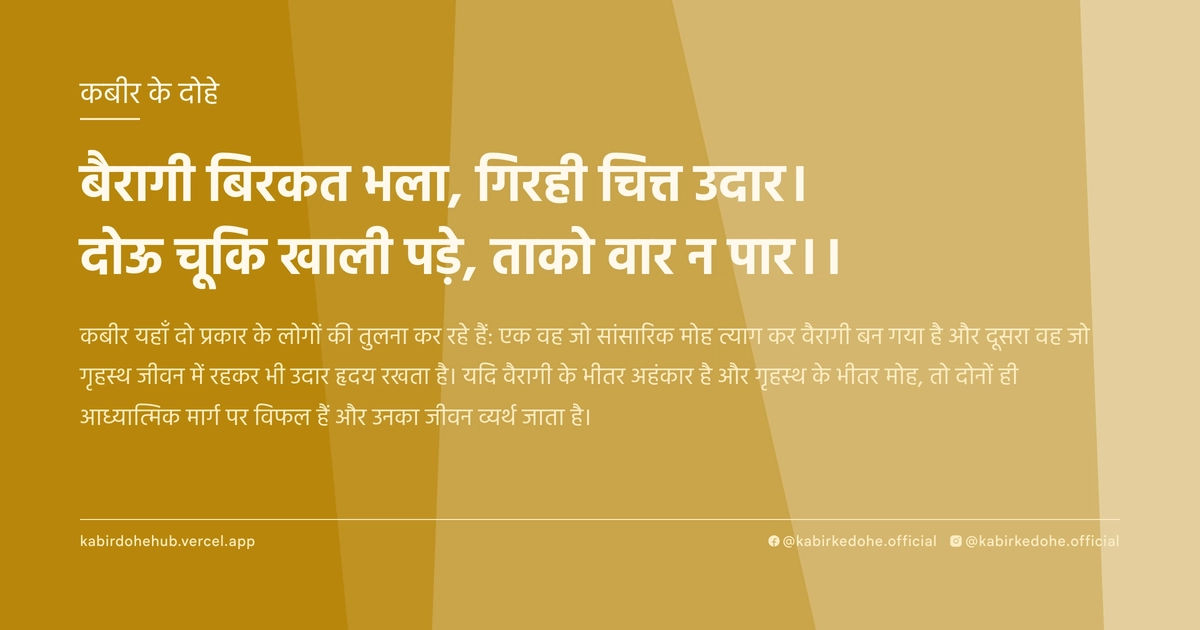
बैरागी बिरकत भला, गिरही चित्त उदार।
दोऊ चूकि खाली पड़े, ताको वार न पार।।
Bairagi birkat bhala, girahi chitt udaar. Dou chuki khaali pade, taako vaar na paar.
इस पृष्ठ पर इस कबीर दोहे का अर्थ (meaning), हिंदी व्याख्या और अंग्रेज़ी अनुवाद, दार्शनिक विश्लेषण और व्यावहारिक जीवन सीख दी गई है। यह दोहा वैराग्य (Detachment) विषय से जुड़ा है — Kabir doha meaning and explanation in Hindi and English.
अर्थ (Meaning):
कबीर यहाँ दो प्रकार के लोगों की तुलना कर रहे हैं: एक वह जो सांसारिक मोह त्याग कर वैरागी बन गया है और दूसरा वह जो गृहस्थ जीवन में रहकर भी उदार हृदय रखता है। यदि वैरागी के भीतर अहंकार है और गृहस्थ के भीतर मोह, तो दोनों ही आध्यात्मिक मार्ग पर विफल हैं और उनका जीवन व्यर्थ जाता है।
Kabir compares two paths: the ascetic who renounces the world and the householder who maintains a generous and open heart. He asserts that if the ascetic lacks true detachment and the householder lacks genuine compassion, both fail in their spiritual quest, leaving their lives devoid of ultimate liberation.
व्याख्या (Interpretation):
इस दोहे का शाब्दिक अर्थ है कि वैराग्य और उदार गृहस्थी दोनों ही श्रेष्ठ हैं, लेकिन यदि दोनों में से कोई भी अपने लक्ष्य में चूक जाए, तो वे खाली हाथ रह जाते हैं। रूपक के स्तर पर, 'वैरागी' बाहरी त्याग का प्रतीक है और 'गिरही' आंतरिक संतुलन का। कबीर यहाँ निर्गुण भक्ति के उस सिद्धांत को रेखांकित कर रहे हैं जहाँ बाहरी वेशभूषा या सामाजिक स्थिति गौण है और आंतरिक शुद्धि प्राथमिक है। माया का प्रभाव केवल भौतिक संपदा में नहीं, बल्कि 'त्याग के अहंकार' में भी हो सकता है। जब तक आत्मा और ब्रह्म की अद्वैत स्थिति का अनुभव नहीं होता, तब तक बाहरी क्रियाएं केवल भ्रम हैं। यह विरोधाभास दर्शाता है कि मुक्ति न तो केवल जंगल जाने से मिलती है और न ही केवल दान करने से, बल्कि अहंकार के पूर्ण विलीनीकरण से मिलती है।
Literally, the verse suggests that both the ascetic and the generous householder are commendable, yet both remain empty if they miss the essence of truth. Metaphorically, the 'ascetic' represents external renunciation, while the 'householder' represents internal equilibrium. Kabir highlights the core of Nirgun Bhakti: external attire or social status is irrelevant; only internal purity matters. Maya manifests not just as material attachment, but also as the 'ego of renunciation.' Until the non-duality of Atman and Brahman is realized, external rituals are mere illusions. This paradox emphasizes that liberation is found neither in fleeing to the forest nor in superficial charity, but in the total annihilation of the ego.
दार्शनिक विश्लेषण (Philosophical Analysis):
कबीर का यह दोहा उस युग की प्रतिक्रिया है जब धर्म केवल कर्मकांडों और बाहरी दिखावे में सिमट गया था। उन्होंने देखा कि कई लोग केवल भगवा वस्त्र पहनकर स्वयं को श्रेष्ठ मानने लगे थे, जबकि कुछ धनी लोग केवल दान देकर पुण्य अर्जित करने का ढोंग कर रहे थे। कबीर ने इस पाखंड पर प्रहार करते हुए बताया कि वास्तविक वैराग्य मन का होता है, शरीर का नहीं।
अद्वैत वेदांत के परिप्रेक्ष्य में, यह दोहा 'साक्षी भाव' की बात करता है। यदि एक वैरागी यह सोचता है कि 'मैं त्याग कर महान बन गया हूँ', तो वह अभी भी द्वैत में फँसा है। इसी तरह, यदि एक गृहस्थ यह सोचता है कि 'मैं उदार हूँ', तो वह अपने अहंकार को पोषित कर रहा है। दोनों ही स्थितियों में, 'मैं' (अहंकार) सत्य के मार्ग में बाधा है।
सूफीवाद के साथ इसका गहरा संबंध है, जहाँ 'फना' (अहंकार का विनाश) की अवधारणा है। कबीर कहते हैं कि जब तक व्यक्ति अपनी पहचान को मिटाकर परमात्मा में विलीन नहीं होता, तब तक वह 'खाली' ही रहेगा। यहाँ 'खाली' होने का अर्थ है कि उसने जीवन के वास्तविक उद्देश्य—आत्म-साक्षात्कार—को प्राप्त नहीं किया है।
कबीर जाति और वर्ण व्यवस्था के साथ-साथ 'धार्मिक श्रेणियों' को भी नकारते हैं। उनके लिए एक मोची जो प्रेम में लीन है, उस पंडित से कहीं अधिक श्रेष्ठ है जो केवल शास्त्रों का पाठ करता है लेकिन हृदय में घृणा रखता है। यह सामाजिक समानता का एक आध्यात्मिक आधार है।
अंततः, यह मनोवैज्ञानिक परिवर्तन की मांग करता है। यह हमें सिखाता है कि हम जहाँ भी हों—चाहे परिवार के बीच या एकांत में—हमारा लक्ष्य आंतरिक मौन और निस्वार्थता होना चाहिए। जब बाहरी पहचान (वैरागी या गृहस्थ) आंतरिक सत्य के सामने झुक जाती है, तभी मनुष्य का 'पार' (मोक्ष) संभव होता है।
This couplet is a reaction to an era where religion had shrunk into mere rituals and external displays. Kabir observed people donning saffron robes to feel superior, while wealthy householders performed charity merely to accumulate spiritual credits. Kabir strikes at this hypocrisy, asserting that true renunciation is a state of mind, not a change of clothing.
From the perspective of Advaita Vedanta, this verse speaks of the 'Sakshi' or witness consciousness. If an ascetic believes, 'I have become great by renouncing,' they remain trapped in duality. Similarly, if a householder thinks, 'I am generous,' they are merely nourishing their ego. In both cases, the 'I' (Ahamkara) is the primary obstacle to Truth.
There is a profound connection here to Sufism and the concept of 'Fana' (annihilation of the self). Kabir suggests that unless one erases their identity and merges into the Divine, they remain 'empty.' Being 'empty' here means failing to achieve the true purpose of existence—Self-realization.
Kabir rejects not only caste and class but also 'religious hierarchies.' To him, a cobbler immersed in love is far superior to a scholar who recites scriptures but harbors hatred in his heart. This provides a spiritual foundation for social equality.
Ultimately, this demands a psychological transformation. It teaches that regardless of our setting—whether amidst family or in solitude—our goal must be internal silence and selflessness. Only when the external identity (ascetic or householder) bows before the internal truth does the crossing over (Moksha) become possible.
मूल संदेश (Core Message):
- बाहरी त्याग व्यर्थ है यदि आंतरिक अहंकार जीवित है।
- सच्ची आध्यात्मिकता वेशभूषा में नहीं, बल्कि हृदय की उदारता में है।
- अहंकार का विलीनीकरण ही वास्तविक मोक्ष का एकमात्र मार्ग है।
- गृहस्थी और वैराग्य दोनों केवल माध्यम हैं, लक्ष्य केवल प्रेम है।
- बिना विनम्रता के किया गया कोई भी आध्यात्मिक प्रयास शून्य है।
- External renunciation is futile if internal ego remains alive.
- True spirituality lies in the generosity of heart, not in attire.
- The annihilation of ego is the only path to genuine liberation.
- Householding and asceticism are mere vehicles; the goal is Love.
- Any spiritual effort devoid of humility is ultimately void.
व्यावहारिक उदाहरण (Practical Example):
वाराणसी के एक पुराने घाट पर माधव नाम का एक वृद्ध व्यक्ति रहता था। माधव ने दशकों पहले अपना घर छोड़ दिया था और एक कठोर वैरागी बन गया था। वह दिन भर मौन रहता और लोगों को उपदेश देता कि संसार माया है। उसके मन में एक गुप्त गर्व था कि वह शहर के सबसे बड़े त्यागी हैं।
उसी घाट के पास, रामदीन नाम का एक छोटा सा नाविक था। रामदीन एक साधारण गृहस्थ था, जिसकी पत्नी और तीन बच्चे थे। वह दिन भर कड़ी मेहनत करता, लेकिन अपनी कमाई का एक हिस्सा चुपचाप उन बीमारों और भूखों की मदद में लगा देता जो घाटों पर शरण लेते थे।
एक दिन, एक महान संत उस घाट पर आए। माधव उनके चरणों में गिर गया और अपनी कठिन तपस्या का बखान करने लगा, यह उम्मीद करते हुए कि संत उसकी प्रशंसा करेंगे। संत ने उसकी ओर देखा और मुस्कुराए, लेकिन कुछ नहीं कहा।
फिर संत ने देखा कि रामदीन चुपचाप एक वृद्ध महिला को सहारा देकर पानी पिला रहा था और उसके फटे कपड़ों को ठीक कर रहा था, बिना यह सोचे कि कोई उसे देख रहा है या नहीं।
संत ने माधव को बुलाया और कहा, 'पुत्र, तुम शरीर से वैरागी हो, लेकिन तुम्हारा मन अभी भी अपनी प्रशंसा की भूख में कैद है। तुम खाली हो।'
फिर उन्होंने रामदीन की ओर इशारा किया और कहा, 'यह व्यक्ति गृहस्थ है, लेकिन इसका हृदय संसार से ऊपर उठ चुका है। इसकी उदारता में कोई अहंकार नहीं है।'
माधव को गहरा धक्का लगा। उसे समझ आया कि उसने केवल बाहरी दुनिया को छोड़ा था, अपने भीतर के 'अहंकार' को नहीं। उसने महसूस किया कि उसका वैराग्य केवल एक मुखौटा था।
रामदीन को भी यह अहसास हुआ कि उसकी सेवा केवल एक आदत नहीं, बल्कि ईश्वर से जुड़ने का मार्ग है। उसने अपनी उदारता को और अधिक सूक्ष्म और निस्वार्थ बना लिया।
माधव ने उस दिन अपना अहंकार त्याग दिया और रामदीन की निस्वार्थ सेवा से सीखना शुरू किया। उसने समझा कि असली वैराग्य वह है जहाँ 'मैं' मिट जाए।
अंततः, दोनों ने पाया कि चाहे वे जंगल में हों या नाव पर, सत्य केवल प्रेम और विनम्रता में निहित है।
On an ancient ghat in Varanasi lived an elderly man named Madhav. Decades ago, Madhav had abandoned his home and become a rigorous ascetic. He spent his days in silence, preaching to others that the world was mere illusion. Deep within, he harbored a secret pride, believing himself to be the greatest renunciant in the city.
Near the same ghat lived Ramdin, a humble boatman. Ramdin was a simple householder with a wife and three children. He worked hard all day, yet he quietly gave a portion of his meager earnings to the sick and hungry who sought refuge on the riverbanks.
One day, a great saint visited the ghat. Madhav fell at the saint's feet and began detailing his grueling penances, hoping for praise. The saint looked at him and smiled, but remained silent.
Then the saint noticed Ramdin quietly supporting an elderly woman, giving her water and fixing her torn clothes, completely unaware that anyone was watching him.
The saint called Madhav and said, 'My son, you are an ascetic in body, but your mind is still imprisoned by the hunger for praise. You are empty.'
He then pointed toward Ramdin and said, 'This man is a householder, yet his heart has risen above the world. In his generosity, there is no ego.'
Madhav was shaken. He realized he had only abandoned the external world, not the 'ego' within. He saw that his renunciation was merely a mask.
Ramdin also realized that his service was not just a habit, but a gateway to the Divine. He made his generosity even more subtle and selfless.
Madhav surrendered his pride that day and began learning from Ramdin's selfless service. He understood that true renunciation occurs only when the 'I' vanishes.
Ultimately, both discovered that whether on a boat or in a cave, truth resides only in love and humility.
अभ्यास मार्गदर्शन (Practice Guidance):
- दैनिक आत्म-निरीक्षण: दिन के अंत में यह विश्लेषण करें कि आपके द्वारा किए गए 'त्याग' या 'दान' के पीछे क्या कोई प्रशंसा पाने की इच्छा थी।
- मौन अभ्यास: प्रतिदिन 30 मिनट पूर्ण मौन रहें, न केवल वाणी से, बल्कि मानसिक रूप से भी अपनी सामाजिक पहचान (पद, प्रतिष्ठा) को भुलाने का प्रयास करें।
- अनाम सेवा: सप्ताह में एक बार ऐसा कार्य करें जिससे किसी की मदद हो, लेकिन यह सुनिश्चित करें कि मदद पाने वाला और देखने वाला कोई भी आपकी पहचान न जान पाए।
- निदान चेकलिस्ट: क्या मैं दूसरों की तुलना में स्वयं को अधिक आध्यात्मिक महसूस करता हूँ? क्या मेरा दान मुझे श्रेष्ठता का अनुभव कराता है? यदि हाँ, तो आप अभी भी 'खाली' हैं।
- Daily Self-Inquiry: At the end of the day, analyze whether your acts of 'renunciation' or 'charity' were driven by a hidden desire for praise.
- Silence Practice: Spend 30 minutes in total silence daily, not just verbally, but mentally attempting to forget your social identity (rank, status).
- Anonymous Service: Once a week, perform an act of kindness ensuring that neither the recipient nor any observer knows your identity.
- Diagnostic Checklist: Do I feel more spiritual than others? Does my generosity make me feel superior? If yes, you are still 'empty' in the spiritual sense.
चिंतन प्रश्न (Reflection Questions):
- क्या मेरा 'आध्यात्मिक व्यक्तित्व' मेरे वास्तविक स्वभाव को छिपाने का एक तरीका है?
- जब मैं दूसरों की मदद करता हूँ, तो क्या मैं वास्तव में उन्हें देख रहा होता हूँ, या अपनी छवि को?
- यदि मेरी सभी उपाधियाँ और मेरी 'त्यागी' या 'दाता' की छवि छीन ली जाए, तो मैं कौन हूँ?
- क्या मैं अपनी नैतिकता का उपयोग दूसरों को नीचा दिखाने के लिए एक हथियार के रूप में करता हूँ?
- मेरे जीवन का वह कौन सा हिस्सा है जहाँ मैं अभी भी 'मैं' और 'मेरा' के जाल में फँसा हूँ?
- Is my 'spiritual persona' merely a way to hide my true, flawed nature?
- When I help others, am I truly seeing them, or am I seeing my own image?
- If all my titles and my image as a 'renunciant' or 'giver' were stripped away, who would I be?
- Do I use my morality as a weapon to make others feel inferior?
- Which part of my life is still tightly gripped by the illusion of 'I' and 'Mine'?