
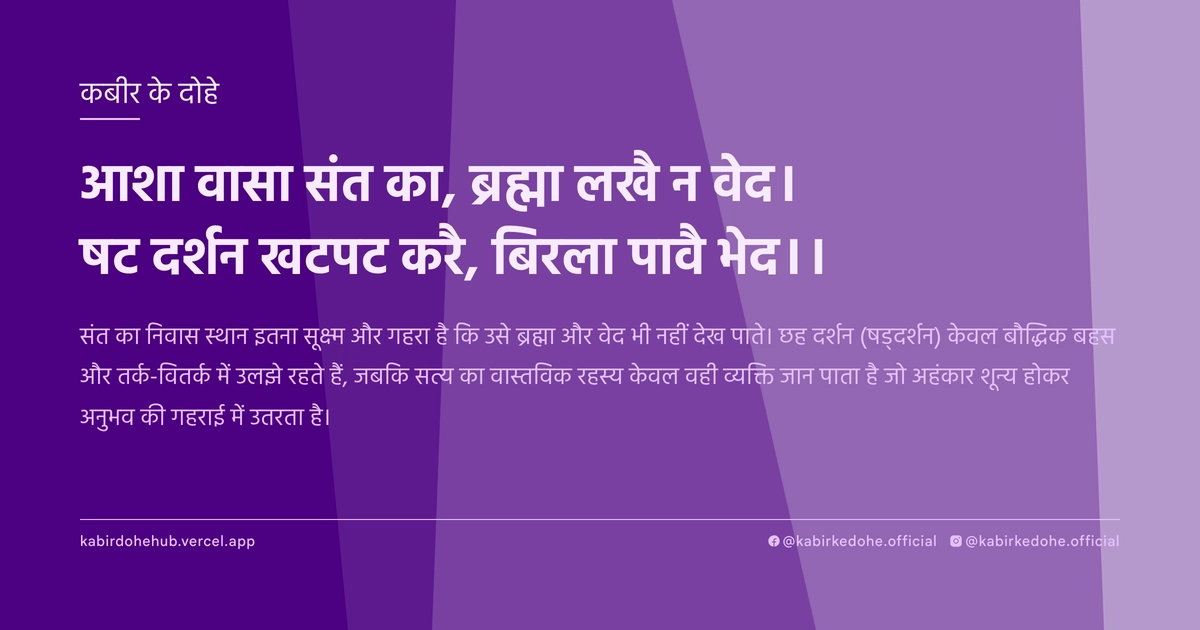
आशा वासा संत का, ब्रह्मा लखै न वेद।
षट दर्शन खटपट करै, बिरला पावै भेद।।
Asha vasa sant ka, Brahma lakhe na ved. Shat darshan khatpat kare, birla paave bhed.
इस पृष्ठ पर इस कबीर दोहे का अर्थ (meaning), हिंदी व्याख्या और अंग्रेज़ी अनुवाद, दार्शनिक विश्लेषण और व्यावहारिक जीवन सीख दी गई है। यह दोहा निर्गुण ब्रह्म (Nirguna Brahman) विषय से जुड़ा है — Kabir doha meaning and explanation in Hindi and English.
अर्थ (Meaning):
संत का निवास स्थान इतना सूक्ष्म और गहरा है कि उसे ब्रह्मा और वेद भी नहीं देख पाते। छह दर्शन (षड्दर्शन) केवल बौद्धिक बहस और तर्क-वितर्क में उलझे रहते हैं, जबकि सत्य का वास्तविक रहस्य केवल वही व्यक्ति जान पाता है जो अहंकार शून्य होकर अनुभव की गहराई में उतरता है।
The dwelling place of a realized saint is so subtle and profound that neither Brahma nor the Vedas can perceive it. While the six schools of philosophy engage in endless intellectual disputes and noise, the secret of ultimate truth is realized only by the rare few who transcend the intellect to experience the divine directly.
व्याख्या (Interpretation):
यहाँ 'वासा' का अर्थ भौतिक घर नहीं, बल्कि वह चेतना की अवस्था है जहाँ आत्मा और परमात्मा एक हो जाते हैं। कबीर कहते हैं कि ज्ञान की पुस्तकें (वेद) और सृष्टि के रचयिता (ब्रह्मा) भी उस आंतरिक मौन को नहीं समझ सकते क्योंकि वे द्वैत में फंसे हैं। 'षट दर्शन' उन सभी बौद्धिक प्रणालियों का प्रतीक हैं जो तर्क के माध्यम से सत्य को खोजने का प्रयास करती हैं, लेकिन सत्य तर्क का विषय नहीं, अनुभव का विषय है। यह निर्गुण भक्ति का सार है, जहाँ ईश्वर किसी आकार या शास्त्र में नहीं, बल्कि शून्य में स्थित है। जब तक साधक 'मैं' और 'मेरा' के शोर में रहता है, वह उस 'भेद' या रहस्य को नहीं पा सकता। यह विरोधाभास है कि जिसे पूरी दुनिया खोज रही है, वह केवल पूर्ण समर्पण और अहंकार के विसर्जन से ही प्राप्त होता है।
Here, 'Vaasa' does not refer to a physical abode, but to that state of consciousness where the Atman and Brahman merge into one. Kabir asserts that even the Vedas and Brahma—the architect of the universe—cannot perceive this internal silence because they operate within the realm of duality. The 'Shat Darshan' (six philosophical schools) symbolize all intellectual frameworks that attempt to capture truth through logic; however, truth is not a subject of logic, but of direct experience. This is the essence of Nirgun Bhakti, where the Divine resides not in forms or scriptures, but in the Void (Shunya). As long as the seeker remains trapped in the noise of 'I' and 'Mine,' the 'Bhed' or secret remains hidden. It is a profound paradox that what the world seeks through complexity is found only through the absolute simplicity of ego-annihilation.
दार्शनिक विश्लेषण (Philosophical Analysis):
कबीर का यह दोहा मध्यकालीन भारत के उस समय का है जब धर्म शास्त्र और कर्मकांडों का बोलबाला था। उन्होंने स्पष्ट रूप से उन विद्वानों पर प्रहार किया है जो केवल ग्रंथों के आधार पर ईश्वर को परिभाषित करते थे। कबीर का दृष्टिकोण अद्वैत वेदांत के करीब है, जहाँ वे मानते हैं कि आत्मा और परमात्मा के बीच का पर्दा केवल अज्ञान (माया) है। वे कहते हैं कि शास्त्र केवल उंगली हैं जो चंद्रमा की ओर इशारा करती हैं, लेकिन लोग उंगली को ही चंद्रमा मान लेते हैं।
सूफी मत के 'फना' (अहंकार का विनाश) की तरह, कबीर भी मानते हैं कि जब तक व्यक्ति अपनी पहचान को मिटाता नहीं, वह उस परम सत्य का अनुभव नहीं कर सकता। यह विश्लेषण हमें बताता है कि बौद्धिक विमर्श (खटपट) अक्सर सत्य की खोज में बाधा बन जाता है। जब हम तर्क करते हैं, तो हम अपने अहंकार को पुष्ट करते हैं, जबकि सत्य केवल मौन में प्रकट होता है।
कबीर ने जाति और धर्म के बाहरी ढांचों को नकारते हुए 'सहज' मार्ग की बात की है। उनके लिए, संतों का निवास वह हृदय है जो प्रेम और करुणा से भरा है, न कि वह जो केवल संस्कृत के श्लोकों का ज्ञाता है। यह एक मनोवैज्ञानिक क्रांति है, जहाँ साधक को बाहरी दुनिया से हटकर अंतर्मुखी होने का आह्वान किया गया है।
यहाँ 'बिरला' शब्द अत्यंत महत्वपूर्ण है। यह दर्शाता है कि सत्य की प्राप्ति कोई सामान्य प्रक्रिया नहीं है; यह एक दुर्लभ उपलब्धि है क्योंकि इसके लिए अपनी पूरी पहचान को दांव पर लगाना पड़ता है। अधिकांश लोग केवल किनारे पर खड़े होकर लहरों का वर्णन करते हैं, लेकिन बिरला वह है जो गहराई में गोता लगाता है।
अंततः, यह दोहा हमें सिखाता है कि ज्ञान (Knowledge) और बोध (Realization) के बीच एक गहरी खाई है। ज्ञान संचित किया जा सकता है, लेकिन बोध केवल जिया जा सकता है। कबीर हमें उस बिंदु पर ले जाते हैं जहाँ शब्द समाप्त हो जाते हैं और केवल अनुभव शेष रहता है।
This couplet emerges from a medieval Indian era dominated by rigid scriptural adherence and ritualism. Kabir explicitly critiques scholars who attempt to define the Divine solely through the lens of texts. His perspective aligns closely with Advaita Vedanta, suggesting that the veil between the Atman and Brahman is merely ignorance (Maya). He posits that scriptures are merely fingers pointing toward the moon, yet people mistake the finger for the moon itself.
Mirroring the Sufi concept of 'Fana' (annihilation of the self), Kabir argues that unless one erases their individual identity, the ultimate truth remains inaccessible. This analysis reveals that intellectual discourse (khatpat) often becomes an obstacle to spiritual discovery. When we argue, we reinforce the ego; whereas truth manifests only in absolute silence.
Rejecting the external structures of caste and creed, Kabir advocates for the 'Sahaj' (natural/spontaneous) path. For him, the 'abode of the saint' is a heart overflowing with love and compassion, not one that merely possesses mastery over Sanskrit verses. This represents a psychological revolution, calling the seeker to shift from extroversion to profound introversion.
The term 'Birla' (the rare one) is pivotal here. It indicates that the realization of truth is not a common occurrence; it is a rare achievement because it requires staking one's entire identity. Most people stand on the shore describing the waves, but the 'Birla' is the one who dives into the depths.
Ultimately, this Doha teaches us the vast chasm between Knowledge and Realization. Knowledge can be accumulated, but Realization can only be lived. Kabir leads us to the threshold where words cease to exist and only pure experience remains.
मूल संदेश (Core Message):
- बौद्धिक तर्क सत्य की खोज में बाधा बन सकते हैं।
- सत्य शास्त्रों में नहीं, बल्कि जीवंत अनुभव में है।
- अहंकार का विसर्जन ही परमात्मा के निवास का द्वार है।
- मौन वह भाषा है जिसे ब्रह्मा भी विस्मृत कर देते हैं।
- दुर्लभता केवल ज्ञान में नहीं, बल्कि आत्म-साक्षात्कार में है।
- Intellectual arguments can become obstacles in the search for truth.
- Truth resides not in scriptures, but in living experience.
- The dissolution of ego is the only gateway to the Divine abode.
- Silence is the language that even Brahma forgets.
- Rarity lies not in knowledge, but in self-realization.
व्यावहारिक उदाहरण (Practical Example):
एक समय की बात है, वाराणसी के घाटों पर एक वृद्ध विधवा रहती थी, जिसका नाम जानकी था। जानकी का जीवन अत्यंत कठिन था; उसके पास न धन था, न परिवार। वह दिन भर मंदिर की सफाई करती और जो कुछ मिलता, उससे अपना गुजारा करती। शहर के बड़े पंडित और विद्वान अक्सर उसके पास से गुजरते और उसे अनपढ़ कहकर अनदेखा कर देते।
वहीं पास में एक युवा विद्वान रहता था, जिसने दुनिया भर के दर्शनशास्त्र पढ़ लिए थे। वह दिन भर इस बात पर बहस करता कि ईश्वर का स्वरूप क्या है, वह सगुण है या निर्गुण। वह शास्त्रों के हर श्लोक का विश्लेषण करता, लेकिन उसके मन में शांति नहीं थी। वह हमेशा तनाव में रहता और दूसरों को नीचा दिखाने की कोशिश करता।
एक दिन, उस विद्वान ने देखा कि जानकी एक कोने में चुपचाप बैठी है। उसके चेहरे पर एक ऐसी शांति और तेज था जिसे उसने बड़े-बड़े ऋषियों के चेहरे पर भी नहीं देखा था। विद्वान उसके पास गया और अहंकार से पूछा, 'तुम तो अनपढ़ हो, तुमने कोई वेद नहीं पढ़े, फिर तुम्हारे चेहरे पर यह संतोष कैसे है?'
जानकी ने धीरे से मुस्कुराकर कहा, 'बेटा, तुम शब्दों के जंगल में खो गए हो। तुम ईश्वर को ढूंढ रहे हो, जबकि मैं ईश्वर में खो गई हूँ। तुम नक्शे पढ़ रहे हो, और मैं उस जगह पर खड़ी हूँ जहाँ नक्शे की जरूरत नहीं पड़ती।'
विद्वान को लगा कि यह कोई साधारण बात नहीं है। उसने महसूस किया कि वह अब तक केवल 'खटपट' यानी बौद्धिक शोर में उलझा था। उसने जानकी के चरणों में सिर झुका दिया। उसे समझ आया कि जिस सत्य को वह किताबों में खोज रहा था, वह तो एक सरल, निस्वार्थ और समर्पित हृदय में निवास करता है।
उस दिन के बाद, विद्वान ने अपनी बहसें छोड़ दीं। उसने जानकी के साथ बैठकर मौन रहना सीखा। उसने पाया कि जब वह चुप होता है, तो उसे वह संगीत सुनाई देता है जो किसी शास्त्र में नहीं लिखा था।
उसका अहंकार धीरे-धीरे पिघलने लगा। उसने देखा कि जानकी की सेवा और उसकी सरलता ही असली 'वेद' थे। उसने महसूस किया कि ज्ञान का बोझ उसे सत्य से दूर ले जा रहा था।
अंत में, वह विद्वान भी एक 'बिरला' बन गया। उसने जान लिया कि संतों का निवास किसी विशेष स्थान या पुस्तक में नहीं, बल्कि उस शून्य में है जहाँ 'मैं' का अस्तित्व समाप्त हो जाता है।
Once, on the ghats of Varanasi, lived an elderly widow named Janki. Janki's life was arduous; she possessed neither wealth nor family. She spent her days cleaning the temple and survived on the meager offerings she received. The city's prominent pundits and scholars often passed her by, ignoring her as an illiterate woman.
Nearby lived a young scholar who had studied all the philosophies of the world. He spent his days debating the nature of God—whether He was Saguna (with form) or Nirguna (formless). He analyzed every verse of the scriptures, yet he lacked inner peace. He was perpetually stressed and sought to belittle others to feel superior.
One day, the scholar noticed Janki sitting quietly in a corner. Her face radiated a peace and luminosity that he had never seen even in the most revered sages. Driven by curiosity, he approached her and asked arrogantly, 'You are illiterate; you have read no Vedas, yet how is it that such contentment resides on your face?'
Janki smiled gently and replied, 'My son, you are lost in a forest of words. You are searching for God, while I am lost in Him. You are studying the map, while I am standing in the place where maps are no longer needed.'
The scholar realized this was no ordinary statement. He felt that he had been trapped in 'khatpat'—the noise of intellectual friction. He bowed at Janki's feet, understanding that the truth he sought in books resided in a simple, selfless, and surrendered heart.
From that day on, the scholar abandoned his debates. He learned the art of silence by sitting with Janki. He discovered that when he became quiet, he could hear a melody that was written in no scripture.
His ego began to melt away slowly. He saw that Janki's service and her simplicity were the true 'Vedas.' He realized that the burden of academic knowledge had been distancing him from the truth.
Eventually, the scholar too became a 'Birla.' He understood that the abode of the saints is not in a specific place or book, but in that void where the existence of 'I' ceases to be.
अभ्यास मार्गदर्शन (Practice Guidance):
- दैनिक मौन अभ्यास: प्रतिदिन कम से कम 30 मिनट पूर्ण मौन में बैठें। शब्दों और विचारों के शोर को केवल देखें, उनमें उलझें नहीं।
- स्व-अन्वेषण जर्नल: हर रात लिखें कि आज आपने कितनी बार अपनी बौद्धिक श्रेष्ठता का उपयोग दूसरों को छोटा महसूस कराने के लिए किया।
- अहंकार विसर्जन: किसी ऐसे व्यक्ति की सेवा करें जिसे समाज 'निम्न' मानता हो, और यह महसूस करें कि आप उनसे श्रेष्ठ नहीं, बल्कि उनके माध्यम से स्वयं को जान रहे हैं।
- निदान चेकलिस्ट: यदि आप किसी सत्य पर बहस करते समय क्रोधित महसूस करते हैं, तो समझ लें कि आप 'खटपट' (अहंकार) में हैं, 'भेद' (सत्य) में नहीं।
- Daily Silence Practice: Sit in absolute silence for at least 30 minutes daily. Observe the noise of words and thoughts without becoming entangled in them.
- Self-Inquiry Journaling: Every night, record instances where you used your intellectual superiority to make others feel inferior.
- Ego Dissolution: Serve someone whom society deems 'lowly,' and realize that you are not superior to them, but are discovering yourself through them.
- Diagnostic Checklist: If you feel anger while debating a truth, recognize that you are in 'khatpat' (ego-friction), not in 'bhed' (realization).
चिंतन प्रश्न (Reflection Questions):
- क्या मेरी बौद्धिक क्षमता मुझे सत्य के करीब ले जा रही है, या यह मेरे अहंकार का एक नया मुखौटा बन गई है?
- मैं अपनी पहचान को किताबों और डिग्रियों से जोड़ता हूँ या अपने आंतरिक मौन से?
- जब मैं किसी से असहमत होता हूँ, तो क्या मैं सत्य को खोज रहा होता हूँ या अपनी जीत को?
- मेरे जीवन का वह कौन सा हिस्सा है जहाँ मैं अभी भी 'खटपट' (शोर) में जी रहा हूँ?
- यदि मुझसे मेरी सारी शिक्षा और ज्ञान छीन लिया जाए, तो क्या मेरे पास ईश्वर से जुड़ने का कोई रास्ता बचेगा?
- Is my intellectual capacity bringing me closer to truth, or has it become a new mask for my ego?
- Do I anchor my identity in books and degrees, or in my inner silence?
- When I disagree with someone, am I seeking the truth or seeking my own victory?
- Which part of my life am I still living in 'khatpat' (noise) rather than peace?
- If all my education and knowledge were stripped away, would I still have a path to connect with the Divine?