
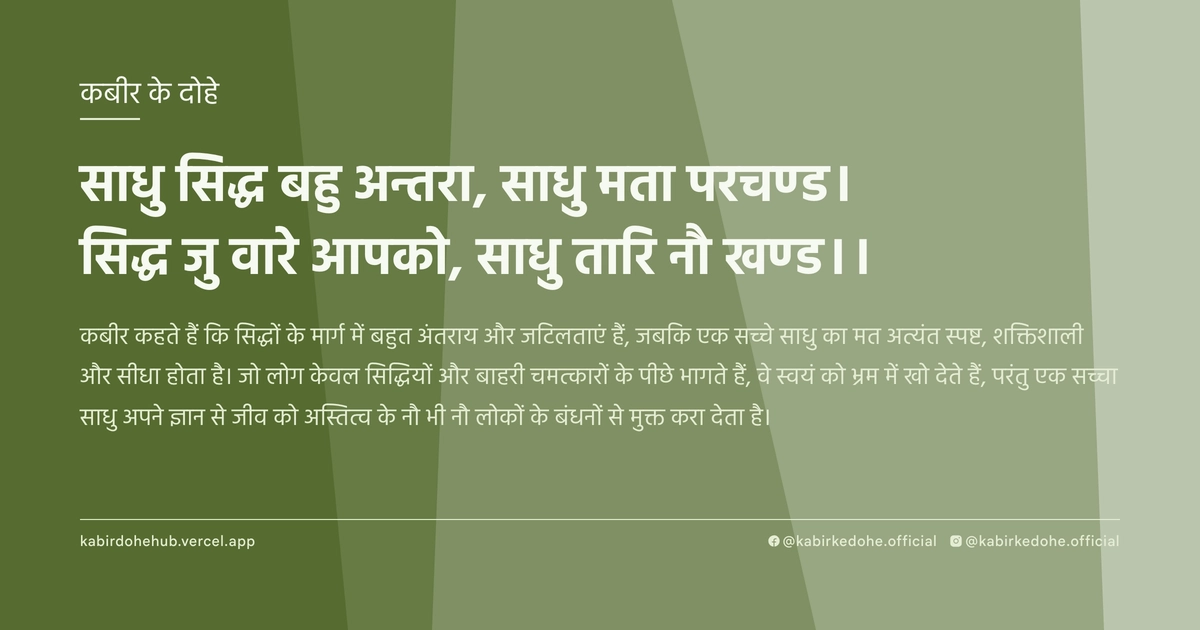
साधु सिद्ध बहु अन्तरा, साधु मता परचण्ड।
सिद्ध जु वारे आपको, साधु तारि नौ खण्ड।।
Sadhu siddha bahu antara, sadhu mata parchand. Siddha ju vaare aapko, sadhu taari nau khand.
इस पृष्ठ पर इस कबीर दोहे का अर्थ (meaning), हिंदी व्याख्या और अंग्रेज़ी अनुवाद, दार्शनिक विश्लेषण और व्यावहारिक जीवन सीख दी गई है। यह दोहा गुरु महत्व (The Guru's Importance) विषय से जुड़ा है — Kabir doha meaning and explanation in Hindi and English.
अर्थ (Meaning):
कबीर कहते हैं कि सिद्धों के मार्ग में बहुत अंतराय और जटिलताएं हैं, जबकि एक सच्चे साधु का मत अत्यंत स्पष्ट, शक्तिशाली और सीधा होता है। जो लोग केवल सिद्धियों और बाहरी चमत्कारों के पीछे भागते हैं, वे स्वयं को भ्रम में खो देते हैं, परंतु एक सच्चा साधु अपने ज्ञान से जीव को अस्तित्व के नौ भी नौ लोकों के बंधनों से मुक्त करा देता है।
Kabir asserts that the paths of the 'Siddhas' (those seeking occult powers) are riddled with internal contradictions and complexities, whereas the vision of a true 'Sadhu' (a realized soul) is potent and direct. Those who gamble their lives chasing supernatural feats only lose themselves, but a true sage liberates the seeker from the shackles of the nine realms of existence.
व्याख्या (Interpretation):
यहाँ 'सिद्ध' उन योगियों का प्रतीक है जो कुंडलिनी या बाहरी शक्तियों के माध्यम से मोक्ष पाना चाहते हैं, जो अक्सर अहंकार का नया रूप ले लेते हैं। 'साधु' यहाँ उस व्यक्ति को कहा गया है जिसने 'सहज' मार्ग अपनाया है। यह दोहा निरगुण भक्ति के उस सिद्धांत को रेखांकित करता है जहाँ बाहरी आडंबरों के बजाय आंतरिक शुद्धि को प्राथमिकता दी जाती है। माया का जाल तब और गहरा हो जाता है जब साधक आध्यात्मिक शक्तियों को ही लक्ष्य मान लेता है। अद्वैत वेदांत के अनुसार, जब तक 'मैं' और 'मेरा' का भाव है, तब तक कोई भी सिद्धि बंधन ही है। सच्चा साधु वह है जो आत्मा और ब्रह्म की अभिन्नता को पहचानकर द्वैत को समाप्त करता है। यह विरोधाभास है कि जो शक्ति पाने की कोशिश करता है वह गिरता है, और जो स्वयं को समर्पित कर देता है वह मुक्त हो जाता है।
The 'Siddha' symbolizes those practitioners who seek liberation through occult powers or psychic phenomena, which often become a refined form of ego. In contrast, the 'Sadhu' represents the realized soul who follows the 'Sahaja' or natural path. This verse underscores the core of Nirgun Bhakti, prioritizing internal purity over external theatricality. The veil of Maya thickens when a seeker mistakes spiritual superpowers for the ultimate goal. According to Advaita Vedanta, as long as the sense of 'I' and 'mine' persists, any psychic power is merely another chain. A true sage is one who recognizes the non-duality of Atman and Brahman, dissolving the illusion of separation. The central paradox presented is that the pursuit of power leads to spiritual bankruptcy, while the surrender of the ego leads to universal liberation.
दार्शनिक विश्लेषण (Philosophical Analysis):
कबीर का यह दोहा उस समय के सामाजिक-धार्मिक परिवेश की प्रतिक्रिया है जहाँ नाथ पंथ और अन्य सिद्ध परंपराओं में शारीरिक योग और चमत्कारों का बोलबाला था। कबीर ने देखा कि कैसे लोग ध्यान के नाम पर केवल मानसिक शक्तियों का संचय कर रहे थे, जिससे उनका अहंकार और बढ़ गया। वे ritualism और बाहरी प्रदर्शन का कड़ा विरोध करते हैं क्योंकि उनका मानना था कि ईश्वर किसी विशेष मुद्रा या कठिन तपस्या में नहीं, बल्कि हृदय की सरलता में बसता है।
दार्शनिक स्तर पर, यह सूफीवाद के 'फना' (अहंकार का विनाश) और अद्वैत के 'माया' विनिर्मुक्त होने के सिद्धांत से मिलता-जुलता है। सिद्धों का मार्ग 'साधन' पर केंद्रित है, जबकि साधु का मार्ग 'साध्य' (परमात्मा) पर। जब साधक सिद्धियों के मोह में पड़ता है, तो वह वास्तव में अपनी वासनाओं को ही आध्यात्मिक जामा पहना रहा होता है।
कबीर यहाँ मनोवैज्ञानिक रूपांतरण की बात कर रहे हैं। वे समझाते हैं कि जब तक मनुष्य अपनी पहचान को 'विशेष' (Special) बनाने की कोशिश करता है, वह सत्य से दूर होता है। वास्तविक मुक्ति तब आती है जब व्यक्ति अपनी विशिष्टता के भ्रम को तोड़कर सार्वभौमिक चेतना में विलीन हो जाता है।
यह दोहा जाति और वर्ग के भेदों को भी चुनौती देता है। सिद्धियाँ अक्सर कुछ विशेष समूहों द्वारा आरक्षित मानी जाती थीं, लेकिन कबीर का 'साधु' कोई भी हो सकता है—एक जुलाहा, एक किसान या एक साधारण व्यक्ति—जिसने सत्य को जान लिया हो।
अंततः, यह संदेश है कि आध्यात्मिक यात्रा का लक्ष्य 'शक्ति' प्राप्त करना नहीं, बल्कि 'शुद्धि' प्राप्त करना है। जो व्यक्ति स्वयं को 'सिद्ध' मानकर दूसरों से ऊपर उठना चाहता है, वह नौ खंडों (संसार के विभिन्न स्तरों) के चक्र में और अधिक फंस जाता है, जबकि सहज मार्ग उसे तुरंत पार लगा देता है।
This verse is a direct response to the socio-religious climate of Kabir's era, dominated by the Nath tradition and other Siddha sects that emphasized physical hatha yoga and the attainment of supernatural powers. Kabir observed that practitioners were merely accumulating psychic abilities, which served only to inflate their spiritual ego rather than dissolve it. He vehemently rejects ritualism and external displays, asserting that the Divine resides not in complex postures or rigorous penance, but in the simplicity of the heart.
Philosophically, this aligns with the Sufi concept of 'Fana' (annihilation of the self) and the Advaita Vedantic principle of transcending 'Maya'. The path of the Siddha is focused on the 'means' (tools/powers), whereas the path of the Sadhu is focused on the 'end' (the Absolute). When a seeker becomes enamored with psychic feats, they are merely dressing their latent desires in spiritual clothing.
Kabir addresses a profound psychological transformation. He explains that as long as a human strives to make their identity 'special' or 'superior' through spiritual achievements, they remain distant from the Truth. True liberation occurs only when the illusion of individuality is shattered and the self merges into the universal consciousness.
Furthermore, this teaching challenges the caste and class hierarchies of the time. While 'Siddhis' were often guarded by elite spiritual circles, Kabir's 'Sadhu' could be anyone—a weaver, a farmer, or a commoner—who has realized the Truth. It democratizes spirituality by stripping away the need for esoteric credentials.
Ultimately, the message is that the goal of the spiritual journey is not 'power' but 'purification'. One who seeks to be perceived as 'Siddha' (perfected/powerful) becomes further entangled in the nine realms of worldly existence, while the path of simplicity and surrender provides immediate liberation.
मूल संदेश (Core Message):
- बाहरी चमत्कार केवल मन का भ्रम और अहंकार का विस्तार हैं।
- सच्ची आध्यात्मिक प्रगति शक्तियों के संचय में नहीं, बल्कि अहंकार के विसर्जन में है।
- सरलता ही वह कुंजी है जो अस्तित्व के सभी बंधनों को खोलती है।
- ज्ञान वह नहीं जो दूसरों को छोटा दिखाए, बल्कि वह है जो स्वयं को शून्य कर दे।
- प्रेम और करुणा ही वास्तविक 'सिद्धि' हैं, बाकी सब माया है।
- External miracles are merely illusions of the mind and extensions of the ego.
- True spiritual progress lies not in accumulating powers, but in dissolving the ego.
- Simplicity is the only key that unlocks all the shackles of existence.
- Knowledge is not that which belittles others, but that which renders the self void.
- Love and compassion are the only real 'Siddhis'; everything else is Maya.
व्यावहारिक उदाहरण (Practical Example):
वाराणसी के घाटों पर रहने वाला एक वृद्ध विधवा, जिसे लोग 'माई' कहते थे, अपनी पूरी जिंदगी शास्त्रों के कठिन नियमों और शुद्धता के कड़े अनुशासन में बिता चुकी थी। वह खुद को एक 'सिद्ध' साधिका मानती थी क्योंकि उसने वर्षों तक कठिन उपवास किए थे और वह केवल उन्हीं लोगों से बात करती थी जिन्हें वह आध्यात्मिक रूप से योग्य समझती थी। उसका अहंकार उसकी पवित्रता की चादर में लिपटा हुआ था।
उसी घाट के पास एक साधारण सा मल्लाह रहता था, जो दिन भर नाव चलाता और शाम को बस एक साधारण भजन गाता। वह कोई बड़ा योगी नहीं था, लेकिन उसके चेहरे पर एक ऐसी शांति थी जो माई के कठोर अनुशासन में नहीं थी। माई उसे तुच्छ समझती थी क्योंकि वह 'शास्त्रों' का पालन नहीं करता था।
एक दिन माई बहुत बीमार पड़ गई और उसके वे सभी 'योग्य' साथी, जिन्हें वह अपनी आध्यात्मिक श्रेणी में रखती थी, उसकी सेवा करने के बजाय उसके 'अशुद्ध' होने के डर से दूर रहे। उस समय, वही मल्लाह, जिसे वह तुच्छ समझती थी, उसकी सेवा के लिए आगे आया। उसने बिना किसी संकोच के उसकी देखभाल की और उसे सांत्वना दी।
मल्लाह की निस्वार्थ सेवा और उसकी सरल बातों ने माई के भीतर एक हलचल पैदा की। उसने देखा कि जिस 'शुद्धता' और 'सिद्धता' का उसने जीवन भर गर्व किया, उसने उसे अकेला कर दिया। लेकिन मल्लाह की 'साधुता'—जो केवल प्रेम और करुणा थी—ने उसे वह सुकून दिया जो हज़ारों उपवासों ने नहीं दिया था।
माई को अहसास हुआ कि वह अपनी आध्यात्मिक उपलब्धियों के जाल में फंसी थी। वह 'सिद्ध' तो बन गई थी, लेकिन 'साधु' नहीं बन पाई थी। उसका अहंकार उसकी सबसे बड़ी बाधा था, जिसे वह अपनी साधना का फल समझ रही थी।
उसने महसूस किया कि मल्लाह का जीवन ही एक जीवित उपदेश था। वह बिना किसी प्रयास के उस सत्य को जी रहा था जिसे माई किताबों और नियमों में खोज रही थी। यह उसके लिए एक 'कबीर ट्विस्ट' था—जहाँ उसकी पूरी दुनिया की समझ पलट गई।
उस दिन के बाद, माई ने अपने कठोर नियमों को त्याग दिया। उसने अपनी पहचान एक 'सिद्ध साधिका' के रूप में नहीं, बल्कि एक साधारण इंसान के रूप में स्वीकार की। उसने सीखा कि करुणा ही सबसे बड़ी सिद्धि है।
उसने अपना शेष जीवन दूसरों की सेवा में लगा दिया, यह जानते हुए कि मोक्ष किसी कठिन योग मुद्रा में नहीं, बल्कि एक दूसरे के दुख को बांटने में है। वह अब वास्तव में मुक्त थी, क्योंकि उसने अपने अहंकार की बलि दे दी थी।
In the ghats of Varanasi lived an elderly widow known as 'Mai,' who had spent her entire life adhering to the strictest scriptural laws and rigorous disciplines of purity. She considered herself a 'Siddha' practitioner because she had performed grueling fasts for years and only interacted with those she deemed spiritually 'qualified.' Her ego was wrapped tightly in the shroud of her perceived holiness.
Nearby lived a simple boatman who spent his days rowing passengers and his evenings singing humble bhajans. He was no great yogi, yet his face radiated a peace that was absent from Mai's rigid discipline. Mai looked down upon him, believing he was spiritually inferior because he did not follow the formal 'shastras.'
One day, Mai fell gravely ill. The 'qualified' companions she had associated with, fearing her illness or the 'impurity' of the situation, stayed away. In that moment of desperation, the boatman—the very man she had dismissed—stepped forward to care for her. He tended to her needs without hesitation and provided genuine emotional solace.
The boatman's selfless service and simple words triggered a profound shift within Mai. She realized that the 'purity' and 'perfection' she had spent a lifetime cultivating had left her utterly alone. The boatman's 'Sadhuta'—which was nothing more than pure love and compassion—gave her a peace that thousands of fasts never could.
Mai recognized that she had been trapped in the web of her own spiritual achievements. She had become a 'Siddha' in form, but not a 'Sadhu' in spirit. Her ego had been her greatest obstacle, disguised as spiritual progress.
She saw that the boatman's life was a living sermon. He was embodying the truth effortlessly, while she had been chasing it through rules and books. This was her 'Kabir Twist'—a moment where her entire worldview was inverted.
After her recovery, Mai abandoned her rigid rules. She stopped identifying as a 'perfected seeker' and accepted herself as a simple human being. She learned that compassion is the only true 'Siddhi' worth possessing.
She spent the remainder of her days serving others, understanding that liberation is not found in a complex yoga posture, but in sharing the burdens of another. She was finally free, for she had sacrificed her ego at the altar of love.
अभ्यास मार्गदर्शन (Practice Guidance):
- दैनिक आत्म-निरीक्षण: दिन के अंत में यह विश्लेषण करें कि क्या आपने किसी कार्य को 'श्रेष्ठ' दिखने के लिए किया या वास्तव में सेवा भाव से।
- अहंकार का विसर्जन: जानबूझकर ऐसे कार्यों में संलग्न हों जहाँ आपकी सामाजिक या आध्यात्मिक पहचान शून्य हो, जैसे किसी अनजान की गुप्त सहायता करना।
- मौन चिंतन: प्रतिदिन 20 मिनट इस विचार पर ध्यान दें कि 'मैं' कौन हूँ—मेरी उपलब्धियाँ, मेरा पद, या वह चैतन्य जो इन सबको देख रहा है।
- डायग्नोस्टिक चेकलिस्ट: यदि आप दूसरों की आध्यात्मिक कमी पर गर्व महसूस करते हैं, तो आप 'सिद्ध' के भ्रम में हैं; यदि आप दूसरों के दुख में स्वयं को पाते हैं, तो आप 'साधु' मार्ग पर हैं।
- Daily Self-Inquiry: At the end of each day, analyze whether your actions were performed to appear 'superior' or out of a genuine spirit of service.
- Dissolution of Ego: Deliberately engage in acts where your social or spiritual identity is invisible, such as providing anonymous aid to a stranger.
- Silent Contemplation: Spend 20 minutes daily meditating on the question: 'Who am I?'—Am I my achievements, my status, or the consciousness observing them all?
- Diagnostic Checklist: If you feel a sense of pride in others' spiritual shortcomings, you are trapped in the 'Siddha' illusion; if you find yourself in the suffering of others, you are on the 'Sadhu' path.
चिंतन प्रश्न (Reflection Questions):
- क्या मेरी आध्यात्मिक साधना मुझे अधिक विनम्र बना रही है, या यह मुझे दूसरों से 'विशेष' महसूस कराने का एक साधन बन गई है?
- मैं अपनी सार्वजनिक छवि (Digital/Social Ego) को बनाए रखने के लिए अपनी आंतरिक शांति का कितना त्याग करता हूँ?
- यदि मेरी सभी उपलब्धियाँ और उपाधियाँ छीन ली जाएँ, तो मेरे भीतर क्या बचेगा?
- क्या मैं वास्तव में सत्य की खोज कर रहा हूँ, या मैं केवल सत्य की 'प्रशंसा' पाने की इच्छा रखता हूँ?
- मेरे जीवन में वह कौन सा 'नियम' या 'अनुशासन' है जो मुझे दूसरों से अलग करता है और वास्तव में मुझे उनसे दूर कर रहा है?
- Is my spiritual practice making me more humble, or has it become a tool to make me feel 'special' compared to others?
- How much of my inner peace do I sacrifice to maintain my public image (Digital/Social Ego)?
- If all my achievements and titles were stripped away, what would remain within me?
- Am I truly seeking the Truth, or am I merely desiring the 'praise' that comes with claiming to know the Truth?
- Which 'rule' or 'discipline' in my life creates a boundary between me and others, and is it actually distancing me from the Divine?