
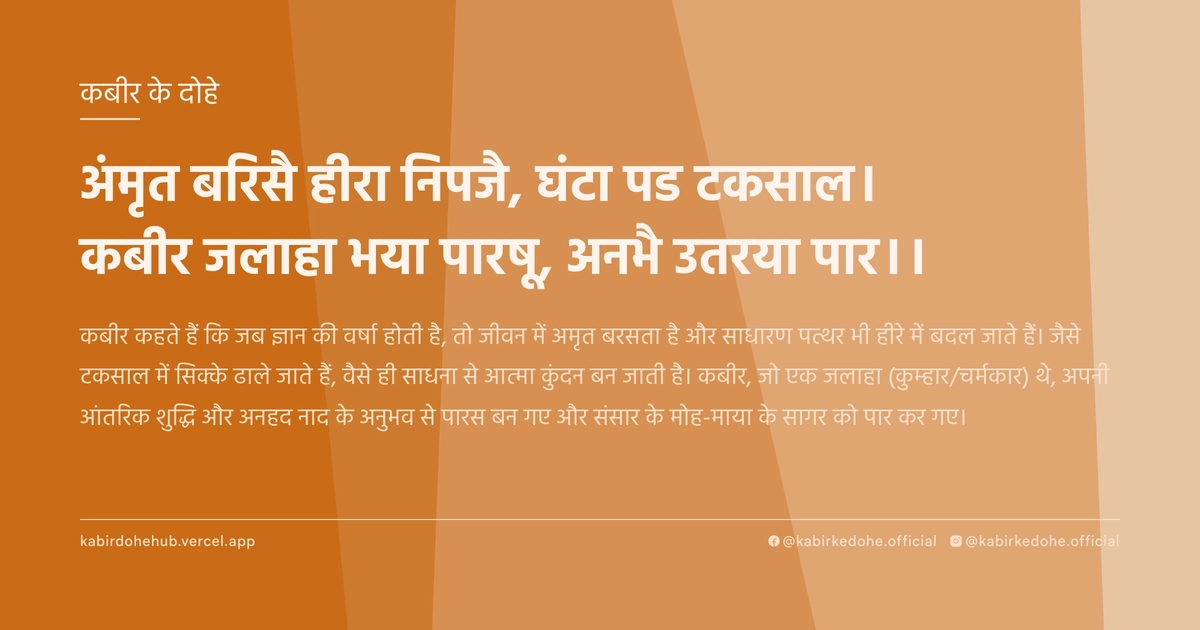
अंमृत बरिसै हीरा निपजै, घंटा पड टकसाल।
कबीर जलाहा भया पारषू, अनभै उतरया पार।।
Amrit barisai heera nipjai, ghanta pad taksal. Kabir jalaha bhaya parashu, anbhai utarya paar.
इस पृष्ठ पर इस कबीर दोहे का अर्थ (meaning), हिंदी व्याख्या और अंग्रेज़ी अनुवाद, दार्शनिक विश्लेषण और व्यावहारिक जीवन सीख दी गई है। यह दोहा मुक्ति (Liberation) विषय से जुड़ा है — Kabir doha meaning and explanation in Hindi and English.
अर्थ (Meaning):
कबीर कहते हैं कि जब ज्ञान की वर्षा होती है, तो जीवन में अमृत बरसता है और साधारण पत्थर भी हीरे में बदल जाते हैं। जैसे टकसाल में सिक्के ढाले जाते हैं, वैसे ही साधना से आत्मा कुंदन बन जाती है। कबीर, जो एक जलाहा (कुम्हार/चर्मकार) थे, अपनी आंतरिक शुद्धि और अनहद नाद के अनुभव से पारस बन गए और संसार के मोह-माया के सागर को पार कर गए।
Kabir proclaims that when the rain of divine knowledge descends, nectar showers upon the soul and ordinary stones are transformed into diamonds. Just as a mint transforms raw metal into coins, spiritual discipline refines the soul into pure gold. Kabir, though born into the humble caste of a leather-worker, became like the mythical philosopher's stone (Paarashu) through the experience of the unstruck sound (Anhad), ultimately crossing the ocean of worldly existence.
व्याख्या (Interpretation):
यह दोहा आध्यात्मिक रूपांतरण की पराकाष्ठा को दर्शाता है। 'अमृत' यहाँ केवल एक पदार्थ नहीं, बल्कि उस सर्वोच्च ज्ञान (Gnosis) का प्रतीक है जो अज्ञान की शुष्कता को समाप्त करता है। 'हीरा निपजै' का अर्थ है कि जब अहंकार का क्षय होता है, तो आत्मा की अंतर्निहित दिव्यता प्रकट होती है। कबीर स्वयं को 'जलाहा' कहकर अपनी सामाजिक निम्नता को स्वीकार करते हैं, लेकिन 'पारषू' (पारस) बनकर यह सिद्ध करते हैं कि आध्यात्मिक उत्थान जाति या कुल पर निर्भर नहीं है। 'अनभै' या अनहद नाद का उल्लेख उस आंतरिक ध्वनि की ओर संकेत करता है जो द्वैत को समाप्त कर आत्मा और परमात्मा के अभेद संबंध (Non-duality) को स्थापित करती है। यह यात्रा स्थूल से सूक्ष्म की ओर और माया के भ्रम से सत्य के साक्षात्कार की ओर है।
This couplet illustrates the pinnacle of spiritual transmutation. 'Amrit' (nectar) is not a physical substance but a symbol of the supreme Gnosis that eradicates the dryness of ignorance. 'Heera nipjai' signifies that as the ego dissolves, the inherent divinity of the soul manifests as a diamond. By identifying as a 'Jalaha' (leather-worker), Kabir acknowledges his social marginalization, yet by claiming to have become 'Paarashu' (the philosopher's stone), he proves that spiritual ascension is independent of caste or lineage. The mention of 'Anbhai' or Anhad Naad refers to the unstruck cosmic sound that annihilates duality, establishing the non-dual union of Atman and Brahman. This journey represents the transition from the gross to the subtle, and from the illusion of Maya to the realization of Absolute Truth.
दार्शनिक विश्लेषण (Philosophical Analysis):
कबीर का यह दर्शन निर्गुण भक्ति और अद्वैत वेदांत का एक अनूठा संगम है। उनके समय में धर्म बाहरी कर्मकांडों, तीर्थयात्राओं और जातिगत श्रेष्ठता में जकड़ा हुआ था। कबीर ने इस व्यवस्था पर प्रहार करते हुए यह स्थापित किया कि ईश्वर किसी मंदिर या मस्जिद में नहीं, बल्कि मनुष्य के भीतर 'शून्य' में निवास करता है। 'टकसाल' का रूपक यहाँ अत्यंत महत्वपूर्ण है; जैसे टकसाल में धातु को तपाकर और पीटकर शुद्ध किया जाता है, वैसे ही साधक को विरक्ति और आत्म-साक्षात्कार की अग्नि में तपना पड़ता है।
सूफी मत के 'फना' (अहंकार का विनाश) और वेदांत के 'अहं ब्रह्मास्मि' का प्रभाव यहाँ स्पष्ट है। कबीर का 'पारस' बनना वास्तव में उनके व्यक्तित्व का विलोपन है, जहाँ व्यक्तिगत पहचान समाप्त हो जाती है और केवल सार्वभौमिक चेतना शेष रहती है। यह मनोवैज्ञानिक रूपांतरण है जहाँ एक व्यक्ति अपनी सामाजिक पहचान (जलाहा) को अपनी आध्यात्मिक पहचान (पारस) में बदल देता है।
वे इस बात पर जोर देते हैं कि मोक्ष किसी बाहरी अनुष्ठान से नहीं, बल्कि आंतरिक अनुशासन और 'सहज' मार्ग से प्राप्त होता है। ritualism का विरोध करते हुए वे बताते हैं कि असली 'हीरा' वह है जो माया के पर्दों को फाड़कर सत्य को देख सके। यहाँ 'अमृत' वह बोध है जो जन्म और मृत्यु के चक्र को समाप्त कर देता है।
ऐतिहासिक रूप से, कबीर ने समाज के सबसे निचले तबके को यह विश्वास दिलाया कि दिव्यता पर किसी विशेष वर्ग का एकाधिकार नहीं है। उनका दर्शन एक लोकतांत्रिक आध्यात्मिकता है, जहाँ केवल सत्य की खोज और प्रेम की तीव्रता ही पात्रता की कसौटी है।
अंततः, यह दोहा हमें सिखाता है कि रूपांतरण संभव है। कोई भी व्यक्ति, चाहे उसकी पृष्ठभूमि कितनी भी साधारण या तिरस्कृत क्यों न हो, यदि वह अपने भीतर के शोर को शांत कर 'अनहद' को सुन ले, तो वह स्वयं एक मार्गदर्शक और प्रकाश स्तंभ बन सकता है।
Kabir's philosophy here is a unique confluence of Nirgun Bhakti and Advaita Vedanta. In his era, religion was shackled by external rituals, pilgrimages, and caste superiority. Kabir attacked this system, establishing that God does not reside in temples or mosques, but within the 'Shunya' (void) of the human heart. The metaphor of the 'Taksal' (mint) is crucial; just as metal is heated and beaten in a mint to be purified, a seeker must undergo the fire of detachment and self-realization.
The influence of the Sufi concept of 'Fana' (annihilation of the ego) and the Vedantic 'Aham Brahmasmi' is evident. Kabir becoming 'Paarashu' is not a magical change but the dissolution of his personality, where individual identity vanishes, leaving only universal consciousness. This is a psychological transformation where a person shifts their identity from a social label (Jalaha) to a spiritual essence (Paarashu).
He emphasizes that liberation is not achieved through external rites but through internal discipline and the 'Sahaja' (natural) path. Opposing ritualism, he asserts that the true 'diamond' is one who can tear through the veils of Maya to perceive the Truth. The 'Amrit' mentioned is the awakening that terminates the cycle of birth and death.
Historically, Kabir empowered the most marginalized sections of society by asserting that divinity is not the monopoly of any specific class. His philosophy represents a democratic spirituality, where the only criteria for eligibility are the quest for truth and the intensity of love.
Ultimately, this couplet teaches us that transmutation is possible. Regardless of how humble or rejected one's background may be, if they can silence the internal noise and hear the 'Anhad' (unstruck sound), they can become a guide and a beacon of light for others.
मूल संदेश (Core Message):
- बाहरी पहचान एक मुखौटा है, आंतरिक दिव्यता ही वास्तविक सत्य है।
- कठोर अहंकार का पिघलना ही आध्यात्मिक रूपांतरण की पहली शर्त है।
- ज्ञान की वर्षा केवल सुनने से नहीं, बल्कि अनुभव करने से होती है।
- सच्ची शुद्धि कर्मकांडों में नहीं, बल्कि चेतना के विस्तार में है।
- जब 'मैं' मिटता है, तब 'वह' (परमात्मा) प्रकट होता है।
- External identity is a mask; internal divinity is the only absolute truth.
- The melting of the rigid ego is the primary condition for spiritual transmutation.
- The rain of knowledge comes not from hearing, but from direct experience.
- True purification lies not in rituals, but in the expansion of consciousness.
- When the 'I' vanishes, the 'Divine' manifests.
व्यावहारिक उदाहरण (Practical Example):
एक समय की बात है, वाराणसी के घाटों पर माधव नाम का एक वृद्ध नाविक रहता था। माधव का पूरा जीवन दूसरों को नदी पार कराने में बीत गया, लेकिन उसका अपना मन क्रोध और कड़वाहट की लहरों में डूबा रहता था। वह अक्सर उन यात्रियों को कोसता था जो उसे कम पैसे देते थे या उसकी गरीबी का मजाक उड़ाते थे। उसका हृदय एक कठोर पत्थर की तरह हो गया था, जिसमें सहानुभूति के लिए कोई जगह नहीं थी।
एक दिन, एक फकीर उसकी नाव पर सवार हुआ। फकीर ने माधव के चेहरे पर छाई उदासी और क्रोध को देखा और बस इतना कहा, "नाविक, तू दूसरों को तो पार लगा देता है, पर खुद किनारे की तलाश में भटक रहा है। तू पत्थर क्यों बना रहना चाहता है जब तू हीरा बन सकता है?"
माधव को पहले तो यह बात समझ नहीं आई, लेकिन फकीर की आँखों में एक अजीब सी शांति थी। फकीर ने उसे सिखाया कि कैसे अपनी सांसों के साथ जुड़कर भीतर की शांति को खोजा जाए। माधव ने धीरे-धीरे अपने क्रोध को देखना शुरू किया। उसने महसूस किया कि उसका गुस्सा वास्तव में उसकी अपनी असुरक्षा और अहंकार का प्रतिबिंब था।
महीनों तक, माधव ने हर सुबह सूर्योदय से पहले मौन रहकर अपनी सांसों का अवलोकन किया। उसने यह अभ्यास किया कि जब भी कोई यात्री उसके साथ बुरा व्यवहार करे, वह प्रतिक्रिया करने के बजाय उस भावना को अपने भीतर देखे। यह उसके लिए 'टकसाल' की आग जैसा था—कठिन और पीड़ादायक।
धीरे-धीरे, माधव के भीतर का 'पत्थर' पिघलने लगा। जिस व्यक्ति को लोग 'चिड़चिड़ा माधव' कहते थे, वह अब 'शांत माधव' बन गया था। उसकी वाणी में अब कड़वाहट नहीं, बल्कि एक ऐसा अमृत था जो दुखी यात्रियों को सुकून देता था।
एक दिन, एक बहुत अमीर व्यापारी उसकी नाव पर आया और उसने माधव का अपमान किया। लेकिन माधव ने केवल मंद मुस्कान के साथ उसे देखा। उस व्यापारी को अपनी गलती का अहसास हुआ और उसने पूछा, "तुम्हारी इस शांति का रहस्य क्या है?"
माधव ने उत्तर दिया, "मैंने बस यह जान लिया कि जिस नाव को मैं चला रहा हूँ, वह शरीर है, और जो इसे चलाने वाला है, वह आत्मा है। जब मैं खुद को इस शरीर और नाम से अलग कर लेता हूँ, तो अपमान और सम्मान दोनों एक समान हो जाते हैं।"
वह व्यापारी, जो अब तक केवल धन को ही सब कुछ मानता था, माधव की इस बात से गहरे तक प्रभावित हुआ। उसने महसूस किया कि माधव ने अपनी सामाजिक स्थिति को अपनी आध्यात्मिक शक्ति में बदल लिया है।
माधव अब केवल एक नाविक नहीं था; वह घाटों पर आने वाले हज़ारों लोगों के लिए एक जीवित 'पारस' बन गया था, जो अपनी उपस्थिति मात्र से दूसरों के जीवन में शांति और प्रेम का संचार करता था।
Once, on the ghats of Varanasi, lived an elderly boatman named Madhav. Madhav had spent his entire life ferrying others across the river, yet his own mind was drowned in waves of anger and bitterness. He often cursed the passengers who paid him poorly or mocked his poverty. His heart had become like a hard stone, with no room for empathy.
One day, a wandering dervish boarded his boat. The dervish noticed the sadness and rage clouding Madhav's face and simply said, "Boatman, you ferry others across, but you yourself wander in search of a shore. Why do you wish to remain a stone when you can become a diamond?"
Madhav didn't understand at first, but there was a strange peace in the dervish's eyes. The dervish taught him how to connect with his breath and find the silence within. Madhav slowly began to observe his anger. He realized that his rage was merely a reflection of his own insecurities and ego.
For months, every morning before sunrise, Madhav practiced silent observation of his breath. He made it a habit that whenever a passenger mistreated him, instead of reacting, he would observe that emotion within himself. This was like the fire of the 'mint'—difficult and painful.
Gradually, the 'stone' within Madhav began to melt. The man people called 'Irritable Madhav' became 'Serene Madhav.' His speech no longer held bitterness but a nectar that provided solace to distressed travelers.
One day, a very wealthy merchant boarded his boat and insulted Madhav. But Madhav only looked at him with a gentle smile. The merchant, struck by this, asked, "What is the secret of your peace?"
Madhav replied, "I have simply realized that the boat I row is the body, and the one rowing it is the Soul. When I detach myself from this body and name, both insult and honor become the same."
The merchant, who until then believed only in wealth, was deeply moved by Madhav's words. He realized that Madhav had transformed his social condition into spiritual power.
Madhav was no longer just a boatman; he had become a living 'Paarashu' (philosopher's stone) for thousands of people visiting the ghats, spreading peace and love simply through his presence.
अभ्यास मार्गदर्शन (Practice Guidance):
- प्रतिदिन 20 मिनट 'अनहद' या आंतरिक मौन का अभ्यास करें। शोर के बीच भी अपने भीतर के शून्य को खोजने का प्रयास करें।
- स्व-पूछताछ जर्नल: प्रतिदिन लिखें कि आज किस परिस्थिति में आपका 'अहंकार' (पत्थर) सक्रिय हुआ और आप उसे 'बोध' (हीरे) में कैसे बदल सकते थे।
- व्यवहार परिवर्तन: जब कोई आपको उकसाए, तो तुरंत प्रतिक्रिया देने के बजाय 3 गहरी सांसें लें और महसूस करें कि वह व्यक्ति केवल आपके भीतर के दर्पण को प्रतिबिंबित कर रहा है।
- निदान चेकलिस्ट: क्या आप अभी भी अपनी पहचान अपनी नौकरी, जाति या सामाजिक स्थिति से जोड़ रहे हैं? यदि हाँ, तो आप अभी भी 'जलाहा' (सीमित पहचान) में हैं। यदि आप हर व्यक्ति में उसी एक चेतना को देखते हैं, तो आप 'पारस' की ओर बढ़ रहे हैं।
- Practice 20 minutes of 'Anhad' or internal silence daily. Attempt to find the void within yourself even amidst external noise.
- Self-Inquiry Journal: Write daily about which situation triggered your 'ego' (the stone) and how you could have transformed it into 'awareness' (the diamond).
- Behavioral Shift: When provoked, instead of reacting instantly, take three deep breaths and realize that the other person is merely reflecting a mirror back to you.
- Diagnostic Checklist: Are you still identifying yourself by your job, caste, or social status? If yes, you are still in the state of 'Jalaha' (limited identity). If you see the same consciousness in every being, you are moving toward becoming 'Paarashu'.
चिंतन प्रश्न (Reflection Questions):
- मेरी वह कौन सी सामाजिक या पेशेवर पहचान है जिसे मैं अपनी आत्मा से अधिक महत्व देता हूँ?
- क्या मैं वास्तव में दूसरों की मदद करता हूँ, या मेरी मदद करने की इच्छा मेरे अपने 'मसीहा' होने के अहंकार को संतुष्ट करती है?
- मेरे जीवन का वह 'कठोर पत्थर' क्या है जिसे मैं बदलने से डरता हूँ?
- यदि मेरी सारी उपलब्धियाँ और पद छीन लिए जाएँ, तो मेरे भीतर क्या शेष बचेगा?
- क्या मैं अपनी शांति के लिए बाहरी परिस्थितियों पर निर्भर हूँ, या मैंने अपने भीतर की 'टकसाल' खोज ली है?
- Which social or professional identity do I value more than my own soul?
- Do I truly help others, or does my desire to help merely satisfy my ego's need to be a 'savior'?
- What is that 'hard stone' in my life that I am afraid to transform?
- If all my achievements and titles were stripped away, what would remain within me?
- Am I dependent on external circumstances for my peace, or have I found the 'mint' within myself?