
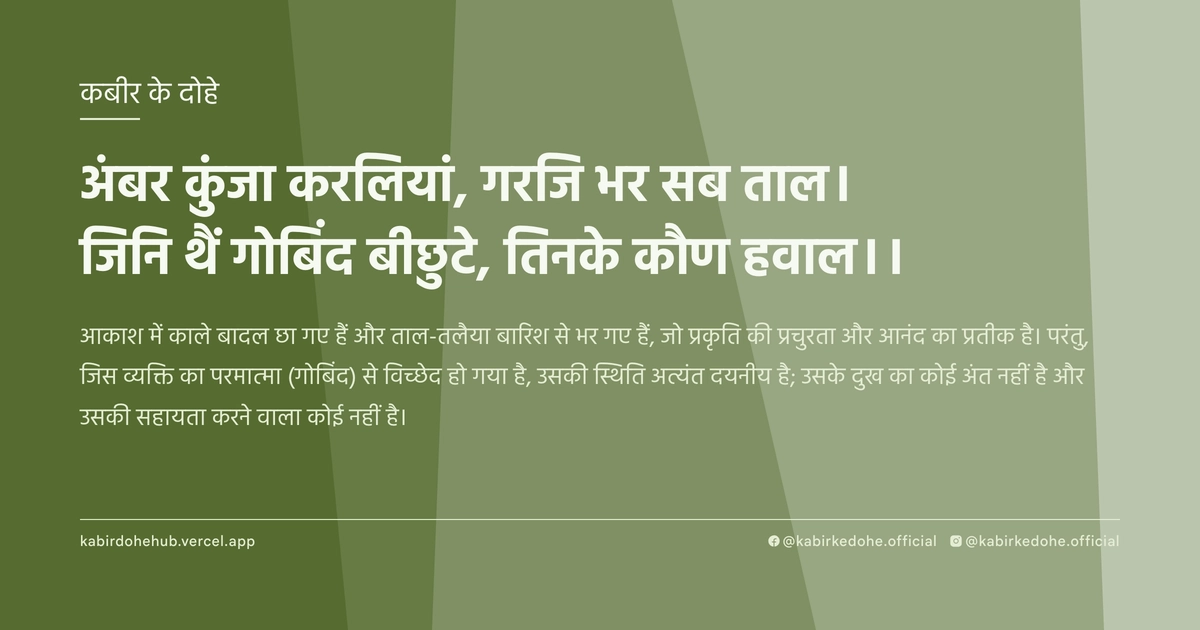
अंबर कुंजा करलियां, गरजि भर सब ताल।
जिनि थैं गोबिंद बीछुटे, तिनके कौण हवाल।।
Ambar kunja karaliya, garji bhar sab taal. Jini thain gobind bichute, tinke kaun hawaal.
इस पृष्ठ पर इस कबीर दोहे का अर्थ (meaning), हिंदी व्याख्या और अंग्रेज़ी अनुवाद, दार्शनिक विश्लेषण और व्यावहारिक जीवन सीख दी गई है। यह दोहा भक्ति (Bhakti) विषय से जुड़ा है — Kabir doha meaning and explanation in Hindi and English.
अर्थ (Meaning):
आकाश में काले बादल छा गए हैं और ताल-तलैया बारिश से भर गए हैं, जो प्रकृति की प्रचुरता और आनंद का प्रतीक है। परंतु, जिस व्यक्ति का परमात्मा (गोबिंद) से विच्छेद हो गया है, उसकी स्थिति अत्यंत दयनीय है; उसके दुख का कोई अंत नहीं है और उसकी सहायता करने वाला कोई नहीं है।
The sky is draped in dark, rain-bearing clouds, and the ponds are overflowing with water, symbolizing the abundance and joy of the natural world. However, for those who have become estranged from the Divine (Gobind), their condition is one of utter misery; they are adrift in a void where no earthly comfort can alleviate their spiritual longing.
व्याख्या (Interpretation):
कबीर यहाँ प्रकृति के सौंदर्य और मानवीय विरह के बीच एक गहरा विरोधाभास प्रस्तुत करते हैं। 'अंबर कुंजा' और 'भर सब ताल' बाहरी जगत की पूर्णता को दर्शाते हैं, जबकि 'गोबिंद बीछुटे' आंतरिक शून्यता को। यह विरह केवल भौतिक दूरी नहीं, बल्कि माया के कारण आत्मा का परमात्मा से विस्मृत होना है। निर्गुण भक्ति के संदर्भ में, यह उस तड़प को दर्शाता है जहाँ साधक को अहसास होता है कि संसार की समस्त सुख-सुविधाएं व्यर्थ हैं यदि भीतर का ईश्वरीय प्रकाश लुप्त है। यह अद्वैत वेदांत की उस अवस्था है जहाँ जीव स्वयं को ब्रह्म से अलग मानकर दुख भोगता है। अंततः, यह दोहा चेतावनी देता है कि बाहरी समृद्धि आध्यात्मिक रिक्तता को नहीं भर सकती।
Kabir presents a profound paradox between the lushness of nature and the desolation of the human spirit. The 'dark clouds' and 'overflowing ponds' symbolize external abundance and the cyclical rhythm of life, yet they serve as a foil to the internal void of 'separation from Gobind.' This separation is not a physical distance but an ontological blindness caused by Maya, where the Atman forgets its identity as Brahman. In the context of Nirgun Bhakti, this represents the 'Viraha' or longing—the agonizing realization that all worldly acquisitions are illusory if the inner spark of the Divine is extinguished. It highlights the central paradox: one can be surrounded by a world of plenty and yet be spiritually starving. The poem asserts that without the realization of the Formless One, the soul remains in a state of perpetual crisis.
दार्शनिक विश्लेषण (Philosophical Analysis):
यह दोहा कबीर के उस दर्शन को उजागर करता है जहाँ वे बाहरी कर्मकांडों और भौतिक उपलब्धियों को आध्यात्मिक सत्य के सामने तुच्छ मानते हैं। कबीर के युग में, धर्म अक्सर बाहरी दिखावे और जातिगत श्रेष्ठता में सिमट गया था। वे तर्क देते हैं कि जिस प्रकार बारिश के बिना धरती प्यासी रहती है, उसी प्रकार परमात्मा के बिना आत्मा मृत समान है। यहाँ 'गोबिंद' शब्द केवल एक नाम नहीं, बल्कि उस सार्वभौमिक चेतना (Universal Consciousness) का प्रतीक है जो हर कण में व्याप्त है।
सूफी मत के 'इश्क-ए-हकीकी' (ईश्वरीय प्रेम) के साथ इसका गहरा संबंध है, जहाँ प्रेमी (साधक) और प्रियतम (ईश्वर) के बीच का विरह ही उसे पूर्णता की ओर ले जाता है। कबीर यहाँ यह समझा रहे हैं कि जब तक अहंकार (I-ness) जीवित है, तब तक विच्छेद बना रहेगा। अद्वैत वेदांत के अनुसार, यह विच्छेद एक भ्रम है; वास्तव में आत्मा और परमात्मा एक ही हैं।
कबीर का प्रहार उन लोगों पर है जो मंदिर-मस्जिद और बाहरी अनुष्ठानों में ईश्वर को खोजते हैं, जबकि वे अपने भीतर के अलगाव को नहीं पहचानते। वे बताते हैं कि प्रकृति की प्रचुरता हमें ईश्वर की याद दिलाती है, लेकिन जो अंधा है, वह केवल बादलों को देखता है, उनके पीछे के रचयिता को नहीं।
मनोवैज्ञानिक स्तर पर, यह दोहा 'अस्तित्वगत अकेलेपन' (Existential Loneliness) की व्याख्या करता है। जब मनुष्य अपनी मूल पहचान खो देता है, तो वह भीड़ में भी अकेला महसूस करता है। यह शून्यता ही उसे आत्म-साक्षात्कार की ओर प्रेरित करती है।
अंततः, कबीर यह संदेश देते हैं कि मोक्ष का मार्ग बाहरी संचय में नहीं, बल्कि आंतरिक मिलन में है। जब 'मैं' मिटता है, तभी 'वह' प्रकट होता है, और तभी यह विरह समाप्त होकर आनंद में बदल जाता है।
This couplet illuminates Kabir's philosophy where external rituals and material achievements are rendered trivial in the face of spiritual truth. In Kabir's era, religion had largely devolved into outward displays and caste-based hierarchies. He argues that just as the earth remains parched without rain, the soul remains lifeless without the Divine. Here, 'Gobind' is not merely a deity but a symbol of the Universal Consciousness permeating every atom of existence.
There is a profound resonance with the Sufi concept of 'Ishq-e-Haqiqi' (Divine Love), where the agony of separation (Viraha) between the lover (seeker) and the Beloved (God) is the very catalyst for spiritual evolution. Kabir suggests that as long as the ego (the 'I') persists, the sense of separation will remain. According to Advaita Vedanta, this separation is an illusion (Maya); in reality, the Atman and Brahman are non-dual.
Kabir critiques those who seek the Divine in temples, mosques, or through rigid rituals while remaining oblivious to their internal estrangement. He implies that while the abundance of nature serves as a mirror to God's generosity, the spiritually blind see only the clouds, not the Creator behind them.
Psychologically, the verse addresses 'existential loneliness.' When a human loses touch with their primordial identity, they experience a void that no amount of worldly success can fill. This very void is the necessary tension that drives the seeker toward self-realization.
Ultimately, Kabir posits that liberation is not found in external accumulation but in internal union. Only when the ego is annihilated does the Divine manifest, transforming the pain of separation into the ecstasy of oneness.
मूल संदेश (Core Message):
- बाहरी समृद्धि आंतरिक शून्यता का उपचार नहीं है।
- अहंकार ही वह पर्दा है जो हमें परमात्मा से अलग करता है।
- सच्ची भक्ति नियमों में नहीं, बल्कि विरह की तड़प में है।
- जब 'मैं' मिटता है, तभी अनंत का अनुभव होता है।
- परमात्मा कहीं बाहर नहीं, बल्कि हमारी अपनी चेतना है।
- External abundance cannot cure internal spiritual emptiness.
- The ego is the only veil creating the illusion of separation.
- True devotion lies in the longing of the soul, not in rituals.
- Only when the 'I' dissolves does the Infinite manifest.
- The Divine is not a destination, but our own fundamental consciousness.
व्यावहारिक उदाहरण (Practical Example):
वाराणसी के एक पुराने घाट पर रहने वाली एक वृद्ध विधवा, जानकी, का जीवन अत्यंत सरल था। वह दिन भर मंदिर की सीढ़ियों पर बैठकर लोगों को देखते हुए अपना समय बिताती थी। उसके पास रहने को एक छोटी सी कुटिया थी और खाने के लिए जो दान मिलता था, वही उसकी जीविका थी।
शहर में मानसून की पहली बारिश आई थी। घाटों पर पानी उफान पर था, चारों ओर हरियाली थी और लोग बारिश का आनंद ले रहे थे। जानकी ने देखा कि उसके आस-पास के लोग कितने खुश थे, लेकिन उसके भीतर एक अजीब सी बेचैनी थी। उसे महसूस होता था कि वह इस उत्सव का हिस्सा नहीं है।
वह अक्सर सोचती थी कि उसने जीवन भर पूजा-पाठ किया, व्रत रखे और तीर्थ यात्राएं कीं, फिर भी उसके मन में वह शांति नहीं थी जिसकी उसने उम्मीद की थी। उसे लगता था कि वह ईश्वर से बात तो करती है, पर उसे सुनता कोई नहीं।
एक दिन उसकी मुलाकात एक घुमक्कड़ फकीर से हुई, जिसने जानकी की उदासी को भांप लिया। फकीर ने उससे पूछा, "माता, बाहर तो इतनी प्रचुरता है, फिर यह सूखापन कैसा?"
जानकी ने रोते हुए कहा, "मैंने सब कुछ किया, फिर भी मैं अकेली हूँ। मुझे लगता है कि मेरा ईश्वर मुझसे रूठ गया है।"
फकीर मुस्कुराया और बोला, "तुमने ईश्वर को बाहर खोजा, उसे मंदिर की मूर्तियों और नियमों में बांधा। तुमने अपनी 'मैं' को इतना बड़ा कर लिया कि ईश्वर के लिए अंदर जगह ही नहीं बची। तुम ईश्वर से अलग नहीं हो, तुम बस अपनी ही परछाईं को ईश्वर मान बैठी हो।"
यह बात जानकी के हृदय पर बिजली की तरह गिरी। उसे समझ आया कि उसकी सारी धार्मिकता केवल एक अहंकार था कि "मैं एक भक्त हूँ।"
उसने अपनी सारी बाहरी पहचान, अपनी 'भक्त' होने की छवि को त्याग दिया और मौन में डूब गई। उसने महसूस किया कि जिस ईश्वर को वह बाहर ढूंढ रही थी, वह उसकी अपनी सांसों में बसा है।
धीरे-धीरे उसकी बेचैनी समाप्त हो गई। अब जब बारिश होती, तो वह केवल पानी नहीं देखती थी, बल्कि उस परमात्मा की उपस्थिति को महसूस करती जो हर बूंद में समाया था। उसका विरह अब मिलन में बदल गया था।
In the ancient ghats of Varanasi lived an elderly widow named Janaki. Her life was stripped to the barest essentials; she spent her days observing the ebb and flow of pilgrims from a small stone ledge. She possessed nothing but a tiny hut and the meager offerings of strangers.
One year, the monsoon arrived with unprecedented ferocity. The Ganges overflowed, the surrounding hills turned a vibrant emerald, and the air was thick with the scent of wet earth. Everywhere, people were celebrating the rain, dancing in the downpour.
Janaki watched them, but instead of joy, she felt a crushing sense of isolation. Despite the external abundance, she felt a hollow ache in her chest. She had spent decades in rigorous prayer, fasting, and pilgrimage, yet the promised peace remained elusive.
She felt as though she were shouting into a void, and the Divine was ignoring her pleas. She believed she was a devoted servant, yet she felt utterly abandoned by her God.
One afternoon, she encountered a wandering Sufi dervish. Seeing her tear-streaked face, the dervish asked, "Mother, the world is overflowing with water, yet why is your heart a desert?"
Janaki sobbed, "I have followed every rule, performed every ritual, yet I am alone. I am separated from my Lord."
The dervish smiled gently and replied, "You sought the Divine in the distance, in the stone of the temple and the rigidity of the law. You built a wall of 'piety' around yourself, and in doing so, you shut the door on the Guest. You are not separated from God; you are separated from your own True Self by the illusion of being a 'devotee'."
These words struck Janaki like a bolt of lightning. She realized that her lifelong religious identity was merely another layer of ego—a spiritual pride that whispered, "I am a holy woman."
She stopped performing rituals for the sake of reward and surrendered her identity into the silence of the present moment. She stopped asking for God and started being the awareness that observes.
Slowly, the void vanished. Now, when the rains fell, she no longer felt like an outsider looking in. She realized that the rain, the river, and her own breath were all the same Divine movement. Her separation had dissolved into an eternal union.
अभ्यास मार्गदर्शन (Practice Guidance):
- प्रतिदिन 20 मिनट मौन बैठें और बाहरी शोर के बीच अपने आंतरिक शून्य को महसूस करें; इसे भरने की कोशिश न करें, बस इसे देखें।
- एक डायरी लिखें जिसमें आप उन क्षणों को दर्ज करें जब आप भीड़ में भी अकेलापन महसूस करते हैं, और विश्लेषण करें कि क्या यह 'अहंकार' के कारण है।
- व्यवहार परिवर्तन: किसी भी धार्मिक कार्य को 'पुरस्कार' या 'पाप-पुण्य' की भावना से करने के बजाय, उसे केवल समर्पण भाव से करें।
- निदान चेकलिस्ट: क्या आप बाहरी सफलता मिलने पर भी अंदर से खाली महसूस करते हैं? क्या आप ईश्वर को केवल मंदिर/मस्जिद में पाते हैं? यदि हाँ, तो आप अभी भी 'विच्छेद' की स्थिति में हैं।
- Practice 20 minutes of daily silence, observing the internal void amidst external noise; do not attempt to fill it, simply witness its existence.
- Maintain a journal to record moments of 'existential loneliness' in crowds, analyzing whether this stems from the ego's perceived separation from the Whole.
- Behavioral Shift: Perform acts of service or devotion without the expectation of spiritual merit or reward, shifting from 'transactional' to 'surrendered' action.
- Diagnostic Checklist: Do you feel empty despite material success? Do you perceive the Divine only in specific sacred spaces? If yes, you are currently operating from a state of perceived separation.
चिंतन प्रश्न (Reflection Questions):
- क्या मेरी धार्मिक पहचान वास्तव में मुझे ईश्वर के करीब ले जा रही है, या यह केवल मेरे अहंकार को संतुष्ट कर रही है?
- मैं अपनी सफलता और उपलब्धियों के पीछे किस खालीपन को छिपाने की कोशिश कर रहा हूँ?
- यदि मेरे जीवन से सभी बाहरी मान्यताएं और पद छीन लिए जाएं, तो मेरे भीतर क्या बचेगा?
- क्या मैं वास्तव में ईश्वर को चाहता हूँ, या मैं केवल उस 'महसूस' को चाहता हूँ जो मुझे श्रेष्ठ बनाता है?
- मेरे जीवन का वह कौन सा हिस्सा है जहाँ मैं अभी भी खुद को ब्रह्मांड से अलग महसूस करता हूँ?
- Does my religious identity actually bring me closer to the Divine, or is it merely feeding my spiritual ego?
- What specific void am I attempting to mask with my professional achievements and social status?
- If all my external labels and titles were stripped away, what essence of 'me' would remain?
- Do I truly seek the Divine, or am I merely seeking the feeling of superiority that comes with being 'spiritual'?
- In which area of my life do I still cling to the illusion that I am a separate entity from the rest of existence?