
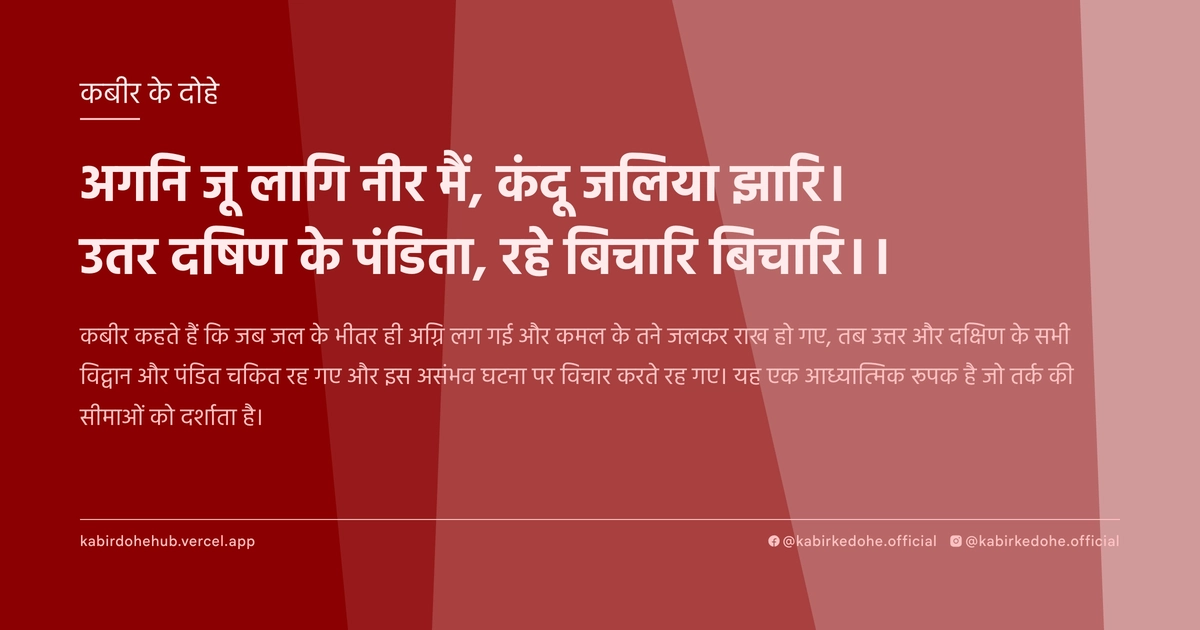
अगनि जू लागि नीर मैं, कंदू जलिया झारि।
उतर दषिण के पंडिता, रहे बिचारि बिचारि।।
Agni ju laagi neer main, kandu jaliya jhaari. Utar dashin ke pandita, rahe bichaari bichaari.
इस पृष्ठ पर इस कबीर दोहे का अर्थ (meaning), हिंदी व्याख्या और अंग्रेज़ी अनुवाद, दार्शनिक विश्लेषण और व्यावहारिक जीवन सीख दी गई है। यह दोहा धार्मिक पाखंड (Religious Hypocrisy) विषय से जुड़ा है — Kabir doha meaning and explanation in Hindi and English.
अर्थ (Meaning):
कबीर कहते हैं कि जब जल के भीतर ही अग्नि लग गई और कमल के तने जलकर राख हो गए, तब उत्तर और दक्षिण के सभी विद्वान और पंडित चकित रह गए और इस असंभव घटना पर विचार करते रह गए। यह एक आध्यात्मिक रूपक है जो तर्क की सीमाओं को दर्शाता है।
Kabir describes a paradoxical event where fire ignited within the water itself, incinerating the lotus stalks. The learned scholars from the North and South remained stunned, endlessly contemplating this impossibility. It serves as a metaphor for the transcendence of logical reasoning in the face of divine mystery.
व्याख्या (Interpretation):
शाब्दिक अर्थ में यह एक असंभव घटना है, लेकिन आध्यात्मिक स्तर पर यह 'माया' और 'परमात्मा' के खेल को दर्शाता है। यहाँ जल शांति और चेतना का प्रतीक है, जबकि अग्नि ज्ञान या ईश्वरीय शक्ति की तीव्रता है। जब साधक के भीतर ज्ञान की अग्नि प्रज्वलित होती है, तो वह संसार के द्वैत (जैसे जल और अग्नि) को मिटा देती है। यह निर्गुण भक्ति का सार है जहाँ तर्क विफल हो जाता है और केवल अनुभव शेष रहता है। यह अद्वैत वेदांत के उस सत्य की ओर संकेत करता है जहाँ विपरीत तत्व एक ही ब्रह्म में विलीन हो जाते हैं। अंततः, यह पंडिताई या किताबी ज्ञान के अहंकार पर प्रहार है जो केवल विश्लेषण करता है, अनुभव नहीं।
Literally, the verse describes an impossibility, but spiritually, it mirrors the play of Maya and the Absolute. Water symbolizes the calm of consciousness, while fire represents the intensity of divine gnosis. When the fire of realization ignites within the seeker, it consumes the duality of existence—the perceived opposites of water and fire. This is the essence of Nirgun Bhakti, where logical structures collapse, leaving only direct experience. It aligns with Advaita Vedanta, suggesting that all contradictions are resolved in the non-dual Brahman. Ultimately, it is a critique of intellectual arrogance; the scholars analyze the phenomenon, but they fail to experience the Truth that transcends analysis.
दार्शनिक विश्लेषण (Philosophical Analysis):
कबीर का यह दोहा उनके युग के कट्टरपंथ और केवल शास्त्रों पर आधारित ज्ञान के प्रति एक तीखा प्रहार है। उस समय समाज में विद्वानों का एक वर्ग था जो केवल तर्क और ग्रंथों के माध्यम से ईश्वर को खोजने का प्रयास करता था। कबीर यहाँ 'असंभव' का उदाहरण देकर यह समझाते हैं कि सत्य तर्क की परिधि से बाहर है। यह सूफी मत के 'फना' (अहंकार का विनाश) के करीब है, जहाँ तर्क मरता है और प्रेम जागता है।
अद्वैत वेदांत के परिप्रेक्ष्य में, यह दोहा माया के आवरण को हटाने की बात करता है। जब तक हम द्वैत में जीते हैं, जल और अग्नि अलग हैं, लेकिन जब आत्मा का मिलन परमात्मा से होता है, तो सारे विरोधाभास समाप्त हो जाते हैं। कबीर का उद्देश्य यह बताना है कि मोक्ष किसी शास्त्र के पन्ने पलटने से नहीं, बल्कि आंतरिक रूपांतरण से मिलता है।
यहाँ 'उत्तर और दक्षिण के पंडित' केवल भौगोलिक दिशाओं को नहीं, बल्कि संपूर्ण बौद्धिक अहंकार का प्रतिनिधित्व करते हैं। वे 'विचार' करते रह गए, जिसका अर्थ है कि वे विश्लेषण के जाल में फंस गए। कबीर कहते हैं कि सत्य का अनुभव करने के लिए विश्लेषण नहीं, बल्कि समर्पण की आवश्यकता होती है।
यह दोहा ritualism (कर्मकांड) की निरर्थकता को भी उजागर करता है। यदि ईश्वर सर्वव्यापी है, तो वह जल में अग्नि लगा सकता है। जो लोग केवल नियमों और सीमाओं में ईश्वर को खोजते हैं, वे इस चमत्कार को देखकर भ्रमित रहेंगे।
मनोवैज्ञानिक स्तर पर, यह 'कॉग्निटिव डिसोनेंस' (संज्ञानात्मक विसंगति) की स्थिति है। जब मनुष्य का पुराना विश्वास तंत्र टूटता है, तो वह डर जाता है। कबीर हमें उस डर से आगे बढ़कर उस शून्य में कूदने के लिए प्रेरित करते हैं जहाँ केवल सत्य का वास है।
This couplet is a sharp critique of the dogmatism and scripture-centric knowledge prevalent during Kabir's era. He addresses a class of intellectuals who attempted to reach the Divine solely through logic and textual exegesis. By presenting an 'impossibility,' Kabir demonstrates that Truth resides beyond the perimeter of rational thought.
From the lens of Advaita Vedanta, the verse speaks to the piercing of the veil of Maya. In the state of duality, water and fire are opposites; however, in the realization of the Atman-Brahman unity, all contradictions dissolve. Kabir asserts that liberation is not found in the turning of pages, but in internal alchemy.
The 'scholars of the North and South' represent the totality of intellectual ego. Their act of 'contemplating' signifies being trapped in the web of analysis. Kabir suggests that while the mind analyzes, the soul experiences; the former is a barrier to the latter.
Furthermore, the verse exposes the futility of ritualism. If the Divine is omnipresent and omnipotent, the laws of nature are mere suggestions. Those bound by rigid rules are left bewildered by the spontaneous grace of the Nirgun Absolute.
Psychologically, this represents a state of cognitive dissonance. When an individual's rigid belief system is shattered by a transcendent experience, they often retreat into analysis to avoid the terror of the unknown. Kabir urges the seeker to leap beyond this fear into the void of pure existence.
मूल संदेश (Core Message):
- तर्क की सीमा जहाँ समाप्त होती है, वहीं से वास्तविक आध्यात्मिकता शुरू होती है।
- अहंकार का विश्लेषण सत्य के अनुभव में सबसे बड़ी बाधा है।
- परमात्मा विरोधाभासों से परे है; वह जल और अग्नि दोनों का स्रोत है।
- किताबी ज्ञान केवल नक्शा है, लेकिन अनुभव स्वयं मंजिल है।
- समर्पण वह अग्नि है जो बौद्धिक अहंकार को भस्म कर देती है।
- True spirituality begins where the limits of logic end.
- Intellectual analysis is the greatest barrier to the direct experience of Truth.
- The Divine transcends opposites; He is the source of both water and fire.
- Scriptural knowledge is merely a map, but experience is the destination itself.
- Surrender is the fire that incinerates the ego of the learned.
व्यावहारिक उदाहरण (Practical Example):
वाराणसी के एक पुराने घाट पर माधव नाम का एक वृद्ध विधवा महिला रहती थी, जो जीवन भर केवल मंदिर की सीढ़ियों पर बैठकर दूसरों को धर्म की बातें सुनाती थी। वह स्वयं को बहुत ज्ञानी मानती थी क्योंकि उसने कई पुराणों के अंश याद किए थे। वह अक्सर युवा श्रद्धालुओं को बताती थी कि ईश्वर केवल नियमों के पालन से मिलता है।
एक दिन, उसने देखा कि एक छोटा बच्चा, जो शायद मानसिक रूप से अक्षम था, नदी के किनारे बैठकर मिट्टी के घर बना रहा था और जोर-जोर से हंस रहा था। वह बच्चा किसी नियम को नहीं जानता था, न ही उसे किसी शास्त्र का ज्ञान था।
माधव ने उसे डांटा और कहा, "बेटा, तुम इस पवित्र नदी के किनारे ऐसे खेल रहे हो? क्या तुम्हें पता है कि यहाँ ध्यान और अनुशासन की आवश्यकता है?"
बच्चे ने मासूमियत से जवाब दिया, "दादी, मैं तो बस देख रहा हूँ कि पानी के अंदर सूरज कैसे नाच रहा है। वह इतना गर्म है कि पानी भी सोने जैसा चमक रहा है।"
माधव ने तर्क दिया कि सूरज की गर्मी पानी को गर्म कर सकती है, लेकिन वह उसे 'नचा' नहीं सकता, और पानी में अग्नि नहीं हो सकती। वह अपनी किताबी बातों से बच्चे को गलत साबित करने लगी।
तभी एक घटना घटी। एक भीषण तूफान आया और घाट की कुछ पुरानी लकड़ियां नदी में गिर गईं, जिनमें से कुछ जलते हुए मशालों की तरह दिख रहे थे। पानी की लहरों के बीच वह अग्नि ऐसी लग रही थी जैसे जल स्वयं जल रहा हो।
माधव डर गई और चिल्लाने लगी कि यह कोई अपशकुन है, कोई दैवीय प्रकोप है। वह सोचने लगी कि शास्त्रों में ऐसी घटना का क्या वर्णन है। वह अपनी मानसिक लाइब्रेरी में उत्तर खोजने लगी।
लेकिन वह बच्चा शांत था। उसने माधव का हाथ पकड़ा और कहा, "देखो दादी, पानी और आग अब दोस्त बन गए हैं। अब आप डरना छोड़कर बस इसे देखो।"
उस क्षण माधव को महसूस हुआ कि उसका सारा ज्ञान एक बोझ था। वह जिसे 'असंभव' मानकर विश्लेषण कर रही थी, वह बच्चा उसे 'अनुभव' कर रहा था। उसकी सारी पंडिताई उस बच्चे की सहजता के सामने राख हो गई।
माधव ने पहली बार महसूस किया कि ईश्वर नियमों में नहीं, बल्कि उस सहज प्रेम और विस्मय में है जिसे वह अपनी बौद्धिकता के कारण खो चुकी थी। उसने अपनी पुरानी धारणाओं को त्याग दिया और जीवन को एक नए, सरल दृष्टिकोण से देखना शुरू किया।
On an ancient ghat in Varanasi lived an elderly widow named Madhav, who spent her days reciting religious tenets to passersby. She considered herself profoundly learned, having memorized fragments of several Puranas, and often lectured young devotees that the Divine is attained only through rigid adherence to rules.
One day, she noticed a small child, perhaps mentally disabled, sitting by the riverbank building mud houses and laughing exuberantly. The child knew no rules and had no knowledge of scriptures.
Madhav scolded him, saying, "Child, how can you play like this on the banks of this holy river? Do you not know that this place demands meditation and discipline?"
The child replied with innocence, "Grandmother, I am just watching how the sun dances inside the water. It is so hot that the water is shining like gold."
Madhav argued logically that while the sun's heat could warm the water, it could not make it 'dance,' and fire cannot exist within water. She began trying to prove the child wrong using her textual knowledge.
Suddenly, a fierce storm erupted, and some old wooden structures from the ghat collapsed into the river. Some of these were carrying lit torches, which looked like pillars of fire dancing amidst the waves. It appeared as if the water itself was burning.
Madhav panicked, screaming that this was an ill omen or a divine wrath. She began frantically searching her mental library of scriptures to find an explanation for this anomaly.
But the child remained serene. He took Madhav's hand and said, "Look, Grandmother, the water and fire have become friends. Stop fearing and just watch."
In that moment, Madhav realized her entire store of knowledge was a burden. What she was trying to 'analyze' as impossible, the child was 'experiencing' as beauty. Her intellectual pride turned to ash before the child's simplicity.
Madhav felt for the first time that God does not reside in rules, but in the spontaneous love and wonder she had lost to her own intellect. She discarded her old preconceptions and began to view life through a lens of simple, direct presence.
अभ्यास मार्गदर्शन (Practice Guidance):
- प्रतिदिन 20 मिनट मौन बैठें और अपने भीतर के उन विरोधाभासों को देखें जिन्हें आप 'सही' या 'गलत' के खांचे में डालते हैं।
- एक डायरी लिखें जिसमें आप उन क्षणों को दर्ज करें जब आपका तर्क विफल हुआ और आपने कुछ ऐसा अनुभव किया जिसे शब्दों में नहीं बांधा जा सकता।
- व्यवहार परिवर्तन: जब भी आप किसी को 'सुधारने' या 'उपदेश' देने की इच्छा महसूस करें, तो रुकें और स्वयं से पूछें कि क्या आप अपने अहंकार को संतुष्ट कर रहे हैं या वास्तव में मदद कर रहे हैं।
- निदान चेकलिस्ट: क्या आप अभी भी सत्य को केवल किताबों में खोज रहे हैं? क्या आप दूसरों के अनुभवों को अपने तर्क की कसौटी पर कसते हैं? यदि हाँ, तो आप अभी भी 'पंडित' की अवस्था में हैं।
- Sit in silence for 20 minutes daily, observing the contradictions within you that you typically categorize as 'right' or 'wrong.'
- Maintain a journal recording moments where your logic failed and you experienced something that defied verbal description.
- Behavioral Shift: Whenever you feel the urge to 'correct' or 'preach' to someone, pause and ask if you are feeding your ego or genuinely offering help.
- Diagnostic Checklist: Are you still seeking Truth exclusively in books? Do you judge others' spiritual experiences by the yardstick of your logic? If yes, you are still operating in the state of the 'Scholar'.
चिंतन प्रश्न (Reflection Questions):
- मेरे जीवन का वह कौन सा 'सत्य' है जिसे मैं केवल इसलिए मानता हूँ क्योंकि मैंने उसे किसी किताब में पढ़ा है, न कि अनुभव किया है?
- जब मैं दूसरों को सही साबित करने की कोशिश करता हूँ, तो क्या मैं सत्य की खोज कर रहा होता हूँ या अपनी श्रेष्ठता की?
- क्या मैं अपने जीवन के विरोधाभासों (जैसे दुख और सुख) को स्वीकार कर पाता हूँ, या मैं उन्हें तर्क से सुलझाने की कोशिश में जीवन गँवा रहा हूँ?
- मेरी 'डिजिटल पहचान' और मेरी आंतरिक वास्तविकता के बीच कितना अंतर है? क्या मैं ऑनलाइन एक 'ज्ञानी' दिखने की कोशिश कर रहा हूँ?
- यदि आज मेरे सारे विश्वास और मान्यताएं गलत साबित हो जाएं, तो क्या मेरे पास अभी भी कुछ ऐसा बचेगा जिसे मैं 'मैं' कह सकूँ?
- Which 'truth' in my life do I believe only because I read it in a book, rather than having experienced it?
- When I strive to prove others wrong, am I seeking Truth or merely validating my own superiority?
- Do I accept the contradictions of my life (like pain and joy), or am I wasting my existence trying to solve them logically?
- What is the gap between my 'digital identity' and my internal reality? Am I performing the role of a 'knower' online?
- If all my beliefs and convictions were proven wrong today, would there be anything left of me that I could call 'I'?