
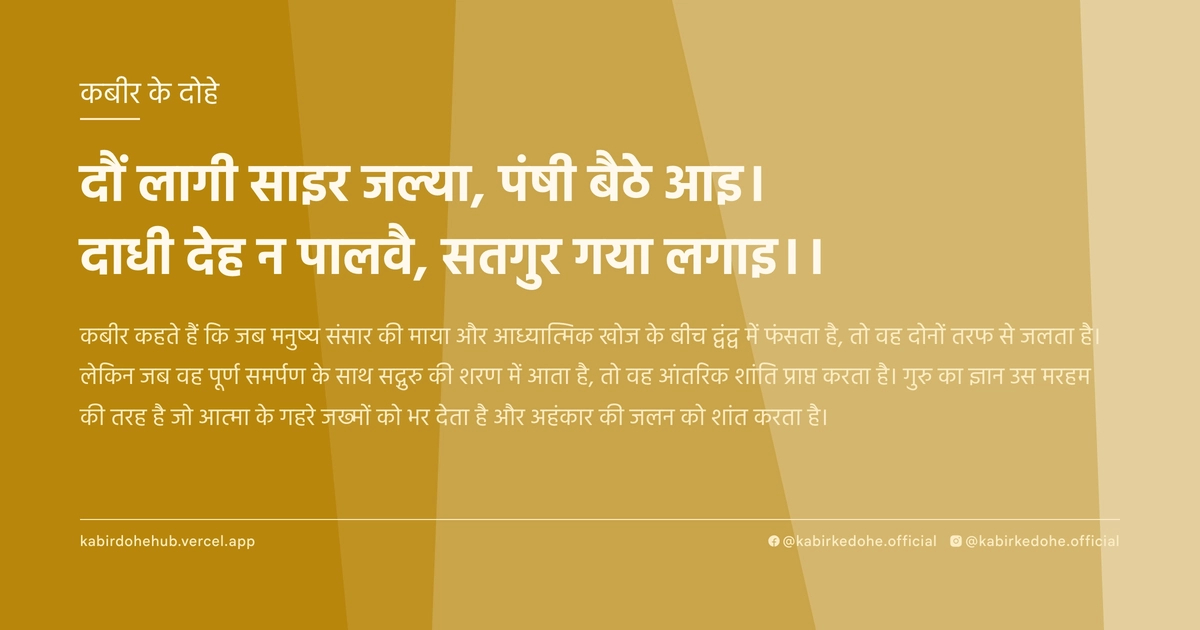
दौं लागी साइर जल्या, पंषी बैठे आइ।
दाधी देह न पालवै, सतगुर गया लगाइ।।
Daun laagi sayar jallya, panshi baithe aai. Daadhi deh na paalvai, satgur gaya lagaai.
इस पृष्ठ पर इस कबीर दोहे का अर्थ (meaning), हिंदी व्याख्या और अंग्रेज़ी अनुवाद, दार्शनिक विश्लेषण और व्यावहारिक जीवन सीख दी गई है। यह दोहा गुरु महत्व (The Guru's Importance) विषय से जुड़ा है — Kabir doha meaning and explanation in Hindi and English.
अर्थ (Meaning):
कबीर कहते हैं कि जब मनुष्य संसार की माया और आध्यात्मिक खोज के बीच द्वंद्व में फंसता है, तो वह दोनों तरफ से जलता है। लेकिन जब वह पूर्ण समर्पण के साथ सद्गुरु की शरण में आता है, तो वह आंतरिक शांति प्राप्त करता है। गुरु का ज्ञान उस मरहम की तरह है जो आत्मा के गहरे जख्मों को भर देता है और अहंकार की जलन को शांत करता है।
Kabir explains that when a human is caught in the conflict between worldly attachments and spiritual longing, they are scorched by both fires. However, when the soul seeks refuge in the True Guru, it finds ultimate peace. The Guru's wisdom acts as a healing balm that soothes the deep wounds of the spirit and extinguishes the burning agony of the ego.
व्याख्या (Interpretation):
यहाँ 'दौं लागी' का अर्थ है दो विपरीत दिशाओं में खिंचना—एक तरफ भौतिक सुखों का मोह और दूसरी तरफ मोक्ष की तड़प। यह स्थिति एक ऐसी अग्नि के समान है जो साधक को मानसिक और आत्मिक रूप से जलाती है। 'पंषी' या पक्षी यहाँ उस जीवात्मा का प्रतीक है जो भटकने के बाद अंततः विश्राम खोजती है। जब आत्मा सद्गुरु के ज्ञान से जुड़ती है, तो वह 'दाधी देह' यानी उस झुलसे हुए शरीर और मन की पीड़ा से मुक्त हो जाती है। यह निरगुण भक्ति का सार है, जहाँ बाहरी कर्मकांड के बजाय आंतरिक रूपांतरण पर जोर दिया गया है। यह अद्वैत वेदांत की उस स्थिति को दर्शाता है जहाँ द्वैत (दोहरापन) समाप्त हो जाता है और केवल एक सत्य शेष रहता है। माया का पर्दा हटते ही आत्मा ब्रह्म में विलीन हो जाती है।
The phrase 'Daun laagi' signifies being pulled in two opposite directions—the lure of material pleasures and the agonizing longing for liberation. This duality creates a spiritual friction, akin to a fire that scorches the seeker's psyche. The 'panshi' or bird symbolizes the wandering soul that finally finds a perch of stability. When the soul aligns with the Satguru's wisdom, the 'daadhi deh' or the scorched existence is healed. This reflects the essence of Nirgun Bhakti, prioritizing internal transformation over external rituals. It mirrors the Advaita Vedanta concept where duality vanishes, leaving only the singular Truth. As the veil of Maya lifts, the individual Atman realizes its non-duality with the universal Brahman, ending the paradox of suffering.
दार्शनिक विश्लेषण (Philosophical Analysis):
कबीर का यह दोहा उस समय के सामाजिक और धार्मिक परिवेश पर एक गहरा प्रहार है जहाँ लोग केवल बाहरी दिखावे और कठोर तपस्या में उलझे थे। कबीर ने स्पष्ट किया कि केवल शरीर को कष्ट देने या तीर्थों पर भटकने से मुक्ति नहीं मिलती, बल्कि अहंकार का विसर्जन आवश्यक है। यह दर्शन सूफीवाद के 'फना' (अहंकार का विनाश) और वेदांत के 'अहं ब्रह्मास्मि' के करीब है।
यहाँ 'जलन' केवल शारीरिक नहीं, बल्कि मनोवैज्ञानिक है। यह उस मानसिक द्वंद्व को दर्शाता है जब व्यक्ति जानता है कि सत्य कहीं और है, लेकिन वह अपनी आदतों और सामाजिक बंधनों से बंधा रहता है। कबीर इस द्वंद्व को समाप्त करने के लिए 'सद्गुरु' को माध्यम बनाते हैं, जो वास्तव में व्यक्ति के भीतर जागृत होने वाली चेतना है।
ritualism (कर्मकांड) का विरोध करते हुए कबीर बताते हैं कि ईश्वर मंदिर या मस्जिद में नहीं, बल्कि उस शून्य में है जहाँ 'मैं' समाप्त हो जाता है। यह मार्ग कठिन है क्योंकि इसमें अपनी पूरी पहचान को मिटाना पड़ता है।
अद्वैत दृष्टिकोण से, यह दोहा बताता है कि जब तक हम स्वयं को शरीर या नाम से जोड़कर देखते हैं, हम अलग-अलग धाराओं में जलते रहेंगे। जैसे ही यह भ्रम टूटता है, हम उस अनंत शांति का अनुभव करते हैं जिसे कबीर 'सतगुर' की कृपा कहते हैं।
अंततः, यह विश्लेषण हमें सिखाता है कि आध्यात्मिक प्रगति का अर्थ अधिक ज्ञान प्राप्त करना नहीं, बल्कि उस अज्ञान और अहंकार को हटाना है जो हमें सत्य से अलग करता है। यह एक मनोवैज्ञानिक सर्जरी की तरह है जहाँ गुरु का ज्ञान पुराने घावों को भरता है और एक नई चेतना का जन्म कराता है।
Kabir's couplet is a profound critique of the socio-religious landscape of his era, where people were entangled in superficial displays of piety and rigorous, mindless asceticism. He asserts that liberation is not achieved through bodily torture or pilgrimage, but through the annihilation of the ego. This philosophy aligns closely with the Sufi concept of 'Fana' (extinction of the self) and the Vedantic realization of 'Aham Brahmasmi'.
The 'burning' mentioned is not physical but psychological. It represents the cognitive dissonance experienced when a seeker knows the Truth lies elsewhere but remains shackled by habitual patterns and societal expectations. Kabir introduces the 'Satguru' as the catalyst to resolve this conflict, where the Guru is not necessarily a person, but the awakened consciousness within.
By rejecting ritualism, Kabir emphasizes that the Divine resides not in temples or mosques, but in the 'Shunya' (void) where the 'I' ceases to exist. This path is arduous as it demands the complete surrender of one's constructed identity.
From an Advaita perspective, the verse suggests that as long as we identify with the body or a social label, we remain fragmented and scorched by duality. Once this illusion shatters, we merge into the infinite peace that Kabir attributes to the Guru's grace.
Ultimately, this analysis reveals that spiritual growth is not about accumulating knowledge, but about stripping away the ignorance and ego that separate us from the Truth. It is a psychological surgery where the Guru's wisdom heals ancient wounds and births a new state of consciousness.
मूल संदेश (Core Message):
- द्वंद्व ही दुख का मूल कारण है, इसे स्वीकार करें।
- सांसारिक कर्तव्य और आध्यात्मिक खोज को अलग न करें।
- अहंकार की अग्नि केवल समर्पण के जल से शांत होती है।
- सद्गुरु वह आंतरिक प्रकाश है जो भ्रम के पर्दे हटाता है।
- पूर्णता बाहरी उपलब्धियों में नहीं, आंतरिक संतुलन में है।
- जब 'मैं' मिटता है, तभी वास्तविक शांति का उदय होता है।
- Duality is the root of suffering; acknowledge its presence.
- Do not separate worldly duties from spiritual longing.
- The fire of ego is extinguished only by the water of surrender.
- The True Guru is the inner light that dissolves the veil of illusion.
- Wholeness lies not in external achievement, but in internal equilibrium.
- Only when the 'I' vanishes does true peace emerge.
व्यावहारिक उदाहरण (Practical Example):
वाराणसी के एक पुराने घाट पर माधव नाम का एक बुनकर रहता था। वह अपनी कला में निपुण था, लेकिन उसका मन हमेशा अशांत रहता था। एक तरफ वह अपने परिवार की गरीबी मिटाने के लिए दिन-रात मेहनत करता, और दूसरी तरफ उसे लगता कि यह सब व्यर्थ है, उसे शांति केवल वैराग्य में मिलेगी। वह अक्सर मंदिर जाता, दान करता, लेकिन उसके भीतर का क्रोध और असंतोष कम नहीं होता था। वह एक ऐसे द्वंद्व में जल रहा था जहाँ वह न तो पूरी तरह सांसारिक बन पाया और न ही आध्यात्मिक।
एक दिन उसकी मुलाकात एक फकीर से हुई जो घाट की सीढ़ियों पर चुपचाप बैठा था। माधव ने अपनी व्यथा सुनाई कि वह शांति की तलाश में है लेकिन उसकी इच्छाएं उसे चैन नहीं लेने देतीं। फकीर ने उससे पूछा, "क्या तुम उस कपड़े को बुन सकते हो जिसमें धागे अलग-अलग हों लेकिन कपड़ा एक हो?"
माधव ने कहा, "हाँ, यही तो बुनकर का काम है।"
फकीर ने मुस्कुराते हुए कहा, "तो फिर अपने जीवन के विरोधाभासों को अलग-अलग मत देखो। अपनी मेहनत को ही अपनी प्रार्थना बना लो। जब तुम कपड़े के हर धागे को ईश्वर मानकर बुनोगे, तो तुम्हारी जलन समाप्त हो जाएगी।"
माधव को यह बात गहराई से छू गई। उसने महसूस किया कि वह अब तक 'काम' और 'भक्ति' को दो अलग चीजें मानकर उनके बीच संघर्ष कर रहा था। उसने अपनी मानसिकता बदली। अब वह केवल पैसे के लिए नहीं, बल्कि एक सेवा भाव से काम करने लगा।
उसने पाया कि जब उसने 'मैं' और 'मेरा लाभ' का विचार छोड़ा, तो उसका काम ही ध्यान बन गया। उसकी चिड़चिड़ाहट गायब हो गई और उसके चेहरे पर एक अनोखी चमक आ गई।
वह अब भी वही गरीबी में जी रहा था, लेकिन उसके भीतर की आग अब विनाशकारी नहीं, बल्कि प्रकाशमय थी।
उसने सीखा कि सद्गुरु का ज्ञान कोई बाहरी मंत्र नहीं, बल्कि जीवन जीने का एक नया नजरिया है।
माधव अब उस घाट का सबसे शांत व्यक्ति माना जाता था, जिसने अपनी मेहनत के धागों से शांति का वस्त्र बुन लिया था।
On an ancient ghat in Varanasi lived a weaver named Madhav. He was a master of his craft, yet his mind was a storm of unrest. On one hand, he labored tirelessly to lift his family from poverty; on the other, he felt this struggle was futile and believed peace could only be found in total renunciation. He visited temples and gave alms, but the fire of anger and dissatisfaction continued to burn within him. He was scorched by the duality of wanting both worldly success and spiritual liberation.
One day, he encountered a wandering dervish sitting silently on the stone steps of the ghat. Madhav poured out his grief, explaining that his desires prevented him from finding the peace he craved. The dervish asked him, "Can you weave a cloth where the threads are distinct, yet the fabric is one?"
Madhav replied, "Yes, that is the very essence of a weaver's art."
The dervish smiled and said, "Then stop viewing the contradictions of your life as separate battles. Make your labor your prayer. When you weave every thread as if it were a manifestation of the Divine, your inner burning will cease."
This realization struck Madhav deeply. He understood that he had been suffering because he viewed 'work' and 'devotion' as opposing forces. He shifted his consciousness. He stopped working merely for profit and began to work as an act of service.
He discovered that once he relinquished the notion of 'I' and 'my gain,' his work transformed into a meditation. His irritability vanished, replaced by a serene radiance.
Though he still lived in poverty, the fire within him was no longer destructive; it had become a light.
He learned that the Guru's wisdom is not a secret mantra, but a fundamental shift in how one perceives existence.
Madhav became known as the most peaceful man on the ghat, having woven a garment of serenity from the very threads of his daily struggle.
अभ्यास मार्गदर्शन (Practice Guidance):
- प्रतिदिन 20 मिनट 'साक्षी भाव' का अभ्यास करें: अपने भीतर उठने वाले द्वंद्वों (जैसे लालच बनाम संतोष) को बिना किसी निर्णय के केवल देखें।
- आत्म-पूछताछ जर्नल: लिखें कि जीवन के किन दो विपरीत छोरों के बीच आप वर्तमान में संघर्ष कर रहे हैं और यह संघर्ष आपकी ऊर्जा को कैसे नष्ट कर रहा है।
- कर्म-योग का प्रयोग: दिन के किसी एक साधारण कार्य (जैसे बर्तन धोना या चलना) को पूरी जागरूकता के साथ करें, यह मानकर कि यह कार्य ही आपकी सर्वोच्च पूजा है।
- निदान चेकलिस्ट: क्या आप अभी भी 'सही' और 'गलत' के बीच मानसिक युद्ध कर रहे हैं? क्या आप शांति के लिए बाहरी परिस्थितियों के बदलने का इंतज़ार कर रहे हैं? यदि हाँ, तो आप अभी भी 'दौं लागी' की स्थिति में हैं।
- Practice 'Witness Consciousness' for 20 minutes daily: Observe the internal conflicts (e.g., greed vs. contentment) arising within you without judgment.
- Self-Inquiry Journaling: Document the two opposing poles of your life that are currently in conflict and analyze how this friction is draining your spiritual energy.
- Application of Karma Yoga: Perform one mundane task (like washing dishes or walking) with total mindfulness, treating the action itself as your highest form of worship.
- Diagnostic Checklist: Are you still engaged in a mental war between 'right' and 'wrong'? Are you waiting for external circumstances to change before finding peace? If yes, you are still in the state of 'Daun Laagi'.
चिंतन प्रश्न (Reflection Questions):
- वह कौन सा मुखौटा है जिसे आप दुनिया के सामने पहनते हैं, जबकि भीतर आप कुछ और ही महसूस करते हैं?
- क्या आपकी आध्यात्मिक खोज वास्तव में शांति के लिए है, या यह केवल सांसारिक असफलताओं से भागने का एक तरीका है?
- यदि आपका सामाजिक पद, नाम और संपत्ति छीन ली जाए, तो आपके पास अपनी पहचान के लिए क्या बचेगा?
- आप किन ऐसी मान्यताओं को पकड़े हुए हैं जो आपको दूसरों से श्रेष्ठ महसूस कराती हैं, लेकिन वास्तव में आपको अकेला कर रही हैं?
- क्या आप अपने जीवन के विरोधाभासों को स्वीकार करने का साहस रखते हैं, या आप उन्हें दबाकर 'आदर्श' दिखने की कोशिश कर रहे हैं?
- आपके भीतर का वह कौन सा हिस्सा है जिसे आप कभी नहीं छोड़ना चाहते, और वही हिस्सा आपकी शांति में सबसे बड़ी बाधा है?
- What is the mask you wear for the world, while internally feeling something entirely different?
- Is your spiritual quest truly for peace, or is it merely an escape from worldly failures?
- If your social status, name, and wealth were stripped away, what would remain as your identity?
- What beliefs are you clinging to that make you feel superior to others, but are actually isolating you?
- Do you have the courage to accept the contradictions of your life, or are you suppressing them to appear 'ideal'?
- Which part of yourself are you most unwilling to let go of, and how is that very part the greatest obstacle to your peace?