
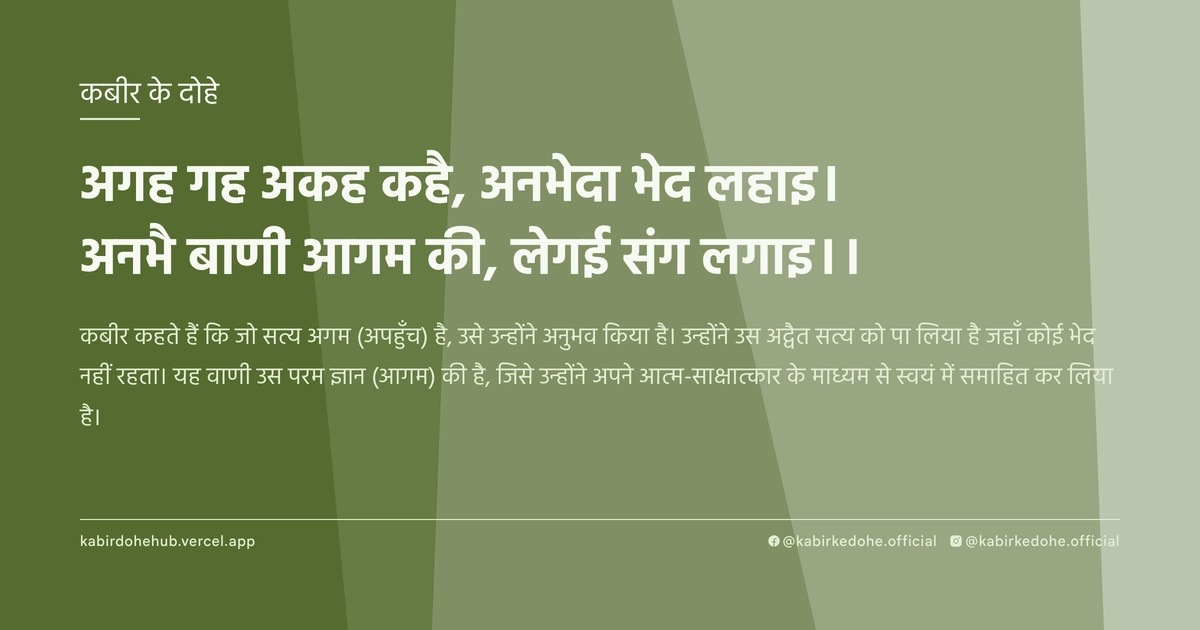
अगह गह अकह कहै, अनभेदा भेद लहाइ।
अनभै बाणी आगम की, लेगई संग लगाइ।।
Agah gah akah kahai, anbheda bhed lahai. Anbhai bani agam ki, legai sang lagai.
इस पृष्ठ पर इस कबीर दोहे का अर्थ (meaning), हिंदी व्याख्या और अंग्रेज़ी अनुवाद, दार्शनिक विश्लेषण और व्यावहारिक जीवन सीख दी गई है। यह दोहा निर्गुण ब्रह्म (Nirguna Brahman) विषय से जुड़ा है — Kabir doha meaning and explanation in Hindi and English.
अर्थ (Meaning):
कबीर कहते हैं कि जो सत्य अगम (अपहुँच) है, उसे उन्होंने अनुभव किया है। उन्होंने उस अद्वैत सत्य को पा लिया है जहाँ कोई भेद नहीं रहता। यह वाणी उस परम ज्ञान (आगम) की है, जिसे उन्होंने अपने आत्म-साक्षात्कार के माध्यम से स्वयं में समाहित कर लिया है।
Kabir asserts that he has grasped the 'unreachable' truth. He has discovered the secret of non-duality, where all distinctions vanish. This speech is the manifestation of the ultimate scripture (Aagam), which he has internalized through direct spiritual experience rather than mere study.
व्याख्या (Interpretation):
शाब्दिक अर्थ में, कबीर उस ज्ञान की बात कर रहे हैं जो शब्दों से परे है। यहाँ 'अगह' उस परमात्मा को दर्शाता है जिसे तर्क या बुद्धि से नहीं पाया जा सकता। 'अनभेदा' का अर्थ है वह अवस्था जहाँ भक्त और भगवान, या आत्मा और परमात्मा के बीच का अंतर समाप्त हो जाता है। यह निर्गुण भक्ति का चरम है, जहाँ साधक माया के पर्दे को हटाकर अद्वैत स्थिति में पहुँचता है। कबीर यह स्पष्ट करते हैं कि सत्य किसी बाहरी पुस्तक में नहीं, बल्कि स्वयं के भीतर के अनुभव में है। यह विरोधाभास है कि जो 'अकह' (अनकहा) है, उसे ही कबीर शब्दों के माध्यम से व्यक्त करने का प्रयास कर रहे हैं। अंततः, यह आत्मा और ब्रह्म की एकता का उद्घोष है।
Literally, Kabir speaks of a knowledge that transcends language. 'Agah' refers to the Divine which is unreachable by logic or intellect. 'Anbheda' signifies the state of non-duality where the distinction between the devotee and the Divine, or Atman and Brahman, dissolves. This is the pinnacle of Nirgun Bhakti, where the seeker pierces the veil of Maya to reach a state of oneness. Kabir clarifies that truth resides not in external scriptures but in internal realization. There is a profound paradox here: he attempts to articulate the 'Akah' (the unspoken) through poetry. Ultimately, this is a proclamation of the absolute identity of the individual soul with the Universal Consciousness.
दार्शनिक विश्लेषण (Philosophical Analysis):
कबीर का यह दोहा उनके युग के धार्मिक कट्टरवाद और कर्मकांडों के विरुद्ध एक सशक्त प्रहार है। उस समय समाज बाहरी आडंबरों, जैसे तीर्थयात्रा और मूर्तिपूजा में उलझा था, जबकि कबीर 'सहज' मार्ग और आंतरिक अनुभव पर बल दे रहे थे। उनका दर्शन अद्वैत वेदांत से मेल खाता है, जहाँ 'अहं ब्रह्मास्मि' (मैं ही ब्रह्म हूँ) की अनुभूति ही मोक्ष है।
सूफी मत के 'फना' (अहंकार का विनाश) के सिद्धांत की तरह, कबीर भी स्वयं को मिटाकर परमात्मा में विलीन होने की बात करते हैं। उनके लिए 'आगम' कोई लिखित ग्रंथ नहीं, बल्कि वह जीवंत अनुभव है जो हृदय के भीतर घटित होता है। वे तर्क देते हैं कि यदि ईश्वर सर्वव्यापी है, तो उसे बाहर खोजने की आवश्यकता क्यों है?
यह विश्लेषण दर्शाता है कि कबीर ने जाति और धर्म की सीमाओं को तोड़कर एक सार्वभौमिक सत्य की खोज की। उन्होंने बताया कि ज्ञान केवल पंडितों या मौलवियों की बपौती नहीं है, बल्कि एक साधारण बुनकर भी आत्म-साक्षात्कार के माध्यम से परम सत्य को प्राप्त कर सकता है।
मनोवैज्ञानिक स्तर पर, यह दोहा 'अहं' (Ego) के विसर्जन की प्रक्रिया है। जब तक 'मैं' और 'तू' का भेद रहता है, तब तक सत्य ओझल रहता है। जैसे ही यह द्वैत समाप्त होता है, साधक उस अनंत शांति का अनुभव करता है जिसे शब्दों में बांधना असंभव है।
अतः, कबीर हमें यह सिखाते हैं कि वास्तविक धर्म वह है जो हमें स्वयं से मिलाए। ritualism केवल एक बाहरी खोल है, जबकि वास्तविक भक्ति वह आंतरिक अग्नि है जो अज्ञानता के अंधकार को जलाकर भस्म कर देती है।
This couplet is a powerful critique of the religious dogmatism and ritualism prevalent during Kabir's era. While society was embroiled in external observances like pilgrimages and idol worship, Kabir emphasized the 'Sahaj' path and internal experience. His philosophy aligns with Advaita Vedanta, where the realization of 'Aham Brahmasmi' (I am Brahman) is the ultimate liberation.
Similar to the Sufi concept of 'Fana' (the annihilation of the ego), Kabir speaks of dissolving the self to merge with the Divine. For him, 'Aagam' is not a written scripture but a living experience occurring within the heart. He argues that if the Divine is omnipresent, why seek it in external locations?
This analysis reveals that Kabir transcended the boundaries of caste and religion to seek a universal truth. He demonstrated that knowledge is not the monopoly of priests or clerics; even a simple weaver can attain the ultimate truth through self-realization.
Psychologically, this doha describes the process of ego dissolution. As long as the duality of 'I' and 'Thou' persists, the truth remains hidden. The moment this duality vanishes, the seeker experiences an infinite peace that is impossible to encapsulate in words.
Thus, Kabir teaches us that true religion is that which reconnects us with our authentic self. Ritualism is merely an external shell, while true devotion is the internal fire that incinerates the darkness of ignorance.
मूल संदेश (Core Message):
- सत्य शब्दों में नहीं, बल्कि अनुभव की गहराई में निहित है।
- बाहरी कर्मकांड केवल भ्रम हैं; वास्तविक मंदिर हृदय के भीतर है।
- अहंकार का विसर्जन ही परमात्मा से मिलन का एकमात्र मार्ग है।
- द्वैत (भेद) माया है; अद्वैत (एकता) ही शाश्वत सत्य है।
- परम ज्ञान किसी पुस्तक से नहीं, बल्कि आत्म-साक्षात्कार से आता है।
- Truth resides not in words, but in the depths of direct experience.
- External rituals are mere illusions; the true temple is within the heart.
- The dissolution of ego is the only path to union with the Divine.
- Duality is Maya; non-duality is the eternal and absolute truth.
- Supreme knowledge comes from self-realization, not from reading books.
व्यावहारिक उदाहरण (Practical Example):
वाराणसी के एक पुराने घाट पर रहने वाली एक वृद्ध विधवा, जानकी, का जीवन केवल पूजा-पाठ और नियमों के सख्त पालन में बीता था। वह मानती थी कि मोक्ष केवल कठिन तप और बाहरी शुद्धता से मिलता है। वह हर दिन घंटों गंगा स्नान करती और मंत्रों का जाप करती, लेकिन उसके मन में अब भी दूसरों के प्रति निर्णय और क्रोध की भावना थी।
एक दिन उसकी मुलाकात एक घुमक्कड़ फकीर से हुई, जिसने उसे कबीर का यह दोहा सुनाया। फकीर ने उससे पूछा, "माँ, तुम जिस ईश्वर को नदी के पानी में खोज रही हो, क्या वह तुम्हारे भीतर के क्रोध में नहीं रहता?"
जानकी को यह बात अजीब लगी। उसने तर्क दिया कि वह शास्त्रों के अनुसार चल रही है। फकीर मुस्कुराया और बोला, "शास्त्र केवल उंगली हैं जो चाँद की ओर इशारा करती हैं, लेकिन तुम उंगली को ही चाँद समझ बैठी हो। असली आगम तुम्हारे हृदय की करुणा है।"
शुरुआत में जानकी ने इस बात को नकारा, लेकिन धीरे-धीरे उसने महसूस किया कि उसकी बाहरी भक्ति उसके आंतरिक खालीपन को नहीं भर पा रही थी। उसने अपनी आँखें बंद कीं और बाहरी शोर के बजाय अपने भीतर की सांसों पर ध्यान देना शुरू किया।
उसने पाया कि जब वह दूसरों की मदद करती थी, बिना किसी उम्मीद के, तब उसे वही शांति मिलती थी जो वह घंटों की पूजा में नहीं पाती थी। उसने महसूस किया कि 'भेद' वास्तव में उसके अपने मन की रचना थी—कि वह 'पवित्र' है और दूसरे 'अपवित्र'।
एक दिन, जब उसने एक बीमार भिखारी की सेवा की जिसे समाज ने दुतकारा था, उसे अचानक एक तीव्र अनुभूति हुई। उसे लगा कि वह भिखारी और वह स्वयं एक ही चेतना के दो अलग-अलग रूप हैं।
उस क्षण, जानकी के लिए 'अनभेदा' सत्य हो गया। उसने महसूस किया कि जिसे वह 'अगम' (अपहुँच) समझकर बाहर खोज रही थी, वह उसके अपने प्रेम और करुणा में ही विद्यमान था।
उसका जीवन बदल गया। अब वह केवल कर्मकांड नहीं करती थी, बल्कि हर जीव में उसी एक नूर को देखती थी। उसकी भक्ति अब प्रदर्शन नहीं, बल्कि एक मौन अनुभव बन गई थी।
Janaki, an elderly widow living on an old ghat in Varanasi, had spent her entire life in strict adherence to rituals and religious laws. She believed that salvation could only be achieved through rigorous penance and external purity. She spent hours bathing in the Ganges and chanting mantras, yet her heart remained filled with judgment and anger toward others.
One day, she met a wandering fakir who recited this doha of Kabir to her. The fakir asked, "Mother, the God you seek in the river water, does He not also reside within your anger?"
Janaki found this strange. She argued that she was following the scriptures. The fakir smiled and said, "Scriptures are merely fingers pointing toward the moon, but you have mistaken the finger for the moon. The real Aagam is the compassion in your heart."
Initially, Janaki denied this, but gradually she realized that her external devotion was not filling her internal void. She closed her eyes and began to focus on her breath rather than the external noise of the ghats.
She discovered that when she helped others without expectation, she felt a peace that hours of ritual prayer never provided. She realized that the 'distinction' (bheda) was a creation of her own mind—the belief that she was 'pure' and others were 'impure'.
One day, while serving a sick beggar whom society had shunned, she had a sudden, intense realization. She felt that the beggar and she were simply two different forms of the same consciousness.
In that moment, 'Anbheda' became a living truth for Janaki. She realized that what she had considered 'Agah' (unreachable) and sought externally was present within her own love and compassion.
Her life transformed. She no longer performed rituals for show, but saw the same Divine Light in every living being. Her devotion ceased to be a performance and became a silent, internal experience.
अभ्यास मार्गदर्शन (Practice Guidance):
- दैनिक मौन अभ्यास: प्रतिदिन 20 मिनट पूर्ण मौन में बैठें। शब्दों और विचारों को हटाकर केवल 'होने' के अहसास पर ध्यान केंद्रित करें।
- अद्वैत चिंतन: दिन भर में किसी भी व्यक्ति या वस्तु को देखते समय मन में यह विचार लाएं कि "इसमें और मुझमें कोई भेद नहीं है।"
- स्व-पूछताछ जर्नल: प्रतिदिन लिखें कि आज आपने कहाँ 'मैं' और 'दूसरा' का भेद महसूस किया और उस भेद को मिटाने के लिए क्या किया।
- निदान चेकलिस्ट: यदि आप अभी भी दूसरों को सही/गलत के पैमाने पर तौल रहे हैं, तो आप 'भेद' में हैं। यदि आप दूसरों के दुख में स्वयं का दुख महसूस करते हैं, तो आप 'अनभेदा' की ओर बढ़ रहे हैं।
- Daily Silence Practice: Sit in complete silence for 20 minutes daily. Strip away words and thoughts, focusing solely on the sensation of 'being'.
- Non-Dual Contemplation: Throughout the day, while looking at any person or object, consciously think, "There is no distinction between this and me."
- Self-Inquiry Journal: Daily record instances where you felt the divide of 'I' and 'Other', and how you attempted to dissolve that boundary.
- Diagnostic Checklist: If you are still weighing others on a scale of right/wrong, you are living in 'Bheda' (duality). If you feel another's pain as your own, you are moving toward 'Anbheda' (non-duality).
चिंतन प्रश्न (Reflection Questions):
- क्या मेरी धार्मिक पहचान मुझे दूसरों से जोड़ती है या मुझे श्रेष्ठता का भ्रम देकर अलग करती है?
- मैं अपनी 'पवित्रता' के दावे के पीछे किन अंधेरों और पूर्वाग्रहों को छिपा रहा हूँ?
- यदि मैं अपनी सभी उपाधियों, पदों और रिश्तों को हटा दूँ, तो जो बचेगा, क्या वह मुझसे अलग है या ब्रह्मांड से अलग?
- क्या मैं सत्य को खोजने के लिए केवल दूसरों के बताए रास्तों पर चल रहा हूँ, या मैंने कभी अपने भीतर की आवाज़ सुनी है?
- मेरा 'अहं' किस तरह मुझे यह विश्वास दिलाता है कि मैं इस अनंत चेतना का एक अलग हिस्सा हूँ?
- Does my religious identity connect me to others, or does it isolate me through a delusion of superiority?
- What shadows and biases am I hiding behind my claims of 'purity' and 'righteousness'?
- If I strip away all my titles, roles, and relationships, is what remains separate from me or separate from the universe?
- Am I merely following paths carved by others to find truth, or have I ever listened to the silence within?
- How does my 'ego' convince me that I am a separate fragment of this infinite consciousness?