
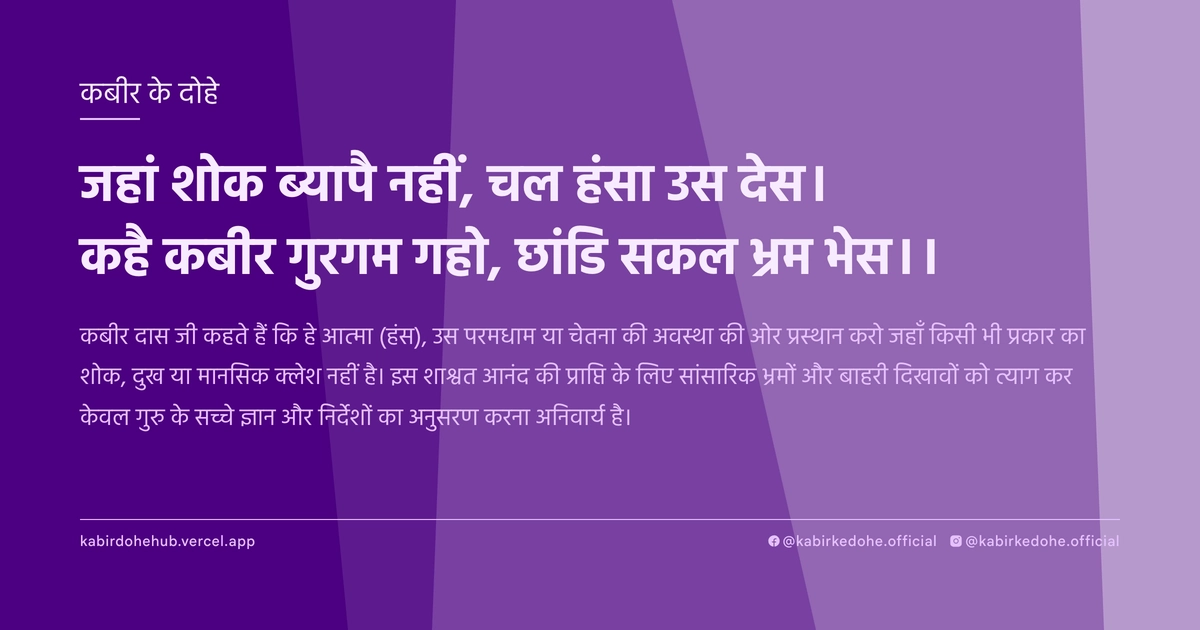
जहां शोक ब्यापै नहीं, चल हंसा उस देस।
कहै कबीर गुरगम गहो, छांडि सकल भ्रम भेस।।
Jahan shok vyapai nahin, chal hansa us des. Kahai kabir gurgam gaho, chhandi sakal bhram bhes.
इस पृष्ठ पर इस कबीर दोहे का अर्थ (meaning), हिंदी व्याख्या और अंग्रेज़ी अनुवाद, दार्शनिक विश्लेषण और व्यावहारिक जीवन सीख दी गई है। यह दोहा गुरु महत्व (The Guru's Importance) विषय से जुड़ा है — Kabir doha meaning and explanation in Hindi and English.
अर्थ (Meaning):
कबीर दास जी कहते हैं कि हे आत्मा (हंस), उस परमधाम या चेतना की अवस्था की ओर प्रस्थान करो जहाँ किसी भी प्रकार का शोक, दुख या मानसिक क्लेश नहीं है। इस शाश्वत आनंद की प्राप्ति के लिए सांसारिक भ्रमों और बाहरी दिखावों को त्याग कर केवल गुरु के सच्चे ज्ञान और निर्देशों का अनुसरण करना अनिवार्य है।
Kabir urges the soul, symbolized as the 'Hansa' (swan), to journey toward that supreme state of consciousness where sorrow and mental anguish do not exist. He emphasizes that to reach this eternal abode of peace, one must discard all worldly illusions and superficial identities, clinging solely to the authentic wisdom and guidance provided by the Guru.
व्याख्या (Interpretation):
इस दोहे में 'हंस' मानव आत्मा का प्रतीक है, जो अपनी शुद्धता और विवेक के कारण सत्य को पहचानने में सक्षम है। 'शोक' केवल बाहरी दुख नहीं, बल्कि वह अज्ञानता है जो हमें विरह और अभाव का अनुभव कराती है। कबीर यहाँ उस अवस्था की बात कर रहे हैं जहाँ द्वैत समाप्त हो जाता है और केवल अद्वैत सत्य शेष रहता है। 'भ्रम भेस' का अर्थ है वे सामाजिक, धार्मिक और व्यक्तिगत मुखौटे जिन्हें हम अपनी वास्तविक पहचान मान लेते हैं। जब साधक इन कृत्रिम परतों को हटाता है, तब वह माया के जाल से मुक्त होकर निर्गुण ब्रह्म में विलीन हो जाता है। यह यात्रा बाहरी नहीं, बल्कि आंतरिक चेतना का रूपांतरण है। गुरु का मार्ग यहाँ केवल एक व्यक्ति नहीं, बल्कि वह विवेक है जो आत्मा को उसके वास्तविक स्वरूप से मिलाता है।
In this couplet, the 'Hansa' (swan) symbolizes the human soul, possessing the innate purity and discernment to distinguish truth from falsehood. 'Sorrow' here refers not merely to emotional pain, but to the fundamental ignorance that creates a sense of separation and lack. Kabir points toward a state of being where duality vanishes, leaving only the non-dual reality of the Absolute. 'Bhram Bhes' refers to the social, religious, and personal masks we mistake for our true identity. When the seeker strips away these artificial layers, they break free from the web of Maya and merge into the Nirgun Brahman. This journey is not a physical migration but an internal transmutation of consciousness. The 'Guru's word' represents the awakened intellect or the spiritual catalyst that guides the soul back to its primordial source, resolving the paradox of being a finite creature yearning for the infinite.
दार्शनिक विश्लेषण (Philosophical Analysis):
कबीर का यह दर्शन निर्गुण भक्ति और अद्वैत वेदांत के संगम पर स्थित है। उन्होंने उस समय के कट्टरपंथ और कर्मकांडों का विरोध किया, जहाँ मोक्ष को केवल बाहरी अनुष्ठानों या तीर्थयात्राओं से जोड़ा गया था। कबीर के लिए 'देश' कोई भौगोलिक स्थान नहीं, बल्कि एक मानसिक और आध्यात्मिक स्थिति है। यह सूफी मत के 'फना' (अहंकार का विनाश) के करीब है, जहाँ साधक अपनी व्यक्तिगत पहचान को ईश्वर की व्यापकता में विलीन कर देता है।
यहाँ 'शोक' का मूल कारण 'माया' है। माया वह पर्दा है जो आत्मा को यह विश्वास दिलाता है कि वह शरीर है, नाम है, या किसी विशेष जाति का सदस्य है। जब यह भ्रम टूटता है, तो शोक स्वतः समाप्त हो जाता है क्योंकि शोक केवल उस व्यक्ति को होता है जो स्वयं को सीमित मानता है। अद्वैत वेदांत के अनुसार, जब जीव को यह बोध होता है कि वह स्वयं ब्रह्म है, तब भय और शोक का कोई स्थान नहीं रहता।
कबीर ने 'गुरगम' (गुरु के वचन) पर जोर दिया है क्योंकि बिना एक मार्गदर्शक के, मन अपनी पुरानी आदतों और भ्रमों के कारण पुनः माया में गिर जाता है। गुरु यहाँ वह दर्पण है जो साधक को उसके वास्तविक स्वरूप का दर्शन कराता है। यह प्रक्रिया मनोवैज्ञानिक रूप से 'अहंकार के विसर्जन' की है, जहाँ 'मैं' का विलोपन ही परम आनंद की कुंजी है।
ऐतिहासिक रूप से, कबीर ने समाज के सबसे निचले तबके को यह विश्वास दिलाया कि ईश्वर तक पहुँचने के लिए किसी मध्यस्थ या जटिल शास्त्र की आवश्यकता नहीं है। केवल आंतरिक ईमानदारी और सत्य की खोज पर्याप्त है। उन्होंने धर्म को मंदिर-मस्जिद से निकालकर हृदय की गहराई में स्थापित किया।
अंततः, यह दोहा हमें सिखाता है कि शांति कहीं बाहर खोजने की वस्तु नहीं है, बल्कि वह हमारे भीतर की वह स्थिति है जो तब प्रकट होती है जब हम अपने झूठे व्यक्तित्वों (भ्रम भेस) को त्याग देते हैं। यह एक क्रांतिकारी आह्वान है कि हम अपनी पहचान को संकीर्ण सीमाओं से मुक्त कर ब्रह्मांडीय चेतना में विलीन हो जाएं।
Kabir's philosophy in this verse stands at the intersection of Nirgun Bhakti and Advaita Vedanta. He vehemently opposed the rigid ritualism and orthodoxy of his era, which tethered salvation to external ceremonies or pilgrimages. For Kabir, the 'country' or 'abode' is not a geographical location but a state of consciousness. This aligns closely with the Sufi concept of 'Fana' (annihilation of the self), where the seeker dissolves their individual ego into the vastness of the Divine.
The root of 'sorrow' is identified as 'Maya'. Maya is the cosmic illusion that deceives the soul into believing it is merely a body, a name, or a member of a specific caste. When this illusion is pierced, sorrow ceases to exist because grief only affects those who perceive themselves as limited and separate entities. According to Advaita Vedanta, once the Jiva (individual soul) realizes its identity as Brahman (the Absolute), fear and sorrow vanish instantaneously.
Kabir emphasizes 'Gurgam' (the Guru's word) because, without a catalyst, the mind tends to revert to its habitual patterns of illusion. The Guru serves as a spiritual mirror, reflecting the seeker's true nature back to them. Psychologically, this is the process of 'ego-death,' where the dissolution of the 'I' becomes the gateway to supreme bliss.
Historically, Kabir empowered the marginalized by asserting that reaching the Divine required no intermediaries or complex scriptures. Only internal honesty and a relentless quest for truth were necessary. He shifted the locus of religion from the temple and mosque to the depths of the human heart.
Ultimately, this doha teaches that peace is not a destination to be reached but a state to be uncovered. It is the residue that remains when all false identities (Bhram Bhes) are stripped away. It is a revolutionary call to transcend narrow boundaries and merge with the universal consciousness.
मूल संदेश (Core Message):
- शोक अज्ञानता की उपज है, सत्य की नहीं।
- बाहरी पहचानें आध्यात्मिक प्रगति में बाधा हैं।
- गुरु का ज्ञान भ्रम के पर्दों को हटाने वाला शस्त्र है।
- शांति किसी स्थान में नहीं, चेतना की अवस्था में है।
- आत्मा का वास्तविक स्वरूप आनंदमय और अविनाशी है।
- Sorrow is a product of ignorance, not of truth.
- External identities are obstacles to spiritual evolution.
- The Guru's wisdom is the tool that strips away the veils of illusion.
- Peace is not a location, but a state of consciousness.
- The true nature of the soul is blissful and indestructible.
व्यावहारिक उदाहरण (Practical Example):
वाराणसी के एक पुराने घाट पर रहने वाली एक वृद्ध विधवा, जानकी, का जीवन केवल शोक और विरह के इर्द-गिर्द घूमता था। वह अपने मृत पति और बेटों की यादों के बोझ तले दबी थी, और उसका पूरा दिन केवल उनके लिए प्रार्थना करने और अपनी व्यथा को दोहराने में बीतता था। वह मानती थी कि उसका दुख ही उसकी एकमात्र पहचान है और इसी दुख के माध्यम से वह अपने प्रियजनों से जुड़ी हुई है।
एक दिन, घाट पर एक घुमंतू साधु आए, जिन्होंने जानकी की आँखों में गहरा खालीपन देखा। उन्होंने जानकी से कहा, "माता, आप जिस शोक को ओढ़े हुए हैं, वह आपका असली वस्त्र नहीं है, बल्कि एक भ्रम का भेस है। आप स्वयं को एक दुखी विधवा मान रही हैं, जबकि आप उस अनंत चेतना का हिस्सा हैं जिसे न जन्म दिया जा सकता है और न ही मृत्यु।"
जानकी को पहले यह बात अजीब लगी। उसने तर्क दिया कि उसके पास खोने के लिए बहुत कुछ था। साधु ने मुस्कुराते हुए पूछा, "क्या आपने कभी सोचा है कि वह कौन है जो इस दुख को महसूस कर रहा है? क्या वह दुख है, या वह आत्मा जो दुख को देख रही है?"
इस प्रश्न ने जानकी के भीतर एक हलचल पैदा कर दी। उसने महसूस किया कि वह वर्षों से 'दुख' नामक एक भूमिका निभा रही थी। उसने अपनी पहचान को केवल अपनी त्रासदियों से जोड़ लिया था। उसने महसूस किया कि उसका शोक वास्तव में उसकी अपनी 'अहंकार' की एक सूक्ष्म अभिव्यक्ति थी—यह विचार कि "मेरा दुख सबसे बड़ा है।"
अगले कुछ महीनों तक, जानकी ने साधु के मार्गदर्शन में मौन का अभ्यास किया। उसने अपनी यादों को पकड़कर रखने के बजाय, उन्हें केवल साक्षी भाव से देखना शुरू किया। उसने पाया कि जब वह अपनी 'विधवा' वाली पहचान को छोड़ देती है, तो वह केवल एक शुद्ध चैतन्य बन जाती है।
धीरे-धीरे, उसने घाट पर आने वाले अन्य दुखी लोगों की मदद करना शुरू किया। अब वह उन्हें अपनी व्यथा नहीं सुनाती थी, बल्कि उन्हें यह याद दिलाती थी कि वे इस संसार के दुखों से कहीं अधिक बड़े और पवित्र हैं।
एक दिन, उसने महसूस किया कि वह अब अपने पति और बेटों को याद तो करती है, लेकिन उस याद में अब कोई टीस नहीं थी। वह शोक अब एक शांत प्रेम में बदल गया था। उसने पाया कि वह 'देश' जहाँ शोक नहीं है, वास्तव में उसके भीतर ही था।
जानकी का रूपांतरण यह था कि उसने अपनी पहचान को 'दुख' से हटाकर 'करुणा' पर केंद्रित किया। उसने समझ लिया कि बाहरी दुनिया में कोई ऐसा स्थान नहीं है जहाँ दुख न हो, लेकिन भीतर एक ऐसा केंद्र है जो हर तूफान के बीच भी स्थिर रहता है।
Janaki, an elderly widow living on an old ghat in Varanasi, spent her life revolving around sorrow and separation. She was burdened by the memories of her deceased husband and sons, and her entire day was spent in prayers for them and repeating her grievances. She believed her grief was her only identity and the only thread connecting her to her loved ones.
One day, a wandering monk arrived at the ghat and noticed the profound emptiness in Janaki's eyes. He told her, "Mother, the sorrow you are wearing is not your true garment, but a mask of illusion. You identify yourself as a grieving widow, whereas you are a part of that infinite consciousness which can neither be born nor die."
Janaki initially found this absurd. She argued that she had lost too much. The monk smiled and asked, "Have you ever wondered who it is that feels this sorrow? Is it the sorrow itself, or the soul that is observing the sorrow?"
This question triggered a stir within Janaki. She realized she had been playing the role of 'the grieving one' for years. She had tethered her identity solely to her tragedies. She began to see that her sorrow was actually a subtle expression of the ego—the belief that "my pain is the most significant thing about me."
Over the next few months, under the monk's guidance, Janaki practiced silence. Instead of clinging to her memories, she began to observe them as a witness. She discovered that when she let go of the identity of the 'widow,' she became pure consciousness.
Gradually, she started helping other distressed people coming to the ghat. She no longer shared her own misery but reminded them that they were far greater and more sacred than the sorrows of this world.
One day, she realized that while she still remembered her husband and sons, the memory no longer carried a sting. The sorrow had transformed into a quiet, luminous love. She found that the 'country' where sorrow does not exist was actually within her.
Janaki's transformation lay in shifting her identity from 'grief' to 'compassion.' She understood that there is no place in the external world devoid of pain, but there is a center within that remains still amidst every storm.
अभ्यास मार्गदर्शन (Practice Guidance):
- दैनिक साक्षी भाव: दिन में तीन बार 10 मिनट के लिए बैठें और अपने विचारों को ऐसे देखें जैसे आप किसी अजनबी को देख रहे हों। स्वयं से पूछें, "क्या मैं यह विचार हूँ, या मैं वह हूँ जो इस विचार को देख रहा है?"
- भ्रम-भेस विश्लेषण: एक डायरी में उन सभी पहचानों की सूची बनाएं जिन्हें आप दुनिया के सामने पेश करते हैं (जैसे- पद, प्रतिष्ठा, पारिवारिक भूमिका)। फिर विचार करें कि यदि ये सब छीन लिए जाएं, तो आपका 'स्व' क्या बचेगा।
- मौन का अभ्यास: सप्ताह में एक दिन या दिन में कुछ घंटे पूर्ण मौन रहें। बाहरी शब्दों के शोर को कम करें ताकि आप भीतर की उस शांति को सुन सकें जहाँ शोक का अस्तित्व नहीं है।
- डायग्नोस्टिक चेकलिस्ट: यदि आप छोटी बातों पर विचलित होते हैं, दूसरों की सफलता से ईर्ष्या करते हैं, या अतीत की गलतियों पर पछताते हैं, तो इसका अर्थ है कि आप अभी भी 'भ्रम भेस' में हैं। यदि आप विपरीत परिस्थितियों में भी एक आंतरिक स्थिरता महसूस करते हैं, तो आप 'हंस' की यात्रा पर हैं।
- Daily Witnessing: Sit for 10 minutes three times a day and observe your thoughts as if you are watching a stranger. Ask yourself, "Am I this thought, or am I the one observing this thought?"
- Illusion-Mask Analysis: In a journal, list all the identities you present to the world (e.g., professional title, social status, family role). Then contemplate: if all these were stripped away, what would remain of your 'Self'?
- Practice of Silence: Observe complete silence for one day a week or a few hours a day. Reduce the noise of external words to hear the inner silence where sorrow has no existence.
- Diagnostic Checklist: If you are easily agitated by trivialities, feel envy toward others' success, or dwell in regret over past mistakes, you are still wearing the 'mask of illusion.' If you feel an inner stability even amidst adversity, you are on the journey of the 'Hansa'.
चिंतन प्रश्न (Reflection Questions):
- वह कौन सा 'भेस' या मुखौटा है जिसे मैं समाज में सबसे अधिक पहनता हूँ, और उसे उतारने का डर मुझे क्यों लगता है?
- क्या मेरा दुख वास्तव में किसी क्षति के कारण है, या यह मेरी उस इच्छा का परिणाम है कि चीजें मेरे अनुसार होनी चाहिए?
- यदि मैं अपनी सभी उपलब्धियों और रिश्तों को हटा दूँ, तो क्या मैं उस शून्य में शांति महसूस करूँगा या घबराहट?
- मैं अपनी आध्यात्मिक यात्रा में 'गुरु' किसे मानता हूँ—किसी व्यक्ति को, किसी पुस्तक को, या अपने स्वयं के विवेक को?
- क्या मैं वास्तव में शोक से मुक्त होना चाहता हूँ, या मैं अपने दुख को अपनी पहचान बनाकर उसमें सुरक्षित महसूस करता हूँ?
- Which 'mask' or identity do I wear most frequently in society, and why does the thought of removing it frighten me?
- Is my sorrow truly caused by a loss, or is it the result of my desire for things to be exactly as I wish?
- If I were to strip away all my achievements and relationships, would I feel peace in that void or anxiety?
- Who do I consider the 'Guru' in my spiritual journey—a person, a book, or my own inner discernment?
- Do I truly wish to be free from sorrow, or have I made my grief an identity in which I feel strangely secure?