
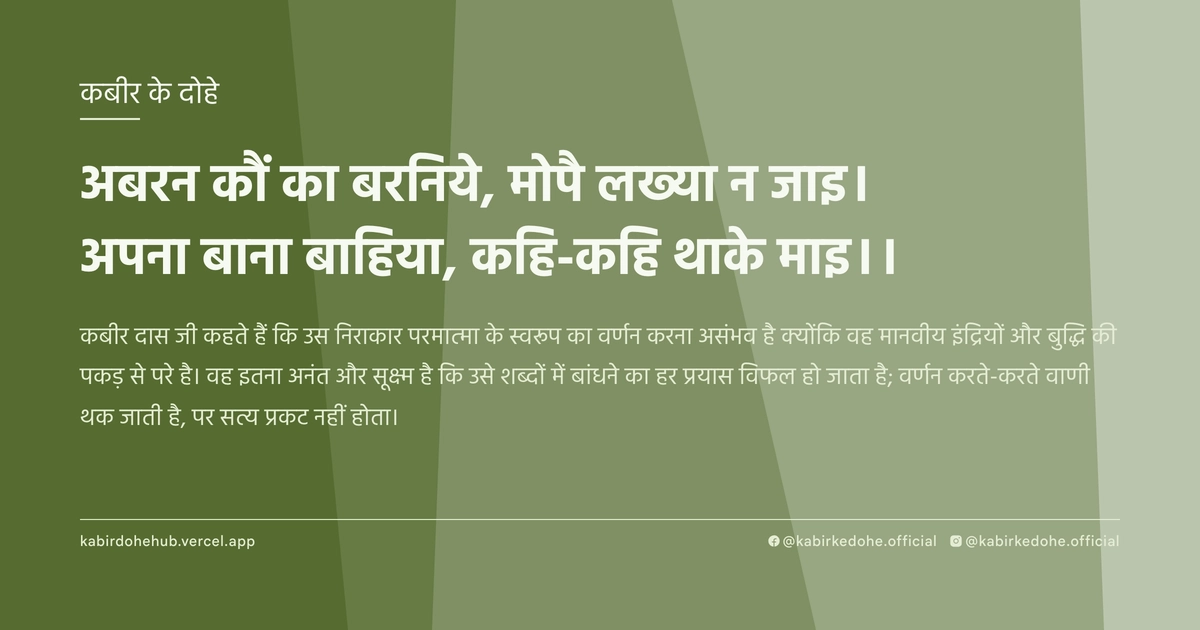
अबरन कौं का बरनिये, मोपै लख्या न जाइ।
अपना बाना बाहिया, कहि-कहि थाके माइ।।
Abran kaun ka barniye, mopai lakhya na jaaye. Apna bana bahiya, kahi-kahi thake mai.
इस पृष्ठ पर इस कबीर दोहे का अर्थ (meaning), हिंदी व्याख्या और अंग्रेज़ी अनुवाद, दार्शनिक विश्लेषण और व्यावहारिक जीवन सीख दी गई है। यह दोहा निर्गुण ब्रह्म (Nirguna Brahman) विषय से जुड़ा है — Kabir doha meaning and explanation in Hindi and English.
अर्थ (Meaning):
कबीर दास जी कहते हैं कि उस निराकार परमात्मा के स्वरूप का वर्णन करना असंभव है क्योंकि वह मानवीय इंद्रियों और बुद्धि की पकड़ से परे है। वह इतना अनंत और सूक्ष्म है कि उसे शब्दों में बांधने का हर प्रयास विफल हो जाता है; वर्णन करते-करते वाणी थक जाती है, पर सत्य प्रकट नहीं होता।
Kabir asserts that the nature of the Formless Divine is impossible to describe because it transcends human senses and intellectual grasp. The Divine is so infinite and subtle that every attempt to capture it in words fails; the tongue grows weary from speaking, yet the ultimate Truth remains unuttered and elusive.
व्याख्या (Interpretation):
इस दोहे का शाब्दिक अर्थ है कि ईश्वर के गुणों का वर्णन करना कठिन है। आध्यात्मिक स्तर पर, यह 'नेति-नेति' (यह नहीं, वह नहीं) के सिद्धांत को दर्शाता है। कबीर यहाँ निर्गुण भक्ति की बात कर रहे हैं, जहाँ ईश्वर किसी आकार, रंग या गुण में सीमित नहीं है। 'बाना' यहाँ केवल वस्त्र नहीं, बल्कि वह मायावी आवरण है जिसके पीछे सत्य छिपा है। जब साधक अपनी सीमित बुद्धि से उस असीम को मापने की कोशिश करता है, तो वह केवल शब्दों के जाल में फंसता है। यह द्वैत (साधक और ईश्वर) के बीच के अंतराल को दर्शाता है, जिसे केवल अनुभव के माध्यम से ही मिटाया जा सकता है, वर्णन के माध्यम से नहीं।
Literally, the verse speaks of the difficulty in describing God. Spiritually, it embodies the principle of 'Neti-Neti' (not this, not that). Kabir invokes Nirgun Bhakti, where the Divine is not confined by form, color, or attribute. 'Baana' refers not just to clothing, but to the illusory veil of Maya hiding the Truth. When a seeker attempts to measure the Infinite with a finite intellect, they become trapped in a web of words. This highlights the gap between the duality of the seeker and the Divine—a gap that can only be bridged through direct experiential realization (Anubhava), not through linguistic description.
दार्शनिक विश्लेषण (Philosophical Analysis):
कबीर का यह दोहा मध्यकालीन भारत के उस दौर का है जब धर्म कर्मकांडों और बाहरी प्रतीकों में उलझा था। कबीर ने स्पष्ट रूप से उन पंडितों और मुल्लाओं को चुनौती दी जो ईश्वर को किताबों या परिभाषाओं में सीमित करते थे। उनका दर्शन अद्वैत वेदांत के करीब है, जहाँ आत्मा और ब्रह्म एक ही हैं, लेकिन अज्ञानता के कारण अलग प्रतीत होते हैं।
यहाँ सूफी मत का प्रभाव भी दिखता है, जहाँ 'फना' (अहंकार का विनाश) के बिना सत्य का साक्षात्कार संभव नहीं है। कबीर तर्क देते हैं कि यदि हम ईश्वर को शब्दों में परिभाषित कर सकते हैं, तो हम उसे सीमित कर रहे हैं। वास्तविक सत्य 'अनिर्वाचनीय' है।
यह विश्लेषण हमें बताता है कि भाषा केवल संकेत दे सकती है, गंतव्य नहीं हो सकती। जब हम कहते हैं कि 'ईश्वर दयालु है', तो हम मानवीय दया की परिभाषा को ईश्वर पर थोप रहे होते हैं। कबीर इस मानसिक प्रक्षेपण (projection) को तोड़ने की बात करते हैं।
सामाजिक रूप से, यह संदेश जाति और संप्रदाय की दीवारों को गिराता है। यदि ईश्वर का कोई वर्णन संभव नहीं है, तो किसी एक समूह का दावा कि 'ईश्वर ऐसा है', पूरी तरह गलत है। यह सभी के लिए समान आध्यात्मिक द्वार खोलता है।
अंततः, यह मनोवैज्ञानिक रूपांतरण की मांग करता है। यह हमें बौद्धिक अहंकार से मुक्त कर मौन की ओर ले जाता है। जब शब्द समाप्त होते हैं, वहीं से वास्तविक आध्यात्मिक यात्रा शुरू होती है।
This couplet emerges from a medieval Indian era where religion was entangled in rituals and external symbols. Kabir explicitly challenged the pundits and mullahs who attempted to confine God within books or rigid definitions. His philosophy aligns closely with Advaita Vedanta, suggesting that Atman and Brahman are one, appearing separate only due to Avidya (ignorance).
The influence of Sufism is evident here, emphasizing that without 'Fana' (the annihilation of the ego), the realization of Truth is impossible. Kabir argues that if we can define God in words, we are limiting the Infinite. The ultimate Truth is 'Anirvachaniya'—ineffable.
This analysis reveals that language can only provide pointers, not the destination. When we claim 'God is merciful,' we are projecting human definitions of mercy onto the Divine. Kabir seeks to shatter this psychological projection.
Socially, this message dismantles the walls of caste and sect. If the Divine defies description, then any group claiming an exclusive definition of God is fundamentally mistaken. This opens a universal spiritual gateway for all humanity.
Ultimately, it demands a psychological transformation. It urges the seeker to move from intellectual arrogance toward the sanctuary of silence. Where words end, the true spiritual journey begins.
मूल संदेश (Core Message):
- शब्द सत्य की ओर इशारा करते हैं, वे स्वयं सत्य नहीं हैं।
- बौद्धिक अहंकार आध्यात्मिक जागृति का सबसे बड़ा अवरोध है।
- परमात्मा को परिभाषित करना उसे सीमित करने का प्रयास है।
- मौन वह भाषा है जिसे आत्मा और परमात्मा दोनों समझते हैं।
- सत्य का अनुभव किया जाता है, उसे शब्दों में वर्णित नहीं किया जा सकता।
- Words are pointers to the Truth, not the Truth itself.
- Intellectual ego is the greatest obstacle to spiritual awakening.
- To define the Divine is to attempt to limit the Limitless.
- Silence is the only language understood by both the Soul and the Divine.
- Truth is to be experienced, not described in linguistic terms.
व्यावहारिक उदाहरण (Practical Example):
एक समय की बात है, वाराणसी के घाटों पर रहने वाला एक वृद्ध बुनकर था, जिसका नाम माधव था। माधव अपनी पूरी जिंदगी बेहतरीन रेशमी वस्त्र बुनने में बिता चुका था। वह मानता था कि दुनिया की हर चीज को एक सही पैटर्न या डिजाइन में बांधा जा सकता है। वह अक्सर अन्य बुनकरों से बहस करता कि कौन सा रंग सबसे पवित्र है और कौन सा धागा सबसे मजबूत।
माधव का अहंकार उसकी कला में था। वह सोचता था कि उसने जीवन के सारे रहस्य समझ लिए हैं क्योंकि वह जटिल से जटिल डिजाइन बना सकता था। वह ईश्वर को भी एक महान बुनकर मानता था जिसने दुनिया को एक निश्चित योजना के अनुसार बुना है।
एक दिन उसकी मुलाकात एक फकीर से हुई, जिसने माधव के सबसे महंगे वस्त्र को देखा और मुस्कुराते हुए कहा, "यह सुंदर है, लेकिन क्या तुम उस धागे का वर्णन कर सकते हो जिससे यह पूरा ब्रह्मांड बुना गया है?"
माधव ने गर्व से कई रंगों और रेशमों के नाम गिनाए। उसने घंटों तक अपनी शब्दावली का प्रदर्शन किया, यह बताते हुए कि कैसे सूक्ष्मता और मजबूती का संतुलन होता है। लेकिन फकीर चुपचाप सुनता रहा।
जैसे-जैसे माधव बोलता गया, उसे महसूस हुआ कि वह जितना अधिक वर्णन कर रहा था, वह उतना ही भ्रमित होता जा रहा था। उसके शब्द उसे सत्य के करीब नहीं, बल्कि दूर ले जा रहे थे। वह थक गया और चुप हो गया।
उस सन्नाटे में, माधव ने पहली बार महसूस किया कि वह जिसे 'डिजाइन' समझ रहा था, वह वास्तव में एक अनंत प्रवाह था। उसने महसूस किया कि उसकी पूरी जिंदगी केवल बाहरी आवरणों (बाना) को सजाने में बीती थी, जबकि भीतर का शून्य पूरी तरह खाली था।
उसने अपनी सारी उपलब्धियों का अहंकार त्याग दिया। उसने महसूस किया कि शब्दों के माध्यम से ईश्वर को पकड़ना वैसा ही है जैसे समुद्र को एक छोटे से प्याले में भरने की कोशिश करना।
माधव का व्यवहार बदल गया। अब वह अपनी कला का प्रदर्शन नहीं करता था, बल्कि उसे एक प्रार्थना की तरह बुनता था। उसने यह स्वीकार कर लिया कि वह कभी नहीं जान पाएगा कि ईश्वर क्या है, और इसी 'न जानने' की विनम्रता में उसे परम शांति मिली।
Once, on the ghats of Varanasi, lived an elderly weaver named Madhav. Madhav had spent his entire life weaving the finest silk fabrics. He believed that everything in the world could be captured in a perfect pattern or design. He often debated with other weavers about which color was the most sacred and which thread the strongest.
Madhav's ego resided in his craft. He believed he had unlocked the secrets of existence because he could create the most intricate designs. He viewed God as a Great Weaver who had woven the world according to a strict, definable plan.
One day, he met a wandering fakir. The fakir looked at Madhav's most expensive garment and smiled, asking, "This is beautiful, but can you describe the thread from which the entire universe is woven?"
Proudly, Madhav listed countless colors and types of silk. He spent hours showcasing his vocabulary, explaining the balance of subtlety and strength. The fakir remained silently observant.
As Madhav continued to speak, he realized that the more he described, the more confused he became. His words were not leading him toward the Truth, but away from it. Eventually, he grew exhausted and fell silent.
In that profound silence, Madhav felt for the first time that what he perceived as a 'design' was actually an infinite flow. He realized his whole life had been spent decorating external veils (baana), while his inner void remained untouched.
He surrendered the ego of his achievements. He understood that trying to capture God through words was like trying to fit the entire ocean into a small cup.
Madhav's behavior transformed. He no longer wove for prestige or display, but treated his craft as a silent prayer. He accepted that he would never 'know' what God is, and in this humility of 'not knowing,' he found ultimate peace.
अभ्यास मार्गदर्शन (Practice Guidance):
- प्रतिदिन 20 मिनट 'मौन साधना' करें। किसी भी विचार या शब्द को परिभाषित करने की कोशिश न करें, बस साक्षी भाव से देखें।
- एक डायरी रखें जिसमें आप अपने उन विश्वासों को लिखें जिन्हें आप 'परम सत्य' मानते हैं, और फिर उनके सामने लिखें: "यह केवल मेरा विचार है, सत्य नहीं।"
- जब भी आप किसी आध्यात्मिक अनुभव को शब्दों में व्यक्त करने की कोशिश करें, तो रुकें और महसूस करें कि शब्द कैसे उस अनुभव को सीमित कर रहे हैं।
- डायग्नोस्टिक चेकलिस्ट: क्या आप अभी भी ईश्वर या सत्य को किसी विशेष धर्म, किताब या परिभाषा में खोज रहे हैं? यदि हाँ, तो आप अभी भी 'बाना' (आवरण) में फंसे हैं।
- Practice 20 minutes of 'Silent Meditation' daily. Do not attempt to define any thought or feeling; simply observe as a witness.
- Maintain a journal where you list beliefs you consider 'Absolute Truths,' and next to each, write: "This is merely my perception, not the Truth."
- Whenever you attempt to verbalize a spiritual experience, pause and notice how the words limit and diminish the actual feeling.
- Diagnostic Checklist: Are you still searching for God or Truth within a specific religion, book, or definition? If yes, you are still trapped in the 'Baana' (veil).
चिंतन प्रश्न (Reflection Questions):
- क्या मेरी धार्मिक पहचान वास्तव में सत्य की खोज है, या केवल एक सामाजिक मुखौटा है?
- मैं अपनी डिजिटल पहचान (सोशल मीडिया) के माध्यम से खुद को कैसे परिभाषित करता हूँ, और वह मेरे वास्तविक स्वरूप से कितना अलग है?
- यदि मुझसे मेरे सभी विचार, नाम और पद छीन लिए जाएं, तो मेरे भीतर क्या बचेगा?
- मैं किन पूर्वाग्रहों को 'सत्य' मानकर दूसरों को आंकता हूँ?
- क्या मैं मौन रहने से डरता हूँ क्योंकि वहां मेरा अहंकार जीवित नहीं रह पाता?
- Is my religious identity a genuine search for Truth, or merely a social mask?
- How do I define myself through my digital identity, and how far is that from my actual essence?
- If all my thoughts, names, and titles were stripped away, what would remain within me?
- Which biases do I mistake for 'Truth' when judging others?
- Do I fear silence because my ego cannot survive in its presence?