
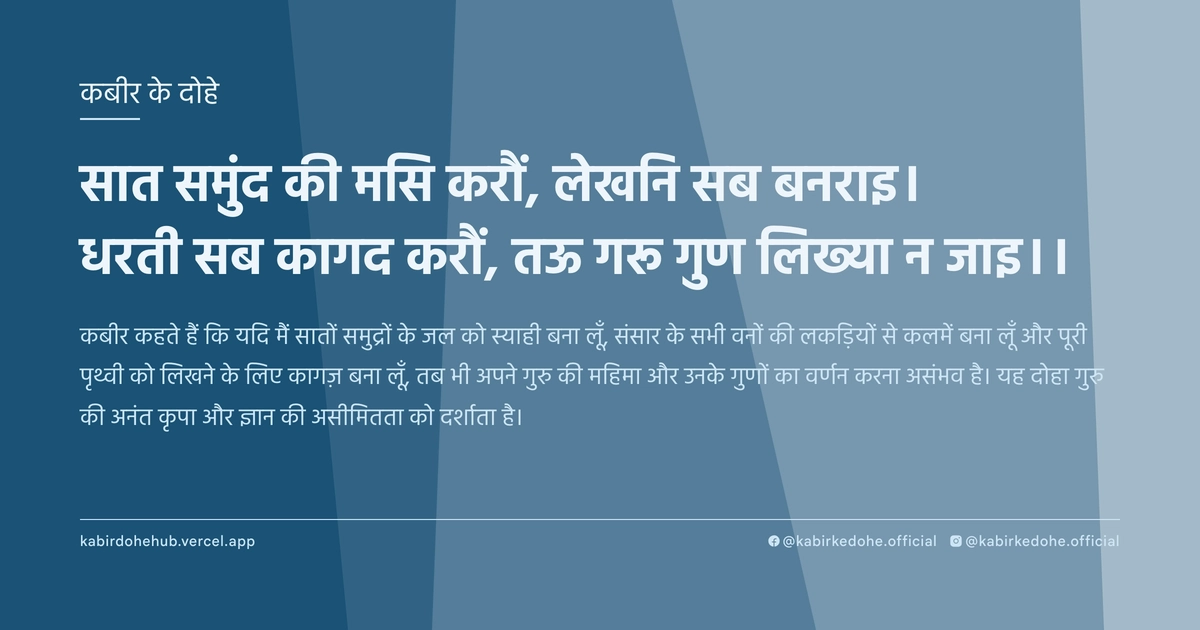
सात समुंद की मसि करौं, लेखनि सब बनराइ।
धरती सब कागद करौं, तऊ गरू गुण लिख्या न जाइ।।
Saat samund ki masi karaun, lekhani sab banrai. Dharti sab kagad karaun, tau guru gun likhya na jaaye.
इस पृष्ठ पर इस कबीर दोहे का अर्थ (meaning), हिंदी व्याख्या और अंग्रेज़ी अनुवाद, दार्शनिक विश्लेषण और व्यावहारिक जीवन सीख दी गई है। यह दोहा गुरु महत्व (The Guru's Importance) विषय से जुड़ा है — Kabir doha meaning and explanation in Hindi and English.
अर्थ (Meaning):
कबीर कहते हैं कि यदि मैं सातों समुद्रों के जल को स्याही बना लूँ, संसार के सभी वनों की लकड़ियों से कलमें बना लूँ और पूरी पृथ्वी को लिखने के लिए कागज़ बना लूँ, तब भी अपने गुरु की महिमा और उनके गुणों का वर्णन करना असंभव है। यह दोहा गुरु की अनंत कृपा और ज्ञान की असीमितता को दर्शाता है।
Kabir proclaims that even if he were to turn the waters of the seven seas into ink, fashion writing pens from every forest in existence, and transform the entire earth into parchment, he would still be unable to fully document the virtues and grace of the Guru. This verse emphasizes the infinite nature of spiritual enlightenment and the boundless debt owed to the teacher.
व्याख्या (Interpretation):
यह दोहा गुरु की भौतिक उपस्थिति से परे उनकी आध्यात्मिक ऊर्जा का वर्णन करता है। यहाँ 'सात समुद्र' और 'पूरी धरती' सांसारिक सीमाओं के प्रतीक हैं, जबकि 'गुरु के गुण' उस निराकार सत्य (Nirgun) का प्रतिनिधित्व करते हैं जिसे शब्दों में नहीं बांधा जा सकता। यह अद्वैत वेदांत के उस सिद्धांत को पुष्ट करता है जहाँ गुरु केवल एक व्यक्ति नहीं, बल्कि वह माध्यम है जो आत्मा (Atman) का ब्रह्म (Brahman) से मिलन कराता है। माया के पर्दे को हटाने वाला यह ज्ञान इतना गहरा है कि कोई भी भौतिक संसाधन इसे मापने में सक्षम नहीं है। यह विरोधाभास है कि जो सत्य शब्दों से परे है, उसे शब्दों के माध्यम से ही खोजने का प्रयास किया जाता है। अंततः, यह दोहा शिष्य के अहंकार के विसर्जन और पूर्ण समर्पण की बात करता है।
This couplet transcends the physical presence of a teacher to describe the spiritual energy of the Guide. The 'seven seas' and 'entire earth' symbolize the finite boundaries of the material world, while the 'Guru's virtues' represent the Formless Truth (Nirgun) that defies linguistic capture. It aligns with Advaita Vedanta, where the Guru is not merely a person but the catalyst facilitating the union of Atman and Brahman. The wisdom that pierces the veil of Maya is so profound that no physical resource can quantify it. It highlights the central paradox: the Truth that is beyond words is often sought through the medium of language. Ultimately, the verse speaks to the dissolution of the disciple's ego and the necessity of absolute surrender to the infinite.
दार्शनिक विश्लेषण (Philosophical Analysis):
कबीर का यह दृष्टिकोण उनके समय के कर्मकांडीय धर्म के विरुद्ध एक सशक्त प्रहार था। उस युग में ज्ञान केवल शास्त्रों और संस्कृत भाषा तक सीमित था, लेकिन कबीर ने यह स्थापित किया कि वास्तविक ज्ञान (Siddha) अनुभवजन्य है, न कि किताबी। वे बताते हैं कि गुरु की महिमा किसी ग्रंथ में नहीं, बल्कि उस परिवर्तन में है जो वह शिष्य के भीतर लाता है।
दार्शनिक स्तर पर, यह सूफीवाद के 'पीर' और वेदांत के 'गुरु' के समन्वय को दर्शाता है। सूफी परंपरा में 'इश्क-ए-इलाही' (ईश्वरीय प्रेम) की प्राप्ति बिना मार्गदर्शक के असंभव है। कबीर यहाँ यह स्पष्ट कर रहे हैं कि गुरु वह दर्पण है जिसमें शिष्य अपना वास्तविक स्वरूप देखता है। जब अहंकार मिटता है, तब गुरु और शिष्य के बीच का द्वैत समाप्त हो जाता है।
यह दोहा इस बात पर जोर देता है कि सत्य 'अनिर्वाचनीय' (ineffable) है। जिस प्रकार पानी की प्यास पानी पीकर ही बुझती है, उसी प्रकार सत्य का अनुभव केवल अनुभव से होता है, वर्णन से नहीं। कबीर ritualism (कर्मकांड) का विरोध करते हुए कहते हैं कि बाहरी दिखावे या लंबी प्रार्थनाओं से अधिक महत्वपूर्ण वह आंतरिक जागृति है जो एक समर्थ गुरु प्रदान करता है।
मनोवैज्ञानिक रूप से, यह शिष्य में 'विनम्रता' का संचार करता है। जब हम यह स्वीकार करते हैं कि सत्य हमारी समझ और संसाधनों से कहीं बड़ा है, तब हमारा अहंकार स्वतः ही गिर जाता है। यही वह बिंदु है जहाँ से वास्तविक आध्यात्मिक यात्रा शुरू होती है।
अंततः, कबीर यहाँ गुरु को ईश्वर का ही एक रूप मानते हैं। उनके लिए गुरु वह द्वार है जिससे गुजरकर साधक उस शून्य (Sunya) में प्रवेश करता है जहाँ न कोई नाम है, न कोई रूप, केवल शुद्ध चेतना है। यह भौतिकता के पूर्ण त्याग और आध्यात्मिक अनंतता के प्रति समर्पण का आह्वान है।
Kabir's perspective serves as a potent critique of the ritualistic religion of his era. During a time when knowledge was restricted to scriptures and the Sanskrit language, Kabir established that true realization (Siddha) is experiential, not academic. He asserts that the Guru's greatness lies not in texts, but in the internal transformation they ignite within the disciple.
Philosophically, this reflects a synthesis of the Sufi 'Pir' and the Vedantic 'Guru'. In Sufism, attaining 'Ishq-e-Ilahi' (Divine Love) is nearly impossible without a guide. Kabir clarifies that the Guru is the mirror in which the disciple perceives their true essence. As the ego dissolves, the duality between the teacher and the taught vanishes.
The verse emphasizes that Truth is 'Anirvachaniya' (ineffable). Just as thirst is quenched only by drinking water, Truth is realized only through experience, not description. Opposing ritualism, Kabir suggests that internal awakening provided by a capable Guru is far more vital than external displays or lengthy prayers.
Psychologically, this fosters profound humility. By acknowledging that Truth exceeds our intellectual and material resources, the ego naturally collapses. This surrender is the precise point where the authentic spiritual journey commences.
Ultimately, Kabir views the Guru as a manifestation of the Divine. To him, the Guru is the gateway to the 'Sunya' (Void), where names and forms cease to exist, leaving only pure consciousness. It is a call for the total abandonment of materiality in favor of spiritual infinity.
मूल संदेश (Core Message):
- शब्द सत्य की ओर इशारा कर सकते हैं, लेकिन वे स्वयं सत्य नहीं हैं।
- गुरु की वास्तविक महिमा उनके शब्दों में नहीं, बल्कि उनके द्वारा लाए गए परिवर्तन में है।
- अहंकार का विसर्जन ही अनंत ज्ञान के द्वार खोलने की एकमात्र कुंजी है।
- भौतिक संसाधन आध्यात्मिक गहराई को मापने के लिए अपर्याप्त हैं।
- सत्य का अनुभव व्यक्तिगत और आंतरिक होता है, जिसे किसी कागज़ पर नहीं उतारा जा सकता।
- Words can point toward the Truth, but they are not the Truth themselves.
- The true glory of a Guru lies in the transformation they ignite, not in their words.
- The dissolution of ego is the only key to unlocking infinite knowledge.
- Material resources are insufficient to measure spiritual depth.
- The experience of Truth is personal and internal, impossible to transcribe on parchment.
व्यावहारिक उदाहरण (Practical Example):
एक समय की बात है, वाराणसी के घाटों पर माधव नाम का एक वृद्ध बुनकर रहता था। माधव अपनी कला में निपुण था, लेकिन उसका मन हमेशा इस बात से अशांत रहता था कि वह जीवन का उद्देश्य नहीं समझ पा रहा है। वह बड़े-बड़े पंडितों के पास गया, कठिन ग्रंथों को पढ़ा, और कई तीर्थों की यात्रा की, लेकिन उसके भीतर का खालीपन नहीं गया।
एक दिन उसकी मुलाकात एक फकीर से हुई जो एक पुराने बरगद के पेड़ के नीचे चुपचाप बैठा था। माधव ने उनसे पूछा, "स्वामी, मैंने सब कुछ पढ़ लिया, सब जगह घूम लिया, फिर भी शांति कहाँ है?"
फकीर ने कोई लंबा उपदेश नहीं दिया। उन्होंने बस माधव को अपने पास बैठने को कहा और उसके हाथ से करघे का धागा पकड़कर उसे एक विशेष लय में बुनने को कहा। फकीर ने कहा, "माधव, तू धागों को देख रहा है, लेकिन उस खाली स्थान को देख जो धागों के बीच है। वही असली कपड़ा है।"
माधव पहले तो उलझन में पड़ गया। उसने सोचा कि यह कैसी अजीब बात है। लेकिन अगले सात दिनों तक वह हर दिन उस फकीर के पास गया। फकीर ने उसे केवल मौन रहना और अपनी सांसों के प्रति जागरूक होना सिखाया। धीरे-धीरे माधव को समझ आया कि वह अब तक केवल 'बाहरी' दुनिया के धागों को जोड़ने की कोशिश कर रहा था, जबकि उसके भीतर का 'शून्य' ही वह असली सत्य था जिसे वह खोज रहा था।
एक शाम, जब माधव ने अपनी आँखें बंद कीं, उसे महसूस हुआ कि वह और वह फकीर, वह करघा और वह पूरा ब्रह्मांड एक ही ऊर्जा से बने हैं। उसकी सारी किताबी शिक्षा और तीर्थयात्राएं उस एक क्षण के अनुभव के सामने तुच्छ लगने लगीं।
उसे एहसास हुआ कि जिस शांति को वह हज़ारों पन्नों में खोज रहा था, वह तो गुरु के एक छोटे से इशारे और मौन मार्गदर्शन में छिपी थी। वह समझ गया कि गुरु का गुण शब्दों में नहीं, बल्कि उस 'परिवर्तन' में है जो उसने माधव के भीतर किया।
माधव का जीवन बदल गया। अब वह केवल कपड़े नहीं बुनता था, बल्कि हर धागे में उस अनंत परमात्मा को देखता था। उसने अपनी सारी संपत्ति गरीबों में बाँट दी और एक सरल जीवन जीने लगा।
गाँव के लोग हैरान थे कि एक साधारण सा फकीर कैसे माधव जैसे विद्वान बुनकर को बदल सकता है। माधव बस मुस्कुराता और कहता, "जिसके पास वह चाबी है जो हृदय का ताला खोल दे, उसकी महिमा को लिखने के लिए पूरी दुनिया का कागज़ भी कम है।"
इस प्रकार, माधव ने अनुभव किया कि गुरु वह नहीं जो जानकारी दे, बल्कि वह है जो अज्ञान की परतों को हटा दे।
Once, in the ghats of Varanasi, lived an elderly weaver named Madhav. Madhav was a master of his craft, yet his mind was perpetually restless, unable to grasp the purpose of existence. He consulted renowned pundits, pored over complex scriptures, and visited numerous shrines, yet the void within him remained unfilled.
One day, he encountered a Fakir sitting silently beneath an ancient banyan tree. Madhav asked, "Swami, I have read everything and traveled everywhere, yet where is peace?"
The Fakir offered no lengthy sermon. He simply asked Madhav to sit beside him and hold the threads of the loom in a specific rhythm. The Fakir whispered, "Madhav, you are looking at the threads, but look at the empty space between them. That space is the true fabric."
Madhav was initially perplexed. He wondered why the Fakir was speaking in such riddles. However, for the next seven days, he returned to the Fakir. The teacher taught him nothing but silence and awareness of his own breath.
Gradually, Madhav realized that he had spent his entire life trying to connect the 'external' threads of existence, while the 'Void' within him was the very Truth he sought.
One evening, closing his eyes, Madhav felt that he, the Fakir, the loom, and the entire universe were woven from the same singular energy. All his academic learning and pilgrimages felt trivial compared to this one moment of realization.
He understood that the peace he sought in thousands of pages was hidden in a single gesture and the silent guidance of the Guru. He realized that the Guru's virtue is not in words, but in the 'transformation' they ignite.
Madhav's life changed. He no longer just wove cloth; he saw the infinite Divine in every thread. He distributed his wealth among the poor and embraced a life of profound simplicity.
Villagers were astonished that a simple Fakir could transform a learned man like Madhav. Madhav would only smile and say, "For the one who holds the key to unlock the heart, the entire world's parchment is insufficient to record their glory."
Thus, Madhav experienced that a Guru is not one who provides information, but one who strips away the layers of ignorance.
अभ्यास मार्गदर्शन (Practice Guidance):
- प्रतिदिन 20 मिनट का मौन अभ्यास करें, जहाँ आप किसी विचार को पकड़ने के बजाय केवल अपने अस्तित्व के साक्षी बनें।
- एक 'कृतज्ञता पत्रिका' (Gratitude Journal) बनाएँ, जिसमें आप उन सूक्ष्म मार्गदर्शनों को लिखें जिन्होंने आपके जीवन की दिशा बदली, चाहे वे किसी व्यक्ति से मिले हों या किसी घटना से।
- अपने भीतर के 'अहंकार' की पहचान करें: जब भी आपको लगे कि आप 'सब जानते हैं', तो सचेत रूप से खुद को याद दिलाएं कि सत्य अनंत है और आपकी समझ सीमित।
- व्यवहार परिवर्तन: किसी ऐसे व्यक्ति की मदद करें जो आपसे सामाजिक या आर्थिक रूप से नीचे हो, बिना यह सोचे कि आप उन पर कोई उपकार कर रहे हैं।
- डायग्नोस्टिक चेकलिस्ट: क्या आप अभी भी सत्य को केवल किताबों में खोज रहे हैं? क्या आप दूसरों को सुधारने की कोशिश करते हैं जबकि स्वयं का अवलोकन नहीं करते? यदि हाँ, तो आप अभी भी माया के प्रभाव में हैं।
- Practice 20 minutes of daily silence, where you act as a witness to your existence rather than clinging to specific thoughts.
- Maintain a 'Gratitude Journal' to record subtle guidances that shifted your life's direction, whether received from a person or a circumstantial event.
- Identify the 'Ego' within: whenever you feel you 'know everything', consciously remind yourself that Truth is infinite and your understanding is finite.
- Behavioral Shift: Help someone socially or economically disadvantaged without the perception that you are doing them a favor.
- Diagnostic Checklist: Are you still seeking Truth solely in books? Do you attempt to correct others while neglecting self-observation? If so, you remain under the influence of Maya.
चिंतन प्रश्न (Reflection Questions):
- क्या मैं वास्तव में ज्ञान की खोज कर रहा हूँ, या मैं केवल अपनी बौद्धिक श्रेष्ठता को सिद्ध करने के लिए जानकारी इकट्ठा कर रहा हूँ?
- मेरे जीवन में 'गुरु' कौन है—एक व्यक्ति, या वह जागरूकता जो मुझे मेरी गलतियों का अहसास कराती है?
- यदि मेरे पास कोई पद, उपाधि या डिजिटल पहचान न हो, तो मेरी आत्मा की वास्तविक कीमत क्या होगी?
- मैं किन पूर्वाग्रहों को सत्य मानकर बैठा हूँ, जो मुझे वास्तविक बोध से दूर रख रहे हैं?
- क्या मैं मौन के डर से शब्दों का सहारा लेता हूँ ताकि मुझे अपने आंतरिक खालीपन का सामना न करना पड़े?
- Am I truly seeking knowledge, or am I merely collecting information to validate my intellectual superiority?
- Who is the 'Guru' in my life—a physical person, or the awareness that alerts me to my own errors?
- If I possessed no title, rank, or digital identity, what would be the actual value of my soul?
- Which biases have I mistaken for Truth, and how are they distancing me from actual realization?
- Do I cling to words out of a fear of silence, simply to avoid facing my own internal void?