
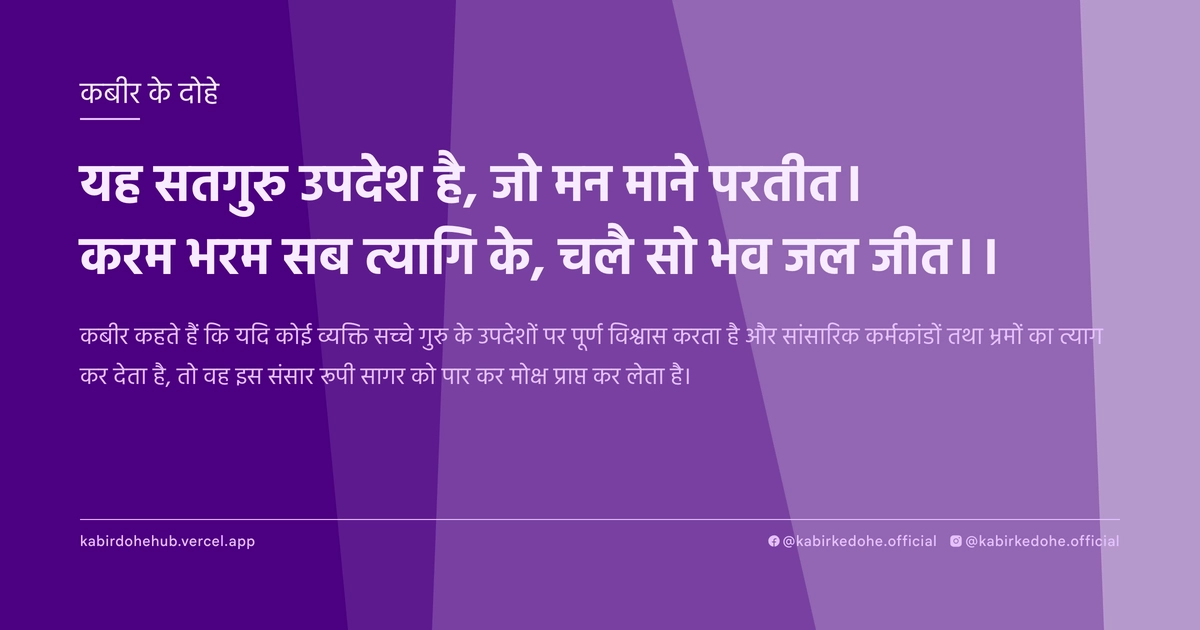
यह सतगुरु उपदेश है, जो मन माने परतीत।
करम भरम सब त्यागि के, चलै सो भव जल जीत।।
Yeh satguru updesh hai, jo man maane parteet. Karam bharam sab tyagi ke, chalai so bhav jal jeet.
इस पृष्ठ पर इस कबीर दोहे का अर्थ (meaning), हिंदी व्याख्या और अंग्रेज़ी अनुवाद, दार्शनिक विश्लेषण और व्यावहारिक जीवन सीख दी गई है। यह दोहा गुरु महत्व (The Guru's Importance) विषय से जुड़ा है — Kabir doha meaning and explanation in Hindi and English.
अर्थ (Meaning):
कबीर कहते हैं कि यदि कोई व्यक्ति सच्चे गुरु के उपदेशों पर पूर्ण विश्वास करता है और सांसारिक कर्मकांडों तथा भ्रमों का त्याग कर देता है, तो वह इस संसार रूपी सागर को पार कर मोक्ष प्राप्त कर लेता है।
Kabir asserts that one who places absolute trust in the teachings of the True Guru and renounces the illusions of ritualistic actions and worldly attachments is the one who successfully crosses the treacherous ocean of worldly existence to attain liberation.
व्याख्या (Interpretation):
इस दोहे का शाब्दिक अर्थ है कि गुरु का ज्ञान ही एकमात्र नौका है। यहाँ 'परतीत' का अर्थ केवल विश्वास नहीं, बल्कि एक ऐसा अनुभव है जहाँ संदेह समाप्त हो जाता है। 'करम भरम' उन बाहरी दिखावों और कर्मकांडों को दर्शाता है जिन्हें लोग मोक्ष का साधन मानते हैं, जबकि वे वास्तव में अहंकार को पुष्ट करते हैं। निरगुण भक्ति के संदर्भ में, यह संकेत देता है कि ईश्वर किसी बाहरी क्रिया में नहीं, बल्कि आंतरिक समर्पण में है। माया हमें यह विश्वास दिलाती है कि हम कर्मों के माध्यम से ईश्वर को 'खरीद' सकते हैं, जबकि सत्य यह है कि केवल अहंकार का विसर्जन ही मुक्ति का मार्ग है। यह अद्वैत वेदांत के उस सिद्धांत को पुष्ट करता है जहाँ जीव और ब्रह्म की एकता केवल तब अनुभव होती है जब 'मैं' का भ्रम मिट जाता है। अंततः, भव-जल को जीतना वास्तव में जन्म-मृत्यु के चक्र से ऊपर उठकर शुद्ध चेतना में विलीन होना है।
Literally, the verse suggests that the Guru's instruction is the only viable vessel for crossing the worldly sea. 'Parateet' here transcends mere belief; it signifies a state of experiential certainty where all doubt dissolves. 'Karam bharam' refers to the external rituals and superstitious performances that people mistake for spiritual ladders, whereas they actually reinforce the ego. In the context of Nirgun Bhakti, this indicates that the Divine is not found in outward acts but in inward surrender. Maya creates the illusion that liberation can be 'earned' through transactional rituals, while the truth is that only the dissolution of the 'I' leads to freedom. This aligns with Advaita Vedanta, where the non-duality of Atman and Brahman is realized only when the veil of individuality is lifted. Ultimately, conquering the 'ocean of existence' is not a physical journey but a psychological shift from the fragmented self to the universal consciousness.
दार्शनिक विश्लेषण (Philosophical Analysis):
कबीर का यह दोहा उस कालखंड की उपज है जब भारतीय समाज कर्मकांडों, जातिगत श्रेष्ठता और बाहरी आडंबरों में गहराई से जकड़ा हुआ था। कबीर ने देखा कि लोग मंदिर, मस्जिद और तीर्थयात्राओं में उलझे थे, लेकिन उनके भीतर का अंधकार यथावत था। उन्होंने 'करम भरम' का खंडन करके यह स्पष्ट किया कि मोक्ष किसी विशेष क्रिया का परिणाम नहीं, बल्कि एक आंतरिक रूपांतरण है।
दार्शनिक स्तर पर, यह सूफी मत के 'फना' (अहंकार का विनाश) और अद्वैत वेदांत के 'माया' के सिद्धांत का संगम है। सूफीवाद में जैसे मुर्शिद (गुरु) के बिना खुदा तक पहुँचना असंभव माना गया है, वैसे ही कबीर सतगुरु को वह दर्पण मानते हैं जिसमें साधक अपना वास्तविक स्वरूप देख सके। यहाँ गुरु कोई व्यक्ति नहीं, बल्कि वह तत्व है जो अज्ञान की परतों को हटाता है।
कबीर का प्रहार उन लोगों पर है जो धर्म को एक व्यापार की तरह देखते हैं—यह सोचकर कि कुछ दान या व्रत करने से पाप धुल जाएंगे। वे तर्क देते हैं कि जब तक मन में 'कर्ता' होने का भाव है, तब तक बंधन बना रहेगा। वास्तविक मुक्ति तब होती है जब व्यक्ति यह समझ जाता है कि वह स्वयं वह अनंत चेतना है, न कि वह शरीर जो कर्म कर रहा है।
मनोवैज्ञानिक रूप से, 'परतीत' या पूर्ण विश्वास एक ऐसी मानसिक अवस्था है जहाँ द्वंद्व समाप्त हो जाता है। जब तक मन में संदेह है, ऊर्जा विभाजित रहती है। पूर्ण समर्पण मानसिक बिखराव को समाप्त करता है और साधक को एकनिष्ठ बनाता है, जिससे आध्यात्मिक प्रगति तीव्र होती है।
अंततः, यह दोहा हमें सिखाता है कि मुक्ति बाहरी दुनिया को जीतने में नहीं, बल्कि आंतरिक भ्रमों को जीतने में है। यह एक क्रांतिकारी आह्वान है कि हम अपनी पहचान को सामाजिक श्रेणियों और धार्मिक पहचानों से ऊपर उठाकर शुद्ध आत्मा के रूप में पहचानें।
This couplet emerges from an era where Indian society was deeply entrenched in ritualism, caste hierarchies, and outward displays of piety. Kabir observed that while people were obsessed with temples, mosques, and pilgrimages, their inner darkness remained untouched. By rejecting 'Karam bharam,' he clarifies that liberation is not the result of a specific ritual act but an internal transformation.
Philosophically, this is a confluence of the Sufi concept of 'Fana' (annihilation of the ego) and the Advaita Vedanta principle of 'Maya.' Just as Sufism posits that reaching the Divine is impossible without a Murshid (guide), Kabir views the Satguru as the mirror in which the seeker can perceive their true nature. Here, the Guru is not necessarily a physical person but the principle of enlightenment that strips away the layers of ignorance.
Kabir attacks the transactional nature of religion—the belief that donations or fasts can 'wash away' sins. He argues that as long as the sense of 'doership' persists, bondage remains. True liberation occurs when the individual realizes they are the infinite consciousness itself, rather than the biological entity performing the actions.
Psychologically, 'Parateet' or absolute trust represents a state where duality ceases. As long as doubt exists, mental energy is fragmented. Total surrender eliminates this psychic scatter, creating a singular focus that accelerates spiritual evolution.
Ultimately, the verse teaches that salvation is not about conquering the external world but about conquering internal delusions. It is a revolutionary call to transcend social categories and religious identities to recognize oneself as the pure, unconditioned Soul.
मूल संदेश (Core Message):
- बाहरी कर्मकांड केवल मानसिक बोझ हैं, मुक्ति का मार्ग नहीं।
- सच्चा विश्वास संदेह के पूर्ण विनाश का नाम है।
- अहंकार का त्याग ही भव-सागर को पार करने की एकमात्र नौका है।
- गुरु का उपदेश केवल सुनने के लिए नहीं, बल्कि जीने के लिए है।
- जब 'कर्ता' मिटता है, तब केवल 'परमात्मा' शेष रहता है।
- External rituals are mere mental burdens, not the path to liberation.
- True faith is the complete annihilation of doubt.
- The surrender of ego is the only vessel to cross the ocean of existence.
- The Guru's teaching is not for auditory consumption, but for lived embodiment.
- When the 'doer' vanishes, only the Divine remains.
व्यावहारिक उदाहरण (Practical Example):
वाराणसी के एक पुराने घाट पर रामदीन नाम का एक वृद्ध बुनकर रहता था। रामदीन ने अपना पूरा जीवन धर्म के नाम पर दान देने, कठिन व्रत रखने और हर साल तीर्थयात्रा करने में बिता दिया था। उसे विश्वास था कि इन 'पुण्यों' के संचय से उसे मृत्यु के बाद स्वर्ग मिलेगा। लेकिन उसके मन में शांति नहीं थी; वह छोटी-छोटी बातों पर क्रोधित होता और अपने परिवार के साथ तनावपूर्ण संबंध रखता था।
एक दिन उसकी मुलाकात एक घुमक्कड़ संत से हुई, जिसने रामदीन के चेहरे पर छाई बेचैनी को देख लिया। संत ने उससे पूछा, 'तुम इतने तीर्थ गए, पर क्या कभी अपने भीतर के उस तीर्थ में गए जहाँ तुम्हारा अहंकार रहता है?'
रामदीन ने गर्व से अपने द्वारा किए गए दान और पूजा की सूची गिनाई। संत मुस्कुराए और बोले, 'ये सब तो केवल व्यापार हैं। तुम ईश्वर को रिश्वत दे रहे हो कि वह तुम्हें स्वर्ग दे। असली पूजा तो वह है जहाँ तुम यह भूल जाओ कि तुम कुछ दे रहे हो।'
रामदीन को यह बात चुभी, लेकिन वह सोचने पर मजबूर हो गया। उसने महसूस किया कि उसके सभी धार्मिक कार्य वास्तव में उसके अहंकार को यह बताने के लिए थे कि वह कितना 'पवित्र' है। वह जितना अधिक पूजा करता, उतना ही खुद को दूसरों से श्रेष्ठ समझने लगता।
अगले कुछ महीनों तक, रामदीन ने बाहरी दिखावों को छोड़ दिया। उसने व्रत करना बंद नहीं किया, लेकिन अब वह व्रत इसलिए नहीं करता था कि उसे फल मिले, बल्कि इसलिए कि वह अपनी इंद्रियों पर नियंत्रण पा सके। उसने दान देना जारी रखा, लेकिन अब वह दान 'दाता' बनकर नहीं, बल्कि एक सेवक बनकर करता था।
उसने अपने भीतर के क्रोध को देखना शुरू किया। जब भी उसे गुस्सा आता, वह खुद से पूछता, 'यह कौन है जो क्रोध कर रहा है? क्या यह वह आत्मा है या वह अहंकार जिसे मैं पवित्र मानता हूँ?'
धीरे-धीरे, उसके जीवन से 'करम भरम' का बोझ उतर गया। वह अब यह नहीं सोचता था कि उसे स्वर्ग मिलेगा या नहीं। उसके लिए वर्तमान क्षण ही मोक्ष बन गया।
उसकी वाणी में मिठास आ गई और उसके घर का वातावरण बदल गया। उसने पाया कि जब उसने मोक्ष की 'कोशिश' करना छोड़ दिया, तभी वह वास्तव में मुक्त हो गया।
रामदीन ने महसूस किया कि सतगुरु का उपदेश केवल शब्दों में नहीं, बल्कि इस बोध में था कि बाहरी कर्म केवल सीढ़ियाँ हैं, मंजिल नहीं।
अंततः, वह बुनकर जो कभी स्वर्ग की तलाश में भटक रहा था, अपने ही घर के करघे पर बैठकर उस अनंत शांति का अनुभव करने लगा जिसे वह दुनिया भर के तीर्थों में खोज रहा था।
In the ancient ghats of Varanasi lived an elderly weaver named Ramdeen. Ramdeen had spent his entire life donating in the name of religion, observing rigorous fasts, and embarking on annual pilgrimages. He believed that by accumulating these 'merits,' he would secure a place in heaven after death. Yet, his mind was devoid of peace; he was prone to sudden outbursts of anger and maintained strained relationships with his family.
One day, he encountered a wandering saint who noticed the restlessness etched on Ramdeen's face. The saint asked, 'You have visited so many shrines, but have you ever visited the shrine within where your ego resides?'
Ramdeen proudly listed his donations and the rituals he had performed. The saint smiled and replied, 'These are mere transactions. You are attempting to bribe the Divine for a ticket to heaven. True worship is that where you forget you are the one giving.'
This struck a chord in Ramdeen, forcing him into deep contemplation. He realized that all his religious activities were actually tools to feed his ego, convincing him of his own 'purity.' The more he prayed, the more he felt superior to others.
Over the next few months, Ramdeen abandoned outward displays. He didn't stop fasting, but he no longer did it for a reward; instead, he did it to master his senses. He continued giving, but no longer as a 'benefactor,' but as a humble servant.
He began to observe his anger. Whenever he felt a surge of rage, he would ask himself, 'Who is this that is angry? Is it the Soul, or is it the ego I pretend is holy?'
Slowly, the burden of 'Karam bharam' lifted from his life. He stopped worrying about whether he would attain heaven or not. For him, the present moment became liberation.
His speech grew sweet, and the atmosphere of his home transformed. He discovered that the moment he stopped 'trying' to achieve liberation, he actually became free.
Ramdeen realized that the Guru's teaching was not just in words, but in the realization that external acts are merely stepping stones, not the destination.
Ultimately, the weaver who had spent his life searching for heaven found an infinite peace while sitting at his own loom, discovering the sanctuary he had sought in distant lands.
अभ्यास मार्गदर्शन (Practice Guidance):
- दैनिक आत्म-निरीक्षण: प्रतिदिन 20 मिनट मौन बैठें और यह देखें कि आपके कौन से कार्य 'पुण्य' कमाने के अहंकार से प्रेरित हैं।
- साक्षी भाव का अभ्यास: जब आप कोई मदद करें, तो तुरंत यह विचार करें कि 'मैं मदद कर रहा हूँ' और उस विचार को विसर्जित करें।
- जर्नलिंग प्रॉम्प्ट: लिखें कि आपके जीवन में वे कौन से 'करम भरम' (दिखावे) हैं जिन्हें आप सत्य मान बैठे हैं।
- निदान चेकलिस्ट: यदि आप अपनी अच्छाई के लिए प्रशंसा की उम्मीद कर रहे हैं, तो समझें कि आप अभी भी भ्रम (Maya) के जाल में हैं।
- Daily Self-Inquiry: Sit in silence for 20 minutes daily and observe which of your 'good deeds' are driven by the ego's desire to accumulate spiritual merit.
- Practice of Witness Consciousness: Whenever you help someone, immediately notice the thought 'I am helping' and consciously dissolve that sense of doership.
- Journaling Prompt: List the 'Karam bharam' (ritualistic illusions) in your life that you have mistaken for actual spiritual progress.
- Diagnostic Checklist: If you find yourself expecting praise or validation for your virtues, recognize that you are still operating within the illusion of Maya.
चिंतन प्रश्न (Reflection Questions):
- क्या मेरी धार्मिक पहचान मुझे दूसरों से जोड़ रही है या मुझे श्रेष्ठता का भ्रम दे रही है?
- यदि मेरे जीवन से सभी बाहरी रीति-रिवाज हटा दिए जाएं, तो मेरे भीतर क्या बचेगा?
- मैं ईश्वर को पाने के लिए क्या 'सौदे' कर रहा हूँ?
- क्या मेरा विश्वास वास्तव में समर्पण है, या केवल एक मानसिक सुरक्षा कवच?
- मेरे भीतर का वह कौन सा हिस्सा है जो अभी भी 'पुण्य' और 'पाप' के हिसाब-किताब में उलझा है?
- Does my religious identity connect me to others, or does it feed a delusion of superiority?
- If all external rituals were stripped away from my life, what would remain within me?
- What 'bargains' am I attempting to strike with the Divine to achieve salvation?
- Is my faith truly a surrender, or is it merely a psychological security blanket?
- Which part of my being is still entangled in the accounting of 'merit' and 'sin'?