
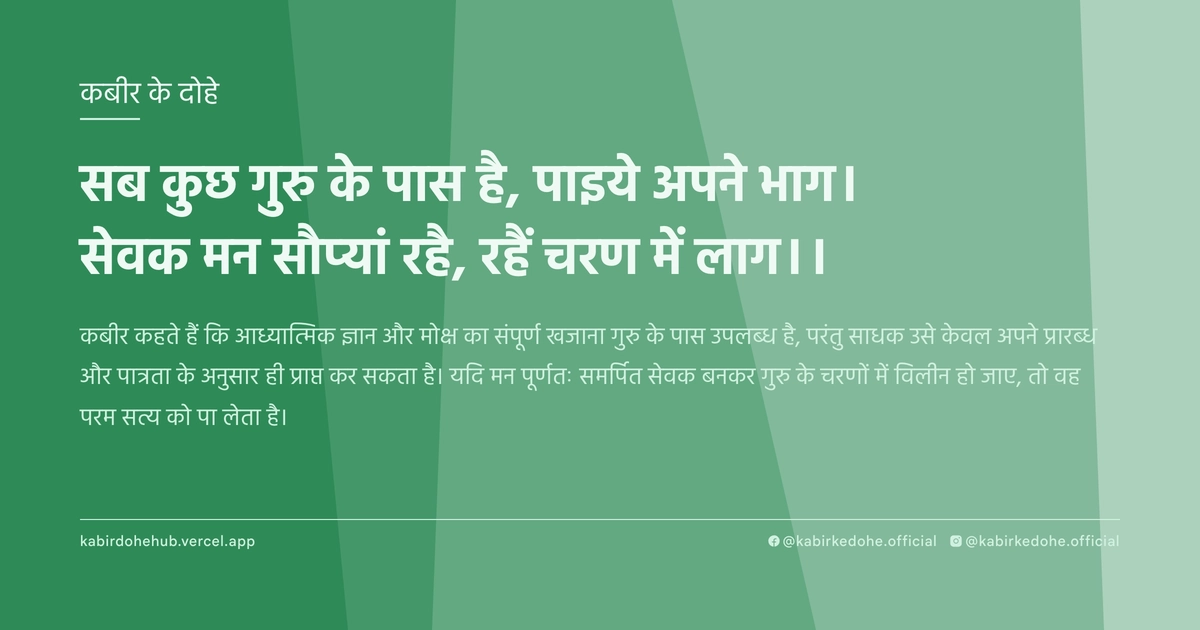
सब कुछ गुरु के पास है, पाइये अपने भाग।
सेवक मन सौप्यां रहै, रहैं चरण में लाग।।
Sab kuch guru ke paas hai, paiye apne bhag. Sevak man saupyan rahe, rahein charan me laag.
इस पृष्ठ पर इस कबीर दोहे का अर्थ (meaning), हिंदी व्याख्या और अंग्रेज़ी अनुवाद, दार्शनिक विश्लेषण और व्यावहारिक जीवन सीख दी गई है। यह दोहा गुरु महत्व (The Guru's Importance) विषय से जुड़ा है — Kabir doha meaning and explanation in Hindi and English.
अर्थ (Meaning):
कबीर कहते हैं कि आध्यात्मिक ज्ञान और मोक्ष का संपूर्ण खजाना गुरु के पास उपलब्ध है, परंतु साधक उसे केवल अपने प्रारब्ध और पात्रता के अनुसार ही प्राप्त कर सकता है। यदि मन पूर्णतः समर्पित सेवक बनकर गुरु के चरणों में विलीन हो जाए, तो वह परम सत्य को पा लेता है।
Kabir asserts that the entirety of spiritual wisdom and liberation resides with the Guru, yet a seeker attains it only according to their own destiny and spiritual readiness. If the mind remains a devoted servant, fully surrendered at the Guru's feet, it eventually merges with the Ultimate Truth.
व्याख्या (Interpretation):
शाब्दिक रूप से यह दोहा गुरु की महिमा गाता है, किंतु गहरा अर्थ 'गुरु' को एक व्यक्ति के बजाय 'परम चेतना' के रूप में देखने में है। यहाँ 'भाग' का अर्थ केवल भाग्य नहीं, बल्कि आंतरिक पात्रता और पात्रता का परिपक्व होना है। निर्गुण भक्ति के संदर्भ में, गुरु वह दर्पण है जो साधक को उसके अपने भीतर छिपे ब्रह्म का साक्षात्कार कराता है। माया के आवरण के कारण हम सत्य को नहीं देख पाते, और गुरु का सानिध्य उस पर्दे को हटाता है। यह अद्वैत वेदांत के उस सिद्धांत को पुष्ट करता है जहाँ जीव और ब्रह्म की एकता को पहचानने के लिए एक मार्गदर्शक की आवश्यकता होती है। समर्पण का अर्थ दासता नहीं, बल्कि अहंकार का विसर्जन है। जब 'मैं' मिटता है, तभी 'वह' प्रकट होता है।
Literally, this couplet praises the Guru, but the deeper meaning views the 'Guru' not as a person, but as the 'Supreme Consciousness.' Here, 'bhaag' (destiny) refers not to mere luck, but to internal readiness and spiritual maturity. In the context of Nirgun Bhakti, the Guru is the mirror reflecting the Brahman hidden within the seeker. Due to the veil of Maya, we fail to perceive the Truth, and the Guru's presence removes that shroud. This reinforces the Advaita Vedanta principle where a guide is essential to realize the non-duality of Atman and Brahman. Surrender here does not mean slavery, but the dissolution of the ego. Only when the 'I' vanishes does the 'Universal Self' manifest.
दार्शनिक विश्लेषण (Philosophical Analysis):
कबीर का युग धार्मिक कट्टरता और बाहरी कर्मकांडों का समय था। उन्होंने देखा कि लोग तीर्थों और मूर्तियों में उलझे हैं, जबकि सत्य उनके भीतर है। इस दोहे में 'गुरु' का उल्लेख वास्तव में उस आंतरिक ज्ञान (Inner Guide) की ओर संकेत है जो व्यक्ति को जाति, धर्म और सामाजिक बंधनों से ऊपर उठाता है। कबीर ने औपचारिक शिक्षा के बजाय अनुभवजन्य ज्ञान पर जोर दिया।
यह दर्शन सूफीवाद के 'पीर' और वेदांत के 'गुरु' के मिलन बिंदु पर स्थित है। सूफी मत में 'फना' (अहंकार का विनाश) की अवधारणा है, जो यहाँ 'सेवक मन' के रूप में प्रकट होती है। जब साधक अपनी इच्छाओं को गुरु की इच्छा में विलीन कर देता है, तो वह द्वैत से अद्वैत की ओर बढ़ता है। यह मनोवैज्ञानिक रूपांतरण है जहाँ व्यक्ति अपनी सीमित पहचान को त्यागकर अनंतता को अपनाता है।
कबीर ritualism (कर्मकांड) का खंडन करते हुए कहते हैं कि केवल गुरु के चरणों में झुकने का अर्थ शारीरिक क्रिया नहीं, बल्कि मानसिक समर्पण है। यदि मन अभी भी अहंकार से भरा है, तो बाहरी झुकाव व्यर्थ है। यह 'शून्य' की अवस्था है जहाँ साधक स्वयं को रिक्त कर लेता है ताकि ईश्वरीय प्रकाश उसमें भर सके।
अक्सर लोग इस दोहे को अंध-भक्ति के रूप में देखते हैं, जो कि एक बड़ी गलतफहमी है। कबीर की भक्ति तर्कसंगत और आंतरिक है। उनके लिए गुरु वह है जो आपको आपसे ही मिलवा दे। यहाँ 'भाग' का अर्थ यह है कि ज्ञान केवल उसे मिलता है जो वास्तव में प्यासा है। बिना पात्रता के, सबसे महान गुरु भी कुछ नहीं सिखा सकता।
अंततः, यह विश्लेषण दर्शाता है कि कबीर के लिए मुक्ति का मार्ग पूर्ण समर्पण और अहंकार शून्य होने में है। यह एक ऐसी प्रक्रिया है जहाँ साधक अपनी व्यक्तिगत पहचान को सामूहिक चेतना में विलीन कर देता है, जिससे जन्म-मृत्यु के चक्र से मुक्ति मिलती है और वह उस निराकार ब्रह्म में लीन हो जाता है।
Kabir's era was marked by religious bigotry and external rituals. He observed people entangled in pilgrimages and idols while the Truth resided within them. The mention of 'Guru' in this couplet actually points toward the 'Inner Guide' who elevates an individual above caste, religion, and social shackles. Kabir emphasized experiential knowledge over formal education.
This philosophy sits at the intersection of the Sufi 'Pir' and the Vedantic 'Guru.' In Sufism, the concept of 'Fana' (annihilation of the ego) is mirrored here as the 'servant mind.' When the seeker merges their will into the Guru's will, they move from duality to non-duality. This is a psychological transformation where the individual sheds their limited identity to embrace the infinite.
Rejecting ritualism, Kabir suggests that bowing at the Guru's feet is not a physical act but a mental surrender. If the mind remains bloated with ego, external prostration is futile. This is the state of 'Shunya' (void), where the seeker empties themselves so that the divine light may fill them.
Commonly, people misinterpret this couplet as a call for blind faith, which is a significant misconception. Kabir's devotion is rational and internal. For him, a true Guru is one who introduces you to your own True Self. 'Bhaag' implies that knowledge is granted only to those who are genuinely thirsty. Without readiness, even the greatest Guru cannot impart wisdom.
Ultimately, this analysis reveals that for Kabir, the path to liberation lies in total surrender and the zeroing of the ego. It is a process where the seeker dissolves their personal identity into the collective consciousness, thereby breaking the cycle of birth and death to merge with the Formless Brahman.
मूल संदेश (Core Message):
- अहंकार ही वह अंतिम पर्दा है जो गुरु और शिष्य के बीच खड़ा है।
- ज्ञान अर्जित नहीं किया जाता, बल्कि पात्रता आने पर वह स्वयं प्रकट होता है।
- समर्पण दासता नहीं, बल्कि स्वयं की सीमित पहचान का विस्तार है।
- सच्चा गुरु वह है जो आपको आपकी अपनी पूर्णता का बोध कराए।
- जब 'मैं' मिटता है, तब ब्रह्मांडीय चेतना का अनुभव होता है।
- The ego is the final veil standing between the Guru and the disciple.
- Knowledge is not acquired; it reveals itself when readiness is achieved.
- Surrender is not slavery, but the expansion of one's limited identity.
- A true Guru is one who makes you realize your own inherent wholeness.
- When the 'I' vanishes, the experience of cosmic consciousness begins.
व्यावहारिक उदाहरण (Practical Example):
वाराणसी के एक पुराने घाट पर माधव नाम का एक वृद्ध बुनकर रहता था। वह अपने काम में निपुण था, लेकिन उसका मन हमेशा इस बात से अशांत रहता था कि वह जीवन में कुछ 'बड़ा' हासिल नहीं कर पाया। वह कई विद्वानों के पास गया, कठिन मंत्र पढ़े, लेकिन शांति नहीं मिली।
एक दिन उसकी मुलाकात एक मौन साधु से हुई, जो केवल एक पेड़ के नीचे बैठे रहते थे। माधव ने उनसे पूछा, 'मुझे वह ज्ञान दीजिए जिससे मैं मुक्त हो जाऊँ।' साधु ने केवल मुस्कुराकर कहा, 'तुम जो माँग रहे हो, वह तुम्हारे पास पहले से है, बस तुम उसे ढूँढने का अहंकार लेकर आए हो।'
माधव को पहले तो यह बात समझ नहीं आई। उसने सोचा कि यह साधु उसे टाल रहे हैं। वह अगले कई महीनों तक उस साधु की सेवा करने लगा। वह उनके लिए पानी लाता, उनके आस-पास की सफाई करता, और बस उनके मौन को देखता।
शुरुआत में माधव का मन विचलित था। वह सोचता था, 'मैं अपना समय बर्बाद कर रहा हूँ, मुझे कोई गुप्त मंत्र क्यों नहीं दिया जा रहा?' उसका अहंकार उसे बता रहा था कि वह एक 'शिष्य' है जिसे 'ज्ञान' मिलना चाहिए।
धीरे-धीरे, सेवा करते-करते माधव का 'मैं' कम होने लगा। उसने महसूस किया कि वह साधु की सेवा नहीं कर रहा, बल्कि अपनी ही आंतरिक उथल-पुथल को शांत कर रहा है। उसने पाया कि जब वह बिना किसी अपेक्षा के सेवा करता है, तो उसका मन शांत हो जाता है।
एक दिन, जब वह साधु के चरणों के पास बैठा था, उसे अचानक अनुभव हुआ कि वह साधु और वह स्वयं अलग नहीं हैं। वह शांति जो वह बाहर खोज रहा था, वह उसके भीतर ही थी, लेकिन वह 'पाने' की इच्छा में उसे देख नहीं पा रहा था।
यह 'कबीर ट्विस्ट' था: जैसे ही माधव ने 'पाने' की इच्छा छोड़ी और 'समर्पण' को अपनाया, उसे वह सब मिल गया जिसकी वह तलाश कर रहा था। उसने महसूस किया कि साधु का मौन ही सबसे बड़ा उपदेश था।
अब माधव अपनी बुनाई को ही ध्यान बना चुका था। वह अब भी कपड़े बुनता था, लेकिन अब वह अहंकार से नहीं, बल्कि आनंद से बुनता था। उसने जान लिया कि गुरु केवल वह माध्यम है जो हमें हमारे अपने स्वभाव से मिलवाता है।
On an old ghat in Varanasi lived an elderly weaver named Madhav. He was skilled in his craft, but his mind was perpetually restless, feeling he had failed to achieve something 'great' in life. He visited many scholars and recited complex mantras, yet found no peace.
One day, he encountered a silent monk who spent his days sitting beneath a tree. Madhav asked, 'Give me the knowledge that will set me free.' The monk merely smiled and said, 'That which you seek is already with you; you have only brought the ego of seeking it.'
At first, Madhav did not understand. He felt the monk was dismissing him. For the next several months, he began serving the monk—bringing water, cleaning the surroundings, and simply observing the monk's silence.
Initially, Madhav's mind was turbulent. He thought, 'I am wasting my time; why am I not being given a secret mantra?' His ego told him he was a 'disciple' entitled to 'knowledge.'
Gradually, through service, Madhav's 'I' began to shrink. He realized he wasn't serving the monk, but calming his own internal chaos. He discovered that when he served without expectation, his mind became still.
One day, while sitting at the monk's feet, he suddenly experienced that he and the monk were not separate. The peace he had been searching for externally was within him, but his desire to 'acquire' it had blinded him.
This was the 'Kabir Twist': the moment Madhav abandoned the desire to 'get' and embraced 'surrender,' he received everything he had been seeking. He realized the monk's silence was the greatest sermon.
Now, Madhav turned his weaving into meditation. He still wove cloth, but no longer with ego, but with joy. He understood that the Guru is merely the medium that introduces us to our own true nature.
अभ्यास मार्गदर्शन (Practice Guidance):
- दैनिक अभ्यास: प्रतिदिन 20 मिनट मौन बैठें और विचार करें कि आपके भीतर का 'अहंकार' किस रूप में प्रकट हो रहा है (जैसे- श्रेष्ठता की भावना या शिकायत)।
- आत्म-पूछताछ जर्नल: लिखें कि आप जीवन में क्या 'पाने' की कोशिश कर रहे हैं और क्या वह इच्छा आपको सत्य से दूर ले जा रही है।
- व्यवहारिक परिवर्तन: दिन में कम से कम एक कार्य बिना किसी फल की इच्छा या पहचान के (Anonymous Service) करें।
- नैदानिक चेकलिस्ट: क्या मैं अभी भी यह सोचता हूँ कि मैं दूसरों से अधिक आध्यात्मिक हूँ? क्या मैं ज्ञान को एक 'वस्तु' की तरह प्राप्त करना चाहता हूँ? यदि हाँ, तो समर्पण अभी अधूरा है।
- Daily Practice: Sit in silence for 20 minutes daily and observe how your 'ego' manifests (e.g., feelings of superiority or constant complaining).
- Self-Inquiry Journal: Write down what you are trying to 'achieve' in life and whether that desire is distancing you from the Truth.
- Behavioral Change: Perform at least one act of service daily without any desire for reward or recognition (Anonymous Service).
- Diagnostic Checklist: Do I still believe I am more spiritual than others? Do I view knowledge as a 'commodity' to be acquired? If yes, the surrender is still incomplete.
चिंतन प्रश्न (Reflection Questions):
- क्या मेरी गुरु-भक्ति वास्तव में समर्पण है, या मैं केवल अपनी आध्यात्मिक श्रेष्ठता की पुष्टि चाहता हूँ?
- मेरे जीवन में वह कौन सा 'अहंकार' है जिसे मैं सबसे अधिक सहेज कर रखता हूँ?
- यदि मुझे वह सब मिल जाए जिसकी मैं कामना करता हूँ, तो क्या मेरा 'मैं' और बड़ा हो जाएगा?
- मैं अपनी सार्वजनिक छवि (Public Identity) को बनाए रखने के लिए अपनी आंतरिक शांति का कितना बलिदान करता हूँ?
- क्या मैं सत्य को खोजने के लिए तैयार हूँ, या मैं केवल अपनी मान्यताओं की पुष्टि चाहता हूँ?
- Is my devotion to a guide true surrender, or am I merely seeking validation for my spiritual superiority?
- What is the specific 'ego' in my life that I cling to most fiercely?
- If I were to achieve everything I desire, would my 'I' only grow larger?
- How much of my inner peace do I sacrifice to maintain my public identity?
- Am I truly ready to find the Truth, or am I only seeking confirmation of my existing beliefs?