
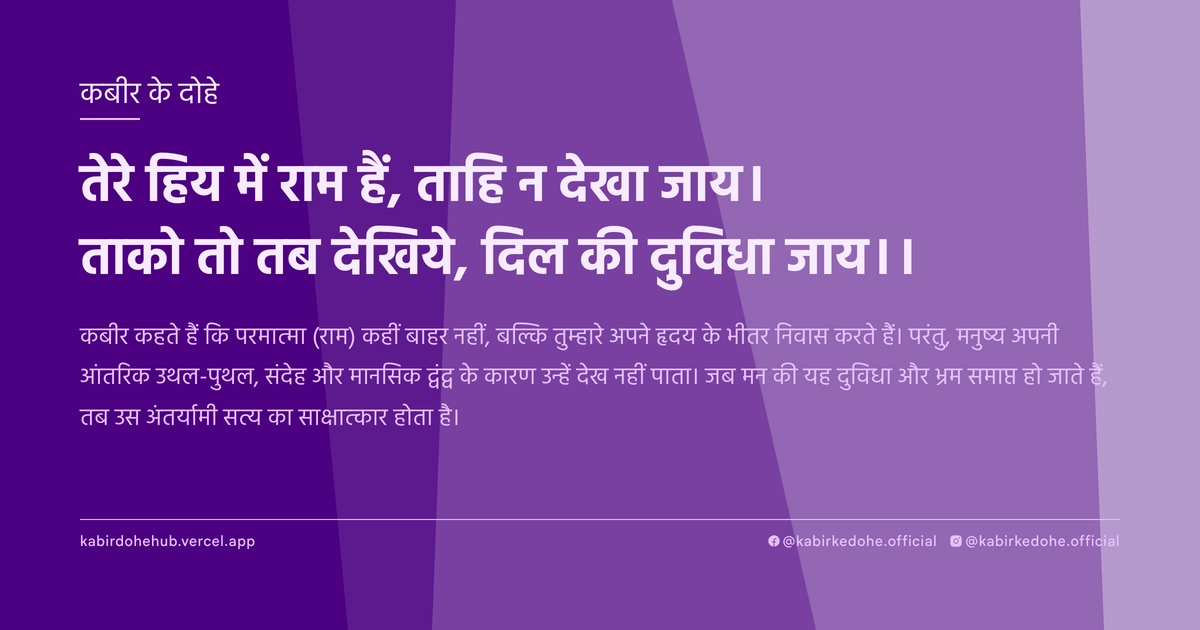
तेरे हिय में राम हैं, ताहि न देखा जाय।
ताको तो तब देखिये, दिल की दुविधा जाय।।
Tere hiy me ram hain, tahi na dekha jaaye. Tako to tab dekhiye, dil ki duvidha jaaye.
इस पृष्ठ पर इस कबीर दोहे का अर्थ (meaning), हिंदी व्याख्या और अंग्रेज़ी अनुवाद, दार्शनिक विश्लेषण और व्यावहारिक जीवन सीख दी गई है। यह दोहा अंतर ज्योति (The Inner Light) विषय से जुड़ा है — Kabir doha meaning and explanation in Hindi and English.
अर्थ (Meaning):
कबीर कहते हैं कि परमात्मा (राम) कहीं बाहर नहीं, बल्कि तुम्हारे अपने हृदय के भीतर निवास करते हैं। परंतु, मनुष्य अपनी आंतरिक उथल-पुथल, संदेह और मानसिक द्वंद्व के कारण उन्हें देख नहीं पाता। जब मन की यह दुविधा और भ्रम समाप्त हो जाते हैं, तब उस अंतर्यामी सत्य का साक्षात्कार होता है।
Kabir asserts that the Divine (Ram) resides not in external shrines, but within the sanctuary of your own heart. However, the human eye is blinded by internal turmoil and mental contradictions. Only when the fog of doubt and the duality of the mind dissolve can the eternal presence within be truly perceived.
व्याख्या (Interpretation):
शाब्दिक अर्थ यह है कि ईश्वर हृदय में है, पर वह अदृश्य है। रूपक के स्तर पर, 'राम' यहाँ किसी व्यक्ति विशेष नहीं, बल्कि निर्गुण ब्रह्म या शुद्ध चेतना का प्रतीक हैं। 'दुविधा' वह माया है जो आत्मा को परमात्मा से अलग करती है। यह दोहा अद्वैत वेदांत के उस सिद्धांत को दर्शाता है जहाँ आत्मा और परमात्मा एक ही हैं। जब तक 'मैं' और 'तू' का भेद बना रहता है, तब तक सत्य ओझल रहता है। जैसे गंदे पानी में चंद्रमा का प्रतिबिंब स्पष्ट नहीं दिखता, वैसे ही अशांत मन में ईश्वर नहीं दिखते। अंततः, यह आंतरिक शुद्धि और मौन की आवश्यकता पर बल देता है।
Literally, the verse states that God is in the heart but remains unseen. Metaphorically, 'Ram' does not refer to a mythological figure but to the Nirgun Brahman—the formless, attributeless Absolute. 'Duvidha' represents Maya, the cosmic illusion that creates a perceived separation between the Atman (soul) and Brahman. This aligns with Advaita Vedanta, suggesting that the seeker is the sought. Just as a turbulent pond obscures the reflection of the moon, the noise of the ego obscures the Divine. The paradox lies in the fact that we search the universe for what is already the core of our being. Realization occurs only when the duality of 'subject' and 'object' collapses into oneness.
दार्शनिक विश्लेषण (Philosophical Analysis):
कबीर का यह दोहा मध्यकालीन भारत के उस दौर का है जब धर्म बाहरी कर्मकांडों, मूर्तियों और जातिगत श्रेष्ठता में जकड़ा हुआ था। कबीर ने इस व्यवस्था पर प्रहार करते हुए 'सहज मार्ग' का प्रस्ताव दिया। उन्होंने बताया कि मोक्ष किसी तीर्थयात्रा या कठिन तपस्या से नहीं, बल्कि अंतर्मुखी होने से मिलता है।
दार्शनिक रूप से, यह सूफीवाद के 'अनल हक़' (मैं सत्य हूँ) और वेदांत के 'अहं ब्रह्मास्मि' का संगम है। यहाँ राम का अर्थ 'रैम' ( permeates) से है, जो कण-कण में व्याप्त है। कबीर बाहरी आडंबरों को नकारते हुए कहते हैं कि यदि तुम मंदिर या मस्जिद में ईश्वर को खोज रहे हो, तो तुम केवल पत्थर या दीवारों को देख रहे हो।
मनोवैज्ञानिक स्तर पर, 'दुविधा' का अर्थ है संज्ञानात्मक विसंगति (cognitive dissonance)। मनुष्य एक साथ भौतिक इच्छाओं और आध्यात्मिक शांति की चाह रखता है, जिससे एक आंतरिक संघर्ष पैदा होता है। यह संघर्ष ही वह पर्दा है जो सत्य को ढकता है।
कबीर का दर्शन यह है कि अहंकार (Ego) ही वह एकमात्र बाधा है। जब व्यक्ति यह समझ लेता है कि वह शरीर नहीं बल्कि वह चेतना है जो शरीर को देख रही है, तब द्वंद्व समाप्त हो जाता है। यह 'शून्य' की अवस्था है जहाँ न कोई प्रश्न बचता है और न कोई उत्तर।
अतः, यह दोहा केवल भक्ति नहीं, बल्कि एक क्रांतिकारी मनोवैज्ञानिक परिवर्तन का आह्वान है। यह मनुष्य को उसकी अपनी गरिमा और दिव्यता की याद दिलाता है, उसे किसी बाहरी मध्यस्थ या पुरोहित की आवश्यकता से मुक्त करता है।
Kabir’s verse emerges from a medieval Indian landscape dominated by rigid ritualism, idol worship, and caste hierarchies. He challenged the institutionalized religion of his time by proposing the 'Sahaj Marg' (the Natural Path), asserting that liberation is an internal realization rather than a destination reached via pilgrimage.
Philosophically, this is a synthesis of the Sufi concept of 'Ana al-Haqq' (I am the Truth) and the Vedantic 'Aham Brahmasmi' (I am Brahman). The term 'Ram' here is derived from the root 'ram', meaning that which permeates everything. Kabir argues that searching for the Divine in temples or mosques is a futile pursuit of shadows, as the source is the observer itself.
Psychologically, 'duvidha' refers to the state of cognitive dissonance. Humans exist in a perpetual conflict between material cravings and the innate longing for spiritual stillness. This internal friction creates a veil of noise that drowns out the subtle whisper of the soul.
Central to this teaching is the annihilation of the ego. In the framework of Nirgun Bhakti, the ego is the only barrier. When the practitioner shifts identity from the limited physical body to the limitless consciousness, the duality of the 'seeker' and the 'goal' vanishes.
Ultimately, this doha is a call for a radical psychological shift. It liberates the individual from the need for priestly intermediaries, placing the power of salvation directly within the human heart, thereby democratizing spirituality and emphasizing the inherent divinity of every soul regardless of social standing.
मूल संदेश (Core Message):
- बाहरी खोज एक भ्रम है; सत्य केवल भीतर है।
- मानसिक द्वंद्व ही आत्मा और परमात्मा के बीच की दीवार है।
- पवित्रता कर्मकांडों में नहीं, बल्कि मन की सरलता में है।
- अहंकार का विसर्जन ही वास्तविक साक्षात्कार का द्वार है।
- जब 'मैं' मिटता है, तब केवल 'वह' शेष रहता है।
- External searching is a mirage; Truth resides only within.
- Mental duality is the only wall between the soul and the Absolute.
- Purity is found in simplicity of heart, not in complex rituals.
- The dissolution of ego is the only gateway to true realization.
- When the 'I' vanishes, only the 'One' remains.
व्यावहारिक उदाहरण (Practical Example):
वाराणसी के घाटों पर रहने वाली एक वृद्ध विधवा, जानकी, का जीवन केवल पूजा-पाठ और कठोर नियमों में बीता था। वह मानती थी कि ईश्वर केवल गंगा की लहरों और मंदिर की घंटियों में बसते हैं।
वह हर दिन घंटों मंत्र जाप करती, लेकिन उसके मन में हमेशा यह डर रहता कि क्या वह पर्याप्त पवित्र है। उसके भीतर एक निरंतर द्वंद्व था—भक्ति और भय के बीच।
एक दिन वह एक साधु से मिली जिसने उससे कहा, 'जानकी, तुम गंगा में डुबकी लगाती हो, पर क्या तुमने अपने भीतर की गहराई को देखा है?'
जानकी ने पूछा, 'वहाँ क्या है?' साधु ने उत्तर दिया, 'वहाँ वह है जिसे तुम बाहर खोज रही हो। तुम्हारी दुविधा ही तुम्हारा पर्दा है।'
जानकी ने कुछ समय के लिए बाहरी अनुष्ठानों को छोड़ा और मौन में बैठना शुरू किया। उसने महसूस किया कि उसकी 'पवित्रता' की चिंता ही उसका सबसे बड़ा बंधन था।
जैसे-जैसे उसने यह स्वीकार किया कि वह जैसी है, वैसी ही पूर्ण है, उसके मन का डर और द्वंद्व धीरे-धीरे शांत होने लगा।
एक शाम, जब वह चुपचाप बैठी थी, उसे अचानक एक असीम शांति का अनुभव हुआ। उसे महसूस हुआ कि जिस 'राम' को वह पत्थरों में खोज रही थी, वह उसके अपने हृदय की धड़कन में समाहित हैं।
उसकी आँखों से आँसू बहने लगे, लेकिन यह दुख के नहीं, बल्कि पहचान के आँसू थे। उसने जाना कि ईश्वर कोई बाहरी पुरस्कार नहीं, बल्कि उसकी अपनी अंतरात्मा का विस्तार है।
अब जानकी मंदिर तो जाती थी, पर वह वहाँ कुछ माँगने नहीं, बल्कि उस आंतरिक शांति को साझा करने जाती थी जो उसने अपने भीतर पा ली थी।
उसका जीवन अब भय से नहीं, बल्कि एक सहज प्रेम से संचालित था, क्योंकि उसकी 'दुविधा' समाप्त हो चुकी थी।
Janaki, an elderly widow living on the ghats of Varanasi, had spent her entire life adhering to rigorous rituals and strict religious codes. She believed that the Divine resided only in the ripples of the Ganges and the ringing bells of the temples.
Every day she spent hours chanting mantras, yet her heart was plagued by a persistent fear: was she 'pure' enough to be heard? She lived in a state of constant duality—torn between genuine devotion and the anxiety of inadequacy.
One day, she encountered a wandering mystic who asked her, 'Janaki, you dive into the Ganges daily, but have you ever dived into the depths of your own being?'
Confused, Janaki asked, 'What is there to find?' The mystic replied, 'There lies the very One you seek outside. Your doubt is the only veil between you and the Truth.'
Taking this to heart, Janaki stepped back from her external rituals and began practicing silence. She realized that her obsession with 'purity' was actually her greatest bondage.
As she accepted herself exactly as she was, the internal conflict between the 'sinful self' and the 'divine goal' began to dissolve.
One evening, while sitting in absolute stillness, she was overwhelmed by a sense of infinite peace. She felt that the 'Ram' she had been searching for in stone idols was actually the very rhythm of her own heartbeat.
Tears streamed down her face—not tears of sorrow, but of recognition. She understood that God was not an external reward to be earned, but the very essence of her existence.
Janaki continued to visit the temple, but no longer to beg for mercy; she went to share the silence she had discovered within.
Her life shifted from a trajectory of fear to one of effortless love, for the 'duvidha'—the internal division—had finally vanished.
अभ्यास मार्गदर्शन (Practice Guidance):
- प्रतिदिन 20 मिनट 'साक्षी भाव' का अभ्यास करें: अपने विचारों को बिना किसी निर्णय के देखें, जैसे आप किसी और के विचार देख रहे हों।
- आत्म-पूछताछ जर्नल: प्रतिदिन लिखें कि आज किस समय आप 'द्वंद्व' (दुविधा) में थे और वह द्वंद्व किस अहंकार या डर से पैदा हुआ था।
- मौन व्रत: सप्ताह में एक बार कुछ घंटों के लिए पूर्ण मौन धारण करें, ताकि बाहरी शोर कम हो और आंतरिक ध्वनि सुनाई दे।
- निदान चेकलिस्ट: क्या मैं अभी भी ईश्वर को किसी स्थान, व्यक्ति या वस्तु में खोज रहा हूँ? क्या मेरे भीतर शांति के बजाय 'सही या गलत' की लड़ाई चल रही है? यदि हाँ, तो आप अभी भी 'दुविधा' में हैं।
- Practice 'Witness Consciousness' for 20 minutes daily: Observe your thoughts without judgment, as if you are watching a stranger's mind.
- Self-Inquiry Journaling: Document the moments of 'duvidha' (conflict) you experienced today. Identify which specific ego-attachment or fear triggered the duality.
- Vow of Silence: Dedicate a few hours once a week to absolute silence to diminish external noise and amplify the internal resonance.
- Diagnostic Checklist: Am I still seeking the Divine in a specific place, person, or object? Is there a constant battle of 'right vs wrong' within me instead of peace? If yes, the veil of duality is still present.
चिंतन प्रश्न (Reflection Questions):
- मेरे जीवन में वह कौन सी 'दुविधा' है जो मुझे मेरी अपनी आंतरिक शांति से दूर रखती है?
- मैं अपनी पहचान किन बाहरी लेबलों (पद, जाति, धर्म) से जोड़ता हूँ, और यदि ये सब छीन लिए जाएँ, तो मैं कौन हूँ?
- क्या मेरी आध्यात्मिकता वास्तव में मुक्ति की ओर ले जा रही है, या यह केवल मेरे अहंकार को 'धार्मिक' होने का एक नया आधार दे रही है?
- मैं दूसरों में जिन दोषों को देखता हूँ, क्या वे वास्तव में मेरे अपने आंतरिक अंधकारों का प्रतिबिंब हैं?
- यदि ईश्वर मेरे भीतर है, तो मैं उसे बाहर खोजने के लिए कितना समय और ऊर्जा व्यर्थ करता हूँ?
- What is the specific 'duvidha' (conflict) in my life that consistently separates me from my own inner peace?
- Which external labels (status, caste, religion) do I cling to for identity, and who remains if all these are stripped away?
- Is my spirituality leading toward liberation, or is it merely providing my ego with a new platform to feel 'pious'?
- Are the flaws I perceive in others actually reflections of my own hidden internal shadows?
- If the Divine is already within me, how much energy am I wasting in the futile pursuit of an external God?