
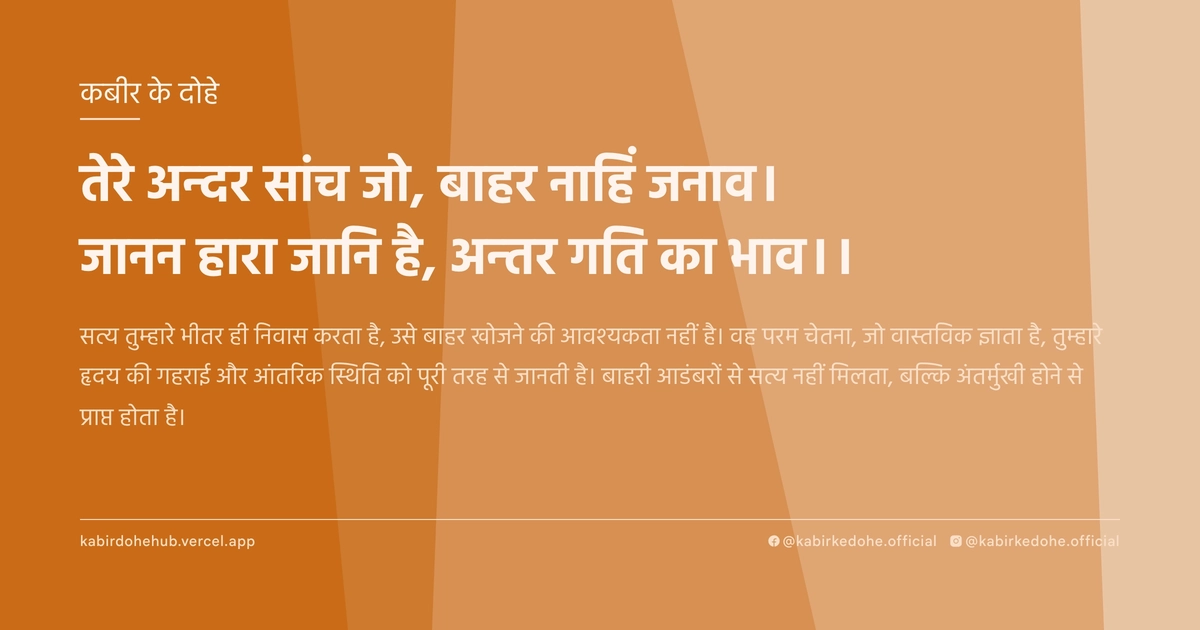
तेरे अन्दर सांच जो, बाहर नाहिं जनाव।
जानन हारा जानि है, अन्तर गति का भाव।।
Tere andar saanch jo, baahar nahin janav. Janan haara jaani hai, antar gati ka bhav.
इस पृष्ठ पर इस कबीर दोहे का अर्थ (meaning), हिंदी व्याख्या और अंग्रेज़ी अनुवाद, दार्शनिक विश्लेषण और व्यावहारिक जीवन सीख दी गई है। यह दोहा अंतर ज्योति (The Inner Light) विषय से जुड़ा है — Kabir doha meaning and explanation in Hindi and English.
अर्थ (Meaning):
सत्य तुम्हारे भीतर ही निवास करता है, उसे बाहर खोजने की आवश्यकता नहीं है। वह परम चेतना, जो वास्तविक ज्ञाता है, तुम्हारे हृदय की गहराई और आंतरिक स्थिति को पूरी तरह से जानती है। बाहरी आडंबरों से सत्य नहीं मिलता, बल्कि अंतर्मुखी होने से प्राप्त होता है।
The Truth resides within you; there is no need to seek it in the external world. The Ultimate Knower, the Divine Consciousness, is fully aware of the deepest movements and the true state of your inner heart. Truth is not found through outward rituals, but through inward turning.
व्याख्या (Interpretation):
कबीर यहाँ बाहरी खोज की व्यर्थता पर प्रहार करते हैं। 'सांच' का अर्थ केवल सत्य नहीं, बल्कि वह निराकार ब्रह्म है जो प्रत्येक जीव में व्याप्त है। जब मनुष्य मंदिर, मस्जिद या तीर्थों में ईश्वर को खोजता है, तो वह वास्तव में अपनी ही आत्मा से दूर भाग रहा होता है। यह दोहा अद्वैत वेदांत के 'अहं ब्रह्मास्मि' के सिद्धांत को दर्शाता है, जहाँ आत्मा और परमात्मा का भेद मिट जाता है। 'जानन हारा' वह साक्षी चेतना है जो हमारे अहंकार के परदे के पीछे छिपी है। माया हमें यह विश्वास दिलाती है कि सत्य कहीं दूर है, जबकि वह हमारे श्वासों में बसा है। अंततः, यह आंतरिक यात्रा ही वास्तविक मोक्ष का मार्ग है।
Kabir strikes at the futility of external searching. 'Saanch' refers not merely to truth, but to the Formless Brahman permeating every being. When a person seeks God in temples, mosques, or pilgrimages, they are effectively fleeing from their own soul. This verse mirrors the Advaita Vedanta principle of 'Aham Brahmasmi,' where the distinction between the Atman and Brahman dissolves. The 'Ultimate Knower' is the Witness Consciousness hidden behind the veil of ego. Maya creates the illusion that Truth is distant, while it actually resides within our very breath. Ultimately, this inward journey is the only authentic path to liberation.
दार्शनिक विश्लेषण (Philosophical Analysis):
कबीर का यह दर्शन उस युग की प्रतिक्रिया था जहाँ धर्म केवल कर्मकांडों और बाहरी प्रतीकों में सिमट गया था। उन्होंने स्पष्ट किया कि ईश्वर किसी विशेष स्थान का निवासी नहीं, बल्कि एक सार्वभौमिक उपस्थिति है। यह दृष्टिकोण सूफीवाद के 'इंसान-ए-कामिल' और हिंदू धर्म के 'निर्गुण भक्ति' का संगम है, जहाँ ईश्वर को किसी आकार या गुण में नहीं, बल्कि शुद्ध चेतना के रूप में देखा जाता है।
यहाँ 'सांच' का अर्थ है वह सत्य जो अपरिवर्तनीय है। कबीर तर्क देते हैं कि यदि सत्य बाहर होता, तो वह व्यक्ति-दर-व्यक्ति भिन्न होता, लेकिन चूंकि वह भीतर है, इसलिए वह सार्वभौमिक है। यह विचार व्यक्ति को सामाजिक और धार्मिक श्रेणियों से ऊपर उठाकर उसे अपनी स्वयं की दिव्यता से जोड़ता है।
अद्वैत वेदांत के संदर्भ में, यह दोहा माया के आवरण को हटाने की बात करता है। हम बाहरी दुनिया के शोर में इतने खो गए हैं कि हम अपनी आंतरिक शांति को भूल चुके हैं। कबीर कहते हैं कि बाहरी ज्ञान केवल सूचना है, जबकि आंतरिक अनुभव ही वास्तविक ज्ञान है।
मनोवैज्ञानिक स्तर पर, यह अहंकार के विसर्जन की प्रक्रिया है। जब हम बाहर खोजते हैं, तो हम 'कर्ता' बने रहते हैं। लेकिन जब हम भीतर देखते हैं, तो हम 'साक्षी' बन जाते हैं। यह साक्षी भाव ही हमें दुख और द्वंद्व से मुक्त करता है।
अंततः, कबीर यह संदेश देते हैं कि सत्य की खोज कोई बौद्धिक व्यायाम नहीं है, बल्कि एक भावनात्मक और आध्यात्मिक समर्पण है। जब बाहरी खोज समाप्त होती है, तभी आंतरिक साक्षात्कार शुरू होता है।
Kabir's philosophy was a direct reaction to an era where religion had shrunk into mere rituals and external symbols. He clarified that God is not the resident of a specific place, but a universal presence. This perspective is a confluence of the Sufi concept of 'Insan-e-Kamil' and the Hindu 'Nirgun Bhakti,' where the Divine is perceived not as a form or attribute, but as pure consciousness.
Here, 'Saanch' refers to the Truth that is immutable. Kabir argues that if Truth were external, it would vary from person to person; however, because it is internal, it is universal. This idea elevates the individual above social and religious categories, connecting them to their own inherent divinity.
In the context of Advaita Vedanta, this verse speaks of removing the veil of Maya. We have become so lost in the noise of the external world that we have forgotten our inner stillness. Kabir asserts that external knowledge is merely information, whereas internal experience is true wisdom.
On a psychological level, this is the process of ego dissolution. When we search externally, we remain the 'doer.' But when we look within, we become the 'witness.' This state of witnessing is what liberates us from suffering and duality.
Ultimately, Kabir conveys that the search for Truth is not an intellectual exercise, but an emotional and spiritual surrender. Only when the external search ends does the internal realization begin.
मूल संदेश (Core Message):
- बाहरी खोज एक भ्रम है जो हमें स्वयं से दूर ले जाती है।
- सत्य कोई वस्तु नहीं, बल्कि आपकी अपनी शुद्ध चेतना है।
- अहंकार का विसर्जन ही आंतरिक सत्य के दर्शन की पहली शर्त है।
- मौन वह भाषा है जिसमें आत्मा और परमात्मा का संवाद होता है।
- वास्तविक धर्म कर्मकांडों में नहीं, बल्कि आत्म-साक्षात्कार में निहित है।
- जब आप स्वयं को जान लेते हैं, तो पूरा ब्रह्मांड आपका अपना हो जाता है।
- External searching is an illusion that distances us from ourselves.
- Truth is not an object, but your own pure consciousness.
- The dissolution of ego is the primary condition for witnessing internal Truth.
- Silence is the language in which the soul and the Divine communicate.
- True religion lies not in rituals, but in the realization of the Self.
- Once you know yourself, the entire universe becomes your own.
व्यावहारिक उदाहरण (Practical Example):
वाराणसी के घाटों पर रहने वाले एक वृद्ध विधवा, जानकी, का जीवन केवल पूजा-पाठ और कठोर उपवासों में बीत रहा था। वह मानती थीं कि यदि वह अधिक कठिन तपस्या करेंगी, तो उन्हें मोक्ष मिलेगा। वह घंटों मंदिर की सीढ़ियों पर बैठकर दूसरों को उपदेश देती थीं कि ईश्वर केवल पवित्र स्थानों पर मिलते हैं।
एक दिन उनकी मुलाकात एक साधारण से बुनकर से हुई, जो शांत भाव से अपना काम कर रहा था। जानकी ने उससे पूछा, 'तुम ईश्वर को कहाँ खोजते हो? क्या तुम कभी तीर्थ नहीं गए?' बुनकर ने मुस्कुराकर कहा, 'माँ, मैं जब धागों को जोड़ता हूँ, तो मैं उसी शांति को महसूस करता हूँ जिसे आप पत्थरों में खोज रही हैं। सत्य बाहर नहीं, मेरे भीतर की इस शांति में है।'
जानकी को यह बात अजीब लगी। उन्होंने सोचा कि एक साधारण बुनकर उन्हें धर्म सिखा रहा है। लेकिन उस रात, जब वह एकांत में बैठी थीं, उन्हें महसूस हुआ कि उनके मन में शांति नहीं, बल्कि एक अंतहीन बेचैनी थी। वह बाहरी नियमों के बोझ तले दबी हुई थीं।
उन्होंने पहली बार अपनी आँखें बंद कीं और बाहरी दुनिया के शोर को भुलाकर अपने हृदय की धड़कन को सुनने की कोशिश की। उन्होंने महसूस किया कि जिस ईश्वर को वह घाटों और मंदिरों में खोज रही थीं, वह वास्तव में उनके भीतर एक मौन उपस्थिति के रूप में मौजूद था।
धीरे-धीरे जानकी ने कठोर उपवास और बाहरी दिखावे को छोड़ दिया। उन्होंने पाया कि करुणा और आंतरिक शांति ही वास्तविक पूजा है। अब वह मंदिर की सीढ़ियों पर उपदेश देने के बजाय, गरीब बच्चों को पढ़ाने लगीं।
उनका व्यवहार बदल गया। अब वह दूसरों के दोष नहीं देखती थीं, बल्कि हर व्यक्ति में उसी 'सांच' या सत्य को देखने लगीं। उनकी आँखों में एक नई चमक थी, जो किसी तीर्थ यात्रा से नहीं, बल्कि आत्म-साक्षात्कार से आई थी।
गाँव के लोग हैरान थे कि जो महिला कभी क्रोधित और कठोर दिखती थी, वह अब इतनी सौम्य कैसे हो गई। जानकी ने बस इतना कहा, 'मैंने बाहर के दरवाजों को बंद किया, तब भीतर का द्वार खुला।'
यह 'कबीर ट्विस्ट' था—बाहरी धार्मिकता का अंत और आंतरिक आध्यात्मिकता का उदय। जानकी ने जान लिया कि सत्य कोई गंतव्य नहीं, बल्कि स्वयं की वास्तविक प्रकृति की पहचान है।
Janaki, an elderly widow living on the ghats of Varanasi, spent her life in rigorous rituals and fasting. She believed that only through extreme penance would she achieve liberation. She spent hours on temple steps, preaching to others that God is found only in sacred places.
One day, she met a simple weaver who was working with profound calmness. Janaki asked him, 'Where do you seek God? Have you never visited the pilgrimages?' The weaver smiled and replied, 'Mother, as I weave these threads, I feel the same peace you seek in stones. Truth is not outside; it is in the stillness within me.'
Janaki found this absurd. She thought a simple weaver was trying to teach her religion. But that night, sitting in solitude, she realized that her mind lacked peace; instead, it was filled with endless restlessness. She was crushed under the weight of external rules.
For the first time, she closed her eyes and tried to listen to her heartbeat, ignoring the noise of the external world. She realized that the God she had been searching for on the ghats and in temples was actually present within her as a silent witness.
Gradually, Janaki abandoned the harsh fasts and external displays of piety. She discovered that compassion and inner peace were the only true forms of worship. Instead of preaching on temple steps, she began teaching poor children.
Her behavior transformed. She stopped seeing the flaws in others and began seeing the same 'Saanch' or Truth in every person. There was a new light in her eyes, born not of pilgrimage, but of self-realization.
The villagers were amazed that the woman who once seemed angry and rigid had become so gentle. Janaki simply said, 'I closed the outer doors, and only then did the inner door open.'
This was the 'Kabir Twist'—the end of external religiosity and the dawn of internal spirituality. Janaki understood that Truth is not a destination, but the recognition of one's own true nature.
अभ्यास मार्गदर्शन (Practice Guidance):
- प्रतिदिन 20 मिनट मौन अभ्यास करें, जहाँ आप केवल अपनी श्वास और आंतरिक संवेदनाओं का अवलोकन करें, बिना किसी निर्णय के।
- एक डायरी लिखें जिसमें आप उन क्षणों को दर्ज करें जब आपने बाहरी प्रशंसा या आलोचना के बजाय अपने आंतरिक अंतर्मन की आवाज़ सुनी।
- व्यवहार परिवर्तन: जब भी आप किसी दूसरे व्यक्ति में कोई कमी देखें, तो रुकें और विचार करें कि वही मानवीय त्रुटि आपके भीतर कहाँ मौजूद है।
- डायग्नोस्टिक चेकलिस्ट: क्या मैं शांति के लिए बाहरी परिस्थितियों पर निर्भर हूँ? क्या मैं ईश्वर/सत्य को किसी स्थान या व्यक्ति से जोड़कर देख रहा हूँ? क्या मेरी भक्ति केवल प्रदर्शन है?
- Practice 20 minutes of daily silence, observing only your breath and internal sensations without judgment.
- Maintain a journal recording moments when you listened to your inner intuition rather than external praise or criticism.
- Behavioral Change: Whenever you perceive a flaw in another, pause and reflect on where that same human error exists within yourself.
- Diagnostic Checklist: Am I dependent on external circumstances for peace? Do I associate Truth/God with a specific place or person? Is my devotion merely a performance?
चिंतन प्रश्न (Reflection Questions):
- मैं अपनी सार्वजनिक छवि को बनाए रखने के लिए अपने भीतर के किस सत्य को दबा रहा हूँ?
- यदि मेरे जीवन से सभी धार्मिक और सामाजिक पहचान हटा दी जाएं, तो वास्तव में 'मैं' कौन हूँ?
- क्या मेरी आध्यात्मिक खोज वास्तव में सत्य की प्यास है, या केवल मानसिक शांति पाने का एक प्रयास?
- मैं किन बाहरी प्रतीकों के पीछे छिपकर अपनी आंतरिक शून्यता को भरने की कोशिश करता हूँ?
- क्या मैं दूसरों को सुधारने की इच्छा के पीछे अपने स्वयं के अहंकार को संतुष्ट कर रहा हूँ?
- मेरे जीवन का वह कौन सा हिस्सा है जहाँ मैं अभी भी 'बाहर' समाधान खोज रहा हूँ जबकि उत्तर भीतर है?
- What internal truth am I suppressing to maintain my public image?
- If all religious and social identities were stripped away, who is the 'I' that remains?
- Is my spiritual quest a genuine thirst for Truth, or merely an attempt to find mental comfort?
- Behind which external symbols am I hiding to fill my internal void?
- Am I satisfying my own ego through the desire to 'correct' others?
- In which area of my life am I still seeking external solutions when the answer lies within?