
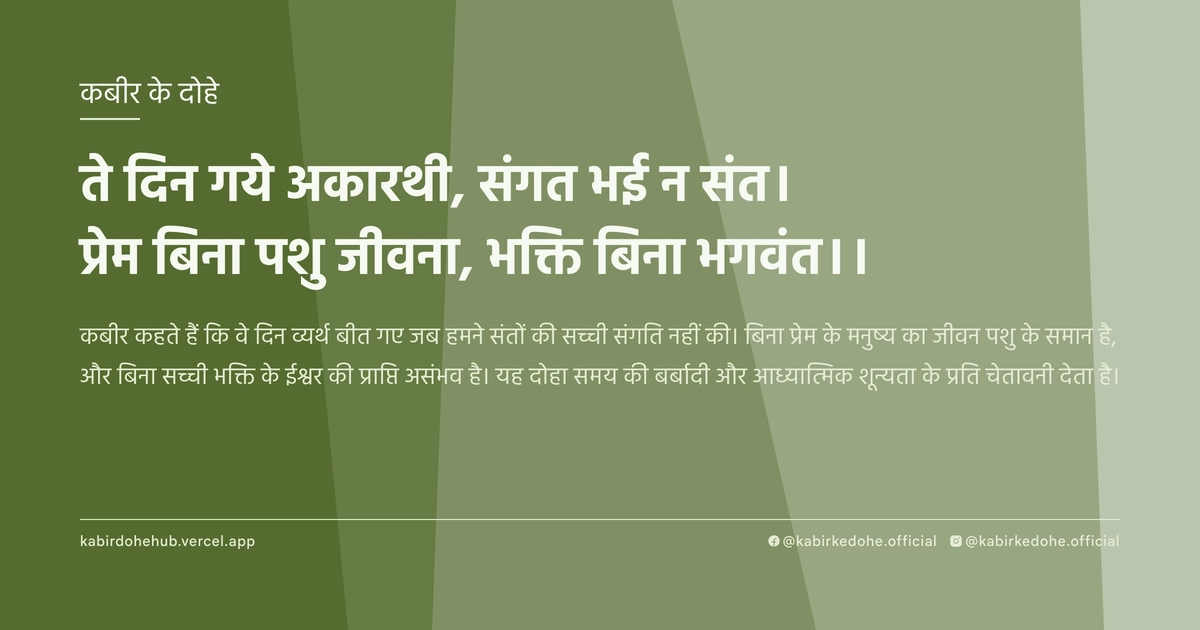
ते दिन गये अकारथी, संगत भई न संत।
प्रेम बिना पशु जीवना, भक्ति बिना भगवंत।।
Te din gaye akarathi, sangat bhayi na sant. Prem bina pashu jeevna, bhakti bina bhagwant.
इस पृष्ठ पर इस कबीर दोहे का अर्थ (meaning), हिंदी व्याख्या और अंग्रेज़ी अनुवाद, दार्शनिक विश्लेषण और व्यावहारिक जीवन सीख दी गई है। यह दोहा सत्संग (Satsang) विषय से जुड़ा है — Kabir doha meaning and explanation in Hindi and English.
अर्थ (Meaning):
कबीर कहते हैं कि वे दिन व्यर्थ बीत गए जब हमने संतों की सच्ची संगति नहीं की। बिना प्रेम के मनुष्य का जीवन पशु के समान है, और बिना सच्ची भक्ति के ईश्वर की प्राप्ति असंभव है। यह दोहा समय की बर्बादी और आध्यात्मिक शून्यता के प्रति चेतावनी देता है।
Kabir laments the wasted days spent away from the company of the enlightened. He asserts that a life devoid of love is no different from the existence of an animal, and without the essence of devotion, the Divine remains unattainable and distant.
व्याख्या (Interpretation):
साब्दिक अर्थ में, यह दोहा सत्संग के अभाव पर शोक व्यक्त करता है। गहरे स्तर पर, 'संत' केवल व्यक्ति नहीं बल्कि उस चेतना का प्रतीक हैं जो माया के पर्दे को हटा चुकी है। 'पशु जीवन' का अर्थ है केवल शारीरिक आवश्यकताओं और वासनाओं में उलझे रहना, जो मनुष्य को उसकी दिव्य क्षमता से अलग करता है। यहाँ प्रेम केवल मानवीय भावना नहीं, बल्कि 'ईश्वरीय प्रेम' (Ishq-e-Haqiqi) है जो अहंकार को गला देता है। निर्गुण भक्ति के संदर्भ में, यह दर्शाता है कि बिना हृदय के रूपांतरण के, केवल कर्मकांड व्यर्थ हैं। यह आत्मा और परमात्मा के बीच के उस सेतु की बात करता है जो केवल प्रेम और समर्पण से निर्मित होता है। अंततः, यह अद्वैत की ओर संकेत करता है जहाँ भक्त और भगवान एक हो जाते हैं।
Literally, the verse mourns the lack of association with the wise. Metaphorically, 'Saints' represent the awakened consciousness that has pierced the veil of Maya. 'Animal life' refers to an existence driven solely by biological instincts and egoic desires, stripping man of his spiritual sovereignty. Love here is not mundane affection but 'Divine Love,' the alchemical force that dissolves the ego. In the context of Nirgun Bhakti, it emphasizes that ritualism is hollow without an internal emotional transformation. The paradox lies in the fact that while the Divine is omnipresent, He is inaccessible to those trapped in the animalistic shell of the ego. It points toward the non-duality of Atman and Brahman, where the bridge is built not by intellect, but by unconditional devotion.
दार्शनिक विश्लेषण (Philosophical Analysis):
कबीर का यह दोहा उस सामाजिक और धार्मिक परिवेश की प्रतिक्रिया है जहाँ धर्म केवल बाहरी दिखावे और कठोर नियमों में सिमट गया था। उन्होंने देखा कि लोग तीर्थों और मूर्तियों में उलझे थे, जबकि उनके भीतर का प्रेम मर चुका था। कबीर का 'प्रेम' सूफी मत के 'इश्क' और वेदांत के 'भक्ति' का संगम है। वे तर्क देते हैं कि जाति, धर्म या शास्त्र ज्ञान तब तक निरर्थक हैं जब तक कि हृदय में करुणा और प्रेम का संचार न हो।
दार्शनिक रूप से, यह 'अहंकार' (Ego) के विनाश की बात करता है। जब तक मनुष्य स्वयं को शरीर और सामाजिक पहचान से जोड़ता है, वह 'पशु' बना रहता है क्योंकि वह केवल अपनी सीमाओं में कैद है। संतों की संगति वास्तव में उस दर्पण की तरह है जो हमें हमारी वास्तविक पहचान—शुद्ध चेतना—से परिचित कराती है।
यह विचार अद्वैत वेदांत के इस सिद्धांत से मेल खाता है कि अज्ञान (Avidya) ही बंधन का कारण है। सत्संग इस अज्ञान को मिटाने का साधन है। कबीर यहाँ यह स्पष्ट करते हैं कि ईश्वर किसी मंदिर या मस्जिद में नहीं, बल्कि उस प्रेम में बसते हैं जो बिना किसी शर्त के बहता है।
सूफीवाद के प्रभाव में, कबीर 'फना' (स्वयं का विलीनीकरण) की बात करते हैं। बिना प्रेम के, मनुष्य केवल एक जैविक मशीन है। भक्ति यहाँ केवल पूजा नहीं, बल्कि एक निरंतर जागरूकता है जो हर सांस को ईश्वर के प्रति समर्पित कर देती है।
अंततः, यह दोहा हमें चेतावनी देता है कि समय सीमित है। आध्यात्मिक आलस्य सबसे बड़ा पाप है। यदि हम अपने जीवन के उद्देश्य को नहीं पहचानते, तो हम केवल अस्तित्व बनाए रखते हैं, जीवन नहीं जीते।
This verse is a visceral reaction to the rigid religious orthodoxy of Kabir's era, where spirituality had devolved into empty rituals and caste-based exclusions. Kabir observed that people were obsessed with pilgrimages and idols while their hearts remained barren of genuine compassion. His concept of 'Love' is a synthesis of the Sufi 'Ishq' and the Vedantic 'Bhakti,' suggesting that scriptural knowledge is useless without the emotional awakening of the heart.
Philosophically, the focus is on the annihilation of the 'Ahamkara' (Ego). As long as a human identifies solely with the physical body or social status, they remain in a 'beastly' state, driven by instinct and survival rather than transcendence. The 'company of saints' serves as a spiritual mirror, reflecting the soul's true nature as pure consciousness, stripped of worldly illusions.
This aligns with Advaita Vedanta's premise that Avidya (ignorance) is the root of all suffering. Satsang (holy company) is the catalyst that dissolves this ignorance. Kabir clarifies that the Divine does not reside in stone structures but in the selfless love that flows between beings.
Drawing from Sufi mysticism, Kabir emphasizes the state of 'Fana'—the dissolving of the self into the Absolute. Without love, a human is merely a biological machine. Devotion here is not a religious act but a state of constant awareness where every breath is an offering to the Formless One.
Ultimately, the verse warns against spiritual procrastination. Spiritual lethargy is presented as the greatest tragedy. To exist without the realization of the Divine is to merely survive; it is not truly living, as the essence of human existence is the return to the Source through the path of love.
मूल संदेश (Core Message):
- बिना प्रेम के धर्म केवल एक सामाजिक मुखौटा है।
- अहंकार का त्याग ही वास्तविक मानवीयता की शुरुआत है।
- ईश्वर को पाने का एकमात्र मार्ग हृदय की करुणा है।
- समय की व्यर्थता को पहचानकर वर्तमान में जागें।
- सच्ची भक्ति बाहरी आडंबरों से परे आंतरिक मिलन है।
- Religion without love is merely a social mask.
- The dissolution of ego is the dawn of true humanity.
- Compassion of the heart is the only path to the Divine.
- Awaken now by recognizing the tragedy of spiritual procrastination.
- True devotion is an internal union, far beyond external rituals.
व्यावहारिक उदाहरण (Practical Example):
वाराणसी के घाटों पर रहने वाले एक वृद्ध विधवा, जानकी, का जीवन केवल नियमों और शोक में बीता। वह हर दिन घंटों मंत्र जाप करती और कठोर उपवास रखती, लेकिन उसके मन में अपने परिवार और समाज के प्रति कड़वाहट भरी थी। वह मानती थी कि उसकी कठोर तपस्या ही उसे मोक्ष दिलाएगी।
एक दिन उसकी मुलाकात एक फकीर से हुई जो घाट के किनारे बैठकर बस मुस्कुरा रहा था। जानकी ने उससे उसकी साधना के बारे में पूछा। फकीर ने उत्तर दिया, 'माता, आप पत्थर की दीवारों को पूज रही हैं, लेकिन अपने भीतर के प्रेम के द्वार बंद रखे हैं। बिना प्रेम के आपकी तपस्या केवल एक बोझ है।'
जानकी को पहले यह बात चुभी, लेकिन फिर उसने गौर किया कि वह अपनी तपस्या का उपयोग दूसरों को नीचा दिखाने के लिए कर रही थी। उसे एहसास हुआ कि वह धर्म के नाम पर केवल एक 'पशुवत' अहंकार पाल रही थी, जहाँ केवल 'मैं' और 'मेरा मोक्ष' था।
उसने धीरे-धीरे अपने व्यवहार में बदलाव लाना शुरू किया। उसने उन लोगों की मदद करना शुरू किया जिन्हें समाज ने त्याग दिया था। उसने पाया कि जब वह किसी भूखे को भोजन कराती, तो उसे वह शांति मिलती जो हज़ारों मंत्रों से नहीं मिली थी।
उसका कठोर अनुशासन अब करुणा में बदल गया। वह अब केवल मंदिर नहीं जाती थी, बल्कि हर जीव में उस निराकार ईश्वर को देखने लगी। उसके चेहरे की कड़वाहट अब एक शांत मुस्कान में बदल गई थी।
उसने महसूस किया कि उसकी पिछली सारी साधनाएँ 'अकारथी' (व्यर्थ) थीं क्योंकि उनमें प्रेम का अभाव था। वह अब केवल एक धार्मिक महिला नहीं थी, बल्कि एक जागृत आत्मा बन गई थी।
उसकी इस यात्रा ने उसे सिखाया कि भक्ति का अर्थ माथे पर तिलक लगाना नहीं, बल्कि हृदय को सबके लिए खोल देना है।
अंत में, जानकी ने पाया कि जिस ईश्वर को वह शास्त्रों में ढूंढ रही थी, वह उसके भीतर के निस्वार्थ प्रेम में ही छिपा था।
Janaki, an elderly widow living on the ghats of Varanasi, spent her life bound by rigid rules and mourning. She spent hours chanting mantras and observing harsh fasts, believing that this austerity was her only ticket to salvation. However, her heart remained filled with bitterness toward her family and society.
One day, she encountered a wandering fakir sitting by the river, radiating a simple, profound joy. When Janaki asked about his spiritual practice, the fakir replied, 'Mother, you are worshiping stone walls while keeping the doors of love within your heart locked. Without love, your penance is merely a burden.'
Initially, Janaki felt offended, but she soon realized that she was using her piety as a tool for spiritual superiority. She saw that she had been nurturing a 'beastly' ego, focused only on 'I' and 'my salvation,' ignoring the suffering of others.
Slowly, she began to change. She started helping those whom society had discarded. She discovered that feeding a hungry stranger brought her a peace that thousands of rote mantras never could.
Her rigid discipline transformed into active compassion. She no longer viewed the temple as the only sacred space; she began to see the Formless Divine in every living being. The bitterness on her face was replaced by a serene smile.
She realized that her previous years of devotion were 'Akarthi' (fruitless) because they lacked the essence of love. She ceased being merely a religious woman and became an awakened soul.
Her journey taught her that true Bhakti is not about the markings on one's forehead, but about opening the heart to the entire universe.
In the end, Janaki found that the God she had been searching for in scriptures was hidden within the very act of selfless love.
अभ्यास मार्गदर्शन (Practice Guidance):
- दैनिक चिंतन: प्रतिदिन 15 मिनट मौन बैठें और विचार करें कि क्या आपके कार्यों का मूल प्रेम है या केवल सामाजिक कर्तव्य।
- आत्म-पूछताछ जर्नल: लिखें कि दिन भर में किन क्षणों में आपने 'पशुवत' व्यवहार (क्रोध, ईर्ष्या, अहंकार) किया और उसे प्रेम में कैसे बदला जा सकता था।
- व्यवहार परिवर्तन: प्रतिदिन एक ऐसा कार्य करें जिसमें आपका कोई व्यक्तिगत लाभ न हो और जो पूरी तरह निस्वार्थ प्रेम पर आधारित हो।
- डायग्नोस्टिक चेकलिस्ट: क्या मैं दूसरों की मदद केवल प्रशंसा के लिए करता हूँ? क्या मेरा धर्म मुझे दूसरों से श्रेष्ठ महसूस कराता है? यदि हाँ, तो मैं अभी भी 'पशु जीवन' में हूँ।
- Daily Contemplation: Spend 15 minutes in silence, questioning whether your actions are rooted in genuine love or merely social obligation.
- Self-Inquiry Journaling: Document moments during the day where you acted from a 'beastly' impulse (anger, jealousy, ego) and how that could have been transmuted into love.
- Behavioral Shift: Perform one act of service daily that offers zero personal gain and is driven purely by selfless compassion.
- Diagnostic Checklist: Do I help others to feel superior? Does my spirituality create a wall between me and others? If yes, I am still operating within the 'animalistic' ego.
चिंतन प्रश्न (Reflection Questions):
- मेरे जीवन का कौन सा हिस्सा केवल 'पशुवत' इच्छाओं (भोग और संग्रह) से संचालित है?
- क्या मेरी धार्मिक पहचान मुझे वास्तव में विनम्र बना रही है या यह मेरे अहंकार को नया रूप दे रही है?
- यदि मैं अपनी सभी उपाधियों और सामाजिक स्थिति को हटा दूँ, तो क्या मेरे भीतर केवल प्रेम शेष बचेगा?
- मैं किन लोगों की संगति से बचता हूँ, और क्या वे वास्तव में वे 'संत' हैं जो मुझे चुनौती दे सकते हैं?
- क्या मेरा 'प्रेम' वास्तव में निस्वार्थ है, या यह केवल एक सूक्ष्म अपेक्षा है?
- Which parts of my life are driven solely by 'beastly' instincts of consumption and accumulation?
- Is my religious identity making me truly humble, or is it just giving my ego a more 'spiritual' disguise?
- If I stripped away all my titles and social status, would only love remain within me?
- Whose company do I avoid, and could they be the 'saints' who possess the truth I fear?
- Is my 'love' truly selfless, or is it a subtle transaction based on expectation?