
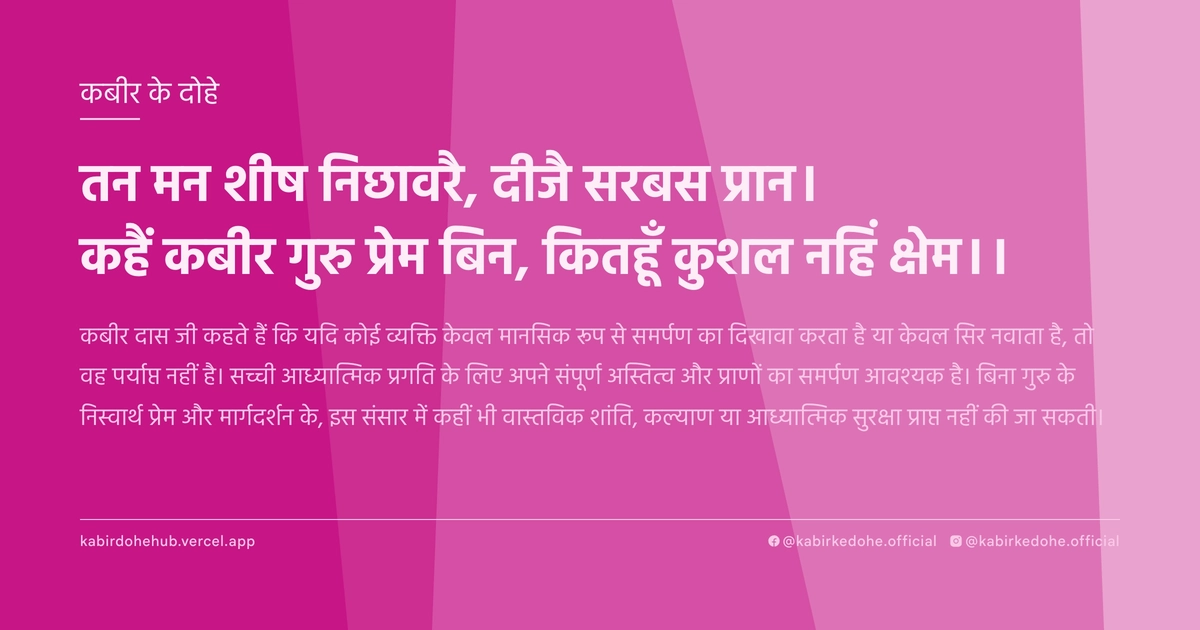
तन मन शीष निछावरै, दीजै सरबस प्रान।
कहैं कबीर गुरु प्रेम बिन, कितहूँ कुशल नहिं क्षेम।।
Tan man sheesh nichhavrai, deeje sarbas praan. Kahen Kabir guru prem bin, kitahun kushal nahin kshem.
इस पृष्ठ पर इस कबीर दोहे का अर्थ (meaning), हिंदी व्याख्या और अंग्रेज़ी अनुवाद, दार्शनिक विश्लेषण और व्यावहारिक जीवन सीख दी गई है। यह दोहा गुरु महत्व (The Guru's Importance) विषय से जुड़ा है — Kabir doha meaning and explanation in Hindi and English.
अर्थ (Meaning):
कबीर दास जी कहते हैं कि यदि कोई व्यक्ति केवल मानसिक रूप से समर्पण का दिखावा करता है या केवल सिर नवाता है, तो वह पर्याप्त नहीं है। सच्ची आध्यात्मिक प्रगति के लिए अपने संपूर्ण अस्तित्व और प्राणों का समर्पण आवश्यक है। बिना गुरु के निस्वार्थ प्रेम और मार्गदर्शन के, इस संसार में कहीं भी वास्तविक शांति, कल्याण या आध्यात्मिक सुरक्षा प्राप्त नहीं की जा सकती।
Kabir asserts that mere mental gestures of submission or the superficial act of bowing one's head are insufficient. True spiritual evolution demands the total surrender of one's entire existence and life force. Without the selfless love and guidance of a Satguru, one cannot find genuine peace, well-being, or spiritual sanctuary anywhere in this transient world.
व्याख्या (Interpretation):
इस दोहे का शाब्दिक अर्थ है कि बाहरी समर्पण व्यर्थ है यदि हृदय में पूर्ण समर्पण न हो। यहाँ 'शीष निछावरना' अहंकार के विसर्जन का प्रतीक है, लेकिन कबीर इसे केवल 'मन' तक सीमित रखने के बजाय 'सरबस प्रान' यानी संपूर्ण जीवन को समर्पित करने की बात करते हैं। यह निर्गुण भक्ति का सार है जहाँ साधक अपनी पृथक पहचान (अहंकार) को मिटाकर परमात्मा में विलीन होना चाहता है। माया का पर्दा तभी हटता है जब शिष्य और गुरु के बीच का द्वैत समाप्त हो जाता है। यह अद्वैत वेदांत के उस सिद्धांत को दर्शाता है जहाँ जीव और ब्रह्म की एकता केवल पूर्ण समर्पण से ही संभव है। यहाँ गुरु केवल एक व्यक्ति नहीं, बल्कि वह तत्व है जो आत्मा को उसके वास्तविक स्वरूप से मिलाता है। अंततः, यह दोहा इस विरोधाभास को उजागर करता है कि स्वयं को पूरी तरह खोकर ही वास्तव में स्वयं को पाया जा सकता है।
Literally, the verse suggests that external displays of submission are futile if the heart lacks total surrender. 'Bowing the head' symbolizes the shedding of ego, yet Kabir urges the seeker to move beyond mental intent to the surrender of 'sarbas praan'—the entire life force. This is the essence of Nirgun Bhakti, where the practitioner seeks to dissolve their separate identity (Ahamkara) into the Formless Divine. The veil of Maya is lifted only when the duality between the disciple and the Guru vanishes. This aligns with Advaita Vedanta, asserting that the unity of Atman and Brahman is achievable only through absolute surrender. Here, the Guru is not merely a human teacher but the spiritual catalyst that awakens the soul to its true nature. Ultimately, the Doha highlights the central paradox: only by completely losing oneself can one truly be found.
दार्शनिक विश्लेषण (Philosophical Analysis):
कबीर का यह विचार उस समय के सामाजिक और धार्मिक परिवेश की प्रतिक्रिया है जहाँ धर्म केवल कर्मकांडों, बाहरी दिखावे और मंदिर-मस्जिद की यात्राओं तक सीमित था। उन्होंने स्पष्ट किया कि मोक्ष किसी बाहरी अनुष्ठान से नहीं, बल्कि आंतरिक रूपांतरण से मिलता है। कबीर का 'गुरु' वह है जो साधक को अंधविश्वासों से मुक्त कर उसे सत्य के साक्षात्कार की ओर ले जाए।
दार्शनिक स्तर पर, यह दोहा सूफी मत के 'फना' (अहंकार का विनाश) और अद्वैत वेदांत के 'अहं ब्रह्मास्मि' के बीच एक सेतु बनाता है। जब कबीर 'सरबस प्रान' देने की बात करते हैं, तो वे शारीरिक मृत्यु की नहीं, बल्कि 'अहंकार की मृत्यु' की बात कर रहे हैं। जब तक 'मैं' जीवित है, तब तक 'परमात्मा' का अनुभव असंभव है।
कबीर ने जाति और वर्ण व्यवस्था का पुरजोर विरोध किया क्योंकि उनका मानना था कि प्रेम और भक्ति किसी सामाजिक श्रेणी की मोहताज नहीं होती। उनके लिए गुरु का प्रेम वह अग्नि है जो जाति, धर्म और संप्रदाय की सारी अशुद्धियों को जलाकर भस्म कर देती है। यह प्रेम कामुक या सांसारिक नहीं, बल्कि एक आध्यात्मिक आकर्षण है जो आत्मा को उसके स्रोत की ओर खींचता है।
मनोवैज्ञानिक दृष्टिकोण से, यह दोहा 'संज्ञानात्मक विसंगति' को संबोधित करता है। हम अक्सर दावा करते हैं कि हम ईश्वर या सत्य को चाहते हैं, लेकिन हम अपनी आदतों, धारणाओं और अहंकार को छोड़ने को तैयार नहीं होते। कबीर चेतावनी देते हैं कि आधा-अधूरा समर्पण केवल भ्रम पैदा करता है, वास्तविक शांति नहीं।
अंततः, यह शिक्षण हमें सिखाता है कि आध्यात्मिक यात्रा में 'बौद्धिक समझ' (Intellectual understanding) और 'अनुभवात्मक सत्य' (Experiential truth) के बीच गहरा अंतर है। केवल यह जानना कि गुरु महान है, पर्याप्त नहीं है; उस महानता में स्वयं को विलीन कर देना ही एकमात्र मार्ग है।
Kabir’s insight is a direct response to the socio-religious climate of his era, where spirituality was reduced to empty rituals, external displays, and pilgrimages. He clarifies that liberation is not a product of ritualistic performance but of internal transformation. To Kabir, the 'Guru' is the catalyst who liberates the seeker from superstition and leads them toward the realization of Truth.
Philosophically, this verse bridges the Sufi concept of 'Fana' (the annihilation of the ego) and the Advaita Vedanta realization of 'Aham Brahmasmi'. When Kabir speaks of surrendering 'all life force,' he is not referring to physical death, but to the 'death of the ego.' As long as the 'I' persists, the experience of the Divine remains impossible.
Kabir vehemently rejected the caste system, believing that love and devotion are not bound by social hierarchies. For him, the Guru's love is a purifying fire that incinerates the impurities of caste, creed, and religion. This love is not erotic or worldly, but a spiritual magnetism pulling the soul back to its primordial source.
From a psychological perspective, this Doha addresses the gap between intellectual assent and actual surrender. We often claim to seek Truth while clinging desperately to our habits, biases, and ego. Kabir warns that partial surrender creates only a facade of spirituality, providing no genuine sanctuary.
Ultimately, this teaching emphasizes the distinction between 'intellectual understanding' and 'experiential truth.' Simply knowing that the Guru is great is insufficient; the only path to liberation is the total dissolution of the self into that greatness.
मूल संदेश (Core Message):
- दिखावे की भक्ति केवल मानसिक बोझ है, वास्तविक मुक्ति नहीं।
- अहंकार का पूर्ण विसर्जन ही परमात्मा से मिलन की एकमात्र कुंजी है।
- गुरु का प्रेम वह सेतु है जो जीव को शिव में बदल देता है।
- आंशिक समर्पण भ्रम पैदा करता है; पूर्ण समर्पण सत्य को प्रकट करता है।
- शांति बाहरी परिस्थितियों में नहीं, बल्कि आंतरिक शून्य में निहित है।
- Performative devotion is a mental burden, not a path to liberation.
- The total dissolution of ego is the only key to union with the Divine.
- The Guru's love is the bridge that transforms the individual into the Universal.
- Partial surrender breeds illusion; absolute surrender reveals the Truth.
- Peace resides not in external circumstances, but in the internal void of ego.
व्यावहारिक उदाहरण (Practical Example):
वाराणसी के एक पुराने घाट पर रहने वाले माधव नाम के एक वृद्ध बुनकर थे। माधव अपने काम में निपुण थे, लेकिन उनका मन हमेशा इस बात से अशांत रहता था कि समाज उन्हें केवल एक निम्न जाति का बुनकर मानता है। वे कई पंडितों के पास गए, महंगे अनुष्ठान किए और मानसिक रूप से यह मान लिया कि वे ईश्वर के भक्त हैं, लेकिन उनके भीतर का क्रोध और हीन भावना कभी समाप्त नहीं हुई।
एक दिन उनकी मुलाकात एक मौन साधु से हुई, जिन्होंने उन्हें केवल एक बात कही: 'तुम अपनी कला को ईश्वर को अर्पित करते हो, लेकिन अपने अहंकार को नहीं।' माधव ने पहले तो इसे साधारण बात माना, लेकिन धीरे-धीरे उन्हें समझ आया कि वे अपनी श्रेष्ठता सिद्ध करने के लिए भक्ति कर रहे थे।
माधव ने तय किया कि वे अब केवल 'दिखावे' के लिए सिर नहीं झुकाएंगे। उन्होंने अपनी पूरी जीवन पद्धति को बदल दिया। उन्होंने अपनी श्रेष्ठतम साड़ियाँ उन लोगों को देना शुरू किया जो उन्हें वह दे सकते थे, बिना किसी बदले की उम्मीद के।
शुरुआत में उनके मन ने विरोध किया, 'मैं अपना नुकसान क्यों करूँ?' लेकिन उन्होंने इस विचार को 'सरबस प्रान' के समर्पण के रूप में देखा। उन्होंने अपने भीतर के 'मैं' को मारना शुरू किया।
एक समय ऐसा आया जब माधव को अब इस बात से फर्क नहीं पड़ता था कि लोग उन्हें क्या कहते हैं। उनकी कला अब केवल जीविका का साधन नहीं, बल्कि एक प्रार्थना बन गई थी।
उनके व्यवहार में एक ऐसी शांति आई कि घाट के लोग, जो पहले उन्हें नजरअंदाज करते थे, अब उनके पास मानसिक शांति के लिए आने लगे।
माधव ने महसूस किया कि जब तक वे अपनी पहचान को बचाने की कोशिश कर रहे थे, वे दुखी थे। जैसे ही उन्होंने अपनी पहचान को गुरु के प्रेम और मानवता की सेवा में विलीन कर दिया, उन्हें वह 'क्षेम' (कल्याण) मिला जिसकी तलाश वे वर्षों से कर रहे थे।
यह रूपांतरण तब हुआ जब उन्होंने यह समझा कि वास्तविक समर्पण केवल मंदिर में सिर झुकाना नहीं है, बल्कि अपने जीवन के हर छोटे-बड़े निर्णय में अहंकार का त्याग करना है।
अंत में, माधव एक साधारण बुनकर से एक जीवित संत बन गए, क्योंकि उन्होंने अपने 'अहं' की आहुति दे दी थी।
In the ancient ghats of Varanasi lived Madhav, an elderly weaver. Madhav was master of his craft, yet his mind was perpetually restless, haunted by the social stigma of his low-caste identity. He visited many priests, performed expensive rituals, and mentally convinced himself he was a devotee, yet the embers of anger and inferiority continued to burn within him.
One day, he encountered a silent ascetic who told him a single thing: 'You offer your art to God, but you do not offer your ego.' Initially, Madhav dismissed this as a simple platitude, but gradually he realized he was practicing devotion merely to prove his spiritual superiority over others.
Madhav decided he would no longer bow his head as a mere formality. He transformed his entire way of living. He began gifting his finest weaves to those in need, expecting absolutely nothing in return.
At first, his mind resisted, whispering, 'Why should I cause myself a loss?' But he viewed this internal struggle as the process of surrendering his 'sarbas praan'—his entire life force and attachment.
There came a moment when Madhav ceased to care about how the world perceived him. His weaving was no longer just a livelihood; it became a living prayer, a meditation in thread and color.
A profound serenity descended upon him, such that the very people who once ignored him now sought his company for mental peace.
Madhav realized that as long as he fought to protect his identity, he remained in agony. The moment he dissolved his identity into the love of the Guru and the service of humanity, he found the 'kshem' (well-being) he had sought for decades.
This transformation occurred only when he understood that true surrender is not bowing in a temple, but the systematic removal of ego from every small decision of life.
In the end, Madhav evolved from a simple weaver into a living saint, for he had finally offered his 'I' as a sacrifice.
अभ्यास मार्गदर्शन (Practice Guidance):
- प्रतिदिन 20 मिनट मौन ध्यान करें, जहाँ आप अपने भीतर उठने वाले 'मैं' (अहंकार) के विचारों को केवल एक साक्षी की तरह देखें और उन्हें विसर्जित करें।
- एक 'समर्पण जर्नल' बनाएँ। प्रतिदिन एक ऐसी स्थिति लिखें जहाँ आपने अपनी इच्छा या अहंकार को किसी दूसरे के हित या सत्य के लिए छोड़ा।
- व्यवहार परिवर्तन: दिन में कम से कम एक बार ऐसा कार्य करें जिसमें आपको कोई श्रेय (Credit) न मिले और आप जानबूझकर अपनी पहचान गुप्त रखें।
- निदान चेकलिस्ट: क्या मैं अपनी धार्मिकता का प्रदर्शन कर रहा हूँ? क्या मैं दूसरों की आलोचना अपनी श्रेष्ठता सिद्ध करने के लिए करता हूँ? यदि हाँ, तो समर्पण अभी अधूरा है।
- Practice 20 minutes of silent meditation daily, observing the thoughts of 'I' (ego) as a witness and consciously dissolving them into the void.
- Maintain a 'Surrender Journal.' Record one instance daily where you relinquished your will or ego for the sake of another's well-being or the Truth.
- Behavioral Shift: Perform at least one act of service daily where you receive no credit and intentionally keep your identity hidden.
- Diagnostic Checklist: Am I performing my spirituality for an audience? Do I criticize others to reinforce my own perceived superiority? If yes, the surrender is still superficial.
चिंतन प्रश्न (Reflection Questions):
- मेरे जीवन में 'सिर झुकाने' (दिखावे) और 'प्राण समर्पित करने' (वास्तविक बदलाव) के बीच क्या अंतर है?
- मैं अपनी आध्यात्मिक पहचान (Spiritual Identity) का उपयोग दूसरों को नीचा दिखाने के लिए किस तरह करता हूँ?
- यदि मेरी सारी उपलब्धियाँ और सामाजिक पद छीन लिए जाएँ, तो मेरे भीतर क्या बचेगा?
- क्या मेरा 'गुरु' वास्तव में मेरा मार्गदर्शन कर रहा है, या मैं केवल अपनी मान्यताओं की पुष्टि करने वाला गुरु खोज रहा हूँ?
- मेरे भीतर का वह कौन सा हिस्सा है जिसे मैं किसी भी कीमत पर छोड़ने को तैयार नहीं हूँ?
- What is the difference in my life between 'bowing the head' (formality) and 'surrendering the life force' (actual change)?
- In what subtle ways do I use my spiritual identity to assert superiority over others?
- If all my achievements and social titles were stripped away, what would actually remain of me?
- Is my 'Guru' truly guiding me toward growth, or am I merely seeking a teacher who validates my existing biases?
- Which part of my identity am I most terrified of losing, and why is that the very thing blocking my liberation?