
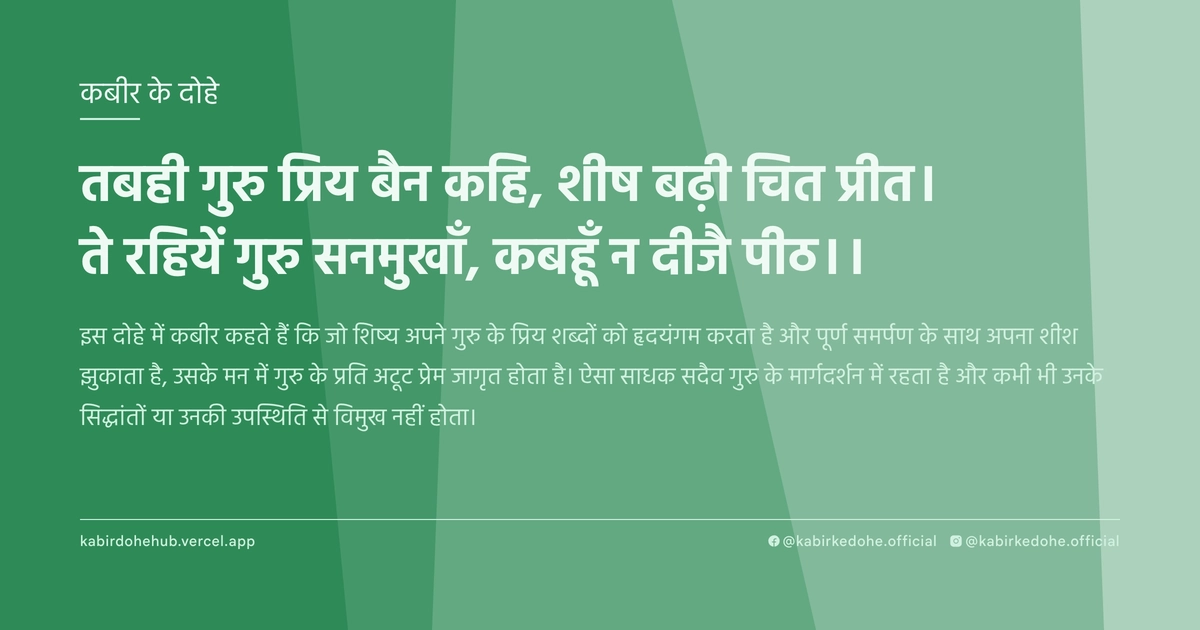
तबही गुरु प्रिय बैन कहि, शीष बढ़ी चित प्रीत।
ते रहियें गुरु सनमुखाँ, कबहूँ न दीजै पीठ।।
Tabhi guru priya bain kahi, sheesh badhi chit preet. Te rahiyen guru sanmukhan, kabahun na deeje peeth.
इस पृष्ठ पर इस कबीर दोहे का अर्थ (meaning), हिंदी व्याख्या और अंग्रेज़ी अनुवाद, दार्शनिक विश्लेषण और व्यावहारिक जीवन सीख दी गई है। यह दोहा गुरु महत्व (The Guru's Importance) विषय से जुड़ा है — Kabir doha meaning and explanation in Hindi and English.
अर्थ (Meaning):
इस दोहे में कबीर कहते हैं कि जो शिष्य अपने गुरु के प्रिय शब्दों को हृदयंगम करता है और पूर्ण समर्पण के साथ अपना शीश झुकाता है, उसके मन में गुरु के प्रति अटूट प्रेम जागृत होता है। ऐसा साधक सदैव गुरु के मार्गदर्शन में रहता है और कभी भी उनके सिद्धांतों या उनकी उपस्थिति से विमुख नहीं होता।
In this couplet, Kabir emphasizes that a disciple who listens to the beloved words of the Guru with deep reverence and bows their head in total surrender develops an unbreakable love in their heart. Such a seeker remains ever-present in the guidance of the Guru and never turns their back on the spiritual truth or the master's presence.
व्याख्या (Interpretation):
शाब्दिक अर्थ में यह गुरु की आज्ञाकारिता की बात करता है, परंतु आध्यात्मिक स्तर पर 'शीष बढ़ाना' अहंकार के विसर्जन का प्रतीक है। जब साधक अपना अहंकार (शीष) गुरु के चरणों में समर्पित करता है, तब 'चित प्रीत' यानी आत्मा का परमात्मा से मिलन संभव होता है। यहाँ गुरु केवल एक व्यक्ति नहीं, बल्कि वह 'ज्ञान-प्रकाश' है जो माया के अंधकार को मिटाता है। यह निर्गुण भक्ति का मार्ग है जहाँ गुरु वह सेतु है जो जीव को ब्रह्म के साथ अद्वैत स्थिति में ले जाता है। 'पीठ न देना' का अर्थ है कि ज्ञान प्राप्ति के बाद भी विनम्रता बनाए रखना और सत्य से विमुख न होना। यह स्थिति साधक को उस शून्य में ले जाती है जहाँ केवल शुद्ध चेतना शेष रहती है।
Literally, this speaks of obedience to a teacher, but metaphorically, 'bowing the head' symbolizes the dissolution of the ego. When the seeker surrenders their pride (the head) at the Guru's feet, 'chit preet' or the soul's longing for the Divine is ignited. Here, the Guru is not merely a human figure but the 'Light of Knowledge' that dispels the darkness of Maya. This aligns with Nirgun Bhakti, where the Guru acts as the bridge leading the individual soul (Atman) toward non-duality with the Absolute (Brahman). 'Never turning one's back' signifies maintaining humility even after enlightenment and remaining steadfast in Truth. This state leads the seeker into the void where only pure consciousness remains.
दार्शनिक विश्लेषण (Philosophical Analysis):
कबीर का यह दोहा उस कालखंड की उपज है जब धर्म कर्मकांडों और बाहरी आडंबरों में जकड़ा हुआ था। कबीर ने स्पष्ट किया कि मोक्ष किसी मंदिर या मस्जिद में नहीं, बल्कि गुरु द्वारा दिखाए गए आंतरिक मार्ग पर चलने में है। यह विचार अद्वैत वेदांत के उस सिद्धांत से मेल खाता है जहाँ गुरु का कार्य शिष्य के भीतर छिपे हुए अज्ञान को हटाकर उसे उसके वास्तविक स्वरूप से परिचित कराना है।
सूफी मत के 'मुर्शिद' और 'मुरीद' के संबंध की तरह, यहाँ भी पूर्ण समर्पण (Fana) की बात की गई है। जब तक शिष्य का 'मैं' जीवित है, तब तक गुरु का ज्ञान उसमें प्रवेश नहीं कर सकता। अहंकार का विसर्जन ही वह एकमात्र द्वार है जिससे सत्य का साक्षात्कार होता है। कबीर जाति और वर्ण के भेदभाव को नकारते हुए केवल 'प्रेम' और 'समर्पण' को पात्रता मानते हैं।
यहाँ 'प्रिय बैन' का अर्थ केवल मीठी बातें नहीं, बल्कि वे कड़वे सत्य हैं जो अहंकार को तोड़ते हैं। यह मनोवैज्ञानिक रूपांतरण की प्रक्रिया है जहाँ साधक अपनी पुरानी पहचान को मिटाकर एक नई आध्यात्मिक पहचान प्राप्त करता है। यह प्रक्रिया कठिन है क्योंकि इसमें स्वयं के अस्तित्व को मिटाने का साहस चाहिए।
साधारण लोग इसे केवल गुरु-भक्ति मान लेते हैं, परंतु वास्तव में यह 'स्व' से 'सर्व' की यात्रा है। जब साधक गुरु के सम्मुख होता है, तो वह वास्तव में अपनी अंतरात्मा के सम्मुख होता है। यह बाहरी समर्पण वास्तव में आंतरिक अनुशासन का प्रतिबिंब है।
अंततः, कबीर यह संदेश देते हैं कि ज्ञान केवल सूचना नहीं है, बल्कि एक अनुभव है। और वह अनुभव तभी संभव है जब शिष्य और गुरु के बीच कोई तीसरा—अर्थात अहंकार—न रहे। यह पूर्णता की वह स्थिति है जहाँ द्वैत समाप्त हो जाता है और केवल एक अखंड सत्य शेष रहता है।
Kabir's couplet emerged during an era when religion was stifled by rituals and outward displays. Kabir clarified that liberation is found not in temples or mosques, but in following the internal path illuminated by the Guru. This mirrors the Advaita Vedanta principle where the Guru's role is to remove the veil of ignorance and introduce the disciple to their true, non-dual nature.
Similar to the Sufi relationship between the 'Murshid' and 'Murid', this emphasizes total annihilation of the self (Fana). As long as the 'I' exists, the Guru's wisdom cannot penetrate. The dissolution of the ego is the only gateway to realizing the Truth. Kabir rejects caste and creed, recognizing only 'Love' and 'Surrender' as the prerequisites for spiritual growth.
'Beloved words' here do not mean pleasantries, but the piercing truths that shatter the ego. This is a process of psychological transformation where the seeker sheds their old identity to attain a spiritual one. This process is arduous as it requires the courage to erase one's own perceived existence.
Common interpretations mistake this for mere devotion to a person, but it is actually the journey from the 'Self' to the 'Universal'. When the seeker stands before the Guru, they are essentially standing before their own inner consciousness. External surrender is a reflection of internal discipline.
Ultimately, Kabir teaches that knowledge is not information, but an experience. That experience is only possible when no third party—the ego—exists between the disciple and the master. This is the state of wholeness where duality vanishes, leaving only the one indivisible Truth.
मूल संदेश (Core Message):
- अहंकार का समर्पण ही ज्ञान का एकमात्र द्वार है।
- गुरु केवल व्यक्ति नहीं, बल्कि सत्य का मार्गदर्शक प्रकाश है।
- विनम्रता के बिना आध्यात्मिक प्रगति एक भ्रम है।
- सत्य के प्रति अटूट निष्ठा ही वास्तविक भक्ति है।
- जब 'मैं' मिटता है, तभी 'वह' प्रकट होता है।
- Surrender of the ego is the only gateway to true knowledge.
- The Guru is not just a person, but the guiding light of Truth.
- Spiritual progress without humility is a mere illusion.
- Unwavering loyalty to Truth is the essence of real devotion.
- Only when the 'I' vanishes does the 'Divine' manifest.
व्यावहारिक उदाहरण (Practical Example):
वाराणसी के एक पुराने घाट पर रहने वाली एक वृद्ध विधवा, जानकी, का जीवन केवल पूजा-पाठ और परंपराओं के इर्द-गिर्द घूमता था। वह मानती थी कि केवल कठिन व्रत और शास्त्रों के रटने से ही उसे मोक्ष मिलेगा। वह अपने आस-पास के लोगों को उनकी अशुद्धता के कारण तुच्छ समझती थी और स्वयं को आध्यात्मिक रूप से श्रेष्ठ मानती थी।
एक दिन उसकी मुलाकात एक फकीर से हुई, जिसने उसे एक साधारण सा सत्य बताया: 'तुम्हारी पूजा केवल तुम्हारे अहंकार को पोषण दे रही है, आत्मा को नहीं।' जानकी को यह बात चुभी, उसने पहले विरोध किया, लेकिन फकीर की आँखों की गहराई और शब्दों की सच्चाई ने उसे सोचने पर मजबूर कर दिया।
उसने महसूस किया कि वह अब तक केवल 'धर्म' का प्रदर्शन कर रही थी, उसे जिया नहीं था। उसने पहली बार अपने भीतर के उस अहंकार को देखा जो उसे दूसरों से अलग करता था। उसने फकीर के चरणों में अपना वह 'श्रेष्ठता का बोध' समर्पित कर दिया।
यह उसके जीवन का वह क्षण था जब उसने 'शीष बढ़ाया'। उसने फकीर के शब्दों को केवल सुना नहीं, बल्कि उन्हें अपने जीवन में उतारा। उसने अपनी कठोरता को त्याग कर करुणा को अपनाया।
अब वह केवल मंत्र नहीं पढ़ती थी, बल्कि घाट पर आने वाले असहायों की सेवा करने लगी। उसने पाया कि जब उसने अपना अहंकार छोड़ा, तो उसे वह शांति मिली जो हज़ारों व्रतों से नहीं मिली थी।
उसकी 'चित प्रीत' अब केवल एक व्यक्ति से नहीं, बल्कि हर जीव में बसे उस एक परमात्मा से जुड़ गई। वह अब किसी भी परिस्थिति में अपने इस बोध से विमुख नहीं हुई।
उसने सीखा कि वास्तविक गुरु वह है जो आपको आपके स्वयं के अहंकार का दर्पण दिखाए। जानकी का जीवन अब एक प्रदर्शन नहीं, बल्कि एक प्रार्थना बन गया था।
अंत में, वह विधवा जो कभी दूसरों को तुच्छ समझती थी, अब पूरे शहर के लिए प्रेम और विनम्रता की प्रतिमूर्ति बन गई। यही कबीर का वह 'ट्विस्ट' था जिसने एक धार्मिक महिला को एक आध्यात्मिक साधिका में बदल दिया।
Janaki, an elderly widow living on an ancient ghat in Varanasi, spent her life revolving around rituals and traditions. She believed that only rigorous fasting and rote memorization of scriptures would grant her salvation. She looked down upon those around her as impure, believing herself to be spiritually superior.
One day, she encountered a wandering fakir who told her a simple truth: 'Your prayers are only nourishing your ego, not your soul.' Janaki was stung by this; she initially resisted, but the depth in the fakir's eyes and the sincerity of his words forced her to reflect.
She realized that she had been performing 'religion' rather than living it. For the first time, she recognized the ego within her that separated her from others. She surrendered this 'sense of superiority' at the fakir's feet.
This was the moment she 'bowed her head.' She didn't just hear the fakir's words; she integrated them into her existence. She traded her rigidity for compassion.
Now, she didn't just chant mantras; she began serving the destitute who came to the ghats. She discovered that by letting go of her ego, she found a peace that thousands of fasts had never provided.
Her 'heart's love' was no longer directed toward a single person, but toward the one Divine presence residing in every living being. She never again turned her back on this realization.
She learned that a true Guru is one who holds up a mirror to your own ego. Janaki's life ceased to be a performance and became a living prayer.
In the end, the widow who once deemed others inferior became an embodiment of love and humility for the entire city. This was the 'Kabir Twist' that transformed a religious woman into a spiritual seeker.
अभ्यास मार्गदर्शन (Practice Guidance):
- दैनिक अभ्यास: प्रतिदिन 15 मिनट मौन बैठें और विचार करें कि आपके जीवन में 'गुरु' (मार्गदर्शक या अंतरात्मा) के शब्द कहाँ प्रभावी रहे हैं।
- आत्म-पूछताछ जर्नल: लिखें कि दिन भर में किन क्षणों में आपका अहंकार (शीष) ऊपर उठा और आपने दूसरों को छोटा महसूस कराया।
- व्यवहार परिवर्तन: किसी ऐसे व्यक्ति की बात को बिना तर्क किए स्वीकार करने का प्रयास करें जिसे आप अपने से कम समझदार मानते हैं।
- डायग्नोस्टिक चेकलिस्ट: क्या आप आलोचना सुनकर क्रोधित होते हैं? क्या आप अपनी उपलब्धियों का श्रेय केवल स्वयं को देते हैं? यदि हाँ, तो आप अभी भी 'पीठ' दिखा रहे हैं।
- Daily Practice: Sit in silence for 15 minutes daily and contemplate where the words of your 'Guru' (guide or inner voice) have been most effective in your life.
- Self-Inquiry Journal: Record moments throughout the day when your ego (the head) rose and you made others feel inferior.
- Behavioral Change: Try to accept a piece of advice without arguing, especially from someone you consider less knowledgeable than yourself.
- Diagnostic Checklist: Do you react with anger to criticism? Do you take sole credit for your achievements? If yes, you are still 'turning your back' on the truth.
चिंतन प्रश्न (Reflection Questions):
- क्या मेरी विनम्रता वास्तविक है, या यह केवल दूसरों से प्रशंसा पाने का एक सामाजिक मुखौटा है?
- मैं किन लोगों को अपना 'गुरु' मानने से इनकार करता हूँ, और वह इनकार मेरे किस डर या पूर्वाग्रह से उपजा है?
- यदि आज मेरा सारा सामाजिक पद और पहचान छीन ली जाए, तो मेरे भीतर क्या शेष रहेगा?
- क्या मैं सत्य को केवल तब स्वीकार करता हूँ जब वह मेरी मान्यताओं के अनुकूल होता है?
- मेरे जीवन का वह कौन सा 'शीष' (अहंकार) है जिसे मैं अब तक समर्पित करने से डर रहा हूँ?
- Is my humility genuine, or is it merely a social mask to gain admiration from others?
- Who are the people I refuse to acknowledge as 'teachers,' and what fear or bias drives that refusal?
- If all my social status and identity were stripped away today, what would remain within me?
- Do I accept the Truth only when it aligns with my pre-existing beliefs?
- What is that specific 'head' (ego) in my life that I am still afraid to surrender?