
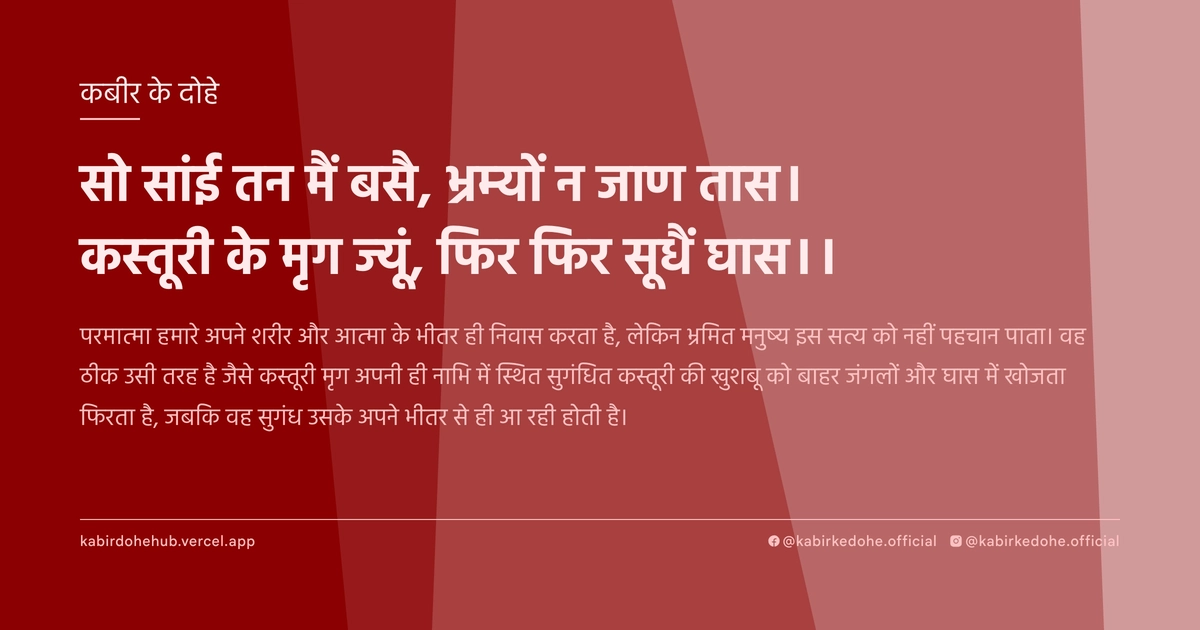
सो सांई तन मैं बसै, भ्रम्यों न जाण तास।
कस्तूरी के मृग ज्यूं, फिर फिर सूधैं घास।।
So sai tan main basai, bhramyo na jaan taas. Kasturi ke mrig jyun, phir phir sudhain ghaas.
इस पृष्ठ पर इस कबीर दोहे का अर्थ (meaning), हिंदी व्याख्या और अंग्रेज़ी अनुवाद, दार्शनिक विश्लेषण और व्यावहारिक जीवन सीख दी गई है। यह दोहा अंतर ज्योति (The Inner Light) विषय से जुड़ा है — Kabir doha meaning and explanation in Hindi and English.
अर्थ (Meaning):
परमात्मा हमारे अपने शरीर और आत्मा के भीतर ही निवास करता है, लेकिन भ्रमित मनुष्य इस सत्य को नहीं पहचान पाता। वह ठीक उसी तरह है जैसे कस्तूरी मृग अपनी ही नाभि में स्थित सुगंधित कस्तूरी की खुशबू को बाहर जंगलों और घास में खोजता फिरता है, जबकि वह सुगंध उसके अपने भीतर से ही आ रही होती है।
The Divine resides within one's own body and soul, yet the deluded human fails to recognize this truth. He is like the musk deer who, smelling the fragrance of musk emanating from its own navel, wanders aimlessly through the forests and grass in search of the source, unaware that the scent originates from within itself.
व्याख्या (Interpretation):
यह दोहा अद्वैत वेदांत के मूल सिद्धांत 'अहं ब्रह्मास्मि' को सरल रूपक के माध्यम से समझाता है। यहाँ 'सांई' का अर्थ उस निर्गुण ब्रह्म से है जो सर्वव्यापी है और व्यक्तिगत चेतना के केंद्र में स्थित है। 'भ्रम' वह माया है जो आत्मा और परमात्मा के बीच एक कृत्रिम विभाजन पैदा करती है, जिससे साधक बाहरी कर्मकांडों और तीर्थों में ईश्वर को खोजता है। कस्तूरी मृग का उदाहरण यह दर्शाता है कि हमारी खोज वास्तव में एक आंतरिक यात्रा होनी चाहिए, न कि बाहरी। जब तक हम बाहरी दुनिया में पूर्णता खोजते हैं, हम केवल अपनी ही अज्ञानता को बढ़ाते हैं। अंततः, यह दोहा यह संदेश देता है कि आत्म-साक्षात्कार ही एकमात्र वास्तविक गंतव्य है।
This couplet elucidates the core principle of Advaita Vedanta, 'Aham Brahmasmi' (I am Brahman), through a poignant metaphor. 'Saai' refers to the Nirgun Brahman—the formless Divine—who is omnipresent and resides at the center of individual consciousness. 'Bhram' (delusion) represents Maya, the cosmic illusion that creates an artificial separation between the Atman (soul) and the Paramatman (Supreme Soul), driving the seeker toward external rituals and pilgrimages. The analogy of the musk deer illustrates that the spiritual quest must be an inward journey rather than an outward search. As long as we seek perfection in the external world, we only amplify our own ignorance. Ultimately, the verse asserts that self-realization is the only true destination.
दार्शनिक विश्लेषण (Philosophical Analysis):
कबीर का यह दर्शन 15वीं शताब्दी के उस सामाजिक-धार्मिक परिवेश में उभरा जहाँ धर्म बाहरी आडंबरों, जातिगत श्रेष्ठता और जटिल कर्मकांडों में सिमट गया था। कबीर ने इन सभी को नकारते हुए 'सहज मार्ग' का प्रतिपादन किया। उनका यह दोहा सीधे तौर पर उस संस्थागत धर्म पर प्रहार करता है जो ईश्वर को मंदिरों, मस्जिदों या विशेष पवित्र स्थानों तक सीमित करता है। कबीर के अनुसार, ईश्वर किसी भौगोलिक स्थान का निवासी नहीं है, बल्कि वह शुद्ध चेतना है जो हर जीव में स्पंदित है।
दार्शनिक स्तर पर, यह सूफी मत के 'इंसान-ए-कामिल' और वेदांत के 'साक्षी भाव' का संगम है। सूफीवाद में भी यह माना गया है कि खुदा इंसान के दिल के भीतर रहता है। कबीर यहाँ अहंकार (Ego) को सबसे बड़ी बाधा मानते हैं। जब तक 'मैं' और 'मेरा' का भाव रहता है, तब तक व्यक्ति उस आंतरिक सुगंध को नहीं पहचान पाता। अहंकार एक पर्दे की तरह काम करता है जो आत्मा को उसके वास्तविक स्वरूप से अलग कर देता है।
इस दोहे में 'मृग' मानव जाति का प्रतीक है और 'कस्तूरी' उस दिव्य चिंगारी का, जो हम सबके भीतर मौजूद है। कबीर यह स्पष्ट करते हैं कि बाहरी खोज वास्तव में एक पलायन है। लोग तीर्थयात्राओं पर इसलिए जाते हैं क्योंकि वे अपने भीतर के शून्य और अशांति का सामना करने से डरते हैं। वे सोचते हैं कि कोई बाहरी शक्ति उन्हें बचा लेगी, जबकि मुक्ति का साधन स्वयं उनके भीतर ही निहित है।
यह विश्लेषण हमें यह समझने में मदद करता है कि कबीर केवल एक कवि नहीं, बल्कि एक मनोवैज्ञानिक थे। वे जानते थे कि मनुष्य की सबसे बड़ी त्रासदी यह है कि वह जिसे खोज रहा है, वही उसे खोज रहा है। यह एक ऐसा विरोधाभास है जहाँ खोजकर्ता और खोजा जाने वाला एक ही हैं। इस सत्य को स्वीकार करना ही 'अहं' का विसर्जन है।
अंततः, कबीर का यह दृष्टिकोण सामाजिक समानता का आधार बनता है। यदि ईश्वर हर व्यक्ति के भीतर है, तो जाति, वर्ण या धर्म के आधार पर भेदभाव करना ईश्वर का ही अपमान करना है। यह विचार मनुष्य को बाहरी सत्ता के डर से मुक्त कर उसे अपनी आंतरिक गरिमा और दिव्यता से परिचित कराता है।
Kabir's philosophy emerged in the 15th century, a period where religion had become confined to external ostentations, caste hierarchies, and complex rituals. Rejecting these, Kabir advocated for the 'Sahaj Marg' (the Natural Path). This couplet directly attacks institutionalized religion that confines the Divine to temples, mosques, or specific holy sites. According to Kabir, God is not a resident of any geographical location but is the pure consciousness vibrating within every living being.
On a philosophical level, this is a confluence of the Sufi concept of 'Insan-e-Kamil' (the Perfect Human) and the Vedantic 'Sakshi' (Witness consciousness). Sufism similarly posits that the Divine resides within the human heart. Kabir identifies the ego as the primary obstacle; as long as the sense of 'I' and 'Mine' persists, one cannot recognize the internal fragrance. The ego acts as a veil, separating the soul from its true nature.
In this verse, the 'deer' symbolizes humanity and the 'musk' represents the divine spark present in all. Kabir clarifies that the external search is essentially an escape. People embark on pilgrimages because they fear facing the inner void and restlessness. They hope an external power will save them, whereas the means of liberation are inherent within.
This analysis reveals Kabir as a psychologist of the spirit. He understood that the greatest human tragedy is that the seeker and the sought are one and the same. Accepting this paradox is the essence of the dissolution of the ego. It is the realization that the distance between the human and the divine is an illusion created by the mind.
Ultimately, Kabir's perspective forms the basis for social equality. If the Divine resides within every individual, then discrimination based on caste, creed, or religion is an insult to the Divine itself. This insight liberates the human being from the fear of external authorities and introduces them to their own internal dignity and divinity.
मूल संदेश (Core Message):
- बाहरी खोज अक्सर आंतरिक शून्यता को छिपाने का एक प्रयास होती है।
- ईश्वर कोई गंतव्य नहीं, बल्कि आपकी अपनी शुद्ध चेतना है।
- अहंकार वह पर्दा है जो हमें हमारी अपनी दिव्यता देखने नहीं देता।
- सच्ची भक्ति मंदिर जाने में नहीं, बल्कि स्वयं को जानने में है।
- जब खोजकर्ता ही खोजा जाने वाला बन जाता है, तब यात्रा समाप्त होती है।
- External searching is often an attempt to mask internal emptiness.
- The Divine is not a destination, but your own pure consciousness.
- The ego is the veil that prevents us from seeing our own divinity.
- True devotion lies not in visiting temples, but in knowing oneself.
- When the seeker becomes the sought, the journey reaches its end.
व्यावहारिक उदाहरण (Practical Example):
वाराणसी के एक पुराने मोहल्ले में माधव नाम का एक वृद्ध बुनकर रहता था। माधव ने अपना पूरा जीवन इस विश्वास में बिताया कि उसे मोक्ष पाने के लिए काशी के सबसे बड़े मंदिरों में दान देना होगा और कठिन व्रत रखने होंगे। वह अपनी कमाई का बड़ा हिस्सा पुजारियों को देता और घंटों लंबी कतारों में खड़ा रहता, इस उम्मीद में कि एक दिन उसे 'ईश्वर के दर्शन' होंगे।
माधव का मन हमेशा अशांत रहता था। वह अक्सर सोचता था कि ईश्वर उससे इतनी दूर क्यों है? वह शास्त्रों को पढ़ता, महान संतों की कहानियाँ सुनता, लेकिन उसके भीतर की रिक्तता कभी नहीं भरी। उसे लगता था कि उसकी भक्ति में कोई कमी है, इसलिए ईश्वर उसे अपनी उपस्थिति का अनुभव नहीं करा रहे हैं।
एक दिन, माधव की मुलाकात एक घुमंतू फकीर से हुई जो गंगा के घाट पर चुपचाप बैठा था। माधव ने उससे पूछा, "बाबा, मैं वर्षों से खोज रहा हूँ, लेकिन ईश्वर मुझे कहाँ मिलेंगे? क्या मुझे किसी और तीर्थ जाना चाहिए?"
फकीर ने मुस्कुराते हुए माधव की ओर देखा और कहा, "माधव, तुम उस सुगंध को खोज रहे हो जो तुम्हारे अपने शरीर से आ रही है। क्या तुमने कभी अपनी सांसों को महसूस किया है? क्या तुमने उस शांति को देखा है जो तब आती है जब तुम बुनते समय पूरी तरह डूब जाते हो?"
माधव उलझन में था। फकीर ने आगे कहा, "जब तुम करघे पर धागे पिरोते हो और दुनिया को भूल जाते हो, तब तुम ईश्वर के सबसे करीब होते हो। तुम्हारी मेहनत, तुम्हारी ईमानदारी और तुम्हारा प्रेम ही वह कस्तूरी है। तुम मंदिर की दीवारों में उसे खोज रहे हो, जबकि वह तुम्हारे हाथों की कला में और तुम्हारे हृदय की करुणा में बसता है।"
यह बात माधव के दिल पर गहरी चोट कर गई। उसने महसूस किया कि वह वर्षों से बाहर भाग रहा था, जबकि वह शांति उसके भीतर ही थी। उसने मंदिर जाना कम नहीं किया, लेकिन अब वह वहां किसी 'पुरस्कार' की उम्मीद में नहीं, बल्कि कृतज्ञता के साथ जाता था।
उसने अपनी कला को ही अपनी प्रार्थना बना लिया। अब वह जब भी कपड़ा बुनता, वह उसे ईश्वर की सेवा मानता। उसने देखा कि जब वह दूसरों की मदद करता, तो उसे वही सुख मिलता जो उसे मंदिर की आरती में मिलता था।
माधव का जीवन बदल गया। उसकी बेचैनी समाप्त हो गई। उसने पाया कि जिस 'सांई' को वह बाहर खोज रहा था, वह वास्तव में उसके भीतर की जागरूकता और प्रेम था। वह अब एक 'भ्रमित मृग' नहीं था, बल्कि एक जागृत आत्मा बन गया था।
In an old neighborhood of Varanasi lived an elderly weaver named Madhav. Madhav spent his entire life believing that to attain salvation, he must donate to the largest temples of Kashi and observe rigorous fasts. He gave a significant portion of his earnings to priests and stood in long queues for hours, hoping that one day he would 'behold the Divine'.
Madhav's mind was perpetually restless. He often wondered why God felt so distant. He read scriptures and listened to stories of great saints, yet the void within him remained unfilled. He felt his devotion was lacking, which is why God refused to manifest His presence to him.
One day, Madhav encountered a wandering fakir sitting silently on the banks of the Ganges. Madhav asked him, "Baba, I have been searching for years, but where will I find God? Should I visit another pilgrimage site?"
The fakir smiled at Madhav and said, "Madhav, you are searching for a fragrance that is emanating from your own body. Have you ever truly felt your breath? Have you noticed the peace that descends when you are completely absorbed in your weaving?"
Madhav was confused. The fakir continued, "When you thread the loom and forget the world, you are closest to God. Your hard work, your honesty, and your love are the musk. You seek Him within temple walls, while He dwells in the art of your hands and the compassion of your heart."
These words struck a deep chord in Madhav. He realized he had been running outward for years, while the peace he craved was already within. He did not stop visiting the temple, but he no longer went seeking a 'reward'; he went with gratitude.
He transformed his craft into his prayer. Now, whenever he wove cloth, he considered it a service to the Divine. He discovered that when he helped others, he felt the same bliss he once sought in temple rituals.
Madhav's life changed. His restlessness vanished. He found that the 'Saai' he was searching for externally was actually the awareness and love within him. He was no longer a 'deluded deer,' but an awakened soul.
अभ्यास मार्गदर्शन (Practice Guidance):
- प्रतिदिन 20 मिनट मौन ध्यान करें, जहाँ आप किसी बाहरी देवता या छवि के बजाय केवल अपनी आती-जाती सांसों के प्रति जागरूक रहें।
- एक 'आंतरिक खोज जर्नल' रखें। हर दिन लिखें कि आपने बाहरी दुनिया में क्या खोजा और क्या वह सुख स्थायी था, या वह आपकी आंतरिक स्थिति पर निर्भर था।
- जब भी आप तनाव या अधूरापन महसूस करें, तो स्वयं से पूछें: "मैं इस समय बाहर क्या खोज रहा हूँ जिसे मैं अपने भीतर पा सकता हूँ?"
- निदान चेकलिस्ट: यदि आप अभी भी मानते हैं कि आपकी खुशी किसी बाहरी व्यक्ति, वस्तु या स्थान पर निर्भर है, तो आप 'मृग' की अवस्था में हैं। यदि आप वर्तमान क्षण में पूर्णता महसूस करते हैं, तो आप 'कस्तूरी' को पहचान रहे हैं।
- Practice 20 minutes of silent meditation daily, focusing not on an external deity or image, but solely on the awareness of your incoming and outgoing breath.
- Maintain an 'Inner Quest Journal'. Each day, record what you sought in the external world and whether that satisfaction was permanent or dependent on your internal state.
- Whenever you feel stress or a sense of incompleteness, ask yourself: "What am I searching for outside right now that I can find within myself?"
- Diagnostic Checklist: If you still believe your happiness depends on an external person, object, or location, you are in the state of the 'deer'. If you feel wholeness in the present moment, you are recognizing the 'musk'.
चिंतन प्रश्न (Reflection Questions):
- मेरे जीवन का वह कौन सा 'बाहरी तीर्थ' है जहाँ मैं अपनी खुशी खोजने के लिए बार-बार जाता हूँ?
- क्या मेरी धार्मिक या आध्यात्मिक पहचान वास्तव में आंतरिक शांति देती है, या यह केवल एक सामाजिक मुखौटा है?
- यदि मुझसे मेरी सभी बाहरी उपलब्धियाँ और पहचान छीन ली जाएँ, तो क्या मैं अपने भीतर की 'कस्तूरी' को पहचान पाऊँगा?
- मैं किन परिस्थितियों में सबसे अधिक 'भ्रमित मृग' की तरह व्यवहार करता हूँ?
- क्या मैं अपनी आंतरिक शांति को बाहरी परिस्थितियों का गुलाम बनाकर रख रहा हूँ?
- What is the 'external pilgrimage' in my life where I repeatedly go to seek happiness?
- Does my religious or spiritual identity truly provide inner peace, or is it merely a social mask?
- If all my external achievements and identities were stripped away, would I be able to recognize the 'musk' within?
- In which specific life situations do I behave most like the 'deluded deer'?
- Am I making my inner peace a slave to external circumstances?